Best Book Tracking App Free in 2026: 8 Apps Compared

- 1
 GoodreadsLargest catalog and communityVisit
- 2
 The StoryGraphStats and mood recommendationsVisit
- 3
 BooklyReading timer and statsVisit
- 4
 LibraryThingDeep personal catalogingVisit
- 5
 BookmoryReading calendar and notesVisit
- Goodreads is the best free book tracker for most readers, with the largest catalog, lists, and reading community.
- The StoryGraph suits readers who want detailed stats, mood-based recommendations, and no social pressure.
- Bookly and Bookmory add reading timers and stats for readers who like tracking time and pages.
- LibraryThing, Literal, Oku, and Hardcover cover cataloging, social reading, and clean tracking for different tastes.
- The best tracker is the one you actually update. Pick the app whose logging flow feels easiest, since a perfect app you ignore helps no reading habit.
Quick comparison
| Product | Ideal for | Price from | Free version | |
|---|---|---|---|---|
| Goodreads | Largest catalog and community | Free | Yes | Visit |
| The StoryGraph | Stats and mood recommendations | Free | Yes | Visit |
| Bookly | Reading timer and stats | Free | Yes | Visit |
| LibraryThing | Deep personal cataloging | Free | Yes | Visit |
| Bookmory | Reading calendar and notes | Free | Yes | Visit |
 Literal | Social reading and clubs | Free | Yes | Visit |
 Oku | Clean minimal tracking | Free | Yes | Visit |
 Hardcover | Modern tracking and stats | Free | Yes | Visit |
The best free book tracking apps
We compared official feature pages, pricing pages, app store listings, and public reviews for the apps below. Our pick for most readers is Goodreads, because its catalog, lists, and community make it easy to log books and find what to read next, all for free.
Goodreads
Ideal for: Largest catalog and community
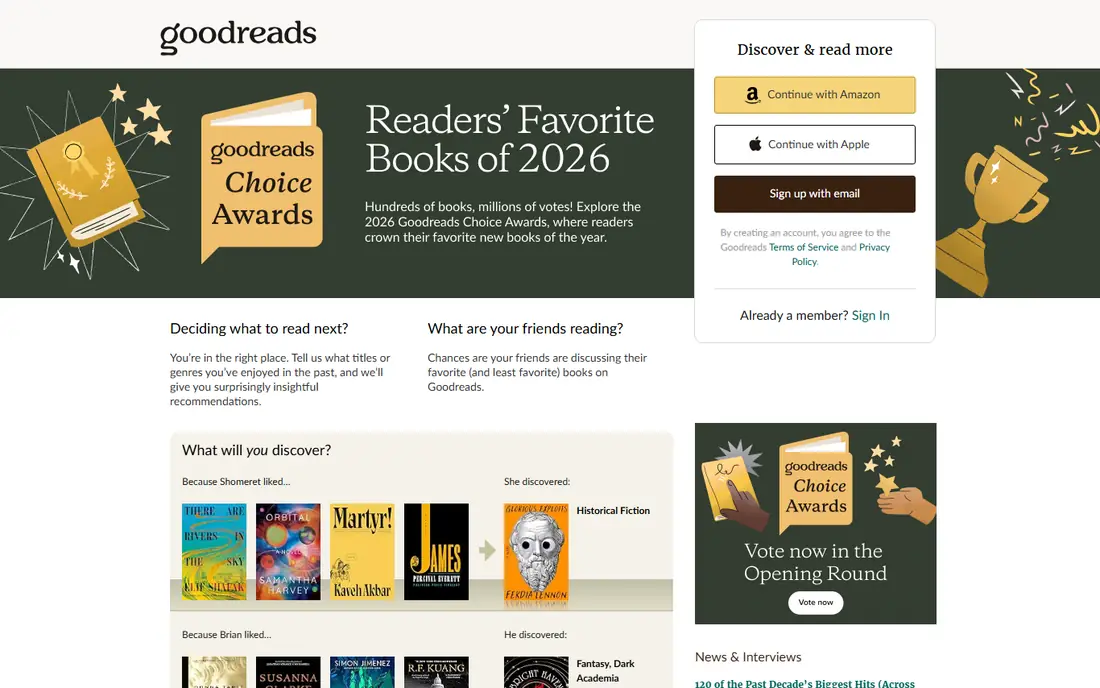
Goodreads is the default book tracker for a reason. Its catalog covers nearly every published book, shelves organize what you have read, are reading, or want to read, and yearly challenges and reading goals keep habits visible. Friend reviews and lists help you find the next book.
The interface feels older than newer rivals, and recommendations can be generic. For catalog depth, community, and free use, Goodreads remains the standard.
- Largest book catalog and community
- Shelves, goals, and challenges
- Friend reviews and recommendations
- Interface feels dated
- Recommendations can feel generic
- Owned by Amazon, which some readers dislike
The StoryGraph
Ideal for: Stats and mood recommendations
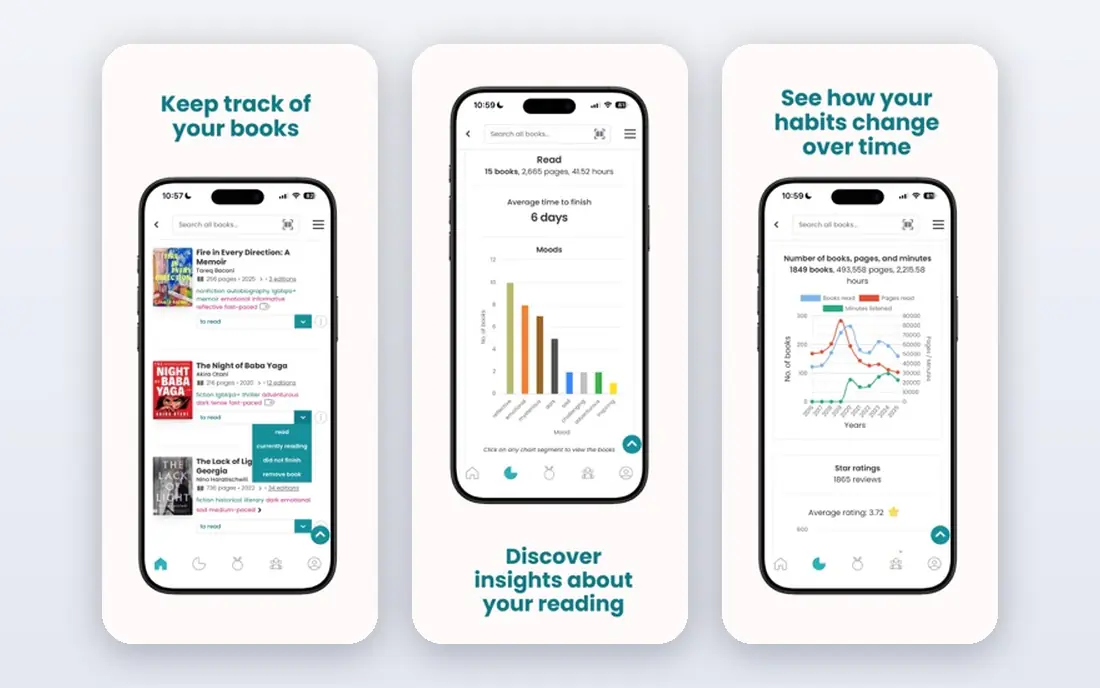
The StoryGraph is the thinking reader's tracker. It logs mood, pace, page count, and content warnings, then recommends books by how you want to feel, not just by genre. Stats show your reading patterns across months and years, and the experience is calm, with no ads or follower pressure.
The community is smaller than Goodreads, and obscure titles can be missing. For readers who love stats and thoughtful recommendations, StoryGraph is our favorite alternative.
- Detailed reading stats and mood tracking
- Recommendations by mood, pace, and content
- No ads or social pressure
- Smaller community than Goodreads
- Catalog gaps for obscure titles
- Some features need a paid Plus plan
Bookly
Ideal for: Reading timer and stats
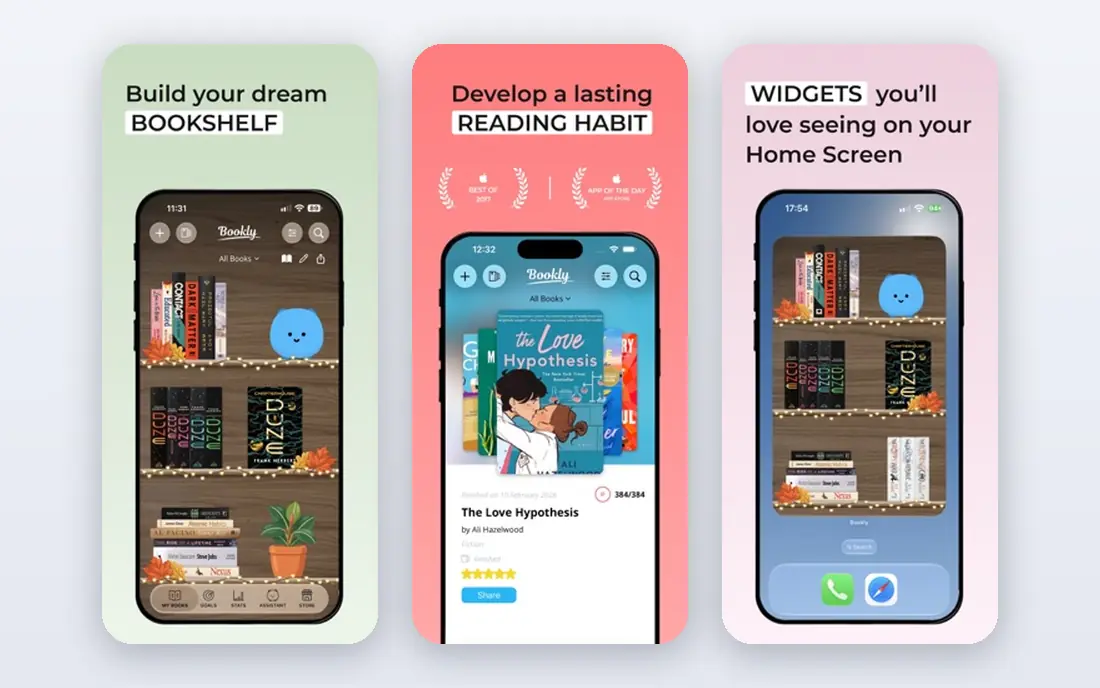
Bookly focuses on the act of reading itself. Start a timer, log pages, and watch stats build for speed, streaks, and goals. That focus suits readers who want to build a daily habit and see progress in minutes and pages.
Social discovery and catalog depth are lighter than Goodreads or StoryGraph. For habit tracking and reading stats, Bookly is a clean and motivating choice.
- Reading timer with page and time stats
- Goals and streaks
- Clean tracking interface
- Social features are lighter than Goodreads
- Some stats need a paid plan
- Catalog is simpler
LibraryThing
Ideal for: Deep personal cataloging
LibraryThing is built for collectors and serious catalogers. Tag books, track editions, organize collections, and draw on library data for accurate records. It handles large personal libraries better than most trackers, with tools for cataloging physical shelves.
The interface feels older, and social features are quieter than Goodreads. For readers with large collections who care about accurate cataloging, LibraryThing is unmatched.
- Deep cataloging with tags, collections, and editions
- Book data from libraries
- Strong for large collections
- Interface feels dated
- Social features are quieter
- Mobile app is simpler than the site
Bookmory
Ideal for: Reading calendar and notes
Bookmory tracks reading on a visual calendar, so you can see at a glance which days you read and how much. Notes, quotes, and memos attach to each book, making it easy to remember what mattered in a story or argument.
Community and discovery features are limited compared with Goodreads. For personal tracking with notes and a satisfying calendar view, Bookmory is a lovely choice.
- Reading calendar shows daily progress
- Notes, quotes, and memos per book
- Clean, visual tracking
- Community features are limited
- Catalog depth varies
- Some features need a paid plan
Literal
Ideal for: Social reading and clubs
Literal is a social reading app with clubs, shared shelves, and a clean modern design. Readers can join clubs, discuss books, and track progress together, with highlights and notes that make reading feel shared.
The catalog and community are smaller than Goodreads, and the app is still growing. For readers who want book clubs and social reading in a modern app, Literal is a fresh option.
- Social reading with clubs and shared shelves
- Clean modern design
- Highlights and notes
- Smaller catalog and community than Goodreads
- Some features are newer
- App is still growing
Oku
Ideal for: Clean minimal tracking
Oku is the minimalist of this list. Its clean interface focuses on shelves, current reads, and goals, without clutter, ads, or social noise. For readers who find Goodreads busy and StoryGraph detailed, Oku is a calm middle ground.
Community features and stats are lighter, and niche titles can be missing. For simple, beautiful tracking, Oku is a pleasure to use.
- Minimal, beautiful tracking interface
- Shelves and reading goals
- No clutter or ads
- Smaller community
- Fewer stats than StoryGraph
- Catalog gaps for niche titles
Hardcover
Ideal for: Modern tracking and stats
Hardcover is a modern book tracker with stats, goals, edition tracking, and Goodreads import, built by readers who wanted a faster, cleaner alternative. Active development means new features arrive regularly, and the interface feels current.
As a newer app, its community is smaller and some features are still maturing. For readers who want modern tracking with stats and an easy move from Goodreads, Hardcover is worth trying.
- Modern tracking with stats, goals, and editions
- Goodreads import
- Active development
- Newer app with a smaller community
- Some features are still maturing
- Catalog gaps for obscure books
How we picked these
We compared official feature pages, pricing pages, app store listings, and public reviews for each app, and we favored apps still operating in October 2026 with genuinely useful free plans for tracking books. We left out paid-only trackers and library apps with no personal tracking. Note that homepage checks for this article were limited by a browser rate-limit error during our work, so readers should confirm current pricing and features on each vendor site and app store page.
Building a reading habit that sticks
Log books the moment you finish them, not at the end of the month. A two-minute update keeps your shelves accurate and your stats honest, while a monthly catch-up usually means forgotten titles and guessed dates.
Set a goal you can actually hit. A yearly goal of 12 books beats an ambitious 100 that collapses by March, and a daily page or minute goal beats a vague promise to read more. Review your stats monthly, celebrate streaks, and let your tracker recommend the next book instead of staring at a shelf full of options.
Setting reading goals works best when the goal fits your life. A goal of twelve books a year means one book a month, which is realistic for busy readers, while a goal of fifty suits fast readers with daily reading time. Track pages or minutes instead of books if you read a mix of long novels and short essays, since a page goal treats every book fairly. Review your goal monthly rather than yearly, and adjust it without guilt if life changes, since a goal that punishes you will kill the habit it was meant to build.
The DNF decision, did not finish, is part of healthy reading. If a book has not earned your attention after a fair try, often fifty to a hundred pages, set it aside and record why, so your tracker remembers what did not work. Annotations also deepen reading: a short note on what a book argued, or a quote that struck you, makes it far easier to recommend later or revisit. Your tracker becomes more useful over time, not because it holds more books, but because it holds your reactions to them, which is what turns a list into a reading life. Joining reading challenges adds motivation without pressure when the challenge fits you. A yearly count challenge suits steady readers, a genre challenge pushes you into books you would not pick alone, and a monthly theme challenge keeps things fresh without a year-long commitment. Share progress with friends if that motivates you, but keep challenges private if comparison steals the joy, since reading is personal and someone else's pace is not your target. Celebrate finishing, not just starting, and let abandoned books count as learning about your taste rather than failure.
Recommending books well is a skill your tracker can support. When you finish a book, note who would enjoy it and why, in a sentence or two, so future recommendations are specific rather than generic. Track books you lent and borrowed too, since lost loans strain friendships and forgotten borrows leave shelves incomplete. Over years, your tracker becomes a map of your reading life, showing phases, favorites, and gaps, and revisiting old entries often reminds you of books worth rereading or authors worth following further.
Frequently asked questions
What is the best free book tracking app?
Goodreads is our pick for most readers, with the largest catalog and community for free. The StoryGraph suits readers who want stats and mood-based recommendations.
Can I move my books from Goodreads to another app?
Yes. Most modern trackers, including StoryGraph and Hardcover, offer Goodreads import from an exported library file. Export from Goodreads settings, then import into your new app.
What is the best book tracker for reading stats?
The StoryGraph offers the deepest free stats, covering mood, pace, page counts, and patterns over time. Bookly suits readers who want time and page stats from a reading timer.
Do book tracking apps work for ebooks and audiobooks?
Yes. Most trackers let you log print, ebook, and audiobook editions, and some track listening progress. Check edition options when logging audiobooks.
Is Goodreads still free?
Yes, Goodreads is free to use, with shelves, goals, challenges, and community features at no cost. It is owned by Amazon, which some readers prefer to avoid by using alternatives like StoryGraph.