Best Budgeting Software for Small Business in 2026: 8 Tools Compared

- LivePlan is the best starting point for a business plan plus budget, with lender-friendly structure.
- PlanGuru and Jirav suit businesses that need detailed multi-year forecasts and scenario planning.
- Float, Dryrun, and Pulse focus on cash flow, which is the question most small owners ask first.
- Causal and Centage fit larger small businesses that need driver-based models and board-ready reports.
Quick comparison
| Product | Ideal for | Price from | Free version | |
|---|---|---|---|---|
 LivePlan | Business plans and budgets | $20 per month | No | Visit |
 PlanGuru | Detailed forecasting | See website | Free trial | Visit |
 Float | Cash flow forecasting | See website | Free trial | Visit |
 Jirav | FP&A for small companies | See website | No | Visit |
 Causal | Driver-based modeling | See website | No | Visit |
 Dryrun | Cash flow scenarios | See website | Free trial | Visit |
 Pulse | Simple cash flow for owners | $29 per month | Free trial | Visit |
 Centage | Mid-market FP&A | See website | No | Visit |
The best budgeting software for small business
We compared official feature pages, pricing pages, and app-store listings for budgeting and forecasting tools available to small businesses in October 2026. The list mixes planning tools, cash flow tools, and fuller FP&A platforms.
This is not financial advice. Forecasts depend on your assumptions and data, so review them with a qualified accountant before making hiring, borrowing, or spending decisions.
LivePlan
Ideal for: Business plans and budgets

LivePlan starts planning at $20 per month and combines a guided business plan builder with financial forecasting. The plan builder walks owners through each section, while the forecast links income, cash flow, and balance sheet so a change in one place flows through the rest. A pitch deck can be built from the same plan data, which helps when talking to lenders or investors.
The limit is depth. LivePlan is not a full FP&A platform with workforce planning and multi-entity consolidation. For a small business that needs a credible plan and budget, especially for funding, it is the most approachable tool here.
- Guided business plan builder
- Connected financial forecasts
- Pitch deck from plan data
- Less deep than full FP&A tools
- Monthly cost for a planning-only need
PlanGuru
Ideal for: Detailed forecasting
PlanGuru is a budgeting and forecasting tool for businesses, nonprofits, and their advisors. It builds integrated income, balance sheet, and cash flow forecasts for up to 10 years, with more than 20 forecasting methods and custom business drivers. Historical results import from QuickBooks, QuickBooks Online, Xero, and Excel, and budget-versus-actual reports update monthly.
The interface is more traditional than newer cloud tools, and owners without accounting experience may need help to set it up well. For a business or accountant that wants detailed, method-driven forecasts without enterprise cost, PlanGuru remains a solid choice.
- Forecasts up to 10 years
- 20-plus forecasting methods
- QuickBooks and Xero imports
- Interface feels dated
- Setup needs accounting comfort
Float
Ideal for: Cash flow forecasting
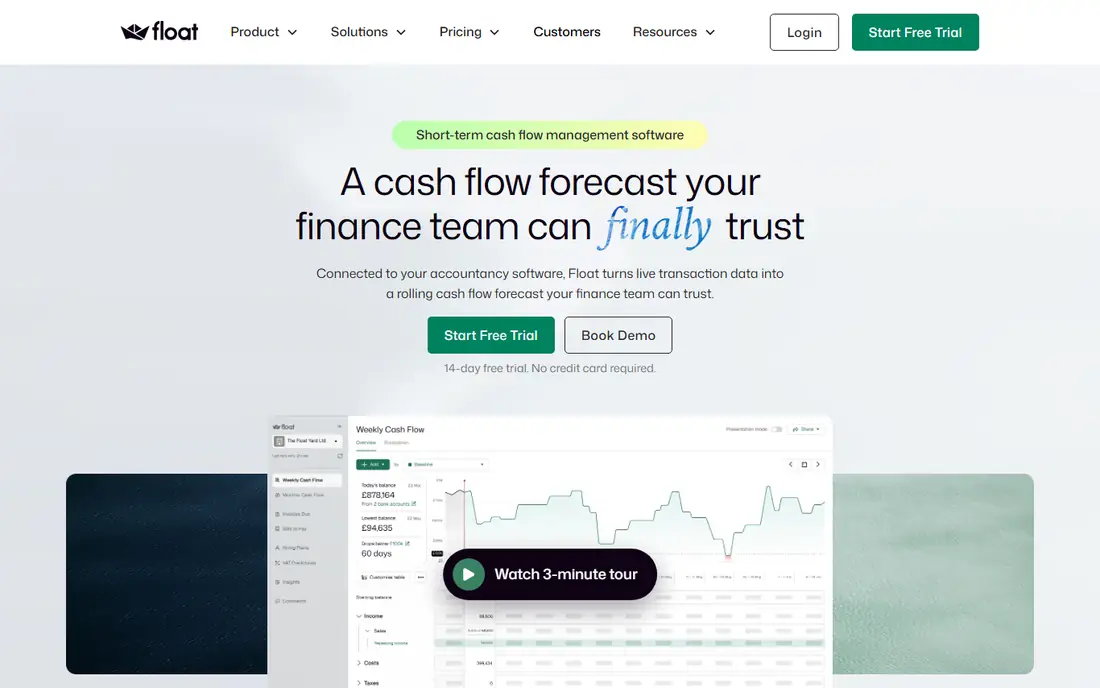
Float turns live accounting data into a rolling cash flow forecast. It syncs with Xero and QuickBooks Online, updates daily, and shows weekly, 13-week, and monthly views from the same data. Scenario planning lets finance teams toggle income and costs on or off to test decisions before committing.
The requirement is the accounting link: Float currently works with Xero and QuickBooks Online, so businesses on other systems cannot use it directly. For a Xero or QuickBooks business that wants a cash forecast it can trust, Float's live connection is a strong advantage over a manual spreadsheet.
- Live forecast from accounting data
- 13-week and monthly views
- Scenario toggles
- Needs Xero or QuickBooks Online
- Pricing is quote-based
Jirav
Ideal for: FP&A for small companies
Jirav is an all-in-one forecasting, budgeting, reporting, and dashboarding tool built for small and midsize companies and accounting firms. It connects accounting, workforce, and operational data, then builds driver-based plans with three-statement models. Templates for KPIs and reports help teams start faster, and scenario plans let leaders test ideas without rebuilding a spreadsheet.
Pricing is quote-based, and the full platform may be more than a micro-business needs. For a growing company that wants real FP&A without enterprise software, Jirav hits a useful middle ground between a spreadsheet and a large planning suite.
- Driver-based budgets and forecasts
- Dashboards and reporting
- Industry templates
- Quote-based pricing
- More tool than a very small business needs
Causal
Ideal for: Driver-based modeling
Causal built visual, driver-based financial models where inputs, calculations, and outputs stay linked and visible. Teams could model revenue, hiring, and spending from drivers rather than hard-coded numbers, which makes scenarios easier to explain. The product has now joined Lucanet, which offers extended planning and analysis as part of its CFO platform.
Buyers should note the change: the Causal site now points to Lucanet, and new-customer onboarding runs through that platform. For a finance team that likes visual models and is open to a Lucanet solution, Causal's approach remains appealing, but confirm the current plan and support terms first.
- Visual driver-based models
- Clear model structure
- Now part of Lucanet
- New-customer path now runs through Lucanet
- Pricing is quote-based
Dryrun
Ideal for: Cash flow scenarios
Dryrun replaces cash flow spreadsheets with automated data plus flexible modeling. It pulls accounting data from QuickBooks Online, Xero, NetSuite, and other systems, then lets users add projects, payroll, debt payments, and other future movements that the books do not yet show. Scenarios can be compared side by side to show how a hire, a project, or a purchase changes cash.
The flexibility needs discipline. A forecast is only as good as its assumptions, and Dryrun gives users a lot of room to set them. For a CFO or owner who wants to explain cash decisions to a board or lender, Dryrun's scenario views are a clear strength.
- Combines accounting data with manual assumptions
- Side-by-side scenarios
- Multi-entity views
- Setup needs care with assumptions
- Pricing is quote-based
Pulse
Ideal for: Simple cash flow for owners
Pulse is cash flow software designed for small business owners, with plans starting at $29 per month and a free trial. It shows a simple chart of cash in and out over time, lets owners toggle income and expenses to test scenarios, and connects to QuickBooks Online to keep actuals in sync. The focus is one thing done well: answering whether the business can afford a hire, a project, or a payout.
Larger companies will outgrow it. Pulse lacks the multi-entity, workforce, and board-reporting depth of Jirav or Centage. For an owner who wants a clear cash picture without learning FP&A, Pulse is the simplest tool on this list.
- Very simple to set up
- Clear cash charts
- Scenario toggles
- QuickBooks Online link
- Fewer features than FP&A tools
- Best for single-entity businesses
Centage
Ideal for: Mid-market FP&A
Centage is an FP&A platform for mid-market finance teams that pairs software with a team to build and run it. It covers budgeting, forecasting, workforce planning by position, multi-entity consolidation, and board-ready reporting, with connectors for NetSuite, Sage Intacct, QuickBooks, and other systems. The company says teams go live in four to six weeks with its help.
That service model suits larger small businesses and mid-market firms, not micro-businesses. Pricing is tailored, so buyers need a conversation to compare costs. For a finance team that wants FP&A run with expert help rather than a toolkit alone, Centage's model is distinctive.
- Tailored FP&A platform with a support team
- Budgeting, forecasting, and consolidation
- Workforce planning
- Aimed at mid-market teams
- Pricing is tailored and quote-based
How we picked these
We compared official feature pages, pricing pages, and app-store listings for budgeting and forecasting tools available in October 2026. We favored tools with live accounting links, scenario planning, and clear reporting, and we included planning tools, cash flow tools, and FP&A platforms. We did not include our own product in this list.
How to choose budgeting software for your business
Start with the question you need answered. If you need a plan for a lender, LivePlan fits. If you need to know next month's cash position, a cash flow tool such as Float, Dryrun, or Pulse fits better. If you need rolling forecasts and board reports, look at Jirav or Centage. Picking the wrong category wastes money even if the tool itself is good.
Then check the accounting connection. A tool that syncs with your accounting system will stay current, while a tool that needs manual exports will go stale. Run one budget cycle with real numbers, test two scenarios, and show the output to the people who will use it. If they trust the numbers and understand the charts, you have the right tool.
Frequently asked questions
What is the best budgeting software for a small business?
LivePlan suits owners who need a business plan plus budget, while Float, Dryrun, and Pulse suit owners focused on cash flow. Growing companies that need rolling forecasts and reporting should look at Jirav or PlanGuru.
Can budgeting software replace a spreadsheet?
Yes, for most small businesses. Budgeting tools link forecasts to live accounting data, update automatically, and handle scenarios without broken formulas. Spreadsheets still suit one-off models, but they go stale fast when used as the main budget.
How much does small business budgeting software cost?
Costs range from $20 per month for LivePlan and $29 per month for Pulse to quote-based pricing for Jirav, Centage, and Dryrun. Cash flow tools often price by company size or entities, so ask for a quote based on your actual setup.
Do I need accounting software too?
Yes, in most cases. Budgeting tools forecast and plan, but accounting software records actual transactions, invoices, and bank activity. The best setups connect the two, so forecasts update from real results.
What is driver-based budgeting?
Driver-based budgeting builds forecasts from the factors that move the numbers, such as headcount, price, or units sold, rather than fixed amounts. Changing a driver updates revenue, costs, and cash together, which makes scenarios faster and easier to explain.