8 Best Campaign ROI Tracking Tools for 2026

- 1
 HubSpotROI reporting inside a CRM and marketing platformVisit
- 2
 Google AnalyticsFree web and campaign measurement for any teamVisit
- 3
 Ruler AnalyticsUnified marketing measurement with ROI and ROAS reportingVisit
- 4
 DreamdataB2B attribution with numbers that trace back to sourceVisit
- 5
 HockeyStackMulti-touch attribution and full-funnel buyer journeysVisit
- Campaign ROI tools connect marketing spend to pipeline and revenue, so teams can defend budgets with numbers rather than impressions.
- HubSpot and Google Analytics suit teams that want ROI reporting inside tools they already use.
- Ruler Analytics, Dreamdata, HockeyStack, and Attribution suit teams that need multi-touch attribution tied to CRM revenue.
- Bizible and WhatConverts suit Adobe users and lead-tracking teams respectively.
- No attribution model is fully accurate, so use more than one method and validate with incrementality tests.
Quick comparison
| Product | Ideal for | Price from | Free version | |
|---|---|---|---|---|
| HubSpot | ROI reporting inside a CRM and marketing platform | See website | Yes | Visit |
| Google Analytics | Free web and campaign measurement for any team | Free | Yes | Visit |
| Ruler Analytics | Unified marketing measurement with ROI and ROAS reporting | See website | No | Visit |
| Dreamdata | B2B attribution with numbers that trace back to source | See website | No | Visit |
| HockeyStack | Multi-touch attribution and full-funnel buyer journeys | See website | No | Visit |
 Bizible | B2B attribution inside the Adobe ecosystem | See website | No | Visit |
 Attribution | Multi-touch attribution for growth and marketing teams | See website | No | Visit |
 WhatConverts | Lead, call, and form tracking for agencies and local businesses | See website | No | Visit |
The best campaign ROI tracking tools
HubSpot
Ideal for: ROI reporting inside a CRM and marketing platform

HubSpot combines marketing, sales, and CRM, so campaign ROI reporting sits on top of the same data that tracks leads, deals, and revenue. Its attribution reports connect campaigns to contacts, deals, and closed revenue, with multi-touch models that show how channels work together rather than crediting only the last click. Because the CRM is the system of record, offline and sales-driven conversions are easier to include than in a web-analytics-only tool. HubSpot offers a free CRM tier, with marketing and reporting features scaling through paid hubs. Pricing varies by hub and tier, so we wrote "See website" for paid starting prices. For teams already running on HubSpot, its native ROI reporting is the most convenient option.
- CRM-native attribution, campaign reporting, free CRM tier
- Full attribution features need paid tiers, Adobe-style depth needs add-ons
Google Analytics
Ideal for: Free web and campaign measurement for any team
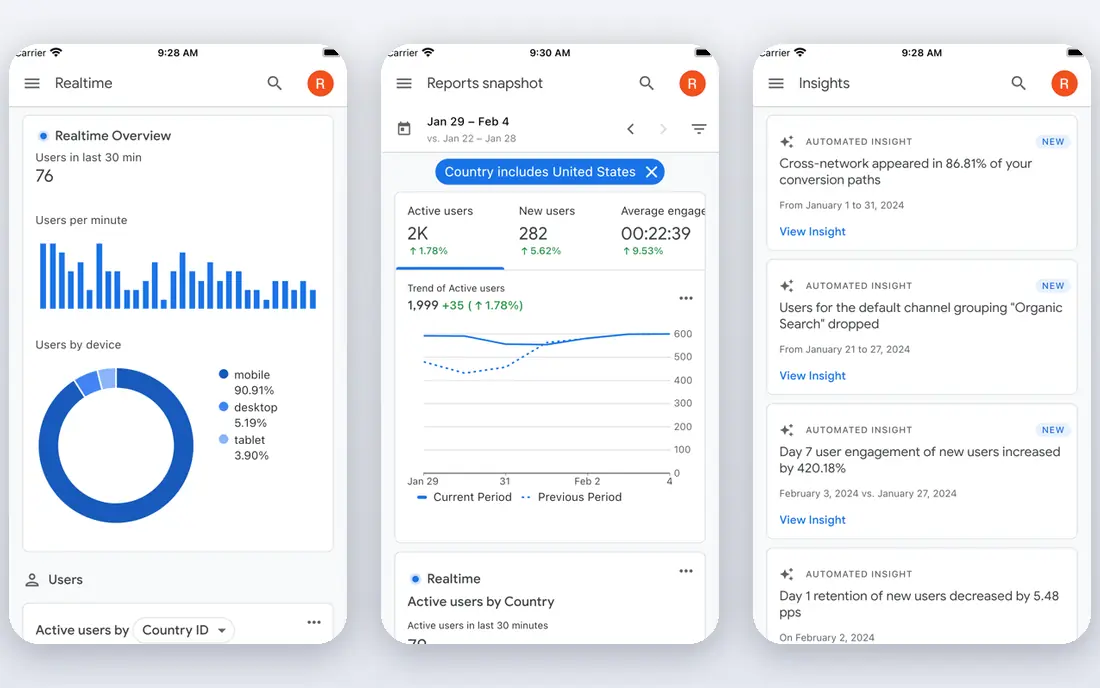
Google Analytics 4 is the free baseline for campaign measurement, tracking website traffic, campaign sources, conversions, and ecommerce revenue, with links to Google Ads and other platforms. Its data-driven attribution model distributes credit across touchpoints, which is an improvement over last-click reporting, and its exploration reports let teams compare channels and campaigns. The limits are real: GA4 struggles to connect web activity to CRM revenue, offline conversions, and long B2B sales cycles without additional tooling. For teams with short, online conversion paths, GA4 alone may be enough. For B2B teams, it works best alongside a dedicated attribution tool from this list.
- Free, widely adopted, campaign and conversion reporting, ad platform links
- Last-click bias in default views, limited CRM revenue attribution
Ruler Analytics
Ideal for: Unified marketing measurement with ROI and ROAS reporting
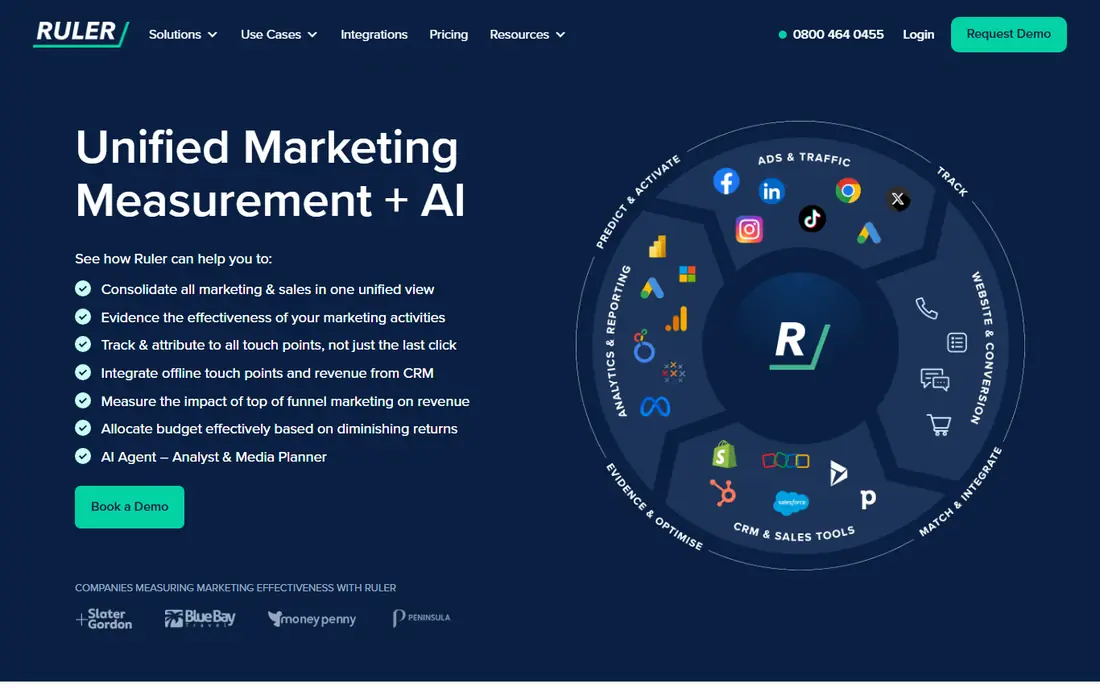
Ruler Analytics provides unified marketing measurement that combines multi-touch attribution, marketing mix modelling, and impression attribution, so teams can track, attribute, and measure ROI from marketing across online and offline touchpoints. It connects customer journeys to CRM revenue, measures the impact of upper-funnel activity that has no click path, and offers a predictive budget planner using saturation curves to forecast ROI and diminishing returns. Ruler is explicit that no single measurement method is fully accurate, and its approach triangulates across methods and validates with incrementality tests. Pricing is quote-based. For teams that need defensible ROI reporting beyond last-click, Ruler is a strong specialist choice.
- Multi-touch and impression attribution, MMM, offline revenue, budget planning
- Setup needs tracking and CRM work, pricing requires a quote
Dreamdata
Ideal for: B2B attribution with numbers that trace back to source
Dreamdata is an agentic B2B attribution platform that captures the whole go-to-market journey, organizes every activity and campaign by account, and ties it to revenue. Its customer journey timelines show every touch behind an account, its attribution numbers trace back to the contacts, companies, and deals behind the revenue, and its AI analytics agent answers questions about marketing impact in plain language with verifiable outputs. Dreamdata also syncs audiences and offline conversions back to ad platforms, so campaigns optimize for pipeline rather than clicks. Pricing is quote-based. For B2B marketers who need attribution they can defend in a board meeting, Dreamdata is a leading platform.
- Complete customer journeys, traceable attribution, AI analytics agent, warehouse export
- B2B focus, pricing requires a quote
HockeyStack
Ideal for: Multi-touch attribution and full-funnel buyer journeys
HockeyStack unifies marketing and sales data into one source of truth, capturing the complete buyer journey from first touch to closed-won. Its cookieless tracking captures dark-funnel activity that CRM and last-touch models miss, its multi-touch attribution models can be compared side by side, and its lift and incrementality reports compare exposed and unexposed accounts to prove which campaigns actually drive conversions. Custom reports and dashboards can be built without SQL, and data syncs both ways with CRM, ad platforms, and warehouses. Pricing is enterprise and quote-based. For B2B teams that want full-funnel visibility and attribution they can customize, HockeyStack is a strong choice.
- Cookieless tracking, multi-touch models, lift reports, custom dashboards
- Enterprise pricing, setup needs data work
Bizible
Ideal for: B2B attribution inside the Adobe ecosystem
Bizible, part of Adobe, provides B2B marketing attribution that connects marketing touches to pipeline and revenue inside the Adobe and CRM ecosystem. Its multi-touch models credit every stage of long B2B journeys, and its reporting links campaigns to opportunities and closed deals rather than stopping at leads. For organizations already invested in Adobe Analytics and Marketo, Bizible's integration depth is a genuine advantage, with shared data and consistent reporting. The cost and complexity reflect the Adobe enterprise scope, and implementation typically needs expertise. For Adobe-centric B2B teams, Bizible is the natural attribution choice.
- Multi-touch attribution, CRM integration, Adobe analytics depth
- Adobe ecosystem pricing and complexity, implementation needs expertise
Attribution
Ideal for: Multi-touch attribution for growth and marketing teams
Attribution is a multi-touch attribution platform that helps marketing teams see which channels and campaigns drive conversions and revenue, with models that distribute credit across the journey rather than only the last click. Its dashboards report ROI by channel and campaign, and its integrations connect ad platforms, analytics, and CRM data. Attribution suits growth and marketing teams that want dedicated attribution without adopting a full enterprise measurement suite, with a more focused scope than Ruler or HockeyStack. Pricing is quote-based. For teams that need clear campaign ROI reporting with faster setup than enterprise platforms, Attribution is worth evaluating.
- Multi-touch models, channel and campaign ROI, integrations
- Smaller vendor profile, pricing requires a quote
WhatConverts
Ideal for: Lead, call, and form tracking for agencies and local businesses
WhatConverts is a lead tracking and reporting platform trusted by PPC and SEO professionals to show clients which campaigns generate leads. It tracks calls, forms, chats, and other lead sources, attributes them to campaigns and keywords, and reports lead value so agencies can prove ROI to clients. Its setup is fast and simple, with a 14-day free trial, and its reporting is built for agency-client relationships where clarity matters more than enterprise attribution modelling. WhatConverts suits businesses where the conversion is a lead rather than a closed deal, and where call tracking is essential. For agencies and local businesses, it is a practical ROI tracking tool.
- Call and form tracking, lead reporting, agency-friendly, 14-day trial
- Lead focus, less suited to long B2B attribution journeys
How we picked these
We looked for tools that connect campaign activity to leads, pipeline, or revenue, not just clicks and impressions. We balanced free baselines, CRM-native reporting, dedicated attribution platforms, and lead tracking tools, because ROI tracking needs differ by sales cycle and business model. We compared official feature pages, pricing pages, documentation, and public reviews, and we left out pure web analytics without revenue attribution and pure ad dashboards without journey tracking. Where a vendor did not publish a current price, we wrote "See website" rather than repeat a third-party figure.
How to set up ROI tracking that you can trust
Start by defining what counts as revenue for each campaign: a lead, a qualified opportunity, or closed-won business, and agree that definition with sales before you build reports. Connect your CRM, ad platforms, and analytics so the same customer journey appears in all three, and include offline conversions such as calls and events. Choose an attribution model that fits your sales cycle, and compare at least two models side by side, because the model choice changes the answer. Validate with incrementality tests where possible, especially for upper-funnel campaigns. Finally, review ROI reports monthly with both marketing and sales, so disagreements about data become a shared process rather than a recurring argument.
Frequently asked questions
What is campaign ROI?
Campaign ROI is the return on a marketing campaign, calculated as revenue or profit generated minus campaign cost, divided by campaign cost. Good tools track both sides of that equation accurately.
What is multi-touch attribution?
It is a method of distributing revenue credit across all the touchpoints in a customer journey, rather than giving all credit to the first or last interaction.
Is last-click attribution enough?
Rarely. Last-click overcredits bottom-of-funnel channels and ignores the awareness and consideration work that made the conversion possible. Multi-touch or modelled attribution gives a fairer picture.
How do I track ROI for offline campaigns?
Use tools that connect offline conversions, such as calls, events, and trade shows, to CRM revenue, and use marketing mix modelling or incrementality tests for activity without a click path.
Can Google Analytics alone track campaign ROI?
For short online sales cycles, often yes. For B2B or offline-heavy businesses, pair it with a CRM-connected attribution tool for revenue-level ROI.
How long should I run a campaign before judging ROI?
Long enough to cover your sales cycle. Judging a B2B campaign after two weeks, when deals take three months to close, will understate its return.