Best Capital Formation Software Private Markets

- Carta is the only tool here with a free tier: Launch costs nothing for a company with fewer than 25 stakeholders and under 1 million dollars raised.
- AngelList is the fastest route to a single-deal SPV, with an 8,000 dollar setup fee plus a 2,000 dollar state filing fee, while Carta charges a 1,500 dollar implementation fee plus per-SPV pricing.
- Juniper Square is the institutional standard for real estate and private equity fund managers, with reported pricing from about 18,000 dollars a year.
- Most platforms in this category are quote only, so the real cost depends on fund size, investor count and whether fund administration is bundled.
- The choice splits by structure: AngelList wins for SPVs and rolling funds, Carta wins for institutional funds, and Juniper Square wins for real estate sponsors.
Quick comparison
| Product | Ideal for | Price from | Free version | |
|---|---|---|---|---|
 Carta | VC funds and startup cap tables | quote only | Yes | Visit |
 AngelList | SPVs, syndicates and rolling funds | $8,000 per SPV setup | No | Visit |
 Juniper Square | Real estate and PE fund managers | quote only | No | Visit |
 Allvue | Private equity and credit fund operations | quote only | No | Visit |
 Affinity | Relationship-driven deal sourcing | quote only | Free trial | Visit |
 Altvia | LP lifecycle on Salesforce | quote only | No | Visit |
 Dynamo Software | End-to-end alternatives fund management | quote only | No | Visit |
 iCapital | Wealth managers and alternative investing | quote only | No | Visit |
The best capital formation software for private markets
Carta
Ideal for: VC funds and startup cap tables
Carta is the default cap table and fund administration platform for venture-backed startups and the funds that back them. Launch is free for a company with fewer than 25 stakeholders and under 1 million dollars raised, and it covers cap table management, SAFE financings, electronic issuance and fundraising benchmarks drawn from Carta own dataset. Build adds priced-round modelling, Grow adds board meeting tools and 409A valuations, and Scale adds exit and waterfall modelling. Fund Administration is sold separately and covers capital calls, distributions, carried interest calculations, investor accounting and LP reporting. Carta fund administration is quote only, and third-party reports put it at 10,000 to 100,000 dollars or more a year depending on assets under management, fund count and reporting requirements. The Premium Institutional SPV carries a 1,500 dollar implementation fee with per-SPV pricing on top. Carta supports more than 9,000 funds and SPVs representing over 185 billion dollars in assets under administration, and startups on Carta raised nearly 120 billion dollars in new funding across 2025. For an institutional fund that needs audit-grade reporting and a Fund CFO service layer, Carta is the standard, but emerging managers should get the full quote before committing.
- Launch is free for eligible early-stage companies
- The largest dataset of startup fundraising benchmarks in the industry
- Fund administration is quote only and priced by assets under management, so costs are hard to predict
- 409A valuations need a subscription tier
AngelList
Ideal for: SPVs, syndicates and rolling funds

AngelList is built for speed on single deals. A standard SPV costs 8,000 dollars to set up plus a flat 2,000 dollar state regulatory filing fee, and a smaller SPV costs 5,000 dollars plus the same 2,000 dollar fee. That package covers entity formation, LP onboarding, KYC checks, tax filings and an investor portal, which would cost 15,000 to 25,000 dollars from a lawyer with none of those services included. Rolling Funds, the AngelList-native product, charge a 2 percent administration fee plus 25,000 dollars per quarterly fund. Syndicates run on the same infrastructure, with lead investors setting their own carry terms. The limit is structure. AngelList wins for SPVs, syndicates and rolling funds where per-deal speed and cost matter, and it is the clear choice for a fund under 10 million dollars in committed capital. Traditional closed-end fund administration is available only through a partner, Belltower, and Carta usually wins once a fund passes 20 million dollars and needs audit-grade quarterly LP statements. For a first-time emerging manager closing a single deal, AngelList is the fastest and most predictable route in this guide.
- The fastest way to launch an SPV or rolling fund
- Per-deal pricing with no annual platform fee for a single SPV
- No traditional closed-end fund administration in house, which runs through a partner
- The 8,000 dollar setup fee is steep for a small deal
Juniper Square
Ideal for: Real estate and PE fund managers
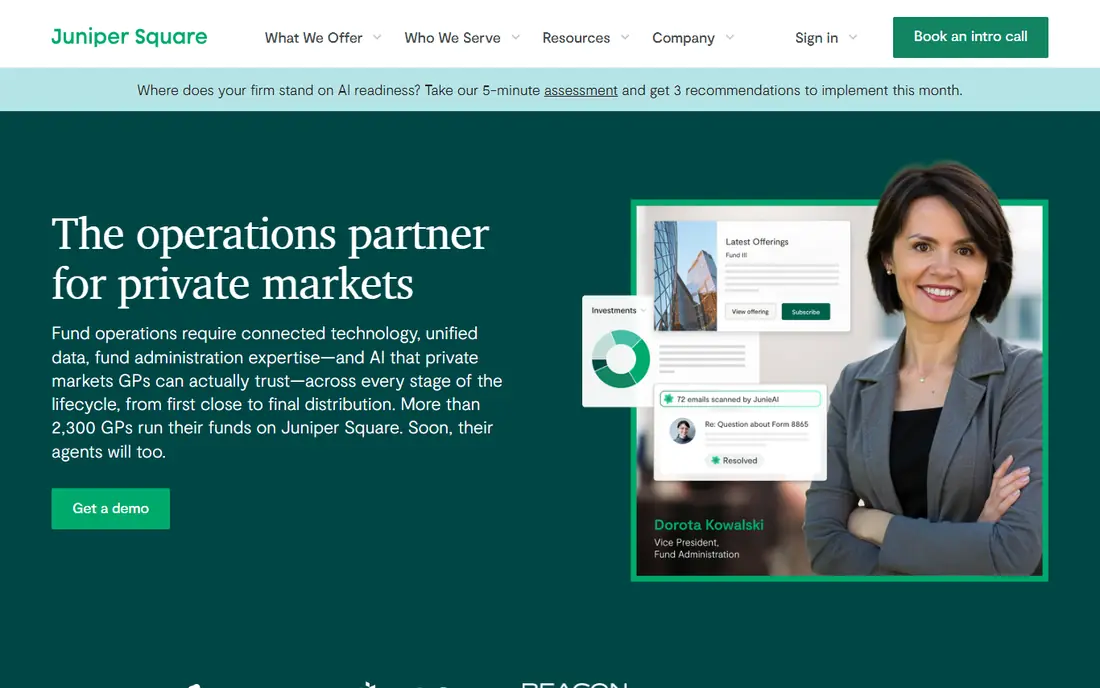
Juniper Square is the institutional standard for real estate, private equity and venture fund managers who raise capital from many investors and need to report to them every quarter. The platform covers fundraising and onboarding, capital calls, distributions, waterfall calculations, LP portals, K-1 delivery and quarterly reporting, and it serves more than 700,000 LP accounts. Its core differentiator is the embedded fund administration team: in-house accountants handle bookkeeping, reporting and compliance as part of the platform, so the software is a full service rather than a tool the fund team must operate alone. Juniper Square does not publish pricing, and third-party sources report it starting at about 18,000 dollars a year, with add-on costs for advanced features, API access and a dedicated success manager pushing first-year totals to 25,000 to 40,000 dollars for a typical mid-market sponsor. A 12-month commitment is required, and onboarding takes about 2.6 months. For a real estate sponsor or PE manager with 500 million dollars or more in assets under management, Juniper Square is the reference platform, but smaller managers who only need basic investor reporting may find it more platform than they need.
- Embedded fund accounting team handles bookkeeping, reporting and compliance
- 200 plus waterfall configurations for complex deals
- No published prices, with reported pricing from about 18,000 dollars a year
- Investor portal and reporting modules cost extra on lower tiers
Allvue
Ideal for: Private equity and credit fund operations
Allvue Systems is a fund operations platform for private equity, private credit, venture capital and fund of funds managers, covering fund accounting, portfolio monitoring, investor reporting, deal management and data aggregation in one system. The platform is designed for firms that run many funds and many portfolio companies at once, and its reporting engine is built to produce LP statements, capital account statements and performance reports at institutional standard. Allvue also offers data aggregation tools that pull portfolio company financials into one view, which matters for firms that track dozens of investments. Allvue publishes no prices, and every deployment is quoted on fund count, assets under management, modules and user count. Implementation is a project, not a signup, and typically takes months with data migration from existing accounting systems. The platform is also built for institutional scale, so an emerging manager with one fund will find the cost and the setup effort hard to justify.
- Deep fund accounting and portfolio monitoring for PE, credit and fund of funds
- Strong reporting and data aggregation
- No published prices and a long implementation cycle
- The platform is built for institutional scale, not emerging managers
Affinity
Ideal for: Relationship-driven deal sourcing
Affinity is a relationship intelligence CRM built for venture capital, private equity and investment banking teams that source deals through their networks. The platform automatically captures email and calendar activity, maps the strength of each relationship across the team, and shows who on the team has the warmest path to a founder, LP or co-investor. That network view is the core value: a deal team can see, before reaching out, whether a partner already knows the founder and how strong that connection is. Affinity also covers deal flow pipelines, fundraising tracking and portfolio company monitoring. The limit is scope. Affinity is a CRM, not a fund administration platform, so it does not handle capital calls, distributions, waterfall calculations or K-1 delivery, and a firm that buys it still needs Carta, Juniper Square or Allvue for fund operations. Affinity publishes no prices, so every deal is quoted on user count and modules. For a VC or PE team whose edge is its network and that wants to turn scattered relationships into a shared deal pipeline, Affinity is the best relationship tool in this guide, but it should be bought alongside a fund administration platform, not instead of one.
- Relationship intelligence maps who knows whom across the team network
- Strong CRM for deal flow and fundraising pipelines
- No published prices
- It is a CRM and relationship platform, not a fund administration tool, so accounting needs a separate system
Altvia
Ideal for: LP lifecycle on Salesforce
Altvia is a fund management platform built natively on Salesforce, and it is the right choice for a firm that already runs its business on Salesforce and wants its LP lifecycle in the same system. The platform covers LP sourcing, fundraising pipelines, investor onboarding, capital calls, distributions, LP reporting and portfolio monitoring, all inside Salesforce objects and workflows. That native build matters: the team does not need to sync data between a CRM and a separate fund platform, and Salesforce reporting, automation and permissions apply to LP data without extra integration work. Altvia publishes no prices, and third-party reports put it at 15,000 to 40,000 dollars or more a year depending on modules, plus the cost of Salesforce licences underneath. Setup also needs Salesforce expertise, either in house or through a partner, since the platform is configured inside Salesforce rather than installed as a standalone tool. For a PE or VC firm that has standardised on Salesforce and wants its fund operations in the same system, Altvia is the natural pick, but a firm that does not run Salesforce should look at Carta or Juniper Square instead.
- Built natively on Salesforce, so LP data lives in the CRM the team already uses
- Covers the full LP lifecycle from sourcing to reporting
- No published prices, with reported pricing from 15,000 to 40,000 dollars a year plus Salesforce licences
- Setup needs Salesforce expertise
Dynamo Software
Ideal for: End-to-end alternatives fund management
Dynamo Software is an end-to-end platform for alternative investment managers, covering fundraising and investor relations, deal management, portfolio monitoring, fund accounting and reporting in one suite. The platform is used by private equity, venture capital, hedge fund, real estate and fund of funds managers, and it is built for firms that run many funds and need one system across the whole lifecycle. Its CRM, reporting engine and data management tools are designed for the complexity of alternatives, where a single firm may track hundreds of portfolio companies and thousands of LP accounts. Dynamo publishes no prices, and every deployment is quoted on fund count, assets under management, modules and user count. Implementation is a multi-month project that includes data migration, workflow configuration and team training, and the platform is priced for institutional scale rather than for an emerging manager with a single fund.
- Covers the full alternatives lifecycle from fundraising to portfolio monitoring
- Strong CRM, reporting and data management in one suite
- No published prices
- Implementation is a multi-month project with data migration and configuration work
iCapital
Ideal for: Wealth managers and alternative investing
iCapital is the technology platform that connects wealth managers, advisors, fund managers and investors in alternative investments. The platform covers fund distribution, subscription processing, reporting, portfolio construction and analytics, and it gives wealth managers access to private equity, private credit, hedge funds and structured investments through one system. For a wealth manager that wants to offer alternatives to clients, iCapital is the distribution route: it handles the subscription documents, the reporting and the data flow between the advisor and the fund. The limit for a GP is scope. iCapital is built for wealth management distribution, not for running a fund own administration, so a fund manager that needs capital calls, waterfall calculations and K-1 delivery still needs Carta, Juniper Square or Allvue. iCapital publishes no prices, and every deal is quoted on assets, user count and modules. For a wealth management firm or private bank that wants to bring alternatives to its clients at scale, iCapital is the leading platform in this guide, but a GP choosing fund software should treat it as a distribution channel, not as a fund administration replacement.
- The largest alternative investment marketplace and technology platform for wealth managers
- Connects advisors, funds and LPs in one network
- No published prices
- Built for wealth management distribution, not for a GP running its own fund administration
How we chose
We compared the vendor pricing pages, product documentation and third-party reads of those pages for each platform, using figures checked on 13 November 2026 and reads dated October and November 2026. We compared pricing models, SPV and fund administration costs, LP portal and reporting depth, CRM and accounting coverage, and setup effort. We did not run hands-on tests, and we did not test account-level features that need a subscription login. Where a vendor publishes no price, we write quote only and give reported ranges only when a credible third-party source documents them, and we flag those ranges as reported rather than vendor list prices. Carta Launch free tier terms and AngelList SPV fees are taken from the vendors own pricing pages.
What to check before you buy
| Question | What to verify | | What structure are you raising? | AngelList wins for SPVs and rolling funds, Carta for institutional funds, Juniper Square for real estate | | Is fund administration included? | Carta, Juniper Square and Allvue bundle it; Affinity does not do it at all, and iCapital is a distribution platform | | What does the quote cover? | Ask whether the price includes implementation, migration, K-1 delivery, waterfall modelling and LP portal access | | How many investors and entities? | Pricing scales with LP count, fund count and assets under management, so get the quote on your real numbers | | How long is onboarding? | Juniper Square takes about 2.6 months; Dynamo and Allvue take months with data migration | | Do you run Salesforce? | Altvia only makes sense on Salesforce; other platforms are standalone |
Frequently asked questions
What is capital formation software?
Capital formation software helps private market firms raise money, manage investors and run fund operations. It covers fundraising pipelines, investor onboarding, SPV formation, capital calls, distributions, waterfall calculations, LP portals, K-1 delivery and reporting. Carta, AngelList, Juniper Square, Allvue, Altvia, Dynamo and iCapital each cover a different part of that lifecycle, so the right choice depends on whether you are raising a fund, running an SPV or distributing alternatives.
How much does it cost to set up an SPV?
AngelList charges 8,000 dollars to set up a standard SPV plus a 2,000 dollar state filing fee, or 5,000 dollars plus 2,000 dollars for a smaller SPV. Carta charges a 1,500 dollar implementation fee for a Premium Institutional SPV plus per-SPV pricing on top. A lawyer-drafted LLC typically costs 15,000 to 25,000 dollars with no LP onboarding, KYC checks, tax filings or investor portal included.
Is Carta free for startups?
Carta Launch is free for a company with fewer than 25 stakeholders and under 1 million dollars raised, and it covers cap table management, SAFE financings and electronic issuance. Once the company passes either limit, it needs a subscription tier, and 409A valuations need the Grow tier or above. Fund Administration is a separate product and is quote only, with third-party reports putting it at 10,000 to 100,000 dollars or more a year.
What is the difference between Carta and AngelList?
Carta is built for institutional funds and startup cap tables, with fund administration, audit-grade reporting and a Fund CFO service layer. AngelList is built for speed on single deals, with SPVs, syndicates and rolling funds at a flat per-deal price. Below 10 million dollars in committed capital, AngelList is usually cheaper and faster; above 20 million dollars, Carta usually wins on reporting depth and institutional credibility.
How much does Juniper Square cost?
Juniper Square does not publish pricing, and third-party sources report it starting at about 18,000 dollars a year, with add-on costs pushing first-year totals to 25,000 to 40,000 dollars for a typical mid-market sponsor. A 12-month commitment is required, and onboarding takes about 2.6 months. Get a quote on your real fund count, investor count and whether you want fund administration bundled.
Do I need fund administration software and a CRM?
Most firms need both, but not always from the same vendor. Carta, Juniper Square, Allvue, Altvia and Dynamo cover fund administration and reporting, while Affinity covers relationship intelligence and deal flow. A firm that buys Affinity still needs a fund administration platform, and a firm that buys Carta may not need a separate CRM. Map your workflow first, then buy the platform that covers the most of it.