Best Card Grading Companies in 2026: 7 Services Compared

- PSA leads on resale value, with more than 80 million collectibles authenticated and graded.
- Beckett leads on subgrades and premium labels, with a black label for perfect cards and four decades of reputation.
- SGC suits vintage collectors, with grading since 1998 and a reputation for accurate, consistent grades.
- CGC Cards suits all card types, covering TCGs, sports cards and non-sports cards with a Pristine 10 chase grade.
- TAG suits data-driven collectors, with a 1,000-point score, digital grading reports and more than 1,000,000 cards graded.
- Ace Grading suits UK and international collectors, with free subgrades and submissions from seven regions.
- ISA Grading suits budget grading at 15 USD per card, with faster turnaround and a sturdy holder.
- Resale value follows the grader: PSA, Beckett, SGC and CGC labels usually sell for more than newer graders.
Quick comparison
| Product | Ideal for | Price from | Free version | |
|---|---|---|---|---|
 PSA | Resale value | See website | No | Visit |
 Beckett | Subgrades and premium labels | See website | No | Visit |
 SGC | Vintage cards | See website | No | Visit |
 CGC Cards | All card types | See website | No | Visit |
 TAG | Data-driven grading | See website | No | Visit |
 Ace Grading | UK and international collectors | See website | No | Visit |
 ISA Grading | Budget grading | $15 per card | No | Visit |
The best card grading companies
Card grading companies authenticate a trading card, grade its condition, seal it in a protective holder and record the result in a database buyers can verify. The grader matters because buyers pay more for trusted labels, and the label affects how a card sells later. We checked each company's official homepage before listing it, and we note where a grader is better for resale versus protection and display.
PSA
Ideal for: Resale value
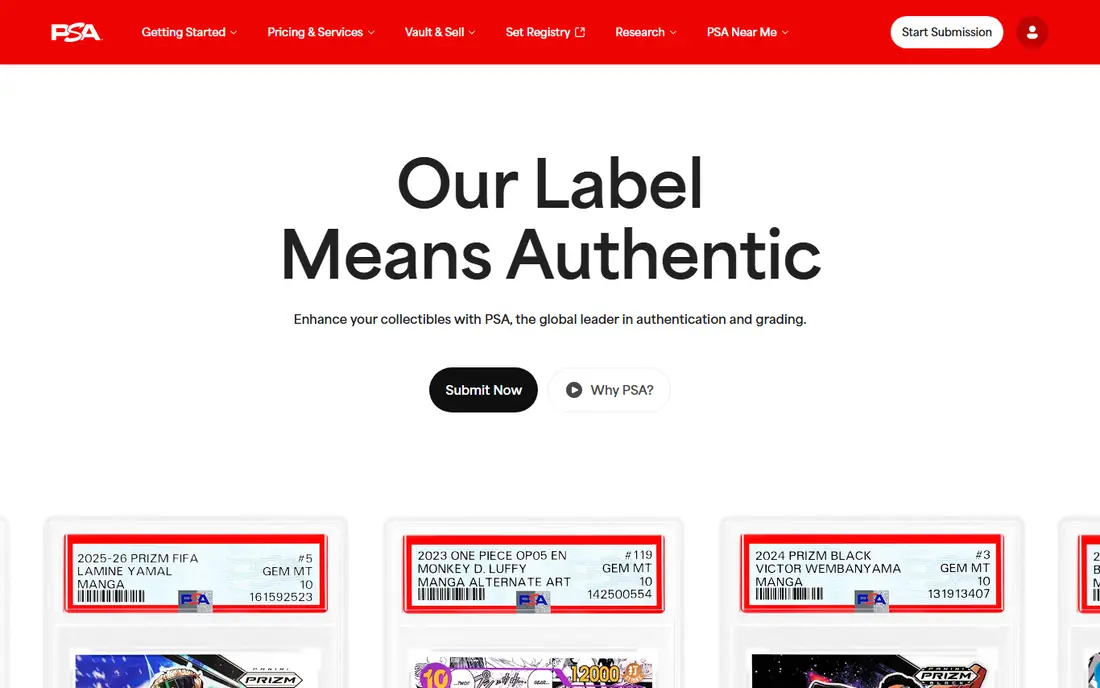
PSA is the default choice for most collectors, and for good reason: its label carries the most weight with buyers. Its homepage calls PSA the global leader in authentication and grading, with more than 80 million collectibles authenticated and graded, and notes that PSA-certified items outsell the field in most sales and auctions. Its proprietary encapsulation preserves cards, and its app lets collectors build submissions with smart photo recognition, rated 4.8 with more than 54,000 ratings.
PSA suits cards you plan to sell, especially modern rookies, vintage stars and high-value TCG cards, where the label adds the most value. The trade-off is cost and turnaround: popular service levels fill fast, and fees rise with declared value. For a personal collection you never plan to sell, a cheaper grader may serve just as well, but for resale PSA remains the safest pick.
- Global leader in authentication and grading
- More than 80 million collectibles authenticated and graded
- PSA-certified items outsell the field in most sales and auctions
- App with smart photo recognition and an official vault with eBay
- Premium pricing and demand can mean longer waits at busy service levels
- Grading fees vary by declared value
Beckett
Ideal for: Subgrades and premium labels
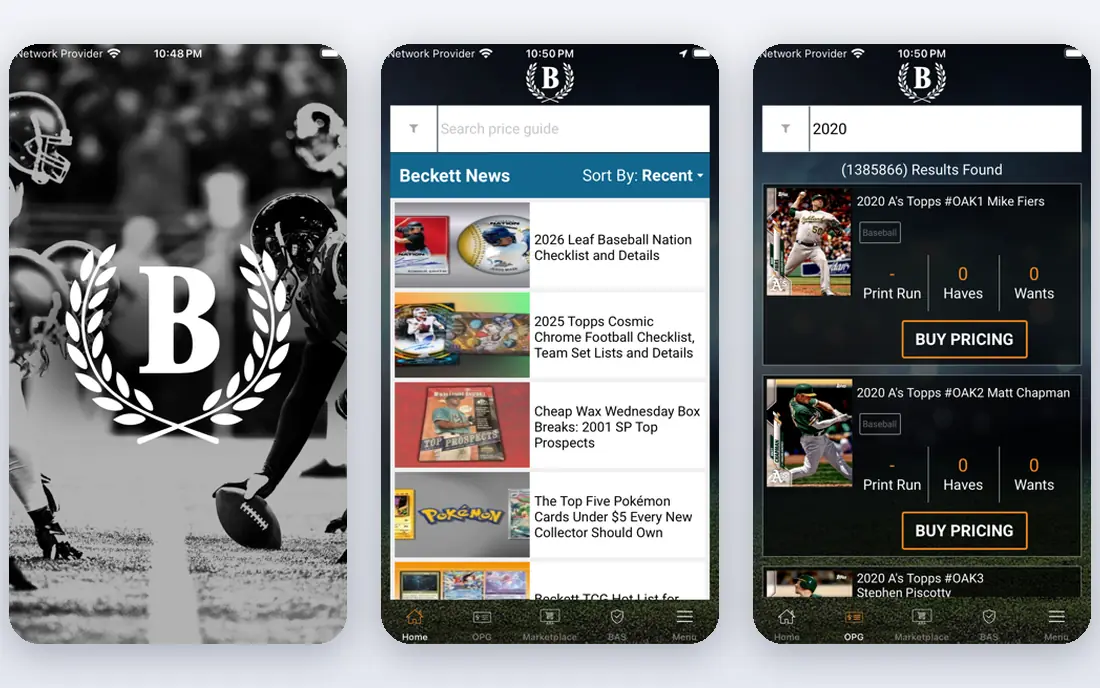
Beckett, known for BGS grading, has built its reputation over four decades on unbiased grading standards, with the black label as the most recognized mark of quality in collecting. Its new label uses a grid-based layout with advanced security features and a new autograph grade designation, fitting more details onto every label while making the design far harder to replicate. Its holders use premium, archival-grade materials, ultrasonically welded and tamper-evident.
Beckett suits collectors who value subgrades and the prestige of a perfect black label, especially for modern cards where a BGS 10 Black Label commands a strong premium. Record sales on its homepage include a 5.2 million USD Pokemon Illustrator card and a 2.4 million USD LeBron James rookie patch autograph, showing the high end Beckett serves. For vintage cards, PSA and SGC often hold stronger resale, but for modern chase cards Beckett is a top choice.
- Four decades of reputation
- New grid-based label with advanced security features and a new autograph grade designation
- Black label for perfect cards
- Archival-grade, ultrasonically welded, tamper-evident holders
- Premium pricing
- Label and holder changes mean older slabs look different from new ones
SGC
Ideal for: Vintage cards
SGC has been a well-established leader in the authentication and grading of trading cards since 1998, with a mission to provide the best grading experience for all collectors. Its homepage stresses accurate and consistent grades delivered in a timely manner, a service it calls unique to the card-collecting community, and describes SGC as one of the pillars of card grading for more than 28 years.
SGC suits vintage collectors in particular, where its consistent grading and distinctive holder have long earned respect, and it remains a strong choice for pre-war and mid-century cards. Its turnaround times are often competitive, and its grades are trusted by dealers and auction houses. For modern cards where PSA resale dominates, SGC may return less at sale, but for vintage and personal collections it is a respected, reliable grader.
- Grading since 1998, one of the pillars of card grading for more than 28 years
- Reputation for accurate and consistent grades in a timely manner
- Smaller market share than PSA and Beckett
- Fewer service options for some card types
CGC Cards
Ideal for: All card types
CGC Cards is the division of CGC devoted to expert grading of collectible cards, including Pokemon, Topps, Magic: The Gathering, Panini, Marvel, Upper Deck, Yu-Gi-Oh and more, backed by graders with decades of experience and experts for each category. Its grading scale offers Gem Mint 10 plus the chase grade Pristine 10, and its holder combines superior display, crystal-clear optics and numerous security features, with a QR code on the back for verification. Every card is backed by an industry-leading guarantee of authenticity and grade.
CGC Cards suits collectors with mixed collections, since one submission can cover TCGs, sports and non-sports cards, and its parent company Certified Collectibles Group is a leader in pop culture certification. The Pristine 10 chase grade appeals to collectors hunting the finest examples. For pure resale on modern sports cards, PSA still leads, but CGC is a strong all-round grader with a trusted name.
- Expert grading for TCGs, sports cards and non-sports cards
- Pristine 10 chase grade above Gem Mint 10
- Holder with crystal-clear optics and security features
- Industry-leading guarantee of authenticity and grade
- Younger in cards than in comics, where parent CGC is best known
- Certification lookup can be rate-limited at busy times
TAG
Ideal for: Data-driven grading
TAG takes a different approach: instead of human-only grading, it uses photometric stereoscopic imaging and patented technology to score cards on a precise 1,000-point scale, translated into an industry-standard 1 to 10 grade. Every slab includes a Digital Image and Grading Report (DIG) with identified defects, high-resolution images, scoring breakdowns, centering, population, rankings and chronology, accessible by scanning the QR code. Slabs graded with DIG Report Plus receive a precise 1,000-point TAG Score, ranking cards on TAG Leaderboards, and slabs block about 99 percent of UV rays below 400 nm.
TAG suits collectors who want objective, repeatable grading with full transparency about why a card earned its grade. Its Card Vision tool lets owners zoom up to 800 percent to inspect surface defects. The trade-off is resale: TAG labels are gaining acceptance but do not yet command PSA-level premiums. For collectors who value data and consistency over immediate resale, TAG is the most advanced option here.
- Multi-patented technological grading on a precise 1,000-point scale
- Digital image and grading reports with defects, scoring and rankings
- More than 1,000,000 cards graded
- UV-resistant, interlocking slabs with digital security
- Newer grader with less resale history than PSA and Beckett
- Digital reports add a learning curve for traditional collectors
Ace Grading
Ideal for: UK and international collectors
Ace Grading is a UK-based grader built around transparency and speed, with free subgrades on every card, a bespoke dashboard for submissions, label choices and grade checks, and grade reveals available immediately after payment. Its slabs are crystal clear and premium, with standard, colour-match and hand-drawn Ace label options, and a GradedGuard product for added protection. It accepts submissions from the UK, EU, USA, Canada, Japan, Australia and New Zealand.
Ace suits UK, European and international collectors who want fast, transparent grading without shipping to the US, and collectors who like custom label art. Free subgrades are a genuine advantage: other graders often charge extra for that detail. Resale is still developing outside the UK, so Ace is best for personal collections and display, or for sellers building a UK buyer base, rather than for maximizing US resale.
- Free subgrades for corners, edges, surfaces and centering
- Fast turnaround
- User dashboard with immediate grade reveals
- Submissions accepted from the UK, EU, USA, Canada, Japan, Australia and New Zealand
- UK-based, so US collectors face international shipping
- Newer grader with less resale history than the big four
ISA Grading
Ideal for: Budget grading
ISA Grading, short for International Sports Authentication, offers sports card grading, authentication, protective holders, certificate verification and collector education from Brighton, Michigan, at a stated price range of 15 USD per card. Customer reviews on its homepage praise professional grading, quicker turnaround, lower cost, a solid and sturdy holder and fair grades, with collectors saying they submit to ISA on an ongoing basis.
ISA suits budget collectors and bulk submissions, where grading many lower-value cards at PSA prices would cost more than the cards are worth. At 15 USD per card, ISA makes grading accessible for personal collections, set building and mid-value cards. Resale will usually trail PSA and Beckett, so ISA is best when protection, authentication and display matter more than maximizing sale price.
- Low 15 USD per card price range
- Quicker turnaround and lower cost than larger graders, per customer reviews
- Sturdy holder
- Sports card grading, authentication, protective holders, certificate verification and collector education
- Smaller grader with less resale strength
- Fewer service tiers and less public data than the big four
How we picked these
We compared official homepages, grading scale, holder quality, verification tools, turnaround claims and resale reputation, favoring companies that are actively grading in 2026 with verifiable certification databases. We covered the big four resale leaders (PSA, Beckett, SGC, CGC Cards) plus three newer or regional options (TAG, Ace, ISA) so collectors can weigh resale against cost, speed and transparency. We checked each company's own site before listing it.
How to choose a card grading company
Start with your goal. If you plan to sell, choose PSA first, with Beckett for modern chase cards and SGC for vintage, since buyers pay more for those labels. If you plan to keep the card, choose on cost, speed and holder quality: TAG for data and transparency, Ace for international service and free subgrades, ISA for budget grading.
Next, check turnaround and fees at your card's value. Grading fees often rise with declared value, and turnaround varies by service level, so compare the total cost including shipping and insurance both ways. A cheaper per-card fee can be offset by slow return times or high shipping, especially for international submissions. Submit one test batch before sending a large collection.
Finally, verify before you buy or sell. Every grader here offers certification lookup by cert number or QR code, so check any graded card you buy against the grader's database and inspect the holder for tampering. A grade is only as good as its verification, and a quick lookup protects you from counterfeit slabs, which remain a risk in the hobby.
Frequently asked questions
Which card grading company is best for resale?
PSA is best for resale overall, with Beckett strong for modern cards and SGC strong for vintage. PSA-certified items outsell the field in most sales and auctions, according to PSA, and its label is the most recognized by buyers.
How much does card grading cost?
Fees vary by grader, service level and declared value. ISA Grading lists a price range of 15 USD per card, while PSA, Beckett, SGC, CGC Cards, TAG and Ace price by service level, so check each company's pricing page for your card's value tier and turnaround choice.
What is a subgrade?
A subgrade scores each part of a card separately, usually centering, corners, edges and surface, so you can see why a card earned its overall grade. Beckett is known for subgrades and its black label for perfect cards, while Ace Grading includes subgrades free.
How long does card grading take?
Turnaround varies by grader and service level, from days at express tiers to weeks or months at economy tiers. SGC and Ace emphasize timely and fast turnaround, while TAG and ISA customers report quicker returns than larger graders, but always check current estimates before submitting.
Should I grade my cards or keep them raw?
Grade cards you plan to sell, high-value cards, and cards you want protected long term. For low-value cards, grading fees can exceed the card's value, so raw storage in sleeves and top loaders may be better. ISA at 15 USD per card and Ace with free subgrades make grading more viable for mid-value cards.
How do I verify a graded card is genuine?
Enter the certification number on the grader's website or scan the QR code on the holder. PSA, Beckett, SGC, CGC Cards, TAG, Ace and ISA all offer certification lookup, and TAG adds digital security embedded in every slab.