Best Career Management Software in 2026: 8 Options Compared

- Lattice leads for performance plus growth in one modern system.
- Culture Amp suits companies that want feedback and development together.
- Fuel50 suits large employers focused on internal mobility and skills.
- Check whether the tool serves employees, managers, or HR best, since the answer changes the pick.
Quick comparison
| Product | Ideal for | Price from | Free version | |
|---|---|---|---|---|
 Lattice | performance plus growth in one system | See website | No | Visit |
 Culture Amp | feedback plus development for people teams | See website | No | Visit |
 Workday | large enterprises wanting career tools inside HR | See website | No | Visit |
 BambooHR | small and mid-sized firms wanting HR plus growth basics | See website | Free trial | Visit |
 15Five | managers wanting check-ins plus growth | See website | Free trial | Visit |
 Fuel50 | large employers focused on internal mobility | See website | No | Visit |
 TalentGuard | employers wanting career pathing plus succession | See website | No | Visit |
 Cornerstone | enterprises wanting learning plus career development | See website | No | Visit |
The best career management software
Career management software helps employees plan growth, managers run development conversations, and companies spot skills gaps before they become hiring problems. Tools range from internal mobility platforms to performance and learning suites. We compared options used by mid-sized and large employers.
Lattice
Ideal for: performance plus growth in one system
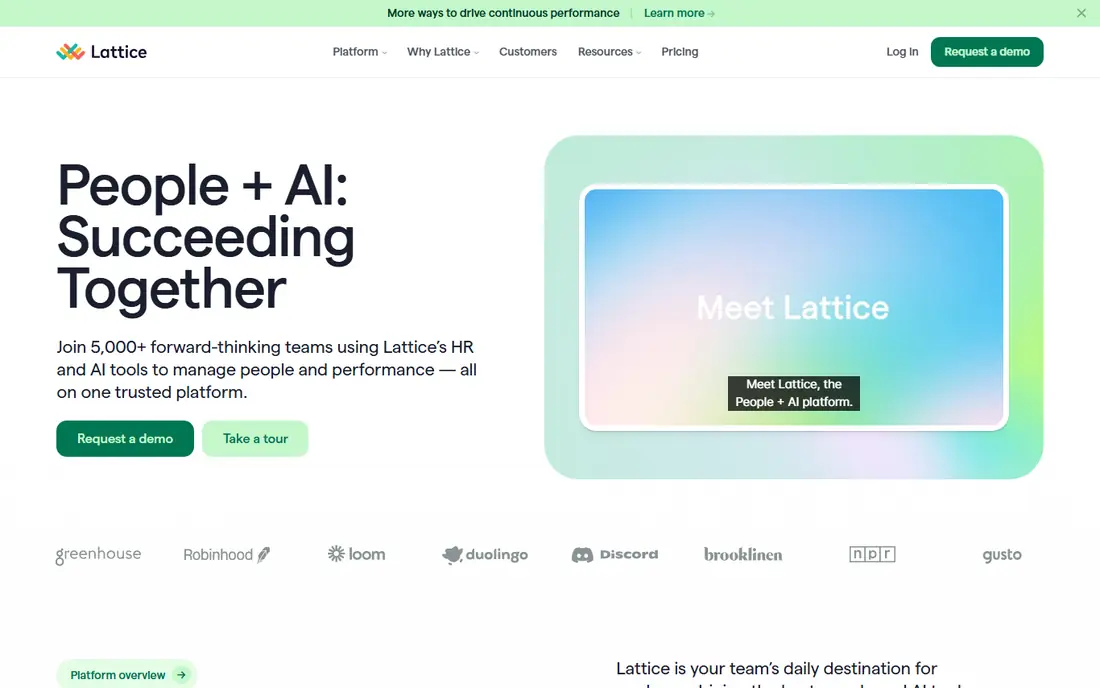
Lattice combines performance reviews, goals, feedback, and career growth paths in a modern system that managers and employees actually use. It suits mid-sized and growing companies that want performance and development together. Pricing is quoted and grows with modules. That focus makes it a practical match for performance plus growth in one system. On pricing, the starting point is see website, and the free plan status is no. Its strengths include performance, goals, and growth paths; modern interface; strong analytics. The trade-off to weigh is pricing by quote; modules add cost. We suggest checking the current plan limits on the vendor site before you commit, since tiers and trial terms change, and confirming that the plan you pick covers the seats, storage, or usage your team actually needs.
- Performance, goals, and growth paths
- Modern interface
- Strong analytics
- Pricing by quote
- Modules add cost
Culture Amp
Ideal for: feedback plus development for people teams
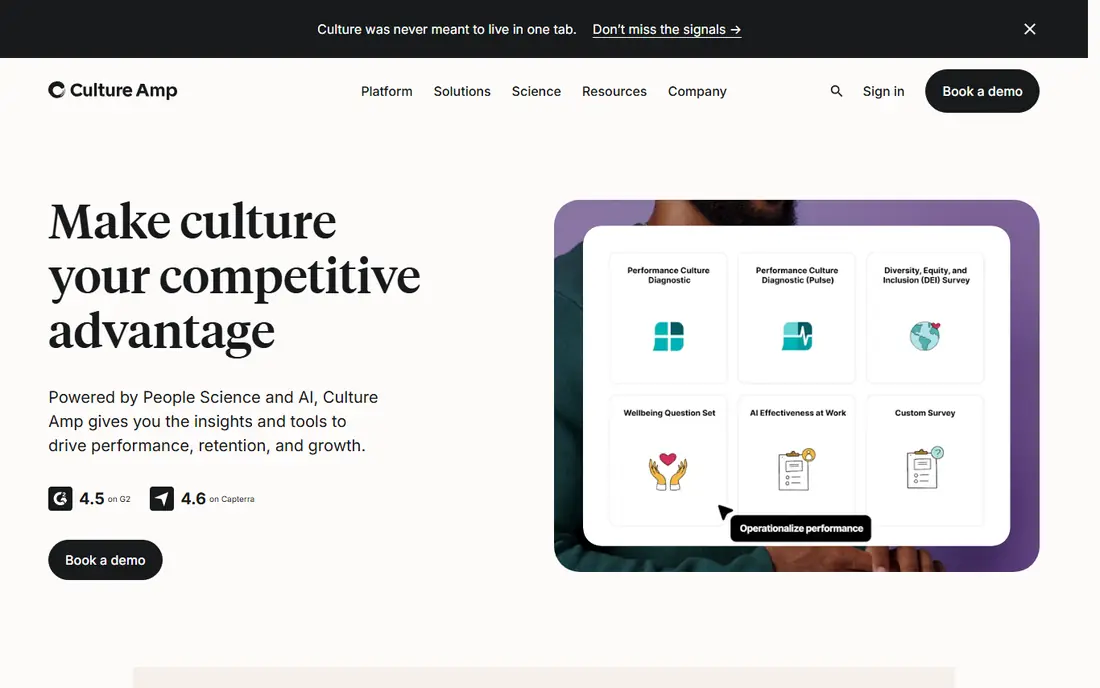
Culture Amp pairs employee feedback and engagement surveys with development and performance tools, helping people teams act on what staff say. It suits companies that want listening and growth in one platform. Pure internal mobility depth is thinner than specialist tools. That focus makes it a practical match for feedback plus development for people teams. On pricing, the starting point is see website, and the free plan status is no. Its strengths include employee feedback and surveys; development tools; benchmarking. The trade-off to weigh is pricing by quote; survey focus over pure career paths. We suggest checking the current plan limits on the vendor site before you commit, since tiers and trial terms change, and confirming that the plan you pick covers the seats, storage, or usage your team actually needs.
- Employee feedback and surveys
- Development tools
- Benchmarking
- Pricing by quote
- Survey focus over pure career paths
Workday
Ideal for: large enterprises wanting career tools inside HR
Workday offers career, skills, and talent tools inside its full human capital platform for large enterprises. It suits organizations already running Workday that want career data tied to HR records. Smaller companies will find it heavy and costly. That focus makes it a practical match for large enterprises wanting career tools inside HR. On pricing, the starting point is see website, and the free plan status is no. Its strengths include full hr suite; skills and talent tools; enterprise scale. The trade-off to weigh is enterprise pricing and implementation; heavy for small firms. We suggest checking the current plan limits on the vendor site before you commit, since tiers and trial terms change, and confirming that the plan you pick covers the seats, storage, or usage your team actually needs.
- Full HR suite
- Skills and talent tools
- Enterprise scale
- Enterprise pricing and implementation
- Heavy for small firms
BambooHR
Ideal for: small and mid-sized firms wanting HR plus growth basics
BambooHR gives small and mid-sized firms core HR, onboarding, and performance basics in an easy system. It suits companies that want career conversations supported without a specialist platform. Larger firms needing deep skills and mobility should look elsewhere. That focus makes it a practical match for small and mid-sized firms wanting HR plus growth basics. On pricing, the starting point is see website, and the free plan status is free trial. Its strengths include simple hr plus performance basics; easy setup; good support. The trade-off to weigh is career depth is basic compared with specialists. We suggest checking the current plan limits on the vendor site before you commit, since tiers and trial terms change, and confirming that the plan you pick covers the seats, storage, or usage your team actually needs.
- Simple HR plus performance basics
- Easy setup
- Good support
- Career depth is basic compared with specialists
15Five
Ideal for: managers wanting check-ins plus growth
15Five helps managers run weekly check-ins, goals, reviews, and growth conversations in one rhythm. It suits teams that want manager-led development as a habit. Deep internal mobility features are thinner than specialist platforms. That focus makes it a practical match for managers wanting check-ins plus growth. On pricing, the starting point is see website, and the free plan status is free trial. Its strengths include weekly check-ins; goals and reviews; manager coaching tools. The trade-off to weigh is career path depth varies by plan; pricing per user. We suggest checking the current plan limits on the vendor site before you commit, since tiers and trial terms change, and confirming that the plan you pick covers the seats, storage, or usage your team actually needs.
- Weekly check-ins
- Goals and reviews
- Manager coaching tools
- Career path depth varies by plan
- Pricing per user
Fuel50
Ideal for: large employers focused on internal mobility
Fuel50 focuses on skills-based career pathing and internal mobility, matching employees to roles, projects, and learning with AI suggestions. It suits large employers with many internal opportunities. Success needs clean skills data and change management. That focus makes it a practical match for large employers focused on internal mobility. On pricing, the starting point is see website, and the free plan status is no. Its strengths include skills-based internal mobility; career pathing; ai matching. The trade-off to weigh is enterprise pricing by quote; needs data investment. We suggest checking the current plan limits on the vendor site before you commit, since tiers and trial terms change, and confirming that the plan you pick covers the seats, storage, or usage your team actually needs.
- Skills-based internal mobility
- Career pathing
- AI matching
- Enterprise pricing by quote
- Needs data investment
TalentGuard
Ideal for: employers wanting career pathing plus succession
TalentGuard combines career pathing, succession planning, and skills tracking for employers that want a dedicated talent platform. It suits mid-sized and large firms planning leadership pipelines. Buyers should confirm current packaging and integrations. That focus makes it a practical match for employers wanting career pathing plus succession. On pricing, the starting point is see website, and the free plan status is no. Its strengths include career pathing; succession planning; skills tracking. The trade-off to weigh is smaller vendor; pricing by quote. We suggest checking the current plan limits on the vendor site before you commit, since tiers and trial terms change, and confirming that the plan you pick covers the seats, storage, or usage your team actually needs.
- Career pathing
- Succession planning
- Skills tracking
- Smaller vendor
- Pricing by quote
Cornerstone
Ideal for: enterprises wanting learning plus career development
Cornerstone pairs learning management with talent and career development tools for large enterprises. It suits organizations that want learning paths tied to career growth at scale. Implementation and complexity are significant. That focus makes it a practical match for enterprises wanting learning plus career development. On pricing, the starting point is see website, and the free plan status is no. Its strengths include learning plus talent tools; large enterprise scale; broad content options. The trade-off to weigh is enterprise pricing and implementation; complexity is high. We suggest checking the current plan limits on the vendor site before you commit, since tiers and trial terms change, and confirming that the plan you pick covers the seats, storage, or usage your team actually needs.
- Learning plus talent tools
- Large enterprise scale
- Broad content options
- Enterprise pricing and implementation
- Complexity is high
How we picked these
We compared official feature pages, pricing pages, app store listings, privacy policies, and public reviews for each option, and we kept only products that exist, work in October 2026, and fit the topic directly. We did not claim hands-on testing we did not do, and we left out products whose fit was weak even when they are well known in a nearby category. Price and plan details change often, so where a vendor does not publish a clear price we write See website rather than guessing. The notes below reflect what each vendor publishes about its own product, not a promise about results for any single team.
How to choose career management software
Decide who the primary user is. Employees need visible paths, skills, and internal roles, managers need conversation guides and team views, and HR needs skills data and succession views. A tool built mainly for HR reporting will see low employee use, while a tool built only for employees may lack the data HR needs. Check integration with your HR system, learning platform, and performance process, since career data must flow between them. Ask how skills are defined and updated, whether AI suggestions are transparent, and how internal mobility handles manager visibility and pay bands. Pilot with one department before a company-wide rollout. Launch with real internal roles and paths, not generic templates, and train managers to hold development conversations regularly. Review usage and mobility outcomes after two quarters, and keep the focus on growth opportunities that actually exist, since a path to nowhere frustrates staff.
Frequently asked questions
What is career management software?
It helps employees explore roles, skills, and growth paths inside a company, and helps managers and HR support development, internal moves, and succession planning. It connects people data with learning and opportunity data.
Is career software the same as performance software?
No, though many platforms combine both. Performance software reviews past work and goals, while career software looks forward to skills, paths, and future roles. Combined platforms cover both, but check which side is stronger.
Can career software improve retention?
It can help by making internal opportunities visible and supporting growth conversations, but it cannot fix pay, workload, or manager problems on its own. Retention improves when visible paths lead to real moves.
How does internal mobility software work?
It matches employee skills and interests to open internal roles, projects, and gigs, often with AI suggestions, and lets managers see interested candidates. Good systems respect privacy and manager workflows.
How much does career management software cost?
Pricing is usually per employee per month and quoted for larger employers, varying with modules and integrations. Small teams may use features inside broader HR platforms instead.