Best Church Payroll Services in 2026: 8 Services Compared

- 1
 Ministry BrandsChurch-specific payrollVisit
- 2
 ACS TechnologiesChurch management plus payrollVisit
- 3
 ChurchTracSmall church managementVisit
- 4
 BreezeSimple church managementVisit
- 5
 Planning CenterChurch operations and payrollVisit
- Church payroll is special: clergy housing allowances, dual tax status, and ministerial exceptions change how pay and tax must be handled.
- Ministry Brands and ACS Technologies lead on church-specific payroll, while Gusto and Paychex suit churches that want a general payroll platform.
- Church management software like ChurchTrac, Breeze, and Planning Center adds payroll-adjacent tools but may not replace a full payroll service.
- Always confirm that a provider handles clergy housing allowance, Social Security elections, and state rules for your church.
- Our pick for most churches is Ministry Brands for church-specific payroll, with Gusto as the pick for small churches that want simplicity.
Disclaimer: This is general information only and is not tax or legal advice; confirm clergy pay rules with a qualified tax professional.
Quick comparison
| Product | Ideal for | Price from | Free version | |
|---|---|---|---|---|
| Ministry Brands | Church-specific payroll | See website | No | Visit |
| ACS Technologies | Church management plus payroll | See website | No | Visit |
| ChurchTrac | Small church management | See website | Free trial | Visit |
| Breeze | Simple church management | See website | Free trial | Visit |
| Planning Center | Church operations and payroll | See website | Free trial | Visit |
 Gusto | Simple general payroll | See website | Free trial | Visit |
 Paychex | Full-service payroll | See website | No | Visit |
 Church Windows | Church accounting and payroll | See website | Free trial | Visit |
The best church payroll services
Church payroll covers pastors, staff, and part-time workers, with special rules for clergy that general payroll tools sometimes miss. The services below were compared on clergy pay handling, tax compliance, ease of use for church staff, and fit for different church sizes.
Ministry Brands
Ideal for: Church-specific payroll
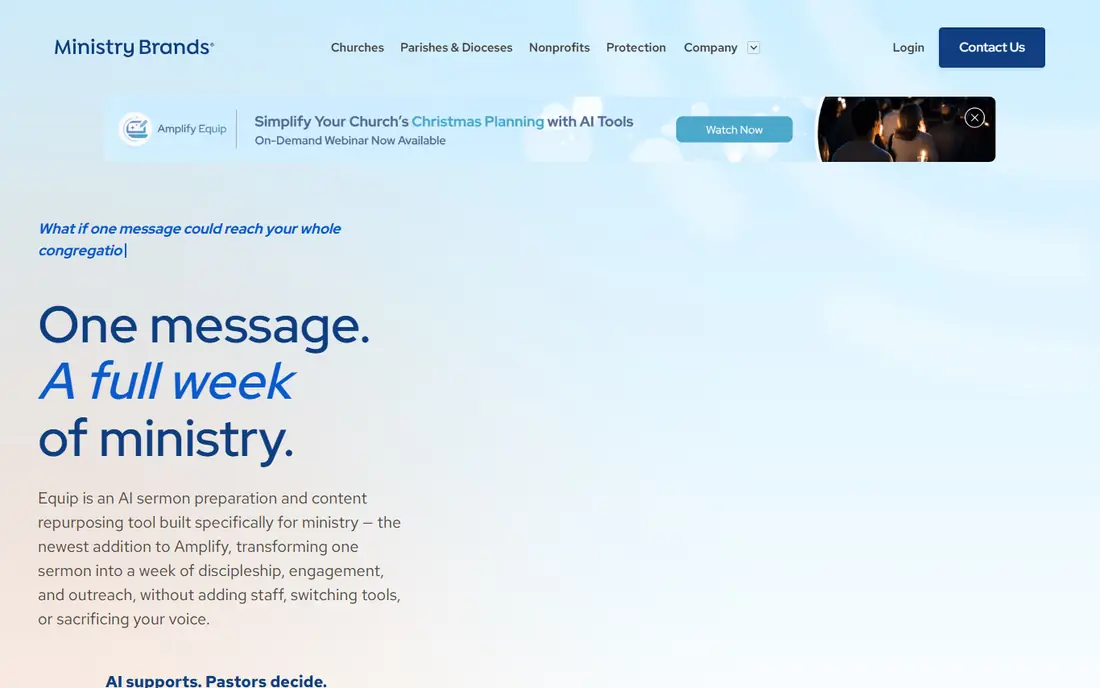
Ministry Brands offers church software that includes payroll designed around church needs, including clergy housing allowances and ministerial tax treatment. Its integration with giving, membership, and accounting tools means payroll sits inside the same system a church already uses for operations. For a church that wants one vendor for management and payroll, that integration is valuable.
Pricing is quote-based, and the full suite can feel large for a very small church. For mid-size and larger churches, Ministry Brands is a leading church-specific payroll choice.
- Built for churches with clergy pay rules
- Integrates with church giving and management
- Broad church software suite
- Pricing is quote-based
- Suite breadth can feel large for a tiny church
ACS Technologies
Ideal for: Church management plus payroll
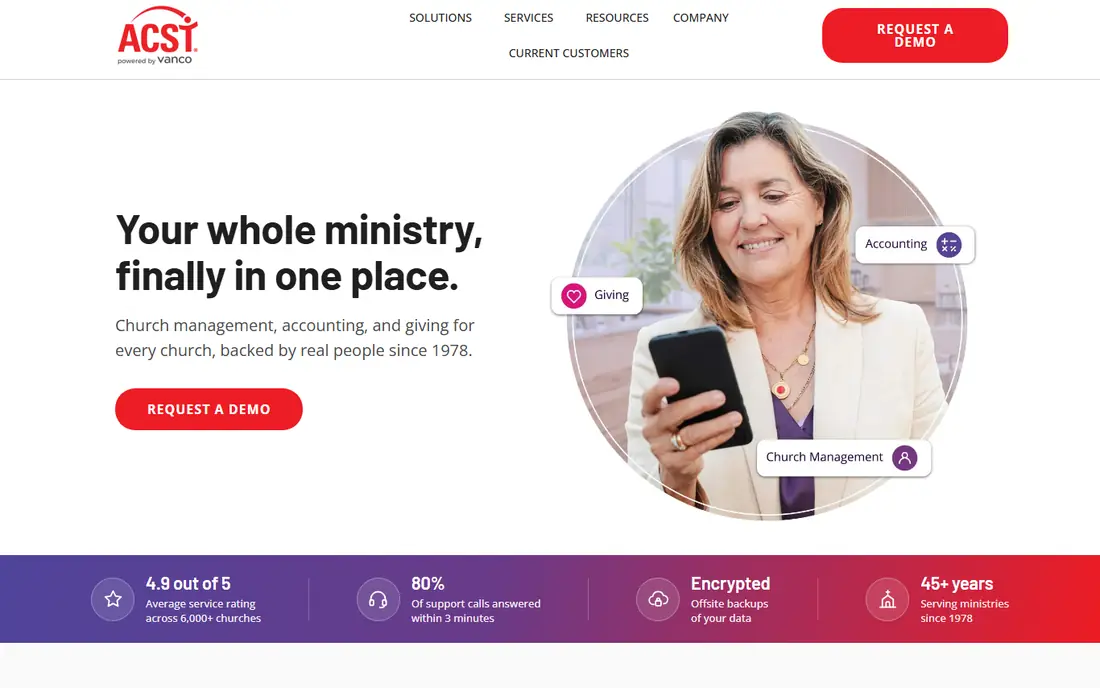
ACS Technologies has served churches for decades with management software that includes payroll handling for clergy and staff. Its payroll tools cover housing allowances and church-specific tax situations, and its integration with membership, giving, and accounting keeps church data together. Churches that have used ACS for years often stay for that familiarity and depth.
Some users find the interface dated compared with newer platforms, and pricing is quote-based. For a church that values proven, church-specific payroll inside a full management suite, ACS remains a strong option.
- Long church software history
- Payroll with clergy features
- Integrated membership and giving
- Interface feels dated to some users
- Pricing is quote-based
ChurchTrac
Ideal for: Small church management
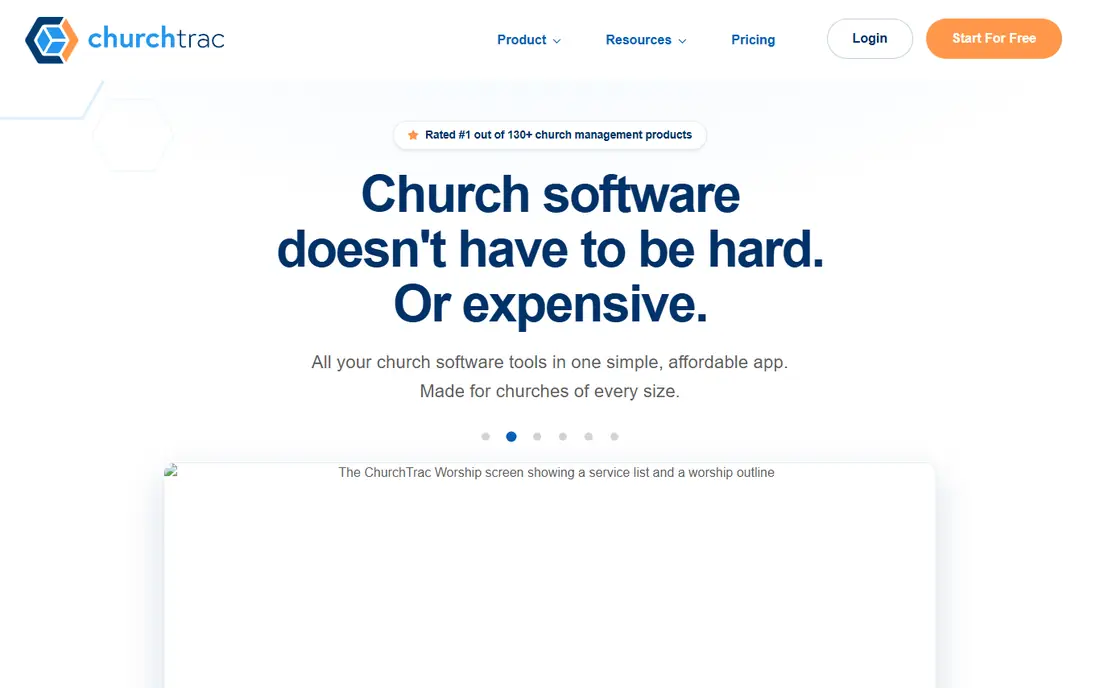
ChurchTrac offers affordable church management software with accounting features that help small churches track payroll-related costs, though its payroll depth is lighter than a specialist provider. Its simple interface suits volunteer treasurers and part-time administrators, and its pricing fits small church budgets. For a small church with a handful of staff, it covers the essentials.
Larger churches or those with complex clergy pay situations may need a fuller payroll service alongside it. For small churches, ChurchTrac is a practical and affordable starting point.
- Affordable for small churches
- Simple interface
- Combines management with accounting basics
- Payroll depth is lighter than specialist providers
- Best for small teams
Breeze
Ideal for: Simple church management
Breeze is a simple church management system known for an easy interface that volunteers can learn quickly, with people, giving, and event tools. Its accounting features help small churches track finances, but it is not a full payroll provider, so churches with clergy pay complexity need a payroll service alongside it. For a small church that wants simple management, Breeze is appealing.
Its payroll limitations mean it works best paired with Gusto or a similar service for actual pay runs. As a management companion, though, Breeze is one of the easiest tools a small church can adopt.
- Very simple interface
- Affordable pricing
- Good for volunteers and small staff
- Not a full payroll provider
- Accounting and payroll features are basic
Planning Center
Ideal for: Church operations and payroll
Planning Center is widely used by churches for services, groups, giving, and people management, and its payroll features handle staff pay inside that operations suite. Its tools are polished and well supported, and its modular pricing lets a church pay for what it uses. For a church already running on Planning Center, adding payroll keeps operations in one place.
Payroll is one module among many, so churches with very complex clergy situations should confirm coverage before relying on it alone. For most churches, Planning Center offers a coherent operations-plus-payroll option.
- Excellent church operations tools
- Payroll features for staff
- Widely used by churches
- Payroll is part of a broader suite
- Pricing scales with modules used
Gusto
Ideal for: Simple general payroll
Gusto is a popular general payroll platform known for simple setup, automatic tax filings, and affordable pricing for small teams. A small church with a pastor and a few staff members can run payroll, handle benefits, and file taxes without payroll expertise. Its interface is among the easiest in the industry.
Churches must check how Gusto handles clergy-specific items like housing allowances and dual tax status, since those need correct setup. For a small church with straightforward payroll needs, Gusto is a simple and reliable choice.
- Very simple payroll setup
- Good tax filing
- Affordable for small teams
- Church-specific clergy features need checking
- Less church integration than specialists
Paychex
Ideal for: Full-service payroll
Paychex offers full-service payroll with expert support, handling tax filings, compliance, and HR tools for businesses and nonprofits of many sizes. Its scale and support suit churches with larger staffs or complex pay situations, including multiple locations or varied worker types. For a church that wants payroll handled by experts, Paychex is a dependable provider.
Pricing is higher than simpler platforms, and its service model suits larger employers better than tiny churches. For a growing church with a substantial staff, Paychex offers comprehensive payroll support.
- Full-service payroll with expert support
- Handles complex tax situations
- Broad HR tools
- Pricing is higher than Gusto
- Service model suits larger employers
Church Windows
Ideal for: Church accounting and payroll
Church Windows provides church accounting software with payroll features designed for congregations, covering staff pay, clergy allowances, and church financial reporting. Its pricing is affordable, and its long history in the church market means its features reflect real church needs. Small and mid-size churches that want accounting plus payroll in one tool often consider it.
Its interface feels dated compared with newer platforms, and payroll depth varies by module. For a church that wants affordable, church-focused accounting and payroll together, Church Windows is a practical option.
- Church-focused accounting with payroll
- Affordable pricing
- Long church market history
- Interface is dated
- Payroll depth varies by module
How we picked these
We compared official product pages, pricing pages, and feature documentation for church payroll and management providers, focusing on clergy pay handling, tax compliance, ease of use, and fit for different church sizes. We favored providers with real church use and included both church-specific and general payroll options.
What to check before you choose
Confirm clergy handling first: housing allowance designation, Social Security and Medicare elections for ministers, and state rules all affect correct pay. Ask the provider directly how it handles each item, and get the answer in writing if possible. Also check who will run payroll week to week: a volunteer treasurer needs a simpler tool than a full-time administrator.
Review total cost, including tax filing and year-end forms, and confirm that the provider files the forms your church needs. Finally, consider integration with your church management and giving tools, since connected systems reduce double entry and errors.
Another practical step is to test support before you depend on it. Send a question during the trial and note how fast and how helpfully the team responds, since that response is a preview of what you will get when something breaks at an awkward moment. Also check the documentation and community: clear guides and an active user community can solve many problems without waiting for support at all. If the service handles important data or money, review its security and privacy pages too, and confirm that its practices match your requirements. A product that is strong on features but weak on support or security can cost far more in stress and risk than it saves in subscription fees.
Frequently asked questions
What makes church payroll different from business payroll?
Clergy have special tax treatment, including housing allowances that can be excluded from income tax and a choice about Social Security coverage, plus ministers are often treated as self-employed for Social Security purposes. Those rules make church payroll more complex than standard business payroll.
Can a church use Gusto or Paychex for payroll?
Yes, many churches do, especially small ones. Confirm that the provider handles clergy housing allowances and ministerial tax elections correctly for your situation before committing.
What is a clergy housing allowance?
It is an amount a church designates as housing allowance for a minister, which can be excluded from income tax, though not from self-employment tax in most cases. The designation must be made in advance and documented properly.
Should a small church use church-specific software or general payroll?
A small church with simple payroll can use general payroll like Gusto, while a church with complex clergy pay or that wants integrated management should consider a church-specific provider like Ministry Brands or ACS.
Who should run payroll at a church?
Ideally a trained treasurer, administrator, or outside service, not an untrained volunteer alone, since payroll tax errors carry penalties. Even with software, someone accountable should review each pay run.
Should I try a free plan or trial first for best church payroll services?
Yes, whenever one is available. A trial with your real data and real tasks reveals fit, speed, and ease of use in a way no sales page can, and it often surfaces deal-breakers early, such as a missing integration or a confusing workflow. Use the trial actively rather than just browsing: complete a typical task end to end, contact support once, and check how easy it is to export your work if you decide to leave.