7 Top Citizen Engagement Software Options Compared (2026)

- 1
 PolcoScientific civic surveys and benchmarkingVisit
- 2
 PublicInputPublic meetings and comment collectionVisit
- 3
 MetroQuestVisual surveys for plans and projectsVisit
- 4
 Citizen SpaceFormal public consultationsVisit
- 5
 ZencityAI analysis of community feedbackVisit
- Polco sits first on this list: scientific civic surveys and benchmarking.
- What to know about PublicInput first: interface less modern than newer rivals, Pricing by quote, Focused on input more than dialogue.
- Pricing across the list, from Polco to GoVocal, is by quote only.
- GoVocal fits community projects and ideation.
Direct answer
Our first pick is Polco, best for scientific civic surveys and benchmarking. PublicInput is better for public meetings and comment collection, and MetroQuest is better for visual surveys for plans and projects. The other 4 tools in the list cover narrower or pricier cases.
Quick comparison
| Product | Ideal for | Price from | Free version | |
|---|---|---|---|---|
| Polco | Scientific civic surveys and benchmarking | See website | No | Visit |
| PublicInput | Public meetings and comment collection | See website | No | Visit |
| MetroQuest | Visual surveys for plans and projects | See website | No | Visit |
| Citizen Space | Formal public consultations | See website | No | Visit |
| Zencity | AI analysis of community feedback | See website | No | Visit |
 Granicus | Full government digital services suite | See website | No | Visit |
 GoVocal | Community projects and ideation | See website | No | Visit |
Tool-by-tool breakdown
This Ainotely guide covers 7 options for Citizen engagement software. Each profile lists a starting price, free plan details, strengths and drawbacks, so you can drop poor fits quickly.
Polco
Ideal for: Scientific civic surveys and benchmarking
Polco targets scientific civic surveys and benchmarking. Polco grew out of civic survey science, and it presents in the product's seriousness about methodology. Its National Community Survey and related instruments are meant to produce results a council can trust and a critic cannot easily dismiss.
Strengths: National research partnerships.
In daily use, just as valuable is the benchmarking: you can see how your residents' satisfaction compares with hundreds of similar communities, which turns abstract scores into a story. It is slower and less flashy than idea-collection tools, since decent survey research cannot be rushed. Polco does not show a starting price in this comparison, so check the vendor site for current pricing. Polco has no free tier. The main drawbacks: Surveys take time to field properly.
- Benchmark data from hundreds of communities
- Trusted by city managers
- Less visual than newer products, Pricing by quote
PublicInput
Ideal for: Public meetings and comment collection
PublicInput works best for public meetings and comment collection. PublicInput comes from the world of public hearings and comment periods, and it is organized around that workflow.
Where it is weaker: Interface less modern than newer rivals, Pricing by quote.
Upsides: Purpose-built for public comment periods.
When a transportation department must document public input for a federally funded project, PublicInput provides them the structure and the paper trail. It is not the flashiest product here, but it understands the regulatory reality of public engagement better than most. Pricing for PublicInput is not stated here, so ask the vendor for current figures. PublicInput has no free tier.
- Reporting aimed at staff workflows
- Manages virtual and hybrid meetings well
- Concentrated on input more than dialogue
MetroQuest
Ideal for: Visual surveys for plans and projects
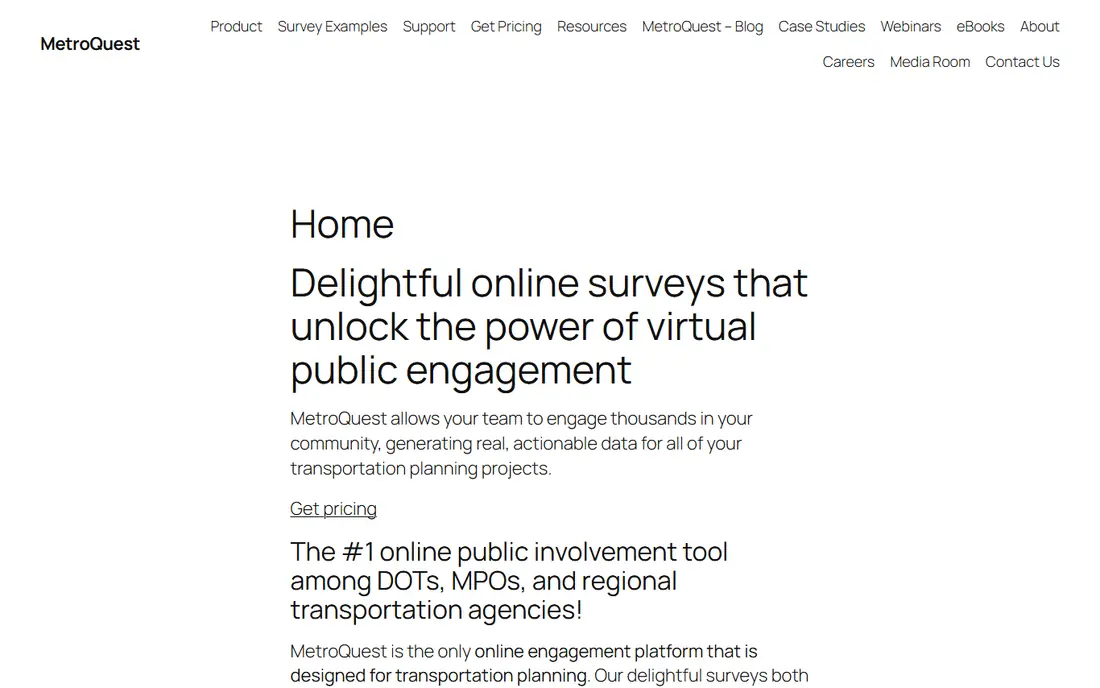
MetroQuest is built with visual surveys for plans and projects in mind. The results side is equally refined: reports and presentations that communicate findings to councils and the public without a data-science degree. If you need year-round community dialogue, look at GoVocal or Granicus instead.
On top of that, MetroQuest makes surveys people actually finish. If your engagement centers on plans, projects, and infrastructure choices, MetroQuest will outperform generic survey tools. The focus is narrow, which is both the strength and the limit. No starting price is listed for MetroQuest here; confirm pricing on the vendor site. MetroQuest has no free tier.
Where MetroQuest stands out: Solid results presentations.
- Designed for planning and transportation projects
- Highly visual
- Niche focus on planning use cases, Pricing by quote, Smaller company
Citizen Space
Ideal for: Formal public consultations
Citizen Space is built with formal public consultations in mind. Citizen Space by Delib is the workhorse of formal public consultation, used across UK government departments, councils, and agencies running thousands of consultations.
Watch-outs: Consultation-focused instead of continuing dialogue.
As for the details, for agencies where the consultation itself must stand up to scrutiny, Citizen Space has the deepest pedigree here. Responses can be coded, themed, and exported in formats that feed straight into decision documents and published reports. Pricing for Citizen Space is not stated here, so ask the vendor for current figures. Citizen Space does not include a free plan.
- Designed for official consultations
- Widely used across UK government
- Less visual than newer rivals, Pricing by quote
Zencity
Ideal for: AI analysis of community feedback
Where Zencity fits: AI analysis of community feedback. Rather than launching another survey, you get a continuing read on what the community cares about, benchmarked against similar cities. More specifically, for agencies drowning in unstructured feedback and short on analysts, Zencity converts a pile of comments into priorities.
The company also provides survey tools, but the analytics engine is the core. From a buyer's view, setup is quicker than the big suites, since much of the data already exists. This comparison lists no price for Zencity; ask the vendor. Zencity has no free plan.
Downsides: Less of a participation front-end.
Upsides: 311 data; social media.
- Benchmarks sentiment against similar cities
- Purpose-built for local government
- Quote-based pricing
Granicus
Ideal for: Full government digital services suite
Pick Granicus if this describes you: full government digital services suite. Granicus is the company most local governments already know, normally through govDelivery, its digital communications product that sends the email and text updates residents actually read. In practice, the trade-off of that breadth is complexity.
The main drawbacks: Can be more product than small towns need, Implementation takes planning.
Highlights: Solid compliance and security posture. Beyond that, Granicus sells through a consultative process, pricing is quoted, and rolling it out across departments takes real project management. But the payoff is a resident experience that links: someone gets a text about a road project, clicks through to an engagement page, submits input, and later receives the decision notice. No starting price is listed for Granicus here; confirm pricing on the vendor site. There is no free plan with Granicus.
- Broadest product range in govtech
- Combines communications with engagement
- Quote-based pricing
GoVocal
Ideal for: Community projects and ideation
GoVocal is aimed squarely at community projects and ideation. Multilingual support is a genuine strength, important for diverse communities where English-only engagement quietly excludes people. The templates include the standard municipal use cases, from thorough plans to park designs.
Points against: Advanced analytics cost additional.
Best features of GoVocal: Decent multilingual support. GoVocal started in Belgium and spread across European cities before pushing into North America, and the product displays that civic DNA. For everyday use, the company ships updates often and listens to its government users. In daily use, for cities that want engagement to feel inviting instead of bureaucratic, GoVocal is a solid pick. The downsides are the usual ones for the category: no public pricing, and analytics depth varies by level. GoVocal shows no starting price here, so confirm the cost on the vendor site. GoVocal does not include a free plan.
- Adaptable project templates
- Clean
- Pricing not published
Citizen Engagement Software: more detail
A city council used to learn what residents thought from whoever showed up on a Tuesday night. That crowd skewed older, louder, and whiter than the community it claimed to represent. From a buyer's view, then agencies started running engagement online and discovered something: participation multiplied, the demographics broadened.
The loudest voice in the room stopped setting the agenda. The best ones handle the unglamorous parts too: moderation, accessibility, multilingual support. An audit trail that proves the input was genuine when a decision gets challenged.
The right one relies on what you are asking residents about, how numerous of them you have to reach, and whether you need the full digital-services suite or a focused engagement tool.
How these tools were picked
Pricing pages, product documentation and feature lists were the main sources, and every entry carries at least one honest drawback. Prices and plan limits come from vendor pages and can change, so confirm them on the vendor site before you buy. The ranking is editorial: typical fit first, then clear pricing, then free access. If your needs are unusual, read the profiles rather than relying on position.
Before you commit
- Confirm the entry price with every vendor: no tool from Polco to GoVocal shows a fixed starting price.
- Read the limits listed for Polco first: less visual than newer products, Pricing by quote, Surveys take time to field properly.
- Confirm that Granicus connects to the apps your team already uses, on the plan you would actually buy.
- Compare total cost, not headline price: for Citizen Space, add extra seats, add-ons and any usage-based charges.
- Get the contract term, renewal terms and any onboarding fees from GoVocal in writing.
Frequently asked questions
Is Polco the right pick for everyone comparing Citizen engagement software?
No single tool suits every team. Polco comes first because it fits scientific civic surveys and benchmarking, while PublicInput suits public meetings and comment collection and MetroQuest suits visual surveys for plans and projects. Match the tool to your own size, budget and workflow before deciding.
What is citizen engagement software?
It is software that helps governments consult the public online: publishing projects, collecting surveys and ideas, hosting virtual meetings, and reporting results. It replaces or supplements in-person town halls with digital participation.
Can online engagement replace public hearings?
Numerous jurisdictions still need formal hearings for certain decisions. The best practice is hybrid: digital input for breadth, in-person or virtual hearings for the formal record.
Do these tools publish their prices?
No. None of the tools, from Polco to GoVocal, shows a fixed starting price here, so budget time for quotes.
Do these platforms work for small towns?
Yes, though the full suites can be overkill. Smaller agencies commonly do well with focused tools like Citizen Space for consultations or Polco for surveys. Most vendors offer scaled-down levels even when pricing is quoted.
Does any tool for Citizen engagement software here have a free plan?
A permanent free plan is not offered by Polco, GoVocal or the other tools here. Plan a short evaluation period instead.