7 Best Cloud AI Services for Machine Learning Options for 2026

- 1
 Hugging FaceOpen models and managed endpointsVisit
- 2
 RunPodAdaptable GPU pods and serverless inferenceVisit
- 3
 LambdaGPU training at hourly ratesVisit
- 4
 Google Vertex AIMachine learning inside Google CloudVisit
- 5
 AWS SageMakerMachine learning inside AWSVisit
- Top of the list is Hugging Face, which targets open models and managed endpoints.
- Hugging Face stands alone as the one tool in this list with a free plan.
- For unified data and machine learning, Databricks is worth a look.
- Hugging Face has the lowest monthly starting price in this list: $9 per user/month.
Direct answer
This list puts Hugging Face first for open models and managed endpoints. RunPod fits adaptable GPU pods and serverless inference; Lambda fits GPU training at hourly rates. The other 4 tools in the list cover narrower or pricier cases.
Quick comparison
| Product | Ideal for | Price from | Free version | |
|---|---|---|---|---|
| Hugging Face | Open models and managed endpoints | $9 per user/month | Yes | Visit |
| RunPod | Adaptable GPU pods and serverless inference | See website | No | Visit |
| Lambda | GPU training at hourly rates | See website | No | Visit |
| Google Vertex AI | Machine learning inside Google Cloud | See website | Free trial | Visit |
| AWS SageMaker | Machine learning inside AWS | See website | Free trial | Visit |
 Microsoft Azure Machine Learning | Machine learning inside Azure | See website | Free trial | Visit |
 Databricks | Unified data and machine learning | See website | Free trial | Visit |
Cloud AI Services for Machine Learning compared in detail
This Ainotely guide covers 7 options for cloud AI services for machine learning. Each profile lists a starting price, free plan details, strengths and drawbacks, so you can drop poor fits quickly.
Hugging Face
Ideal for: Open models and managed endpoints

Where Hugging Face fits: open models and managed endpoints. Its Hub hosts a vast range of open models and datasets. Its Transformers, Datasets, and related libraries are standard tools for numerous practitioners.
Trade-offs to know: Model licences vary and need checking before commercial use.
Teams should check the licence for each model they plan to ship, and test endpoint costs on realistic traffic before launch. For everyday use, managed Inference Endpoints let teams deploy a chosen model without building serving infrastructure, whereas Spaces supply a fast way to demo an app. Starting cost for Hugging Face: $9 per user/month. Hugging Face includes a free tier.
- Huge hub of open models, datasets, libraries
- Managed Inference Endpoints and Spaces
- Managed compute and endpoint costs sit on top of hub pricing
RunPod
Ideal for: Adaptable GPU pods and serverless inference

RunPod is a good fit for adaptable GPU pods and serverless inference. The honest catch is reliability planning.
The main drawbacks: Community cloud quality and availability vary.
For everyday use, persistent volumes help teams keep checkpoints and datasets close to the compute. Check the vendor site for RunPod pricing; none is listed in this comparison. RunPod has no free tier.
- Quick GPU pods with plenty of hardware choices
- Community cloud choices at lower rates
- Spot-style instances can be reclaimed, so jobs need checkpointing
Lambda
Ideal for: GPU training at hourly rates
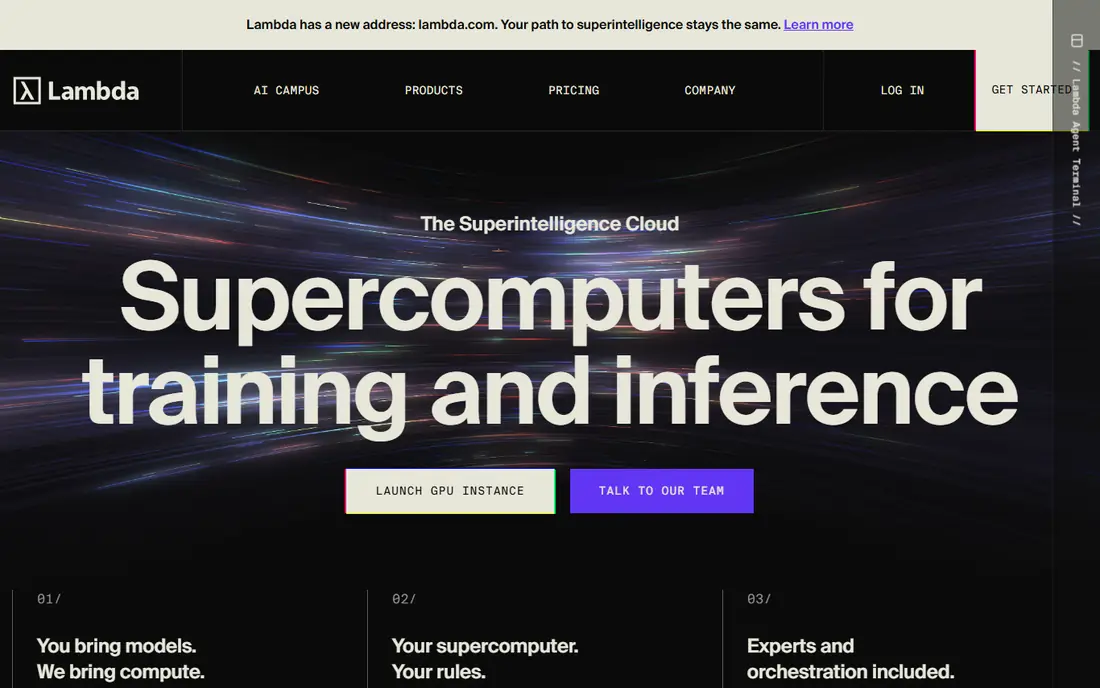
In short, Lambda is for GPU training at hourly rates. Lambda, also known as Lambda Labs, suits teams that primarily need GPU compute for training and fine-tuning, instead of a full managed product. Its published per-GPU hourly rates make budgeting more straightforward than a multi-service cloud bill.
Its claim of no egress fees helps when a job processes large datasets. On top of that, teams that require managed pipelines, feature keeps, and governance tools will need to build or add those themselves. On top of that, researchers and startups frequently use it for training runs that do not need a broad enterprise toolset. From a buyer's view, for pure training compute, the clarity is a real advantage. The honest catch is availability and tooling. Lambda does not show a starting price in this comparison, so check the vendor site for current pricing. Lambda does not include a free plan.
The main drawbacks: Fewer managed machine learning tools than the major clouds.
- Clear published GPU hourly rates
- Solid choice for research and training workloads
- On-demand capacity is first come, first served
Google Vertex AI
Ideal for: Machine learning inside Google Cloud
Google Vertex AI is built with Machine learning inside Google Cloud in mind. From a buyer's view, a model that serves a trickle of traffic can still incur steady endpoint charges. So teams should check scale-to-zero options and batch choices for low-volume work.
Watch-outs: Pricing varies a lot by model, hardware, region.
In daily use, AutoML fits tabular, image, and text tasks where a team wants a capable baseline without writing training code. The honest catch is cost control for always-on endpoints. Google Vertex AI shows no starting price here, so confirm the cost on the vendor site. On free options: Free trial.
- Access to Gemini models through the same cloud
- Close links to BigQuery and Google data tools
- Endpoint and managed surcharge costs need careful tracking
AWS SageMaker
Ideal for: Machine learning inside AWS
AWS SageMaker is built with Machine learning inside AWS in mind. It spans notebooks, data processing, distributed training, automatic tuning, a model registry, and endpoints for live or batch predictions, all inside one managed service. Also, inside AWS, the integration depth is hard to beat, but cost discipline is part of the job.
In practice, links to S3 for storage, and to other AWS data services, keep pipelines close to the data they use. In practice, the honest catch is the bill. Teams should use spot training where a job can restart, set endpoint auto-scaling, and shut down idle notebooks. Pricing for AWS SageMaker is not stated here, so ask the vendor for current figures. Free access: Free trial.
Where it is weaker: The breadth of choices can overwhelm small teams.
- Other AWS services
- Broad managed tools for data prep, training, tuning, deployment
- Pricing is complicated across instance types and services
Microsoft Azure Machine Learning
Ideal for: Machine learning inside Azure
For Machine learning inside Azure, Microsoft Azure Machine Learning is a natural candidate. Its workspaces bring notebooks, automatic machine learning, pipelines, model registry, and endpoints together, with identity and access controls that IT teams already run. The honest catch is the same as with other major clouds.
Points against: The portal handles plenty of ground and takes time to learn.
More specifically, costs rely on compute choice, run duration, storage, and endpoint uptime. So a small experiment and a production deployment can differ by orders of magnitude. Check the vendor site for Microsoft Azure Machine Learning pricing; none is listed in this comparison. Trial and free access: Free trial.
- Power BI
- Microsoft identity controls
- Compute and storage costs vary by instance and region
Databricks
Ideal for: Unified data and machine learning
Databricks is a good fit for unified data and machine learning. For data-heavy teams, the shared product frequently saves more time than the pricing complexity costs. In practice, a 14-day trial helps teams test the system, but production budgeting needs a worked example on real data.
Honest limits: Smaller teams may find it more platform than they need.
On top of that, the total cost merges Databricks Units with the underlying cloud instance cost. So two similar workloads can bill differently by compute type and level. Data engineers can build pipelines, analysts can query with SQL, and data scientists can train models on the same lakehouse data, without moving datasets between separate systems. Databricks shows no starting price here, so confirm the cost on the vendor site. Free options: Free trial.
What Databricks does well: One product for data engineering, SQL.
- Capable notebooks and MLflow tracking
- Machine learning
- Pricing merges Databricks Units with cloud infrastructure costs
What went into this list
For each of the 7 tools we noted price, free plan or trial, fit for cloud AI services for machine learning and the main limit, using vendor pages and documentation. Where a price is missing, the vendor does not list one publicly or ties it to a quote. Always confirm before budgeting. We ordered the tools by general fit, then by how clearly pricing is shown, then by free access. A buyer with unusual needs may reorder them.
What to check before you buy
- Ask RunPod, Lambda, Google Vertex AI and others for a written quote, since no starting price is shown.
- Test the free plan from Hugging Face against your real workload before relying on it.
- Run a trial of Google Vertex AI, AWS SageMaker, Microsoft Azure Machine Learning and Databricks with real work before paying for a year; your own workflow is the best test.
- Before choosing Hugging Face, weigh its main limit: managed compute and endpoint costs sit on top of hub pricing.
- Let daily users try Google Vertex AI on real work; their feedback beats any feature checklist.
- Look at the help docs and support options for Lambda before you commit.
Frequently asked questions
Do these tools publish their prices?
Not all of them. RunPod, Lambda, Google Vertex AI and others publish no starting price, so expect a quote request for those. The rest, Hugging Face included, show a starting price, though seats and billing terms still change the final cost.
Can I try these tools before paying?
Often, yes. Hugging Face has a free plan and Google Vertex AI, AWS SageMaker, Microsoft Azure Machine Learning and Databricks offer a free trial. Use your own data and a real task during the test, and check what the free tier or trial limits before you rely on it.
What is the cheapest option for cloud AI services for machine learning in this list?
On published monthly entry prices, Hugging Face is the lowest here at $9 per user/month. Entry price is only part of the cost, because seats, add-ons and billing terms can change the total.
How do I avoid surprise bills?
Set a budget and alerts in your cloud console, use the smallest compute that runs a job, and test endpoint costs on realistic traffic. In daily use, shut down notebooks and endpoints when they are not in use, checkpoint long training jobs, and check storage and egress charges for large datasets.
What is the difference between AutoML and custom training?
AutoML builds a baseline model from tabular, image, or text data with restricted code, which fits teams that require a result rapidly. AutoML is a solid first step, and custom training is the route when a baseline is not decent enough.
Do I need Databricks if I already use a major cloud?
A major cloud includes training and deployment on its own, and it may be enough for a single team. Databricks earns its place when data engineering, SQL analytics, and machine learning share data and need one governed product.