Best Cloud Infrastructure Management Tools

- 1
 HCP TerraformTeams standardising on Terraform with a managed control planeVisit
- 2
 Pulumi CloudDevelopment-led teams who prefer real code over HCLVisit
- 3
 HPE Morpheus EnterpriseEnterprises running self-service infrastructure across private and public cloudsVisit
- 4
 CloudBoltEnterprises wanting governed self-service provisioning across hybrid cloudVisit
- 5
 Flexera OneLarge enterprises managing hybrid IT, licences, and cloud spend in one placeVisit
- Pulumi Cloud is the only tool here with a fully verified priced tier on its vendor pricing page today, Essentials at $40 per month, plus a free tier.
- HCP Terraform starts from $0.10 per managed resource per month, with a free tier up to 500 resources, but the main pricing page needs a live re-check.
- Five of the eight tools are quote only, because multi-cloud management for large enterprises is sold through a sales conversation.
- IBM Turbonomic offers a 30-day trial with no credit card, while Flexera One has no confirmed free plan or trial length.
- Terraform and Pulumi suit development-led teams, while Morpheus, CloudBolt, and VMware Aria suit enterprises that run private and public clouds together.
Quick comparison
| Product | Ideal for | Price from | Free version | |
|---|---|---|---|---|
| HCP Terraform | Teams standardising on Terraform with a managed control plane | $0.10 per managed resource per month (Essentials) | Yes | Visit |
| Pulumi Cloud | Development-led teams who prefer real code over HCL | $40 per month (Essentials) | Yes | Visit |
| HPE Morpheus Enterprise | Enterprises running self-service infrastructure across private and public clouds | quote only | No | Visit |
| CloudBolt | Enterprises wanting governed self-service provisioning across hybrid cloud | quote only | Yes | Visit |
| Flexera One | Large enterprises managing hybrid IT, licences, and cloud spend in one place | quote only | No | Visit |
 Nutanix Cloud Manager | Nutanix and VMware shops wanting private-cloud self-service | quote only | No | Visit |
 VMware Aria Automation | VMware-heavy enterprises automating private and hybrid cloud provisioning | quote only | No | Visit |
 IBM Turbonomic | Enterprises wanting automated rightsizing across hybrid cloud | quote only | Free trial (30 days) | Visit |
The best cloud infrastructure management tools
HCP Terraform
Ideal for: Teams standardising on Terraform with a managed control plane
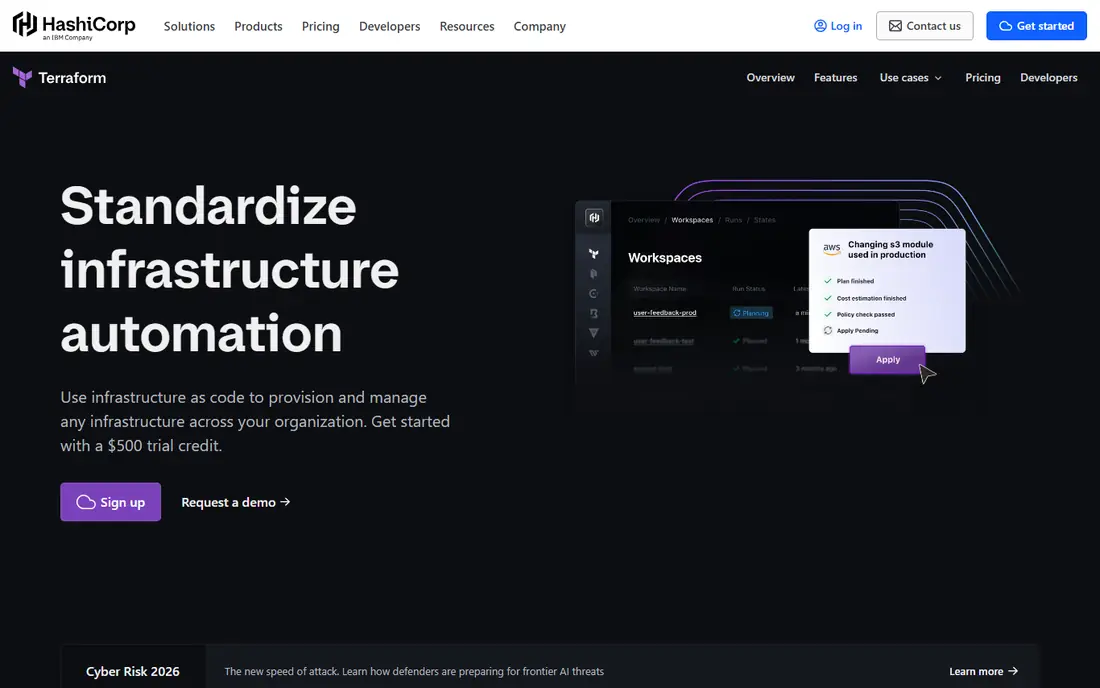
HCP Terraform, from HashiCorp, now part of IBM, is the hosted control plane for the most widely used infrastructure as code workflow. It brings remote state, locking, VCS integration, and a private registry, with the largest provider registry in this list. Policy as code, cost estimation, drift detection, and no-code provisioning arrive on Standard and Premium, so a team can standardise how infrastructure ships across many engineers.
Pricing starts from $0.10 per managed resource per month on Essentials, with Standard from $0.47 and Premium from $0.99. The free tier covers up to 500 managed resources with unlimited users and 1 concurrent remote run. The rates are corroborated by several reads of the vendor pricing page from October to November 2026, and HashiCorp Flex table opened today confirms per-hour billing, but the main pricing page itself was not opened in this run, so re-check it before publishing. Billing is hourly on peak resources, so the bill grows with estate size even when nothing changes.
- Most widely used IaC workflow with the largest provider registry
- Remote state, locking, VCS integration, and private registry in the hosted service
- Billing is hourly on peak managed resources with partial hours rounded up, so cost grows with estate size even with no changes
- Audit logging only on Premium
Pulumi Cloud
Ideal for: Development-led teams who prefer real code over HCL
Pulumi Cloud lets teams define infrastructure in real programming languages, TypeScript, Python, Go, C#, Java, and YAML, with loops, functions, and reusable components, and it can consume Terraform providers. The free edition covers 1 user with state management, Pulumi Deployments, basic Pulumi ESC, unlimited projects, stacks, and environments, unlimited updates and history, and up to 500 workflow minutes, with no credit card required. Essentials adds unlimited users, OIDC, webhooks, and automatic secrets rotation.
Pricing was verified directly on the vendor pricing page on 13 November 2026. Free is $0, Essentials is $40 per month, Pro is $400 per month, and Enterprise is custom, with a 14-day free trial for the priced editions and no credit card required. The con is billing. One credit costs $1, unused credits expire each month, and the control plane bills every declared resource, including component resources and stacks themselves, billed hourly with partial hours rounded up.
- Define infrastructure in real programming languages such as TypeScript, Python, Go, C#, Java, and YAML
- Free edition has no limit on managed resources
- Credit-metered billing is confusing, with unused credits expiring each month, and the control plane bills every declared resource including components and stacks
HPE Morpheus Enterprise
Ideal for: Enterprises running self-service infrastructure across private and public clouds
HPE Morpheus Enterprise, formerly Morpheus Data and acquired by HPE in 2024, is one control plane for AWS, Azure, Google Cloud, and OCI alongside VMware, Nutanix, OpenStack, and other private clouds. It offers automatic discovery, a self-service catalog, and a full API and CLI. It provisions EKS, AKS, and GKE clusters, syncs public cloud invoices for cost tracking by tenant, group, tag, and cloud, and integrates with ITSM tools such as ServiceNow.
There is no public pricing page and no vendor list price, so the starting price is quote only. A marketplace listing reports $198,500 per year for 1,000 workloads, but that is not a vendor price and should not be treated as one. No free plan was found, and no free trial is confirmed. HPE requires its own installation services for new deployments, so a buyer should budget for services as well as licences. The homepage was not directly opened in this run, so re-check it live before publishing.
- One control plane for AWS, Azure, Google Cloud, and OCI alongside VMware, Nutanix, and OpenStack
- Provisions EKS, AKS, and GKE clusters
- Pricing is gated and grows complex as more cloud environments are added
- HPE requires its own installation services for new deployments
CloudBolt
Ideal for: Enterprises wanting governed self-service provisioning across hybrid cloud
CloudBolt gives enterprises a governed self-service catalog, with blueprints that encode approvals, cost controls, tagging, and security requirements, plus full lifecycle automation. It offers more than 200 pre-built integrations, covering AWS, Azure, GCP, VMware, Nutanix, ServiceNow, Terraform, Ansible, and more, and FinOps cost allocation using the FOCUS billing format. The full platform is demo-gated, with no public pricing page.
The starting price is quote only. Third-party listings report $8,500 per user per year, but that is not a vendor price. A free version for up to 100 managed resources was announced on 31 August 2026, according to a PeerSpot user review, and a free trial is listed, though its length is not stated. Pricing is variable by node count and is viewed as expensive, especially for larger enterprises and smaller IT teams, so get the node count priced in writing.
- Self-service catalog with blueprints that encode approvals, cost controls, tagging, and security
- 200 plus pre-built integrations
- Pricing is variable by node count and is viewed as expensive, especially for larger enterprises and smaller IT teams
Flexera One
Ideal for: Large enterprises managing hybrid IT, licences, and cloud spend in one place
Flexera One is one SaaS suite for IT visibility, IT asset management, SaaS management, and FinOps. Its Technopedia data covers more than 5 million technology products from over 100,000 vendors. Cloud Cost Optimization works across AWS, Azure, Google Cloud, and regional providers, and its ITAM data is IBM-certified and Oracle-verified. It suits a large enterprise that wants hybrid IT, software licences, and cloud spend managed in one place.
Flexera does not publicly share pricing, and there is no public pricing page, so the starting price is quote only. Third-party estimates conflict widely and none is a vendor price. No free plan was found, and the trial picture is unclear, with some sources reporting demos and guided proof-of-concepts for qualified enterprises and another reporting a 30-day trial. Do not plan around a trial length without a live check. Users cite a steep learning curve and time-consuming setup, and some advanced functions cost extra.
- One SaaS suite for IT visibility, IT asset management, SaaS management, and FinOps
- Technopedia data on more than 5 million technology products
- Steep learning curve and time-consuming setup, and some advanced functions require additional cost
Nutanix Cloud Manager
Ideal for: Nutanix and VMware shops wanting private-cloud self-service
Nutanix Cloud Manager, called NCM, brings intelligent operations, self-service, and orchestration, formerly Nutanix Calm, together with cost governance, metering, budgeting, and chargeback, and security compliance, in one console. It manages Nutanix and VMware estates from a single pane, with self-service blueprints across Nutanix, VMware, AWS, Azure, and GCP. Nutanix offers free training and a Test Drive, but no free tier or free trial was confirmed.
Pricing is quote only, on a per-core basis, and licensing must cover the full number of cores for full capacity of the cluster. Term licences run from 6 to 60 months, with 1 to 5 year options. The con is the licensing itself. Nutanix changes its licensing models frequently and it is difficult to work out what is included in which package, and users report pricing is very high nowadays compared with a few years ago. Get the full licence scope in writing before signing.
- Unified Build-Operate-Govern platform with intelligent operations, self-service, and cost governance in one console
- Manages Nutanix and VMware estates from a single pane
- Licensing models change frequently and are hard to work out
- Users report pricing is very high nowadays compared with a few years ago
VMware Aria Automation
Ideal for: VMware-heavy enterprises automating private and hybrid cloud provisioning
VMware Aria Automation, formerly vRealize Automation and now sold as VCF Automation under Broadcom, is the automation layer for VMware-heavy estates. It offers deep, native integration across the VMware stack, with self-service multi-cloud setup for VMware Cloud Foundation. One suite covers provisioning through Assembler, a self-service catalog through Service Broker, workflow orchestration through Orchestrator, plus pipelines and configuration, with governance guardrails.
There is no public pricing page, and the product is sold only as a component of VMware Cloud Foundation through Broadcom or a reseller, so the starting price is quote only. Third-party lists report about $1,850 per OSI per year for Standard, $2,950 for Advanced, and $3,850 for Enterprise, but those are not vendor prices. Broadcom is pushing customers from standalone Aria SKUs into VMware Cloud Foundation subscriptions, and initial Broadcom quotes are often 2 to 4 times the prior VMware spend. No free plan or free trial was found.
- Deep, native integration across the VMware stack with self-service multi-cloud setup
- One suite covering provisioning, catalog, orchestration, pipelines, and configuration
- Broadcom is pushing standalone SKUs into VMware Cloud Foundation bundles, and initial quotes are often 2 to 4 times prior VMware spend
IBM Turbonomic
Ideal for: Enterprises wanting automated rightsizing across hybrid cloud
IBM Turbonomic automates application resource decisions in real time across public cloud, Kubernetes, storage, network, and on-premises data centres, with SLO-driven optimisation. Workload Parking automatically stops and starts idle non-production workloads on schedules and policies to cut compute cost. It is the automation choice for a team that wants performance-safe rightsizing without manual ticket work.
The vendor pricing page, opened and verified on 13 November 2026, lists the Trial, Parking Edition, on-premises, and SaaS editions with no dollar prices, so the starting price is quote only. A 30-day trial needs no credit card and covers unlimited optimisation of application resources and cloud costs for AWS, Azure, and GCP accounts. A third-party figure of $40,000 per year for Essentials is not a vendor price. Licensing is complex and hard to forecast as environments grow, and there is no permanent free plan.
Pick by estate size and team type
| Team and estate | First choice | Cost signal | Why it fits | | Small team, under 500 resources | HCP Terraform Free | $0, up to 500 managed resources | Managed control plane at no cost | | Small team, code-first IaC | Pulumi Cloud Free | $0, 1 user, 500 workflow minutes | No limit on managed resources | | Growing team, Terraform standard | HCP Terraform Essentials | From $0.10 per managed resource per month | Remote state, locking, and VCS integration | | Growing team, code-first IaC | Pulumi Cloud Essentials | $40 per month | Unlimited users, OIDC, and secrets rotation | | Hybrid cloud, governed self-service | CloudBolt | Quote only, free version up to 100 resources | Blueprints with approvals and cost controls | | Hybrid IT and licence management | Flexera One | Quote only | IT visibility, ITAM, SaaS, and FinOps in one suite | | Nutanix or VMware private cloud | Nutanix Cloud Manager | Quote only, per-core term licence | One console for Nutanix and VMware estates | | VMware-heavy enterprise | VMware Aria Automation | Quote only, sold inside VCF | Native VMware integration and automation suite | | Automated rightsizing at scale | IBM Turbonomic | Quote only, 30-day trial | Real-time, SLO-driven optimisation |
- Automates application resource decisions in real time across public cloud, Kubernetes, storage, network, and on-premises data centres
- Workload Parking stops idle non-production workloads on schedule
- Complex licensing that is hard to forecast as environments grow
- No permanent free plan and pricing only through sales or marketplace contracts
How we chose
We compared the vendor homepages, product pages, and pricing pages for each tool on 13 November 2026. We checked whether the vendor publishes a price, whether a free plan or trial exists, how the tool manages infrastructure, and who it is built for. We did not run hands-on tests. Pulumi Cloud and IBM Turbonomic pricing pages were opened and verified directly today. Terraform rates are corroborated by several October to November 2026 reads of the vendor pricing page plus the vendor Flex table opened today, but the main pricing page itself was not opened in this run, so re-check it before publishing. The Morpheus homepage was not directly opened, and the Flexera trial length is conflicting across sources, so both need a live re-check. No third-party estimate is presented as a vendor price.
What to check before you buy
Check the billing unit first, because Terraform bills per managed resource per hour and Pulumi bills per credit, so the same estate can cost very different amounts on the two platforms. Check the free tier limits, since Terraform Free covers 500 resources and Pulumi Free covers 1 user with 500 workflow minutes. Check whether the tool is sold standalone or only inside a bundle, since VMware Aria now ships inside VMware Cloud Foundation. Check the contract and licensing terms, because Nutanix licences must cover full cluster core capacity and Turbonomic licensing is hard to forecast as estates grow. Finally, check the trial, since Turbonomic offers 30 days with no card and Pulumi offers 14 days, while Morpheus, Nutanix, and VMware Aria have no confirmed trial.
Frequently asked questions
What is the best cloud infrastructure management tool for a small team?
Pulumi Cloud is the best pick for a small code-first team, with a free tier and Essentials at $40 per month verified on the vendor pricing page. HCP Terraform is the best pick for a small Terraform team, with a free tier up to 500 managed resources and Essentials from $0.10 per managed resource per month. Both let a small team start at $0 and grow without switching tools.
Is there a free cloud infrastructure management tool?
Yes. HCP Terraform offers a free tier up to 500 managed resources, Pulumi Cloud offers a free tier for 1 user with 500 workflow minutes, and CloudBolt announced a free version for up to 100 managed resources. IBM Turbonomic offers a 30-day trial with no credit card instead of a free plan. The other tools here have no confirmed free plan or trial.
What is the difference between Terraform and Pulumi?
Terraform defines infrastructure in HCL, its own configuration language, and HCP Terraform adds a managed control plane with remote state, locking, and policy as code. Pulumi defines infrastructure in real programming languages such as TypeScript, Python, and Go, with loops and functions. Both manage cloud resources, and Pulumi can consume Terraform providers, so the choice comes down to language preference and billing model.
Why do most cloud infrastructure management tools not publish prices?
Most tools in this list are enterprise platforms sold through a sales conversation, with pricing that depends on estate size, node count, cores, modules, and contract length. Five of the eight tools here publish no price. That is normal for this market, but it means a buyer should ask for the billing unit, the licence scope, and the services cost in writing before signing.
Do I need a separate tool if I already use Terraform?
Not always. HCP Terraform adds remote state, locking, VCS integration, policy as code, and drift detection on top of the open source tool, which matters once a team grows past one engineer. If you already run Terraform well and want self-service provisioning, cost governance, and a catalog, a platform such as Morpheus, CloudBolt, or Nutanix Cloud Manager may fit better than a second IaC tool.
Sources
- https://www.hashicorp.com/pricing
- https://www.pulumi.com/pricing/
- https://www.morpheusdata.com/
- https://www.cloudbolt.io/
- https://www.flexera.com/products/flexera-one
- https://www.nutanix.com/products/cloud-manager
- https://www.vmware.com/products/aria-automation
- https://www.ibm.com/products/turbonomic/pricing