Best Commercial Lending Software in 2026: 7 Tools Compared

- Commercial lending software covers origination, underwriting, documentation, servicing, and portfolio monitoring, often in one platform.
- nCino, Abrigo, and Baker Hill suit US banks and credit unions that want purpose-built commercial and small business lending workflows.
- Finastra, Temenos, and FIS suit larger institutions that need lending plus core banking, payments, and global scale.
- Q2 suits banks that want commercial lending tied closely to digital banking and relationship profitability.
- Our pick for most lenders is a platform that fits current credit policy, integrates with core systems, and keeps audit trails clear.
Quick comparison
| Product | Ideal for | Price from | Free version | |
|---|---|---|---|---|
 nCino | Bank lending platform | See website | No | Visit |
 Finastra | Loan servicing and docs | See website | No | Visit |
 Temenos | Core plus lending | See website | No | Visit |
 Abrigo | US bank lending and risk | See website | No | Visit |
 Q2 | Commercial digital banking | See website | No | Visit |
 Baker Hill | Commercial origination | See website | No | Visit |
 FIS | Large-scale banking tech | See website | No | Visit |
The best commercial lending software
Commercial lending is a long, document-heavy process: applications, financial spreading, credit analysis, approvals, documents, booking, servicing, and ongoing monitoring. Good software keeps that chain in one place, so lenders, analysts, and risk teams see the same file, the same conditions, and the same audit trail. The best platform depends on institution size, loan types, and core banking setup.
We compared official product pages for commercial lending and banking platforms used in the US, looking at origination, underwriting, documentation, servicing, credit monitoring, integrations, and compliance support. The list below covers US-focused lenders and global banking platforms, so banks and credit unions can compare realistic options.
nCino
Ideal for: Bank lending platform
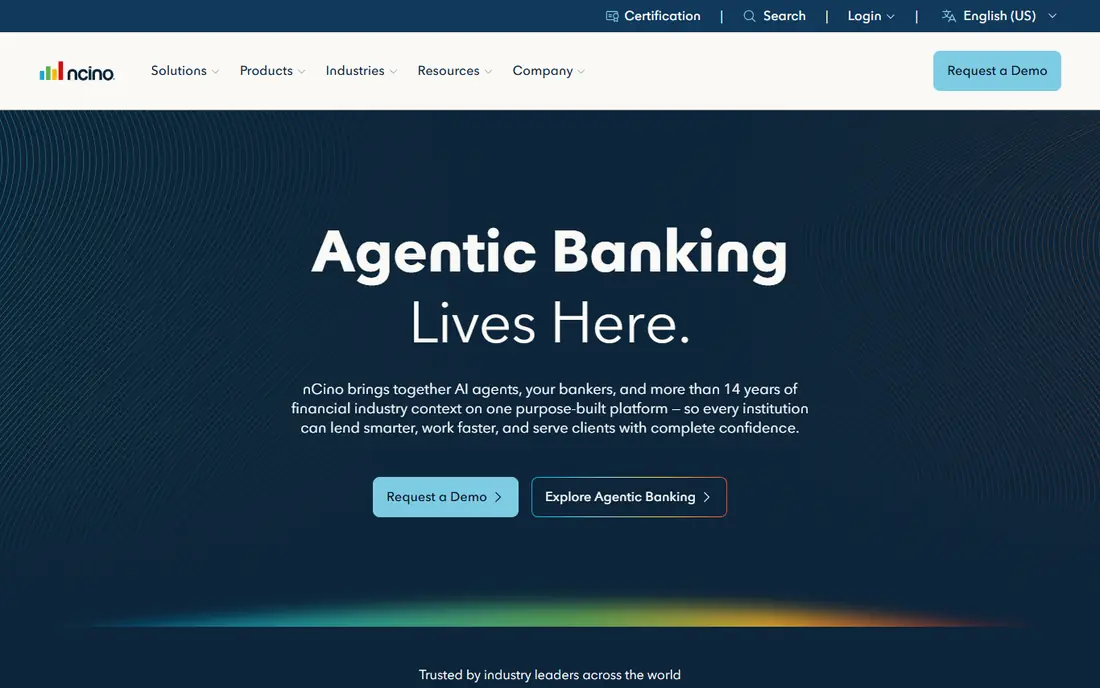
nCino is a bank operating platform that brings AI agents, bankers, and years of financial industry context together, with commercial lending, consumer lending, small business lending, onboarding, mortgage, and portfolio analytics as core solutions. Its homepage highlights role-based AI agents for executives, analysts, service staff, processors, and clients, plus automated spreading that extracts financial data from documents and continuous credit monitoring for at-risk loans. That breadth suits banks that want origination through monitoring in one system.
The trade-off is enterprise scope. nCino pricing is by institution and implementation, and adoption needs credit policy design and training. Smaller lenders should compare Abrigo or Baker Hill first. For banks that want a unified lending platform, nCino is a leading pick.
- Purpose-built bank platform with commercial lending
- AI agents and automated spreading
- Portfolio and credit monitoring
- Enterprise pricing and implementation
- Best fit for banks, not non-bank lenders
- Change management takes planning
Finastra
Ideal for: Loan servicing and docs
Finastra offers financial software for banks, lenders, and credit unions, with Loan IQ as its loan servicing platform for the full spectrum of lending and LaserPro for accurate loan documents with automated checks. Its homepage also lists core banking, payments, trade, and mortgage products, with cloud and on-premises options and compliance tools built in. That suite depth suits institutions that want servicing, documents, and core systems from one vendor family.
The catch is complexity. Finastra's breadth rewards integration planning, and pricing depends on products and scale. Community banks should check which lending modules fit their size. For institutions that need proven loan servicing plus documents at scale, Finastra is a strong choice.
- Loan IQ servicing platform
- LaserPro loan documents
- Broad banking suite with cloud and on-premises options
- Suite breadth needs integration planning
- Pricing by scope
- Smaller banks may find it heavy
Temenos
Ideal for: Core plus lending
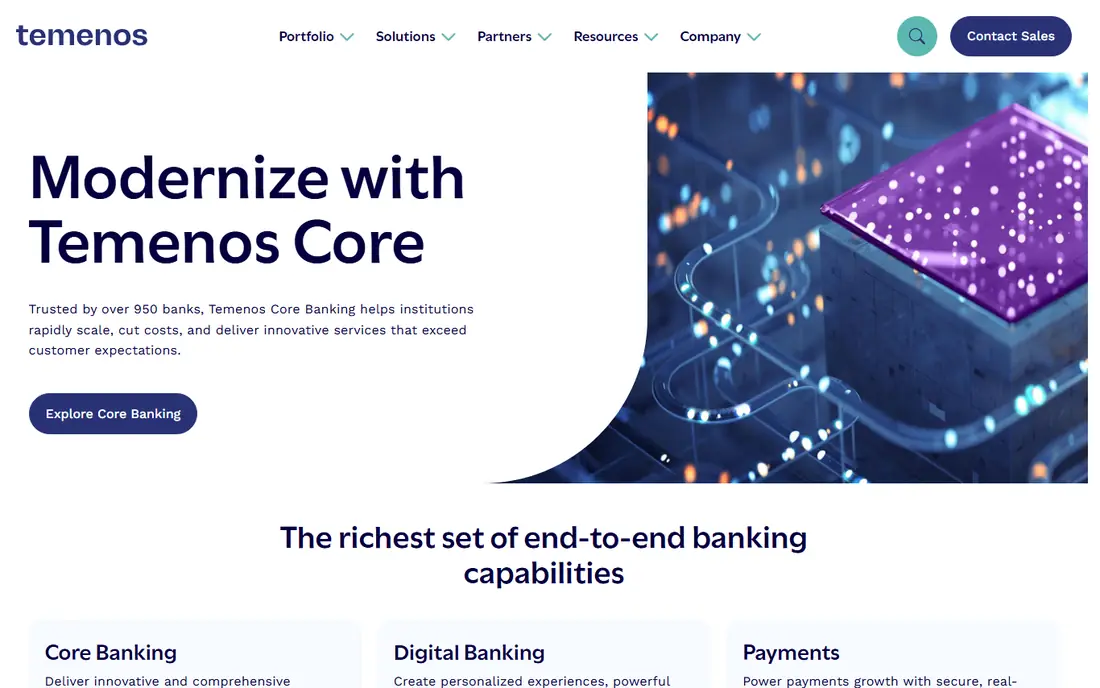
Temenos is a banking technology provider with core banking, digital banking, payments, wealth management, and financial crime mitigation capabilities, offered as SaaS or hosted solutions. Its homepage stresses end-to-end banking capabilities and recent SaaS go-lives for banks and credit unions, including US institutions modernizing core and collections operations. For lenders, Temenos matters most when lending sits inside a broader core and digital modernization, rather than as a standalone origination tool.
The trade-off is project scale. Core modernization is a major undertaking, and pricing is by scope. Lenders that only need origination should compare nCino, Abrigo, or Baker Hill. For banks modernizing core plus lending together, Temenos is a leading platform.
- End-to-end core, digital, payments, and wealth capabilities
- SaaS modernization path
- Global bank experience
- Enterprise implementation
- Core replacement is a major project
- US community banks should check fit
Abrigo
Ideal for: US bank lending and risk
Abrigo offers software for lending, financial crime, risk, and analytics, built for thousands of US financial institutions, with Abrigo APX adding governed AI agents while keeping teams in control of key decisions. Its homepage stresses risk management, compliance, and lending solutions that help institutions grow while managing risk, with support cited as a key strength by bank and credit union customers. That US-focused profile suits community banks and credit unions that want lending plus risk in one vendor relationship.
The catch is module choice. Abrigo covers several domains, so buyers should map which lending, risk, and analytics modules they need and confirm integration with their core. Pricing is by scope. For US banks and credit unions that want lending plus risk together, Abrigo is a strong pick.
- Lending, financial crime, risk, and analytics for US institutions
- Governed AI agents
- Strong community bank fit
- Pricing by scope
- Suite breadth needs module selection
- Implementation takes planning
Q2
Ideal for: Commercial digital banking
Q2 provides digital banking solutions for banks and credit unions, with commercial banking, small business banking, digital onboarding, risk and fraud management, and relationship pricing and profitability products. Its homepage stresses winning profitable commercial deals, onboarding clients faster, optimizing relationship profitability, and reducing risk, with PrecisionLender as a related pricing and profitability tool. That profile suits banks whose commercial strategy starts with digital experience and relationship value.
The trade-off is lending scope. Q2's strength is digital banking and commercial client experience, while deep origination and servicing may sit in companion systems. Buyers should confirm how Q2 fits with their loan origination and core systems. For banks that want commercial lending tied to digital banking, Q2 is a solid choice.
- Digital banking for commercial clients
- Onboarding and relationship profitability tools
- Fraud and risk features
- Lending depth varies by product
- Core integration matters
- Pricing by institution
Baker Hill
Ideal for: Commercial origination
Baker Hill offers loan origination software purpose-built for commercial and small business lending, with a lending command center, intelligent documents and data extraction, and an AI assistant called BKR for answers, policy checks, and task support. Its homepage stresses speed and clarity for complex commercial lending, plus a relationship-centered digital small business LOS and integrations with credit, document, and data providers. SOC 2 Type II and ISO 27001 certifications support its security case.
The catch is scope and fit. Baker Hill suits US banks and credit unions focused on commercial origination, while global or core-replacement needs point to Finastra, Temenos, or FIS. Pricing is by scope and implementation needs planning. For commercial origination, Baker Hill is a strong pick.
- Purpose-built commercial and small business LOS
- AI documents and data tools
- Long lender track record
- Pricing by scope
- US-focused
- Implementation and integrations need planning
FIS
Ideal for: Large-scale banking tech
FIS is a large fintech provider whose technology covers core banking, digital banking, payments, treasury, and finance automation, with analytics to uncover growth while maintaining security and compliance. Its homepage stresses money at rest, in motion, and at work, with digital banking platforms, managed security and compliance, and finance suites for the office of the CFO. For large lenders, FIS offers scale and breadth across the money lifecycle, not only one lending module.
The trade-off is enterprise weight. FIS suits large institutions with complex needs, while community banks should compare Abrigo, Baker Hill, or nCino for focused lending. Pricing and implementation depend on scope. For large-scale banking technology that includes lending, FIS is a leading vendor.
- Broad core, digital, payments, and lending-related tech
- Global scale and resilience
- Analytics for growth
- Enterprise scale and pricing
- Implementation is a major project
- Smaller institutions may find it heavy
How we picked these
We compared official product pages for commercial lending and banking platforms used in the US, looking at origination, underwriting, documentation, servicing, credit monitoring, integrations, and compliance support. We favored platforms with clear commercial lending solutions over generic loan tools, and we kept a range from US-focused lenders to global banking suites. We also favored vendors with current homepages and active development in 2026.
We did not test these platforms on live loan files, and we did not review private contracts. Pricing, implementation scope, and module availability can change, so check the vendor site and run a pilot on real loan types before committing.
What to check before you choose
Start with your loan types and credit policy. List the commercial products you originate, from lines of credit to term loans and SBA loans, then test whether the platform handles their documents, covenants, and approval paths without heavy customization. A platform built for consumer lending will struggle with complex commercial files.
Next, check core and data integrations. Confirm how the platform connects to your core, document systems, credit bureaus, and accounting tools, and how financial spreading and monitoring data flow back to risk teams. Weak integrations create manual re-entry and audit gaps.
Finally, weigh implementation and change effort. Enterprise platforms need policy design, training, and phased rollout, while focused origination tools may go live faster. Ask for total cost including implementation, integrations, training, and support, and pilot with a small lender group first.
Frequently asked questions
What is commercial lending software?
Commercial lending software manages business loans from application and underwriting through documents, booking, servicing, and monitoring. It helps lenders, analysts, and risk teams work from one file with clear audit trails.
Is commercial lending software different from consumer lending software?
Yes, commercial lending involves larger, more complex loans with financial analysis, covenants, guarantors, and ongoing monitoring, while consumer lending is more standardized and score-driven. Platforms built for commercial work handle those complexities better.
Which commercial lending platform is best for community banks?
nCino, Abrigo, and Baker Hill suit US community banks and credit unions with purpose-built commercial lending workflows. The best choice depends on core system, loan mix, and whether risk and analytics modules are also needed.
How long does implementation take?
Implementation varies from months for focused origination tools to longer for core-linked or enterprise platforms. Timeline depends on loan types, integrations, data migration, and training, so ask vendors for phased plans.
How much does commercial lending software cost?
Pricing is by institution, users, modules, and loan volume, and vendors generally quote after scoping. Ask for totals that include implementation, integrations, training, and ongoing support, not only license fees.