Best Compliance-Focused Productivity Software

- 1
 Microsoft 365 Business PremiumRegulated teams under 300 users that want office apps plus security in one licenceVisit
- 2
 Google Workspace Business StandardGoogle-based teams that need Vault, retention rules and 2 TB of pooled storageVisit
- 3
 Smartsheet BusinessCompliance work run as sheets, forms and approval workflowsVisit
- 4
 Asana StarterAudit-friendly task tracking on a small budgetVisit
- 5
 monday.com StandardVisual boards with timelines, guests and automation limitsVisit
- Microsoft 365 Business Premium is the strongest all-round pick for regulated small teams at $22 per user a month billed annually, with Defender, Intune and Entra ID P1 in one licence.
- Google Workspace Business Standard costs $14 per user a month billed annually and adds 2 TB of pooled storage, Meet recording and Vault-ready admin controls.
- Smartsheet Business at $19 per member a month billed annually suits teams that run compliance work as structured sheets, with audit trails and unlimited automations.
- Box Business at $15 and Egnyte Business at $22 per user a month billed annually are the file-first options, with retention, classification and granular permissions.
- Asana Starter at $10.99 per user a month billed annually is the cheapest audit-friendly task tracking, and Notion Plus at $10 per member a month billed annually suits small policy libraries.
Quick comparison
| Product | Ideal for | Price from | Free version | |
|---|---|---|---|---|
| Microsoft 365 Business Premium | Regulated teams under 300 users that want office apps plus security in one licence | $22 per user/month (billed annually) | Free trial (30 days) | Visit |
| Google Workspace Business Standard | Google-based teams that need Vault, retention rules and 2 TB of pooled storage | $14 per user/month (billed annually) | Free trial (14 days) | Visit |
| Smartsheet Business | Compliance work run as sheets, forms and approval workflows | $19 per member/month (billed annually) | Free trial (30 days) | Visit |
| Asana Starter | Audit-friendly task tracking on a small budget | $10.99 per user/month (billed annually) | Yes | Visit |
| monday.com Standard | Visual boards with timelines, guests and automation limits | $12 per seat/month (billed annually) | Yes | Visit |
 Notion Plus | Small policy libraries and wikis with 30-day page history | $10 per member/month (billed annually) | Yes | Visit |
 Box Business | File storage with unlimited storage, e-signatures and admin controls | $15 per user/month (billed annually) | Free trial (14 days) | Visit |
 Egnyte Business | Governed file sharing with ransomware detection and permissions | $22 per user/month (billed annually) | Free trial (15 days) | Visit |
The best compliance-focused productivity software
These eight tools cover the main ways teams keep everyday work inside compliance rules. Some bundle security with office apps, some add audit trails to project work, and some govern files first. Prices below come from each vendor pricing page, checked 11 November 2026.
Microsoft 365 Business Premium
Ideal for: Regulated teams under 300 users that want office apps plus security in one licence

Microsoft 365 Business Premium is the most complete compliance bundle for a small or mid-size business that already lives in Outlook, Word, Excel and Teams. The $22 per user a month price on annual billing covers desktop and web Office apps plus Defender for Business, Intune, Entra ID Premium P1 with Conditional Access, and Defender for Office 365 Plan 1. Purview labels and data loss prevention mark sensitive documents and stop them leaving the organisation by email or file share, which auditors ask about first.
Business plans stop at 300 users, so a growing firm will need to move to an enterprise plan later. Endpoint data loss prevention, Teams chat data loss prevention, Audit Premium and insider risk management are not in the base licence. Microsoft sells the Purview Suite add-on for Business Premium at $10 per user a month, so buy the add-on only for staff who handle the most sensitive data.
- Defender for Business, Intune and Entra ID P1 included
- Purview labels and DLP for data protection
- Hard cap of 300 users per tenant
- Endpoint DLP and Teams DLP need a $10 per user add-on
Google Workspace Business Standard
Ideal for: Google-based teams that need Vault, retention rules and 2 TB of pooled storage
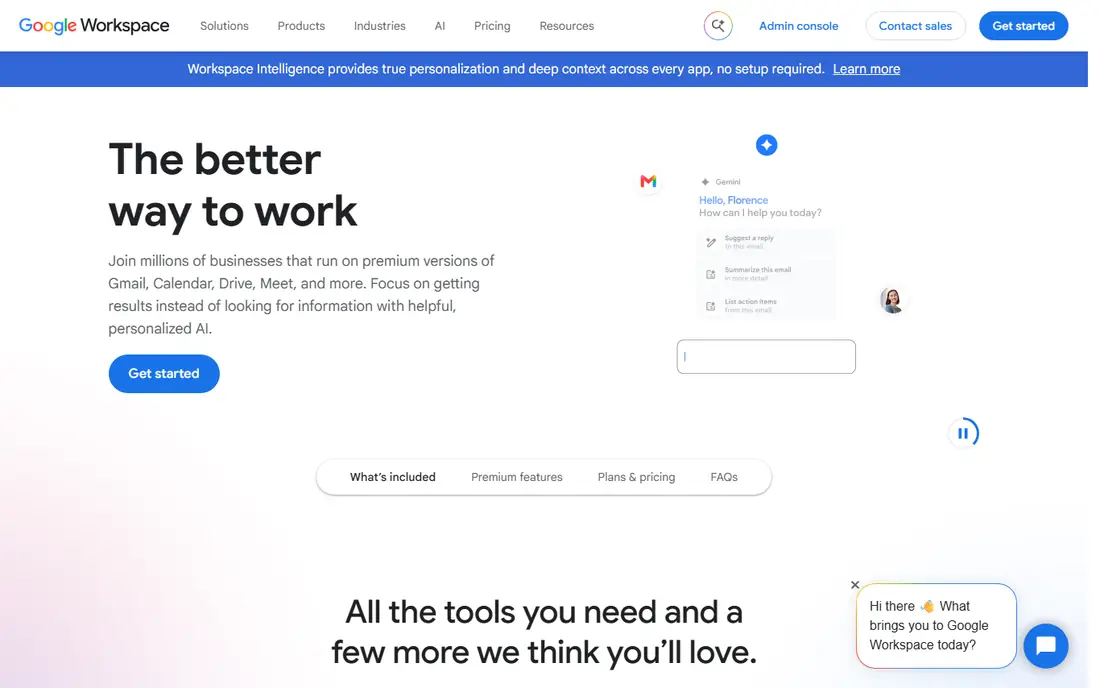
Google Workspace Business Standard costs $14 per user a month on annual billing, or $16.80 on the flexible monthly plan, and it is the tier where Google starts to take compliance seriously. Every user gets 2 TB of pooled storage, Meet calls for up to 150 people with recording, and Gemini inside Gmail, Docs, Sheets, Drive and Meet. Admins get Vault for retention and legal holds, plus sharing, device and two-step verification controls across the domain, all from one console.
The gap to watch is that the deeper compliance controls sit one tier up. Business Plus at $22 per user a month adds eDiscovery, stronger Vault search and enhanced security controls, so a team with formal legal hold or discovery duties should price that tier. The 300-user cap applies here too, and the flexible plan costs about 20 percent more than the annual rate, so take the annual plan when headcount is stable.
- 2 TB pooled storage per user
- Gemini built into Gmail, Docs, Sheets and Meet
- Business plans stop at 300 users
- Advanced Vault eDiscovery and DLP rules need the Plus tier
Smartsheet Business
Ideal for: Compliance work run as sheets, forms and approval workflows
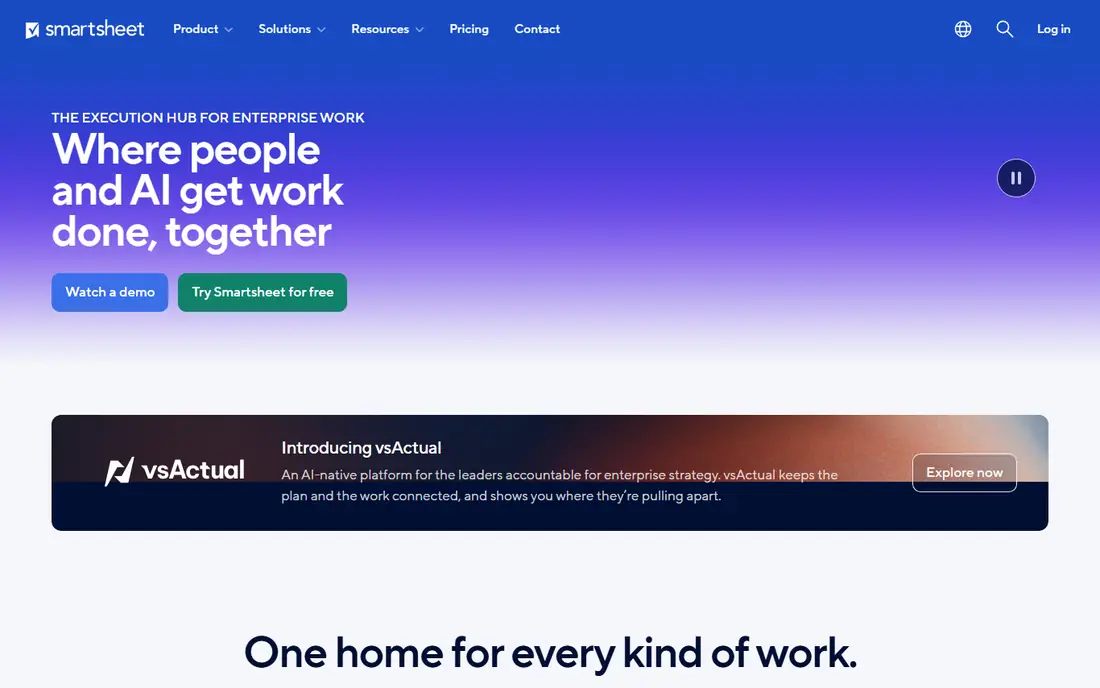
Smartsheet Business costs $19 per member a month billed annually, or $24 billed monthly, with a three-member minimum. It turns compliance work into sheets, forms and automated approval chains, so a team can run vendor reviews, policy attestations, incident logs and audit checklists in one place, with an activity log that records who changed what and when. Unlimited automations run reminders, escalations and status updates without manual chasing, and 1 TB of storage covers the evidence files behind each row.
The plan has clear edges. There is no free plan for new signups, only a 30-day trial, so a team must commit after the trial ends. External guests can edit shared items on Business at no extra cost, which helps auditors and clients get access, but the deeper reporting, resource management and portfolio views need Enterprise, which is quoted. Teams with one or two sheets should start on Pro at $9 per member a month and move up when automation limits bite.
- Unlimited automations and 1 TB storage
- Activity log and admin controls for audit trails
- No free plan for new signups
- Reporting and portfolio features need the Enterprise tier
Asana Starter
Ideal for: Audit-friendly task tracking on a small budget
Asana Starter costs $10.99 per user a month billed annually, or $13.49 billed monthly, and it is the cheapest entry on this list for a team that wants its compliance tasks tracked, assigned and closed with a record. Starter adds Timeline and Gantt views, reporting dashboards, forms, custom fields, custom templates and unlimited automations, plus unlimited free guests for people outside the account. A compliance officer can build a repeatable process for policy reviews, assign each step, and see the full history of every task.
The free Personal plan now covers only one or two people, so a real team will pay for Starter. The bigger jump comes later: portfolios, goals, workload views and native time tracking sit on Advanced at $24.99 per user a month billed annually, more than double the Starter price. Asana sells seats in bands, so check how many seats you must buy, and note the Starter AI limit of five requests per user a month.
- Timeline and Gantt views, dashboards and unlimited automations
- Free Personal plan for up to 2 users
- Portfolios, workload and native time tracking need Advanced at $24.99 per user a month
monday.com Standard
Ideal for: Visual boards with timelines, guests and automation limits
monday.com Standard costs $12 per seat a month billed annually, or $14 billed monthly, with a three-seat minimum. It is the visual option on this list: compliance work becomes colour-coded boards with Timeline and Gantt views, a calendar view, guest access for auditors, and integrations with the tools a team already uses. The free plan covers up to two seats and three boards, enough to test the layout, and templates include ready-made boards for audits, risk registers and policy tracking.
The numbers that matter most are the action limits. Standard allows 250 automation actions and 250 integration actions a month, which a busy compliance team can use up quickly, and the next tier up is Pro at $19 a seat a month. monday.com sells seats in buckets, so a four-person team buys five seats and a six-person team can move into a ten-seat bucket. Count the seats you will be billed for, not the people on your team, before you compare totals.
- Timeline and Gantt views, guest access and calendar view
- Large template library
- Only 250 automation and 250 integration actions a month
- 3-seat minimum with seat buckets
Notion Plus
Ideal for: Small policy libraries and wikis with 30-day page history
Notion Plus costs $10 per member a month billed annually, or $12 billed monthly, and it is the simplest way for a small team to keep policies, procedures and evidence in one searchable wiki. Plus removes the block limit that constrains multi-member teams on the free plan, raises file uploads to 5 GB, extends page history to 30 days, and adds unlimited guests, custom forms and custom database automations. A team can build a policy library with approval dates, owners and review cycles, linked to meeting notes and task databases in the same workspace.
The compliance limits are real. Page history stops at 30 days on Plus, so a team that needs a longer audit trail must move to Business at $20 a member a month. Full Notion AI, including agents and meeting notes, starts on Business, and Plus gets only a trial. Notion bills by member, so everyone with full access takes a seat, and the plan covers the whole workspace.
- Unlimited blocks for teams and 5 GB file uploads
- Custom forms and database automations
- Full Notion AI sits only on Business at $20 a member a month
- No advanced admin controls on Plus
Box Business
Ideal for: File storage with unlimited storage, e-signatures and admin controls
Box Business costs $15 per user a month on annual billing, or $20 billed monthly, with a three-user minimum. It is the file-first pick for a team whose compliance work lives in documents: unlimited storage, a 5 GB per-file upload limit, 50 versions of every file, Box AI for single-file insights, unlimited web e-signatures, and more than 1,500 integrations. Admin controls cover sharing rules, device security and retention, and the audit log records who opened, edited or shared each file.
The catch is external collaboration. On the Business plan, external collaborators are billable accounts, so sharing with clients, auditors or contractors adds seats to the bill. Business Plus at $25 per user a month removes that limit and adds unlimited external collaborators, a 15 GB upload limit and stronger retention controls. A team that shares files outside the organisation weekly should price Business Plus instead, and check the AI unit limits, since Business includes zero AI units beyond single-file features.
- Unlimited storage and 5 GB file uploads
- Box AI and unlimited web e-signatures included
- External collaborators are billable accounts on Business
- 3-user minimum
Egnyte Business
Ideal for: Governed file sharing with ransomware detection and permissions
Egnyte Business costs $22 per user a month billed annually, and it is built for teams that need file governance rather than just storage. The plan includes granular permissions, hybrid storage synchronisation between cloud and local servers, real-time activity monitoring, and ransomware detection with rollback, which lets a team restore files after an attack. Business supports up to 100 power users, covers Google Workspace and Microsoft 365 co-editing, and includes single-document AI search inside files.
The limits are on the compliance side. Business does not include single sign-on, data loss prevention or eDiscovery, so a team with formal discovery or data classification duties needs Enterprise Lite at $39 per user a month or Elite at $48. Every Egnyte plan needs annual prepayment, with no monthly option, and storage beyond the included allocation costs extra. Price the tier that holds the controls your auditor requires, not the one with the lowest headline number.
- Granular permissions and hybrid storage sync
- Ransomware detection and rollback
- No SSO, DLP or eDiscovery on Business
- All plans need annual prepayment
How we chose
We compared vendor pricing pages and plan documentation for each tool on 11 November 2026, and checked the compliance features each plan actually includes rather than the marketing summary. We looked at audit trails, retention and legal hold, data loss prevention, access controls, and the limits that raise the real bill, such as seat minimums, user caps and add-ons. We did not run hands-on tests and we did not count review scores. Prices are US list prices before tax, so check the vendor pricing page on the day you buy.
What to check before you buy
Check seat rules first. Microsoft 365 and Google Workspace stop business plans at 300 users, monday.com sells seats in buckets with a three-seat minimum, and Box and Egnyte carry minimums that set a floor under the monthly bill. Check which compliance controls live on the plan you price: endpoint data loss prevention, eDiscovery and single sign-on often sit one or two tiers above the entry plan, and the add-on can cost as much as the base licence. Check the audit trail too, including how long activity logs and page history are kept, since a 30-day history will not satisfy an auditor who wants a year of records.
| Team size | Tightest budget pick | Balanced pick | Full control pick | | 5 people | Asana Starter, $55 a month | Notion Plus, $50 a month | Microsoft 365 Business Premium, $110 a month | | 10 people | Asana Starter, $110 a month | Smartsheet Business, $190 a month | Microsoft 365 Business Premium, $220 a month | | 25 people | Asana Starter, $275 a month | Google Workspace Business Standard, $350 a month | Microsoft 365 Business Premium, $550 a month | | 100 people | Asana Starter, $1,099 a month | Smartsheet Business, $1,900 a month | Microsoft 365 Business Premium, $2,200 a month |
Monthly totals use annual billing list prices before tax. Asana Starter stays cheapest per seat at every size but has no file governance, so add Box or Egnyte if files are the risk. Microsoft 365 Business Premium costs the most per seat and covers the most ground, so it wins the full control column at every size.
Frequently asked questions
What is compliance-focused productivity software?
Compliance-focused productivity software is everyday work software with built-in controls for audit trails, retention, access management and data loss prevention. It covers office suites, project tools, wikis and file storage that keep records of who did what and when, so a team can show an auditor how work was done. The difference from ordinary productivity software is that the controls are part of the plan, not an add-on.
Which compliance-focused productivity tool is best for a small business?
Microsoft 365 Business Premium is the best pick for most regulated small businesses, because one $22 per user a month licence covers office apps, endpoint protection, device management and identity controls. A team that already uses Google apps should take Google Workspace Business Standard at $14 per user a month instead, and a team that only needs task tracking can start with Asana Starter at $10.99 per user a month.
Do these tools include data loss prevention?
Some do and some do not, and the answer depends on the plan. Microsoft 365 Business Premium includes Purview labels and data loss prevention for email and files, while endpoint and Teams data loss prevention need a $10 per user a month add-on. Google Workspace needs Business Plus for its stronger controls, and Egnyte needs Enterprise Lite or above. Always check the plan comparison page for the exact feature before you buy.
What is the cheapest compliant option for a team of 10?
Asana Starter is the cheapest per seat at $10.99 per user a month billed annually, which is about $110 a month for 10 people before tax. Notion Plus is close at $10 a member a month, or $100 a month for 10 people. Neither covers file governance alone, so a team with sensitive files should add Box Business at $15 per user a month and price the pair together.
How long should audit logs and page history be kept?
There is no single rule, because retention depends on the regulation and the contract. Notion Plus keeps page history for 30 days, which suits internal reviews but not formal audits. Microsoft 365 and Google Workspace offer longer retention through Vault and Purview, and Box keeps 50 versions of every file on Business. Ask your auditor or counsel what retention period applies, then pick a plan that keeps records at least that long.
Sources
- https://www.microsoft.com/en-us/microsoft-365/business/compare-all-microsoft-365-business-products
- https://workspace.google.com/pricing/
- https://www.smartsheet.com/pricing
- https://asana.com/pricing
- https://www.monday.com/pricing
- https://www.notion.com/pricing
- https://www.box.com/pricing
- https://www.egnyte.com/pricing