The 8 Best Consent Management Platforms to Shortlist in 2026

- 1
 DidomiMidmarket and enterprise firms treating consent as UX and complianceVisit
- 2
 Usercentrics CookiebotSMB websites needing solid GDPR and cookie-law complianceVisit
- 3
 CookieYesSmall companies, bloggers and single-site ownersVisit
- 4
 Secure PrivacySMBs and agencies wanting transparent per-domain CMP pricingVisit
- 5
 iubendaSmall to midsize sites needing consent plus legal documentsVisit
- Didomi takes the first slot, best suited to midmarket and enterprise businesses treating consent as UX and compliance.
- Osano fits US-focused SMBs and midmarket businesses wanting a privacy suite.
- Check the limits for Secure Privacy before you commit: smaller vendor with less brand recognition than OneTrust or Usercentrics.
- For the cheapest start, look at Secure Privacy: $15/month/domain.
Direct answer
Didomi leads the list, best for midmarket and enterprise businesses treating consent as UX and compliance. Usercentrics Cookiebot is the stronger choice for SMB websites needing solid GDPR and cookie-law compliance, while CookieYes suits small firms, bloggers and single-site owners. All 8 tools are compared below on price, free plan and limits.
Quick comparison
| Product | Ideal for | Price from | Free version | |
|---|---|---|---|---|
| Didomi | Midmarket and enterprise firms treating consent as UX and compliance | See website (quote-based; reportedly priced on per month unique visitors) | No | Visit |
| Usercentrics Cookiebot | SMB websites needing solid GDPR and cookie-law compliance | €15/month/domain (Premium, 4+ domains); €30/month/domain (1-3 domains) | Yes | Visit |
| CookieYes | Small companies, bloggers and single-site owners | $100/year/domain (Basic); Pro $250; Ultimate $550 (annual, 2 months free) | Yes | Visit |
| Secure Privacy | SMBs and agencies wanting transparent per-domain CMP pricing | $15/month/domain (Small); Business $59; Advanced $249 (per domain/month) | Yes | Visit |
| iubenda | Small to midsize sites needing consent plus legal documents | See website (per-site pricing; third-party figures unverified on vendor page) | Limited (third parties report a free plan; unverified on vendor page) | Visit |
 Termly | Small companies needing a cookie banner plus legal policies | See website (per-website pricing; third-party figures unverified on vendor page) | Limited (third parties report a free plan; unverified on vendor page) | Visit |
 OneTrust | Enterprises and regulated midmarket firms needing full privacy management | See website (quote-based; third-party estimates unverified) | No | Visit |
 Osano | US-focused SMBs and midmarket businesses wanting a privacy suite | See website (no public pricing confirmed on vendor page) | Limited (third parties report a free tier; unverified on vendor page) | Visit |
8 consent management platforms in detail
Ainotely compared 8 consent management platforms. The goal is a practical shortlist: published prices, free plan facts, best-fit use cases and honest limits for every entry.
Didomi
Ideal for: Midmarket and enterprise firms treating consent as UX and compliance
Didomi was built for midmarket and enterprise businesses treating consent as UX and compliance. Didomi treats the consent banner as a conversion surface, not just a legal checkbox. The banner builder and preference center are refined, multi-regulation coverage spans GDPR through CCPA/CPRA.
The analytics present consent rates so teams can optimize banner performance like any other funnel. In practice, if it is a managed, optimized, multi-regulation program, Didomi is designed for that job. In daily use, there is no self-serve path. For everyday use, if consent is a compliance checkbox, the small-business tools above do it for a tenth of the cost. Worth adding: the model is sales-led with no public pricing, reportedly scaled on monthly unique visitors, and positioned above straightforward banner tools. Pricing for Didomi is not stated here, so ask the vendor for current figures. Didomi does not include a free plan.
Downsides: Everything runs through sales.
- Solid consent-rate analytics for optimizing banner performance
- Decent multi-regulation coverage (GDPR, CCPA/CPRA and others)
- No public pricing
Usercentrics Cookiebot
Ideal for: SMB websites needing solid GDPR and cookie-law compliance
Choose Usercentrics Cookiebot for SMB websites needing solid GDPR and cookie-law compliance. Cookiebot's core strength is the scanner. It automatically finds and categorizes your trackers every month.
Watch-outs: Pricing by domain and subpage count gets costly for multi-site or content-heavy firms.
So the consent banner reflects what your site actually loads rather than what it loaded when someone last audited it. Also, for a straightforward business site that wants the banner to stay accurate without babysitting, it is the most diligent choice at the price. Beyond that, watch the counting. Subdomains count as separate domains, subpage thresholds push you between levels, and auto-tier upgrades apply when scans detect growth. In daily use, a content-heavy site with many subdomains can land on a larger bill than expected. What you pay to start with Usercentrics Cookiebot: €15/month/domain. Usercentrics Cookiebot includes a free tier.
- Automatic monthly cookie scanning with categorization keeps the banner accurate
- Free plan and trial make evaluation simple
- Subdomains count as separate domains
CookieYes
Ideal for: Small companies, bloggers and single-site owners
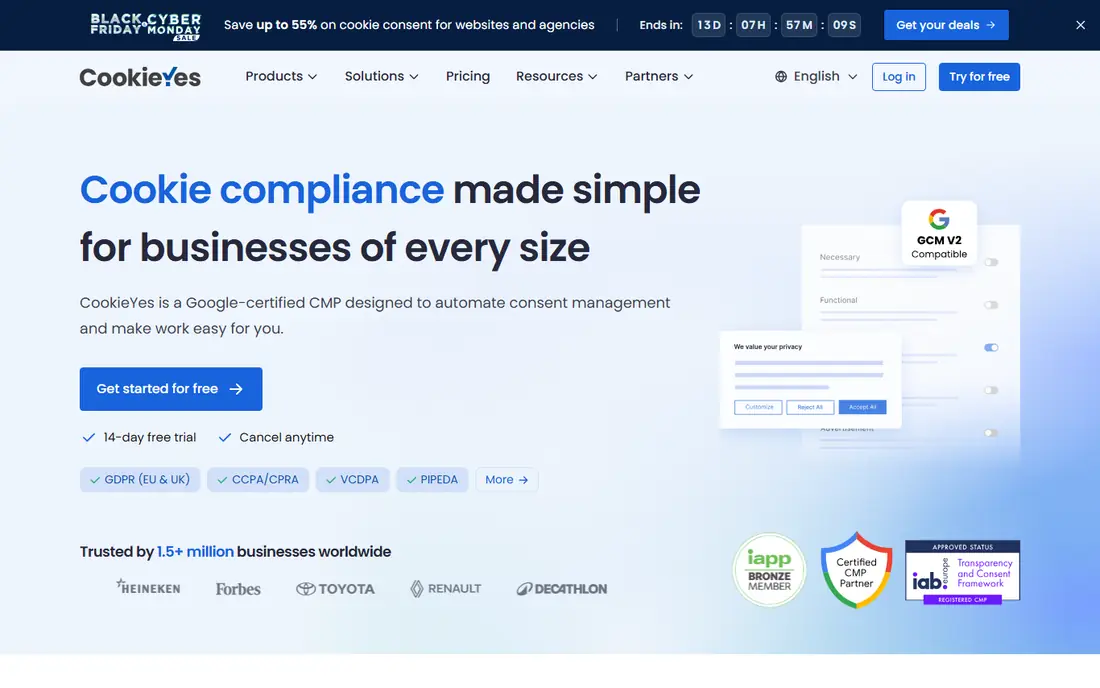
CookieYes makes the most sense for small firms, bloggers and single-site owners. The free level spans 5,000 pageviews per month, and premium plans start at $100 per year per domain with two months free on annual billing. It is a Gold-tier Google CMP Partner with Consent Mode v2 and IAB TCF v2.3 support.
Where it is weaker: No API on lower levels.
So the compliance substance is real, not a decorative banner. Also, every domain needs its own subscription, with pageview overage charges ($0.30 per 1,000 additional pageviews reported). So an agency managing 20 client sites pays 20 subscriptions. CookieYes pricing: $100/year/domain. Free access exists with CookieYes.
- Quick setup with WordPress
- Very low entry price with a genuinely usable free level
- Per-domain
Secure Privacy
Ideal for: SMBs and agencies wanting transparent per-domain CMP pricing
For SMBs and agencies wanting transparent per-domain CMP pricing, Secure Privacy is a natural candidate. Four published levels (Free, Small $15, Business $59, Advanced $249 per domain a month, verified on its own pricing page), each with defined consent volumes and features, no sales call required. The free level spans up to 10 domains with 500 consents per month, which fits small portfolios.
Downsides: Smaller vendor with less brand recognition than OneTrust or Usercentrics.
IAB TCF 2.3 support starts on Small; DSAR handling and cross-domain consent arrive on Business. Consent volumes per level mean a high-traffic site lands on Business or Advanced rapidly, so model your monthly consents before choosing. What you pay to start with Secure Privacy: $15/month/domain. Secure Privacy has a free plan.
- Clear per-domain pricing with a usable free level
- IAB TCF 2.3 support from the Small plan up
- Consent-volume caps mean high-traffic sites must size plans carefully
iubenda
Ideal for: Small to midsize sites needing consent plus legal documents
Where iubenda fits: small to midsize sites needing consent plus legal documents. The pageview-based levels scale from small sites to large publishers, which fits growing content firms better than flat per-site pricing.
iubenda does not show a starting price in this comparison, so check the vendor site for current pricing. Free options: Limited (third parties report a free plan.
Best features of iubenda: Multi-language support for international sites.
- Pageview-based levels scaling from small sites to publishers
- Privacy policies and terms generators
- Pageview caps mean traffic growth forces upgrades
Termly
Ideal for: Small companies needing a cookie banner plus legal policies
Choose Termly for small firms needing a cookie banner plus legal policies. Privacy policy, terms and cookie policy generators with automatic updates for regulatory changes, geared toward non-lawyers who do not want to hire one.
Worth adding: for a small business that needs both, the bundle beats buying a CMP and a policy generator separately. Check the vendor site for Termly pricing; none is listed in this comparison. As for free access: Limited (third parties report a free plan.
- Auto-updated policies track regulatory changes
- Combines consent management with legal policy generators (privacy policy, terms)
- Per-website pricing penalizes businesses with several sites
OneTrust
Ideal for: Enterprises and regulated midmarket firms needing full privacy management
For enterprises and regulated midmarket firms needing full privacy management, OneTrust is a natural candidate. For a company running a full privacy program, the connected system is the argument.
What users get: assessments and governance in one suite.
Pricing for OneTrust is not stated here, so ask the vendor for current figures. OneTrust does not include a free plan. Downsides: Product breadth means longer implementation and heavier administration.
- Enterprise-grade compliance across global regulations
- Deep marketing and data stack integrations
- Enterprise pricing puts it out of reach for small sites
Osano
Ideal for: US-focused SMBs and midmarket businesses wanting a privacy suite
Where Osano fits: US-focused SMBs and midmarket businesses wanting a privacy suite. The pricing transparency went missing: the vendor page did not present public pricing at last check, so buyers need a sales conversation and this article lists "See website." The breadth is also a fit question: if you need a cookie banner, the suite is overkill. More specifically, consent management links to data mapping, subject rights requests and vendor risk management, with solid positioning for US state privacy laws alongside GDPR.
Osano is the suite for businesses whose privacy needs outgrew a banner. For everyday use, buy Osano for the program, not the banner. More specifically, for an US-focused SMB or midmarket company building a real privacy program, the connected suite beats stitching point tools. Check the vendor site for Osano pricing; none is listed in this comparison. As for free access: Limited (third parties report a free tier.
Main advantages: Solid positioning for US state privacy laws alongside GDPR.
- Privacy platform beyond consent: data mapping
- DSARs and vendor risk in one suite
- Product breadth may exceed what a straightforward banner buyer needs
How these tools were picked
The comparison looks at four things: starting price, free access, how well the feature set matches consent management platforms, and the main limit of each tool. Prices and plan limits come from vendor pages and can change, so confirm them on the vendor site before you buy. The order reflects how well each tool fits the most common buying scenario for consent management platforms, then price clarity, then free plan access. It is a starting point, not a verdict.
Before you commit
- Get a written quote from Didomi, iubenda, Termly and others; the list shows no starting price for them.
- Look at free plan limits closely: Usercentrics Cookiebot, CookieYes and Secure Privacy have one, and the caps decide whether it is usable for real work.
- Read the limits listed for Didomi first: no public pricing.
- Ask Didomi whether prices are locked for the first term and what happens at renewal.
- Map your must-have features to a specific CookieYes plan before you compare prices.
Frequently asked questions
Do these tools publish their prices?
Not all of them. Didomi, iubenda, Termly and others publish no starting price, so expect a quote request for those. The rest, Usercentrics Cookiebot included, show a starting price, though seats and billing terms still change the final cost.
Can a CMP manage US state privacy laws too, or just GDPR?
Most modern CMPs handle both: CookieYes, Cookiebot, Secure Privacy, Osano and Didomi all deal with CCPA/CPRA-style opt-outs alongside GDPR opt-ins. The US model (opt-out of sale/sharing) differs from the EU model (prior opt-in consent), so confirm the system supports both frameworks if you serve both audiences.
Which options for consent management platforms have a free plan?
Usercentrics Cookiebot, CookieYes and Secure Privacy offer a free plan in this list. Free plans usually cap users, projects or features, so check the limits on the vendor page.
What is the cheapest option for consent management platforms in this list?
On published monthly entry prices, Secure Privacy is the lowest here at $15/month/domain. Entry price is only part of the cost, because seats, add-ons and billing terms can change the total.
Is Didomi the right pick for everyone comparing consent management platforms?
No single tool suits every team. Didomi comes first because it fits midmarket and enterprise companies treating consent as UX and compliance, while Usercentrics Cookiebot suits SMB websites needing solid GDPR and cookie-law compliance and CookieYes suits small businesses, bloggers and single-site owners. Match the tool to your own size, budget and workflow before deciding.