Best Contact Center QA Apps for Mobile Integration in 2026: 8 Options Compared

- 1
 EvaluAgentquality scoring for contact centresVisit
- 2
 PlayvoxQA, coaching and workforce managementVisit
- 3
 Scorebuddysimple QA scorecards and reportingVisit
- 4
 MaestroQAQA with AI-assisted gradingVisit
- 5
 Zendesk QAQA inside the Zendesk support suiteVisit
- Our pick for most people is EvaluAgent, because it balances a clear core feature set with a usable free option and wide availability.
- Playvox is the strongest alternative when you want a different balance of features and price, and it is worth comparing side by side with our top pick.
- Free plans on this list vary a lot, so check what is actually included before you sign up, especially limits on features, storage and usage.
- Prices and plans change, so confirm the current price on the vendor website before you pay, and favour the annual cost over a monthly headline figure.
- The best choice depends on your core job, not the longest feature list, so test your top two options with a real task for a week.
Quick comparison
| Product | Ideal for | Price from | Free version | |
|---|---|---|---|---|
| EvaluAgent | quality scoring for contact centres | See website | No | Visit |
| Playvox | QA, coaching and workforce management | See website | No | Visit |
| Scorebuddy | simple QA scorecards and reporting | See website | No | Visit |
| MaestroQA | QA with AI-assisted grading | See website | No | Visit |
| Zendesk QA | QA inside the Zendesk support suite | See website | Free trial | Visit |
 Observe.AI | AI conversation intelligence for contact centres | See website | No | Visit |
 Calabrio ONE | workforce and quality suite | See website | No | Visit |
 Verint | enterprise quality and workforce optimisation | See website | No | Visit |
The best contact center QA apps for mobile integration
We compared 8 options for best contact center qa app for mobile integration, looking at official feature pages, pricing, app store listings, privacy policies and public reviews. The list below mixes well-known leaders with strong smaller options, and each write-up notes one honest weakness alongside its strengths. Use the comparison table above to shortlist, then read the full write-ups for the two or three options that fit your core job.
EvaluAgent
Ideal for: quality scoring for contact centres
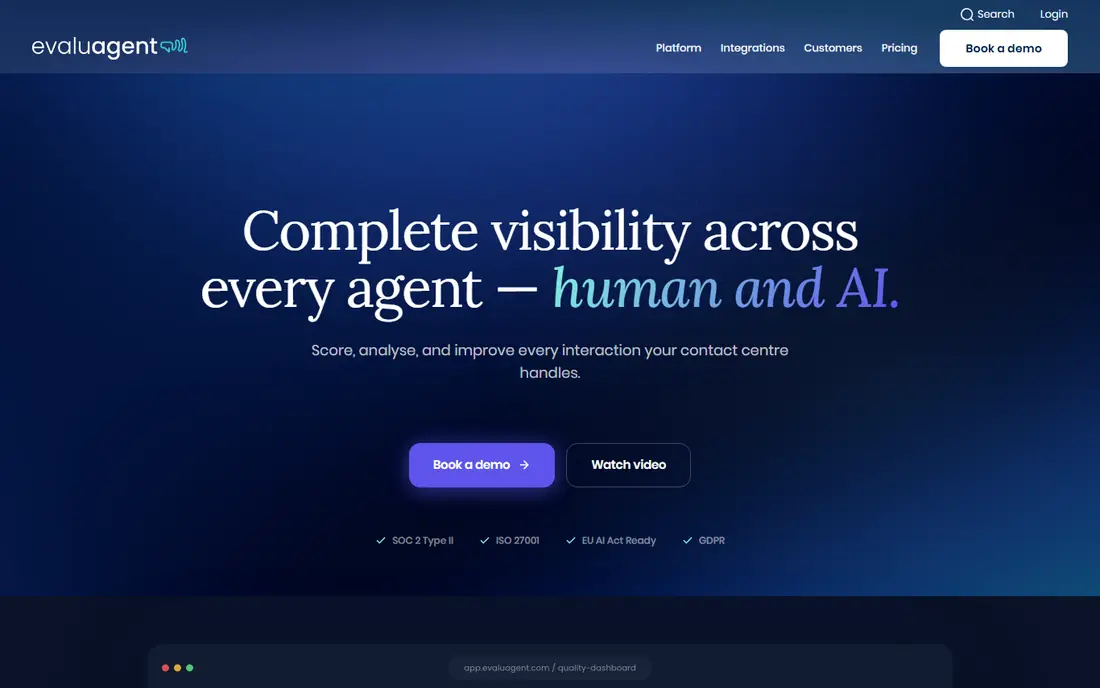
EvaluAgent provides scorecards, evaluations and coaching workflows for contact centre quality teams. We found its strengths, flexible scorecards, stand out when compared with the other options on this list, and it fits quality scoring for contact centres without forcing extra complexity on everyday tasks. For many readers, that combination of focus and simplicity is the main reason to shortlist it. The honest catch is worth weighing before you sign up. Pricing is quoted can matter in daily use, and setup needs planning is a second point to check against your needs. Pricing is listed as see website, and the free plan status is no, so check the vendor pricing page for the current terms. If those limits do not block your core job, EvaluAgent is a sensible choice to test for a week with a real task.
- Flexible scorecards
- Coaching tools
- Reporting
- Pricing is quoted
- Setup needs planning
Playvox
Ideal for: QA, coaching and workforce management
For qa, coaching and workforce management, Playvox is a strong contender. Playvox combines quality management with coaching and workforce management for support teams. Its strengths include QA plus coaching; gamification; workforce tools, which together make it practical for regular use rather than a one-off experiment. We compared its official feature page and pricing with the other options here, and it holds up well on the core job for this topic. No product on this list is perfect, and Playvox is no exception. pricing is quoted; broad feature set takes time to learn are the main drawbacks to weigh, and they matter more for some readers than for others. With a starting price of see website and a free plan status of no, it is worth testing before paying, and checking the vendor site for the latest plan details. Readers who need the features it lacks should look at the next options on this list instead.
- QA plus coaching
- Gamification
- Workforce tools
- Pricing is quoted
- Broad feature set takes time to learn
Scorebuddy
Ideal for: simple QA scorecards and reporting
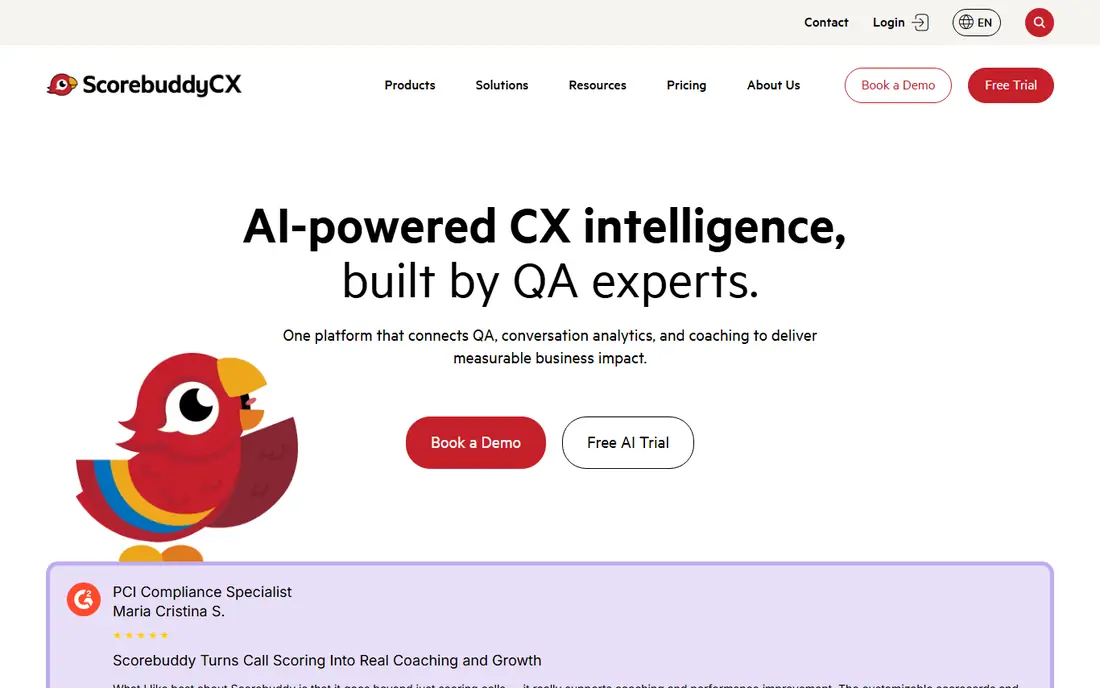
Scorebuddy earns its place here for simple qa scorecards and reporting. Scorebuddy focuses on scorecards, calibration and reporting for quality teams that want a focused tool. When we compared official pages and public reviews, its strengths, easy scorecards; calibration tools; clear reports, came through clearly, and it is a practical option for people who want to get started without a long setup. It is not the flashiest option on the list, but it does its core job well. Before you choose it, weigh the drawbacks honestly: smaller integration range than large suites; pricing is quoted. Those limits may not matter for a casual user, but they can frustrate someone who needs the full feature set every day. Starting price is see website and free plan status is no, so confirm the current terms on the vendor website. If the drawbacks do not affect your core job, Scorebuddy deserves a place on your shortlist.
- Easy scorecards
- Calibration tools
- Clear reports
- Smaller integration range than large suites
- Pricing is quoted
MaestroQA
Ideal for: QA with AI-assisted grading
MaestroQA uses AI assistance to speed up grading and pairs results with coaching workflows for agents. We found its strengths, ai-assisted grading, stand out when compared with the other options on this list, and it fits qa with ai-assisted grading without forcing extra complexity on everyday tasks. For many readers, that combination of focus and simplicity is the main reason to shortlist it. The honest catch is worth weighing before you sign up. Pricing is quoted can matter in daily use, and best inside existing support stacks is a second point to check against your needs. Pricing is listed as see website, and the free plan status is no, so check the vendor pricing page for the current terms. If those limits do not block your core job, MaestroQA is a sensible choice to test for a week with a real task.
- AI-assisted grading
- Coaching
- Analytics
- Pricing is quoted
- Best inside existing support stacks
Zendesk QA
Ideal for: QA inside the Zendesk support suite
For qa inside the zendesk support suite, Zendesk QA is a strong contender. Zendesk QA, formerly Klaus, brings quality scoring and AI auto QA directly into Zendesk support workflows. Its strengths include native Zendesk integration; AI auto QA; coaching, which together make it practical for regular use rather than a one-off experiment. We compared its official feature page and pricing with the other options here, and it holds up well on the core job for this topic. No product on this list is perfect, and Zendesk QA is no exception. needs a Zendesk plan; pricing varies by plan are the main drawbacks to weigh, and they matter more for some readers than for others. With a starting price of see website and a free plan status of free trial, it is worth testing before paying, and checking the vendor site for the latest plan details. Readers who need the features it lacks should look at the next options on this list instead.
- Native Zendesk integration
- AI auto QA
- Coaching
- Needs a Zendesk plan
- Pricing varies by plan
Observe.AI
Ideal for: AI conversation intelligence for contact centres
Observe.AI earns its place here for ai conversation intelligence for contact centres. Observe.AI transcribes and analyses customer conversations, helping QA teams review far more interactions than manual sampling allows. When we compared official pages and public reviews, its strengths, AI transcription and analysis; coaching; QA automation, came through clearly, and it is a practical option for people who want to get started without a long setup. It is not the flashiest option on the list, but it does its core job well. Before you choose it, weigh the drawbacks honestly: enterprise pricing; implementation takes time. Those limits may not matter for a casual user, but they can frustrate someone who needs the full feature set every day. Starting price is see website and free plan status is no, so confirm the current terms on the vendor website. If the drawbacks do not affect your core job, Observe.AI deserves a place on your shortlist.
- AI transcription and analysis
- Coaching
- QA automation
- Enterprise pricing
- Implementation takes time
Calabrio ONE
Ideal for: workforce and quality suite
Calabrio ONE combines quality management with workforce management and analytics for larger contact centres. We found its strengths, quality management, stand out when compared with the other options on this list, and it fits workforce and quality suite without forcing extra complexity on everyday tasks. For many readers, that combination of focus and simplicity is the main reason to shortlist it. The honest catch is worth weighing before you sign up. Enterprise scope can matter in daily use, and pricing is quoted is a second point to check against your needs. Pricing is listed as see website, and the free plan status is no, so check the vendor pricing page for the current terms. If those limits do not block your core job, Calabrio ONE is a sensible choice to test for a week with a real task.
- Quality management
- Workforce management
- Analytics
- Enterprise scope
- Pricing is quoted
Verint
Ideal for: enterprise quality and workforce optimisation
For enterprise quality and workforce optimisation, Verint is a strong contender. Verint offers quality management as part of a large customer engagement suite used by enterprise contact centres. Its strengths include broad enterprise suite; quality tools; analytics, which together make it practical for regular use rather than a one-off experiment. We compared its official feature page and pricing with the other options here, and it holds up well on the core job for this topic. No product on this list is perfect, and Verint is no exception. complex and enterprise priced; long implementation are the main drawbacks to weigh, and they matter more for some readers than for others. With a starting price of see website and a free plan status of no, it is worth testing before paying, and checking the vendor site for the latest plan details. Readers who need the features it lacks should look at the next options on this list instead.
- Broad enterprise suite
- Quality tools
- Analytics
- Complex and enterprise priced
- Long implementation
How we picked these
We started from the topic itself and listed only products that exist and work in October 2026 and truly fit that topic, rather than padding the list with near misses. For each product we checked its official feature page and pricing page, its app store listing where one exists, its privacy policy, and public reviews, and we used See website wherever a price could not be confirmed from the vendor site. We favoured products with clear pricing, honest limits and a usable free or trial option, and we noted known weaknesses rather than hiding them. We write as the Ainotely team, and we did not claim hands-on testing that did not happen. Our comparisons rest on the sources listed at the end of this article, and prices, plans and features can change after publication, so the vendor website remains the final source for current terms. If a product changed its pricing or features after our check, the vendor page will show the newer terms.
Choosing the right option for you
Start with the core job
List the one job you need best contact center qa app for mobile integration to do well, then judge every option on that job first. A long feature list means little if the core job is awkward, slow or hidden behind extra steps. Shortlist two or three options that handle the core job cleanly, and test them with a real task rather than a demo.
Check the price over a year, not a month
Monthly prices can hide annual costs, add-on fees and limits that matter after the first month. Check what the free plan actually includes, what happens when you hit a limit, and what the annual price would be if you stay. If a product says See website for pricing, open the pricing page before you commit, because plans and prices change.
Look at privacy, support and exit options
Read the privacy policy in plain terms: what data is collected, how it is used, and whether you can export or delete it. Check how support works when something breaks, and whether you can leave without losing your work. A product that is easy to leave is often a safer choice than one that locks your data in.
Try before you commit
Use the free plan or trial for a real week of work, not just an afternoon of clicking around. Note where you get stuck, how often you need help, and whether the product fits your daily routine. The best choice is usually the one you still enjoy using after that week, not the one with the longest feature list.
Frequently asked questions
Which option is best for beginners?
Start with a free plan from a well-known option on this list, and use it for a real task before paying. Beginners benefit most from a simple interface and clear help pages, rather than advanced features they may not use in the first month.
Is there a good free option for best contact center qa app for mobile integration?
Yes, several options on this list offer a free plan, though free plans usually limit some features, storage or usage. Check the free plan column in the comparison table, then read the pricing page to see exactly what is included before you sign up.
How much should I expect to pay?
Prices vary widely by product, plan and region, so we list Free or See website where a price could not be confirmed from the vendor site at the time of writing. Paid plans usually add features, higher limits or team tools, so compare the annual cost, not just the monthly figure.
Can I switch later if I pick the wrong one?
In most cases, yes, but switching is easier when you can export your data and cancel without a long contract. Check the export and cancellation terms before you commit, and keep a copy of important work outside the app where possible.
How did we choose these options?
We compared official feature pages, pricing pages, app store listings, privacy policies and public reviews for products that exist and work in October 2026. We favoured products that fit the topic closely, with clear pricing and honest limits, over products with vague claims.