Best Contact Center Software in 2026: 8 Platforms Compared

- 1
 Genesys Cloud CXLarge enterprise CXVisit
- 2
 NiCE CXoneEnterprise AI platformVisit
- 3
 Five9AI contact centerVisit
- 4
 TalkdeskAI automationVisit
- 5
 ZendeskAI-first serviceVisit
- Genesys Cloud CX and NiCE CXone suit large enterprises that need scale, AI and deep integrations.
- Five9 and Talkdesk suit mid-size to large teams that want AI routing, automation and workforce tools.
- Zendesk and Intercom suit teams that want AI-first service across voice and digital channels in one system.
- Freshworks suits agile teams that want customer and employee service on AI-powered workflows.
- RingCentral suits businesses that want contact center tools inside a wider voice and communications platform.
- Most enterprise platforms price by quote, so request a demo and compare total cost including voice minutes, AI usage and add-ons.
Quick comparison
| Product | Ideal for | Price from | Free version | |
|---|---|---|---|---|
| Genesys Cloud CX | Large enterprise CX | See website | No | Visit |
| NiCE CXone | Enterprise AI platform | See website | No | Visit |
| Five9 | AI contact center | See website | No | Visit |
| Talkdesk | AI automation | See website | No | Visit |
| Zendesk | AI-first service | See website | 14-day trial | Visit |
 Intercom | AI and human service | $19/seat/month | 14-day trial | Visit |
 Freshworks | Agile service teams | See website | No | Visit |
 RingCentral Contact Center | Voice-led communications | See website | No | Visit |
The best contact center software
Contact center software now covers voice, chat, email, SMS and social in one queue, with AI agents handling routine work and human agents taking complex cases. The platforms below all offer omnichannel routing, AI assistance and analytics, but they differ in scale, price model and whether they grew from voice, helpdesk or communications roots. We checked each official homepage before listing it.
Genesys Cloud CX
Ideal for: Large enterprise CX
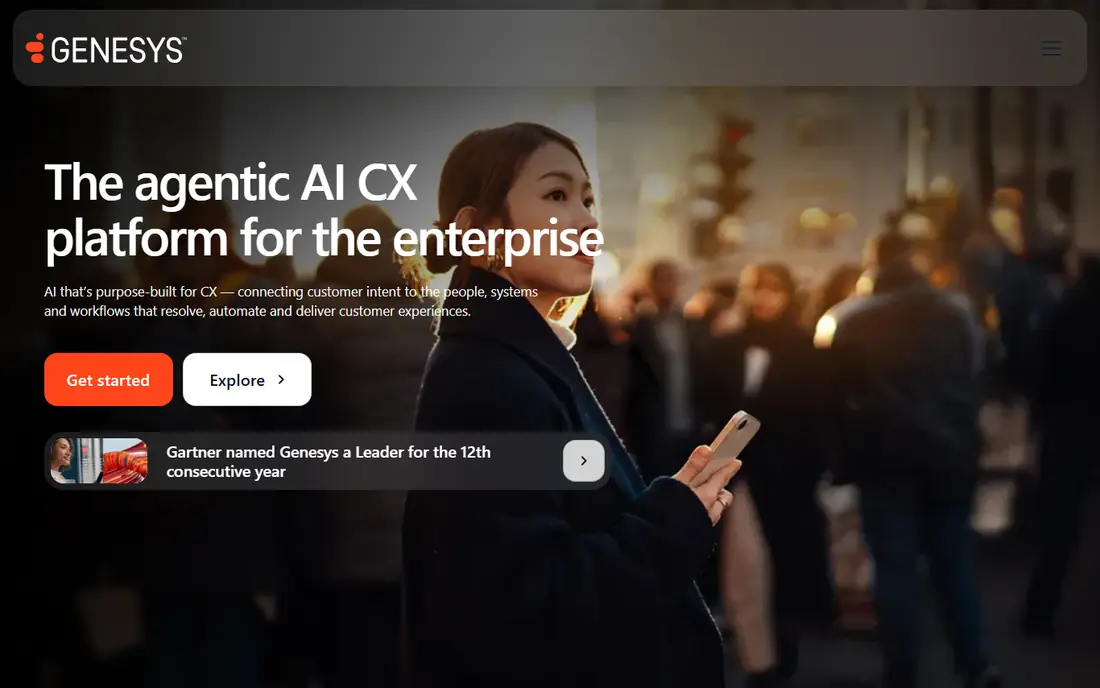
Genesys Cloud CX is an AI-powered customer experience platform that orchestrates human and AI workers around customer needs. Its homepage highlights Genesys Cloud AI, integrations with Salesforce, ServiceNow and a large partner ecosystem, and recognition as a leader by analysts and users, including G2 badges for 2026. Genesys is trusted by large organizations across industries, from utilities to universities.
Genesys suits large contact centers that need scale, reliability and deep integration with CRM and service systems. Its strength is orchestration: routing, AI and workforce tools working as one system rather than separate add-ons. The trade-off is complexity and cost, which suit enterprises better than small teams. For a large center replacing a legacy system, Genesys is a leading choice.
- AI orchestration for human and AI workforce
- Deep partner ecosystem with Salesforce and ServiceNow
- Recognized as a leader by analysts and users
- Enterprise pricing and setup
- Smaller teams may find the platform more than they need
NiCE CXone
Ideal for: Enterprise AI platform
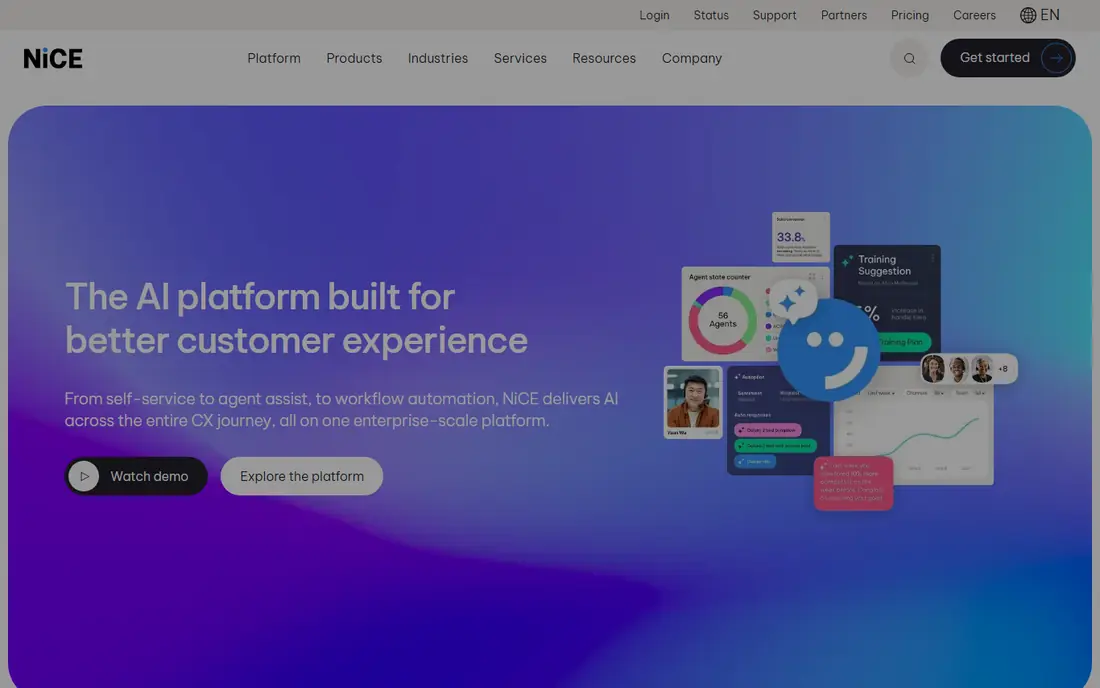
NiCE offers a customer experience AI platform built for transformation at scale, from self-service to agent assist to workflow automation, all on one enterprise platform. Its homepage notes that leading brands trust NiCE to power more than 25 billion interactions a year, and that NiCE CXone delivers AI capabilities across every pillar of customer engagement on a single foundation. It also offers pre-built integrations, open APIs and domain-specific AI.
NiCE suits enterprises that want AI-first service at very large scale, with workforce tools, analytics and automation in one place. Its platform approach avoids stitching together many vendors, which matters when volume and compliance are high. Smaller teams may find NiCE more platform than they need, but for large centers it is a top contender alongside Genesys.
- AI across self-service, agent assist and workflow automation on one platform
- Powers more than 25 billion interactions a year
- CXone unifies AI capabilities
- Enterprise focus and pricing
- Implementation needs planning and resources
Five9
Ideal for: AI contact center
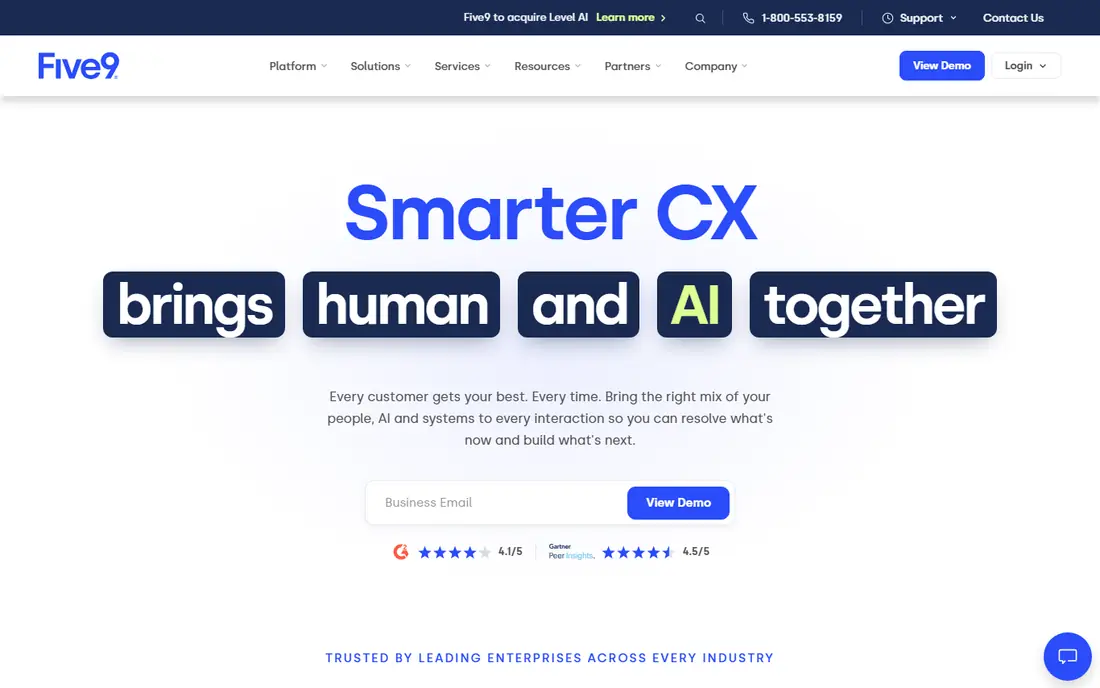
Five9 is an AI contact center platform that brings people, AI and systems to every interaction. Its homepage describes Five9 Engage for inbound and outbound requests across voice, web chat, SMS, email, WhatsApp and video, with AI agents resolving routine work and live agents taking complex cases with context intact. Five9 Orchestrate routes each interaction with AI, while Five9 Optimize scores and coaches on all interactions with forecasting and scheduling. Five9 reports more than 4,000 customers and more than 7 billion interactions handled annually.
Five9 suits mid-size to large teams that want strong AI routing and analytics without building a custom stack. Its case stories, including Wyndham Hotels and Omaha Steaks, show seasonal scaling and automation gains. The trade-off is quote-based pricing, so compare the full cost including voice, AI and workforce modules before deciding.
- Engage, Orchestrate and Optimize tools for routing, AI and analytics
- More than 300 integrations
- Stated 99.999 percent platform uptime SLA
- Pricing by quote
- AI and workforce features add cost on top of base voice
Talkdesk
Ideal for: AI automation
Talkdesk offers AI customer experience automation and contact center software, built around a hybrid workforce where humans handle judgment and empathy while AI agents execute work end to end. Its homepage highlights autonomous agents that can be composed and orchestrated by task, instant scalability without rebuilding workflows, industry-specific agents with domain knowledge, and quality controls that validate behavior and outcomes in real time. Talkdesk reports customer gains such as a 40 percent containment rate in a first week for one credit union member deployment.
Talkdesk suits teams that want to automate real work, not just answer FAQs: appointment updates, order checks and account tasks handled by AI agents. Its compliance badges include ISO, SOC, GDPR, FedRAMP, PCI and HIPAA, which matter for regulated industries. For teams with high volumes of repeatable tasks, Talkdesk's automation focus is a strong fit.
- Hybrid workforce of humans and AI agents
- Industry-specific AI agents with validation
- Named a Leader in the 2026 Gartner Magic Quadrant for CCaaS
- AI automation focus may exceed simple voice needs
- Pricing by quote
Zendesk
Ideal for: AI-first service
Zendesk is an AI-powered customer service platform whose AI agents learn from every resolution, with a stated 4.8 billion resolutions delivered and more than 22,000 service teams using Zendesk AI. Its homepage notes a 14-day free trial with no credit card required, standalone AI agents that work in Zendesk or an existing service platform, and a contact center product that replaces fragmented legacy stacks with a unified system across voice and digital. Zendesk was named a Leader in the 2025 Gartner Magic Quadrant for CRM Customer Engagement Center.
Zendesk suits teams that already use helpdesk software and want to add voice and AI without switching platforms. Its AI-first design means agents and AI share the same system, knowledge and reporting, which keeps handoffs clean. The limit is tiering: the best AI and voice features sit on higher plans, so check the plan that covers your channels before budgeting.
- AI agents that automate up to 80 percent of interactions
- 14-day free trial with no card
- Unified system across voice and digital channels
- Full AI and contact center features need higher tiers
- Pricing scales with agents and AI usage
Intercom
Ideal for: AI and human service
Intercom offers a complete system for AI and human customer service, combining an omnichannel helpdesk with Fin, its AI agent, sharing the same record, knowledge and inbox. Its homepage notes a 14-day free trial with no credit card, more than 30,000 brands using the platform, and Fin resolution rates averaging 76 percent across more than 12,000 customers, with many above 85 percent. Pricing starts at 19 USD per seat per month plus 0.99 USD per Fin resolution, with spending limits you control.
Intercom suits digital-first teams that live in messaging, email and in-app chat, and want AI that improves from every human conversation. Its knowledge hub centralizes content for Fin, human agents and self-serve help, which raises resolution rates over time. For voice-heavy centers, check Intercom's current voice coverage against a voice-led platform such as Five9 or RingCentral before committing.
- Helpdesk with natively integrated Fin AI Agent
- Fin averages 76 percent resolution across more than 12,000 customers
- 14-day free trial with no card
- Voice is newer than its messaging roots
- Outcome-based pricing adds 0.99 USD per resolution on top of seat price
Freshworks
Ideal for: Agile service teams
Freshworks runs employee service and customer support on AI-powered workflows, with AI agents that resolve requests, route issues to the right team and lower cost to serve. Its homepage notes more than 74,000 businesses worldwide, including Databricks, McLaren, New Balance and DHL, plus integrations with Microsoft Teams, Slack, AWS, Azure, Google Cloud, Zoom, Okta and GitHub. Freshworks' Freshdesk product covers customer support, while Freshservice covers employee service, on a shared platform approach.
Freshworks suits agile teams that want one vendor for customer and employee service, with fast setup and a broad integration set. Its workflow approach fits teams that value speed over deep voice customization. For a voice-heavy contact center, compare Freshworks' voice and routing depth against Five9, Genesys or NiCE during a trial, since its roots are in ticketing and service management.
- Customer and employee service on one AI platform
- Trusted by more than 74,000 businesses
- Wide integration marketplace
- Contact center depth varies by product within Freshworks
- Enterprise features need higher tiers
RingCentral Contact Center
Ideal for: Voice-led communications
RingCentral is a voice communications platform used by more than 600,000 businesses, with RingEX for business calls, messages and meetings, RingCX for contact center experiences, and AI agents for reception, representation, assistance and conversation analysis. Its homepage notes 99.999 percent availability, support in more than 100 countries, and more than 500 pre-built integrations or custom APIs. RingCX helps teams manage agents, coach performance and improve satisfaction with every interaction.
RingCentral suits businesses that already use RingCentral for phones and meetings and want to add a contact center without a second vendor. Its voice quality and reliability are proven at scale, and its AI agents handle FAQs, routing and scheduling around the clock. For a standalone, AI-heavy contact center, a dedicated platform such as Genesys or Talkdesk may offer deeper automation, but for voice-led teams RingCentral is a practical choice.
- Voice AI platform used by more than 600,000 businesses
- RingCX for contact center with coaching and satisfaction tools
- More than 500 integrations
- Contact center is one product inside a wider platform
- Advanced AI agents may need AIR products on top
How we picked these
We compared official homepages, channels, AI features and pricing models, favoring platforms that are actively developed, widely used and clear about their strengths. We covered enterprise voice platforms, AI-first helpdesks and communications-led options, because the best contact center software depends on your channels, volume and existing stack. We checked each vendor's own site before listing it, and we note where pricing is by quote so you can budget realistically.
How to choose contact center software
Start with channels and volume. A team that handles mostly phone calls needs strong voice quality, routing and workforce management, while a digital-first team needs messaging, email and AI agents more. Map your current volumes by channel, including peaks, since a platform that handles steady chat may struggle with a seasonal voice surge.
Next, test AI on your real questions. Run a trial with your top 20 contact reasons and measure containment, handoff quality and customer satisfaction, not just demo scores. Check how AI hands off to humans: does context carry over, or does the customer repeat everything? A clean handoff matters more than a high automation claim.
Finally, compare total cost. Seat prices rarely tell the full story: voice minutes, AI resolutions, workforce tools and integrations can add substantially. Intercom's per-resolution pricing is transparent about this, while quote-based platforms need a detailed proposal. Ask for a total cost at your expected volume, including peak months, before signing.
Frequently asked questions
What is the best contact center software for small businesses?
Zendesk and Intercom suit small teams with trials, clear starting prices and fast setup, while RingCentral suits small businesses that already need business phones. Larger platforms such as Genesys and NiCE suit enterprises better, since their pricing and setup reflect large-scale needs.
What is the best contact center software for large enterprises?
Genesys Cloud CX and NiCE CXone lead for large enterprises, with scale, AI, workforce tools and deep CRM integrations. Five9 and Talkdesk are strong alternatives for large teams that want AI routing and automation. Request demos and proof-of-concept trials at your volume before choosing.
How much does contact center software cost?
Prices vary widely: Intercom starts at 19 USD per seat per month plus 0.99 USD per AI resolution, while enterprise platforms such as Genesys, NiCE, Five9 and Talkdesk price by quote. Total cost depends on seats, voice minutes, AI usage and add-ons, so compare quotes at the same volume.
Do I need AI in my contact center?
AI helps most teams with high volumes of repeatable questions, after-hours coverage and agent assistance, but it is not required for every team. Start with AI for FAQs, routing and summaries, measure results, and expand to autonomous agents only where accuracy and customer satisfaction hold up.
What channels should contact center software cover?
At minimum, voice and email, plus the digital channels your customers use: chat, SMS, WhatsApp and social messaging. Omnichannel routing matters because customers switch channels mid-conversation, and a shared queue with full context prevents repeated explanations.
Can contact center software replace a helpdesk?
Some platforms, such as Zendesk and Intercom, combine helpdesk and contact center in one system, while voice-led platforms focus on calls and route tickets to a separate helpdesk. If you need both, prefer a unified system or a platform with a proven two-way integration to your helpdesk.