Best Contractor of Record Software in 2026: 8 Platforms Compared

- 1
 DeelBroad coverage and paymentsVisit
- 2
 RemoteContractors plus employeesVisit
- 3
 OysterDistributed teams and benefitsVisit
- 4
 Papaya GlobalPayroll plus contractor paymentsVisit
- 5
 MultiplierFast multi-country onboardingVisit
- Deel and Remote lead for broad country coverage and contractor payments in one place.
- Oyster and Papaya Global suit companies that also employ staff abroad and want one vendor.
- Multiplier and WorkMotion fit teams that need fast onboarding in many countries.
- Safeguard Global and Atlas serve larger firms with complex compliance needs.
- Confirm who holds the contractor relationship, tax forms, and payment duties in each country.
Quick comparison
| Product | Ideal for | Price from | Free version | |
|---|---|---|---|---|
| Deel | Broad coverage and payments | See website | No | Visit |
| Remote | Contractors plus employees | See website | No | Visit |
| Oyster | Distributed teams and benefits | See website | No | Visit |
| Papaya Global | Payroll plus contractor payments | See website | No | Visit |
| Multiplier | Fast multi-country onboarding | See website | No | Visit |
 WorkMotion | European focus and compliance | See website | No | Visit |
 Safeguard Global | Large firms and complex needs | See website | No | Visit |
 Atlas | Global workforce management | See website | No | Visit |
The best contractor of record software
We compared official feature pages, pricing pages, and public reviews for eight contractor of record platforms. These services engage contractors on your behalf, handle compliant contracts and tax documents, and pay contractors in local currency, which matters when a misclassified worker or a missed form creates legal risk.
Deel
Ideal for: Broad coverage and payments
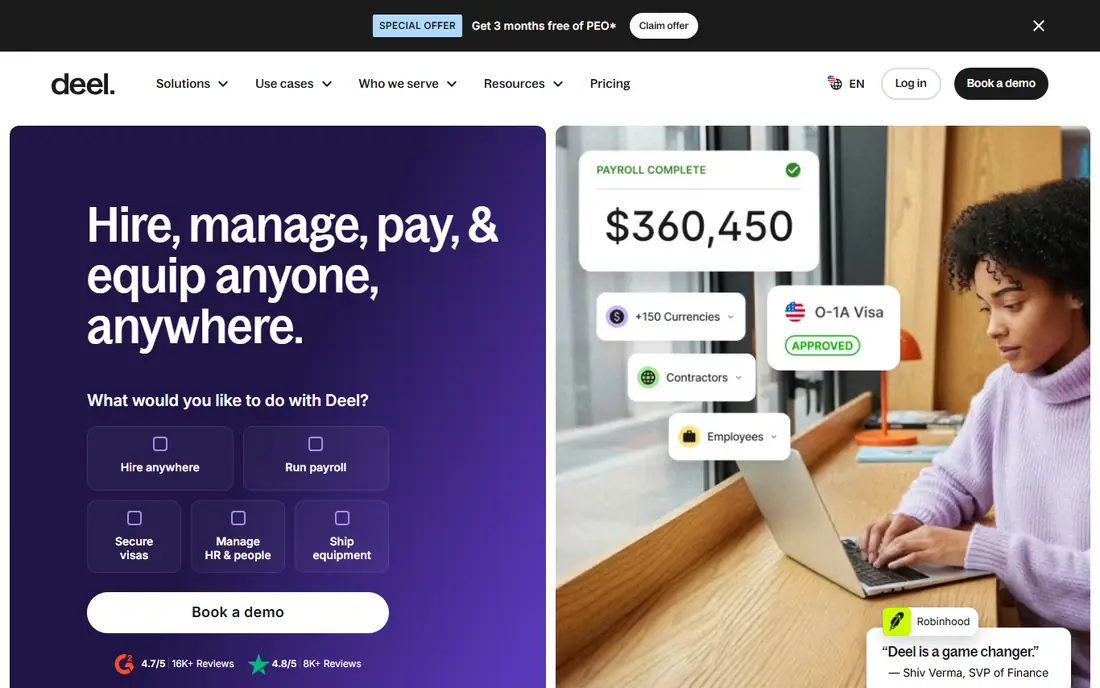
Deel is one of the widest contractor platforms, with onboarding, contracts, and payments for contractors in many countries. Companies can generate locally compliant agreements, collect tax forms, and pay through bank transfer or other methods. Contractors get a dashboard for invoices, payments, and documents, which reduces back-and-forth over email.
The main question is cost at scale, since per-contractor fees add up with a large contractor base. Some users also report uneven support response times across regions. For a company hiring contractors in many countries and wanting one system, Deel is a strong starting point. Confirm coverage and payment methods for each country you plan to hire in.
- Very broad country coverage
- Contractor payments in many currencies
- Compliant contract templates
- Pricing is quoted per contractor
- Support quality can vary by region
Remote
Ideal for: Contractors plus employees
Remote handles both contractors and full employees, which suits companies that start with contractors and later convert some to staff. The company owns many of its local entities rather than relying only on partners, and it publishes country guides that explain local rules. Payments, invoices, and tax documents sit in one dashboard for finance teams.
Onboarding speed varies by country, since local rules and banking differ. Pricing is quoted, so get a written schedule for contractor numbers you expect. For teams that want a single vendor for both worker types, Remote keeps the whole global workforce in one place.
- Contractors and employees in one platform
- Owned local entities
- Clear compliance guidance
- Pricing is quoted
- Some countries have slower onboarding
Oyster
Ideal for: Distributed teams and benefits
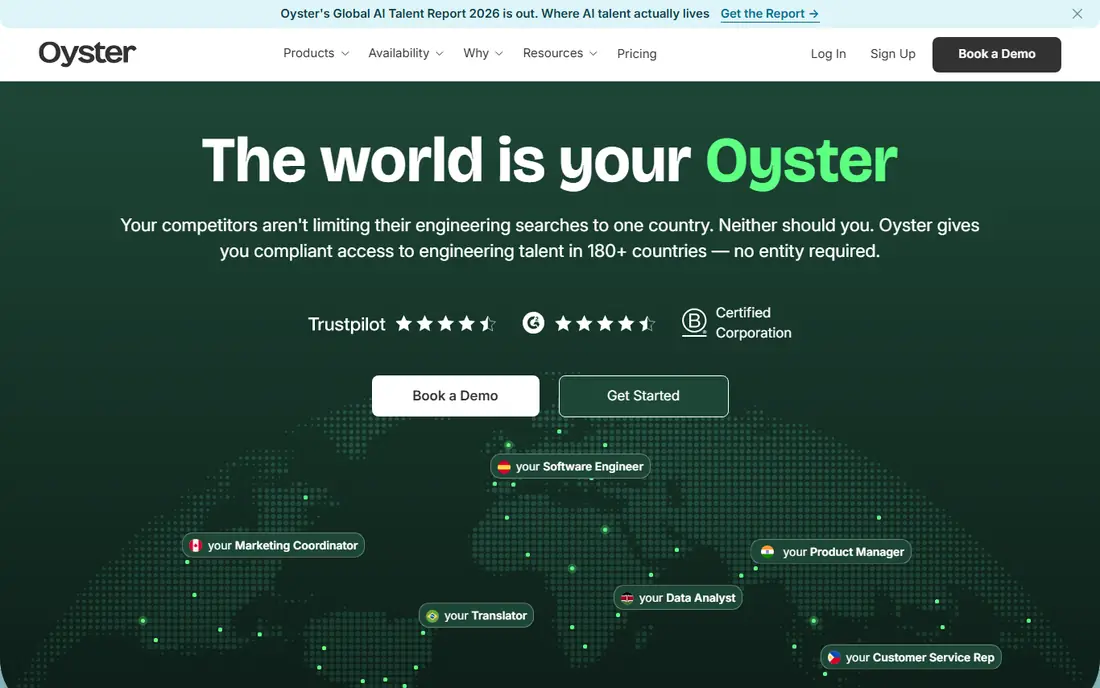
Oyster helps distributed companies hire contractors and employees without setting up local entities. Contractors sign compliant agreements, submit invoices, and get paid through the platform, while employers track status across countries. Benefits guidance and local compliance notes help teams avoid common mistakes in new markets.
Coverage and benefits differ by country, so verify each hiring location before committing. Smaller contractor counts may find per-contractor pricing harder to justify than a simpler payment tool. For remote-first companies that value a clean experience for both sides, Oyster is a solid choice.
- Global hiring in one platform
- Benefits options for contractors where available
- Helpful country guides
- Pricing is quoted
- Coverage varies by country
Papaya Global
Ideal for: Payroll plus contractor payments
Papaya Global combines workforce payroll with contractor payments, which helps finance teams that want one report for all worker costs. The platform tracks contractor onboarding, contracts, invoices, and payments, and it offers compliance checks for worker classification. Reporting gives finance a clear view of spend by country, worker type, and department.
Implementation takes more effort than a lightweight payment tool, since payroll data must be mapped correctly. Smaller teams with only a few contractors may not need this depth. For mid-size and larger firms already running global payroll, adding contractors to Papaya keeps finance work in one system.
- Global payroll and contractor payments together
- Strong finance reporting
- Compliance workflows
- Setup can be involved
- Pricing is quoted
Multiplier
Ideal for: Fast multi-country onboarding
Multiplier focuses on fast, compliant onboarding for contractors and employees across many countries. Employers create contracts, collect documents, and set payment schedules, while contractors manage invoices and payouts. The platform emphasizes local compliance, which matters when hiring in markets with strict labor rules.
Brand recognition is lower than the largest rivals, and some buyers prefer a vendor with longer public history. Check coverage, payment methods, and support hours for your key countries. For teams that need to onboard contractors quickly in several markets, Multiplier offers a practical balance of speed and compliance.
- Quick contractor onboarding
- Multi-currency payments
- Local compliance support
- Smaller brand than Deel or Remote
- Coverage varies by country
WorkMotion
Ideal for: European focus and compliance
WorkMotion, based in Europe, suits companies hiring heavily in European markets. The platform handles contractor agreements, compliance checks, and payments, plus employee hiring where needed. Local knowledge shows in contract details and guidance for European labor rules, which differ sharply by country.
Companies hiring mainly outside Europe may find coverage thinner than with Deel or Remote. Pricing is quoted per worker, so model costs for your expected contractor count. For a European-centered hiring plan, WorkMotion is a focused and capable option.
- Strong European coverage
- Compliant contracts
- Contractor and employee hiring
- Global coverage is narrower than leaders
- Pricing is quoted
Safeguard Global
Ideal for: Large firms and complex needs
Safeguard Global serves larger companies with complex global workforce needs, including contractors, employees, and payroll across many countries. The service model leans on expertise and managed support rather than a purely self-serve product. That suits firms with legal and finance teams that want a partner to review edge cases.
Smaller companies may find the service heavier and costlier than they need. Onboarding and pricing are tailored, so expect a sales process rather than instant signup. For enterprises with strict compliance demands, Safeguard Global brings depth that lighter tools cannot match.
- Enterprise global workforce services
- Compliance expertise
- Payroll integration
- Better suited to larger firms
- Pricing is quoted and higher
Atlas
Ideal for: Global workforce management
Atlas, formerly Elements Global Services, provides global employment and contractor services with compliance workflows for hiring abroad. Employers manage contractors, contracts, and payments in one system, with reporting across countries. The platform suits companies that want a single vendor as they expand into new markets over time.
Depth varies by country, since local partners and rules differ, so verify your priority markets first. Pricing is quoted, and smaller teams should confirm minimums. For companies planning steady international growth, Atlas offers a broad base to build on.
- Global employment and contractor support
- Compliance workflows
- Reporting
- Pricing is quoted
- Platform depth varies by country
How we picked these
We compared official feature pages, pricing pages, country coverage claims, and public reviews for contractor of record platforms in October 2026. We favored platforms with compliant contract templates, tax document handling, multi-currency payments, and clear reporting, and we mixed large global leaders with focused regional options. We did not claim hands-on testing, and we list prices as shown on vendor sites, using See website where pricing is quoted.
What to check before you buy
Start with classification. Confirm how the platform checks whether a worker is truly a contractor or should be an employee in each country, and who bears the risk if a classification is challenged. Then review contracts, tax forms, and data protection duties, and ask for sample agreements for your top countries.
Next, test payments. Check currencies, payout methods, fees, and timing for each contractor location, and confirm how invoices and expenses are handled. Ask about support hours, response times, and what happens when a payment fails. Finally, run a pilot with a small group of contractors, gather feedback from both managers and contractors, and confirm reporting meets finance needs before moving your full contractor base.
A final check before you commit
Trials reveal more than demos when they use real work, so set aside time to run a genuine task through each finalist before deciding. Invite the staff who will use the tool daily, not only the person buying it, and collect notes on speed, clarity, and frustration points. A tool that the daily team resists will sit unused, even if managers like its reports, so adoption signals from a trial carry real weight. Keep the trial short and focused, with two or three tasks that mirror a normal week.
When two tools tie on features, choose the one with clearer reporting and simpler admin, since those qualities compound over time. Managers need reports they can read without help, and admins need permission settings they can adjust without vendor support for every change. A tool that is easy to administer stays correct as staff join and leave, while a tool that needs expert help for routine changes slowly drifts out of date. Simplicity in admin is a feature, not a compromise, and it pays off across the whole life of the system.
Frequently asked questions
What does contractor of record software do?
It engages contractors on your behalf with compliant contracts, collects tax documents, and handles payments. It reduces the legal and admin burden of hiring contractors abroad without setting up local entities.
Is a contractor of record the same as an employer of record?
No. An employer of record employs full staff on your behalf, while a contractor of record engages independent contractors. The distinction matters for taxes, benefits, and labor law, so choose the model that matches the worker relationship.
How are contractors paid?
Most platforms pay by bank transfer in local currency, with some offering other payout methods. Check fees, exchange handling, and payout timing for each country before choosing.
Who handles tax forms for contractors?
The platform usually collects and stores tax documents and issues required forms, but duties vary by country. Confirm exactly which forms the vendor handles and which remain with you or the contractor.
Can I convert a contractor to an employee later?
Many platforms support conversion, including Remote, Oyster, and Papaya Global. Ask about the process, timeline, and costs in the specific country before you need it.