6 Strong Conversational Marketing Software Options in 2026

- 1
 TidioSmall ecommerce keeps that want live chat and an AIVisit
- 2
 CrispSmall teams that want flat per-workspace pricing rather than per-seatVisit
- 3
 HubSpotTeams that want chat, chatbots, and CRM in one placeVisit
- 4
 ManyChatCreators and brands that sell through InstagramVisit
- 5
 IntercomTeams that want an AI agent to resolve chats beforeVisit
- This list starts with Tidio, which is built for small ecommerce keeps that want live chat and an AI agent in one place.
- ManyChat has the lowest monthly starting price in this list: $15 per month.
- LiveChat is the one to check for sales and support teams that want a refined, agent-first live chat tool.
- A free plan is available from 4 of the 6 tools: Tidio, Crisp, HubSpot, ManyChat.
Direct answer
Tidio comes first here, mainly for small ecommerce keeps that want live chat and an AI agent in one. Crisp is better for small teams that want flat per-workspace pricing instead of per-seat billing, and HubSpot is better for teams that want chat, chatbots, and CRM in one place.
Quick comparison
| Product | Ideal for | Price from | Free version | |
|---|---|---|---|---|
| Tidio | Small ecommerce keeps that want live chat and an AI | $24.17 a month (Starter, billed yearly; $29 per month billed monthly) | Yes | Visit |
| Crisp | Small teams that want flat per-workspace pricing rather than per-seat | $45 a month (Mini) | Yes | Visit |
| HubSpot | Teams that want chat, chatbots, and CRM in one place | $20 a month (Marketing Hub Starter, 1,000 marketing contacts) | Yes | Visit |
| ManyChat | Creators and brands that sell through Instagram | $15 per month (Pro, up to 500 contacts) | Yes | Visit |
| Intercom | Teams that want an AI agent to resolve chats before | $29 per seat per month (Essential, annual billing; $19 new-customer price shown 11 Nov 2026) | Free trial (14 days) | Visit |
 LiveChat | Sales and support teams that want a refined | $20 per agent per month (Starter, billed annually) | Free trial (14 days) | Visit |
Tool-by-tool breakdown
Ainotely put together this guide to conversational marketing software for readers who want a clear shortlist without reading every vendor page. It compares 6 tools on starting price, free plans, who each one suits and where each one falls short.
Tidio
Ideal for: Small ecommerce keeps that want live chat and an AI
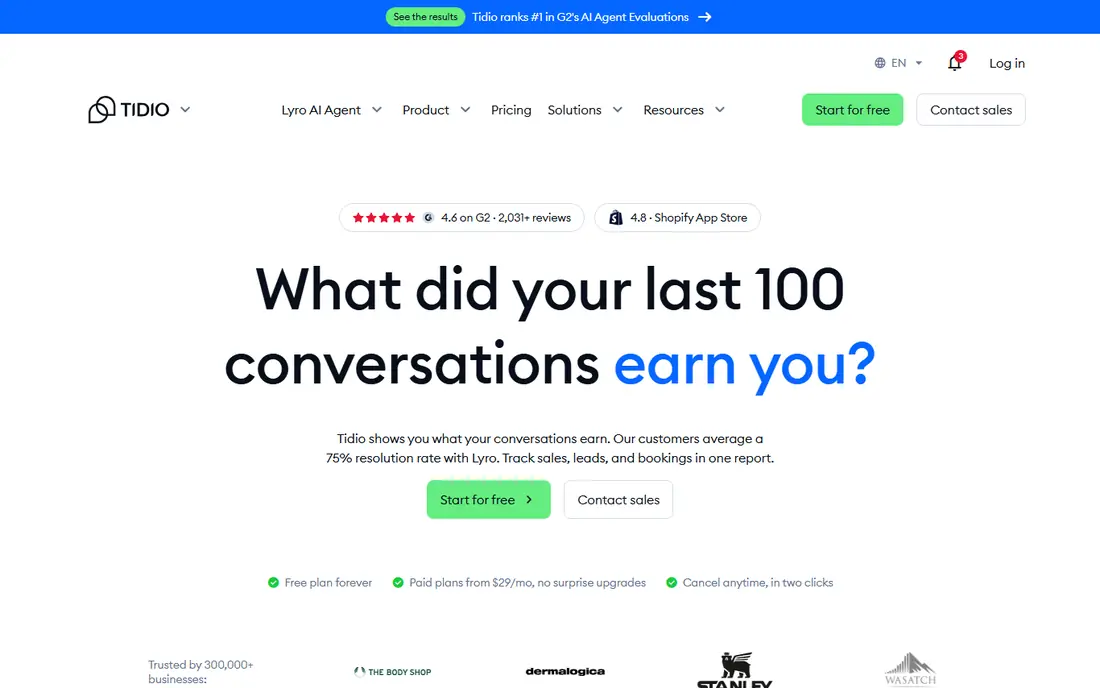
Tidio is a good fit for small ecommerce keeps that want live chat and an AI agent in one place. Starter costs $24.17 a month billed yearly and includes 100 billable conversations per month, with 10 seats included.
Tidio starts at: $24.17 per month. You can start on Tidio without paying.
- Solid Shopify and WooCommerce integrations
- Lyro AI agent answers from your own content
- Lyro AI conversations are metered separately, so heavy AI use pushes you to a higher level or a Lyro package from $39 a month
Crisp
Ideal for: Small teams that want flat per-workspace pricing rather than per-seat
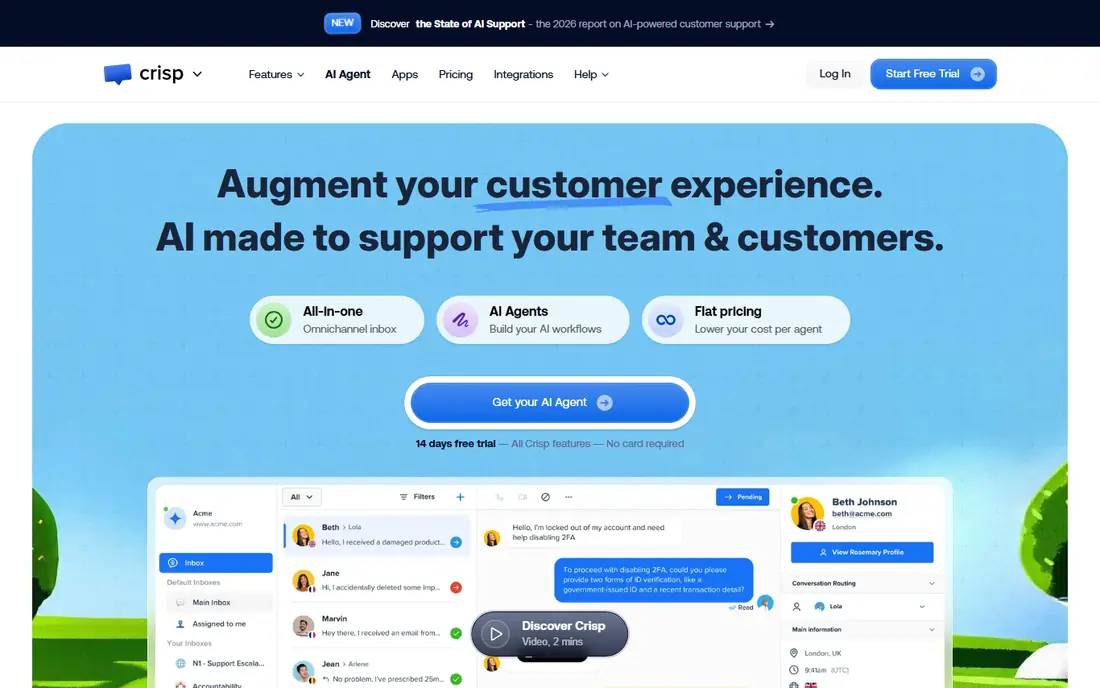
Crisp works best for small teams that want flat per-workspace pricing rather than per-seat billing. The free Basic plan contains 2 seats and unlimited conversations on one website, which is enough for a solo founder or a two-person team to run chat properly.
Honest limits: Crisp restructured pricing in 2026, so the cheapest premium level is now $45 a month.
Price to start with Crisp: $45 per month. Crisp includes a free tier.
- Omnichannel inbox including WhatsApp and Instagram on higher plans
- Flat per-workspace pricing handles the entire team
- The free plan displays Crisp branding
HubSpot
Ideal for: Teams that want chat, chatbots, and CRM in one place
HubSpot serves teams that want chat, chatbots, and CRM in one place. A visitor who chats becomes a contact with a full history that the rep can see.
Honest limits: Professional carries a mandatory $3,000 onboarding fee.
Entry price for HubSpot: $20 per month. You can start on HubSpot without paying.
- Chat and chatbots share one contact record
- Solid email and landing page tools in the same system
- The jump from Starter at $20 a month to Marketing Hub Professional at $890 a month is steep
ManyChat
Ideal for: Creators and brands that sell through Instagram
ManyChat works best for creators and brands that sell through Instagram, Facebook, WhatsApp, and TikTok. ManyChat restructured its pricing on 2 March 2026, and the free plan for new accounts now includes only 25 contacts, so most real companies will pay from day one.
ManyChat starts at: $15 per month. ManyChat has a free plan.
Where it is weaker: AI costs an extra $29 a month.
- Visual flow builder needs no code
- Best-in-class comment and DM automation for Instagram and TikTok
- The March 2026 restructure cut the free plan from 1,000 contacts to 25 for new accounts
Intercom
Ideal for: Teams that want an AI agent to resolve chats before
Choose Intercom for teams that want an AI agent to resolve chats before a human steps in. Intercom rebuilt itself around Fin, its AI agent, and that is now the central reason to buy it. Beyond that, essential starts at $29 per seat a month on annual billing, with a $19 new-customer price shown on 11 November 2026.
Advanced at $85 brings workflow automation, whereas Expert at $132 layers on SSO, HIPAA support, and SLAs. On top of that, Salesforce completed its acquisition of Intercom in September 2026, and pricing has not changed since. Price to start with Intercom: $29 per seat per month. Free options: Free trial (14 days).
- Fin AI agent resolves a large share of chats on its own
- Clean shared inbox
- Fin is billed separately at $0.99 per resolved conversation on top of seats, so a busy month can push the bill well above the seat price
LiveChat
Ideal for: Sales and support teams that want a refined
LiveChat is a good fit for sales and support teams that want a refined, agent-first live chat tool. The primary weakness for conversational marketing buyers is that automation is not bundled: the chatbot lives in a separate product, ChatBot, with its own subscription from about $52 a month.
Limits to weigh: its chatbot is a separate product called ChatBot from about $52 a month.
From a buyer's view, LiveChat does one job and does it well: quick, dependable live chat with an agent desktop that stays fast under heavy volume. LiveChat cost at the entry level: $20 per agent per month. Free plan details: Free trial (14 days).
- Quick and refined agent desktop
- More than 500 integrations
- There is no free plan
Choosing conversational marketing software: what matters
Per-seat pricing punishes an expanding team, so a flat monthly rate like Crisp at $45 a month or Tidio at $24.17 a month billed yearly is simpler to budget than a tool that charges for every agent. Ecommerce keeps should check for a Shopify or WooCommerce integration, since the chatbot is far more handy when it can look up an order, check stock, and recommend products.
Conversational Marketing Software: the basics
Conversational marketing software is the set of tools that lets visitors talk to your business in live, typically through a chat widget on your website, and turns those talks into leads, meetings, and sales. It replaces the static contact form with a live conversation. So a visitor can ask a question and book a meeting in one visit.
What conversational marketing software costs
Conversational marketing software costs anywhere from free to $2,500 a month or more. The pricing model matters as much as the headline number. In practice, small-team tools for example ManyChat, Tidio, and Crisp start at $15 to $45 a month and commonly contain a free plan.
As for the details, mid-market systems like Intercom and LiveChat charge per seat, from $20 to $29 per seat a month on annual billing. In daily use, AI usage is the charge buyers most frequently miss. Intercom bills Fin at $0.99 per resolved conversation, Tidio meters Lyro AI conversations separately, and ManyChat charges an additional $29 a month for its AI add-on.
How these tools were picked
Each tool was reviewed on what its vendor publishes: price, plan limits, core features and stated drawbacks. We did not run hands-on tests. Prices and plan limits come from vendor pages and can change, so confirm them on the vendor site before you buy. Tools are placed by general fit for conversational marketing software, with price clarity and free access as tie-breakers. A different team can reasonably rank them differently.
What to confirm before you sign up
- Confirm the entry price on the vendor page: ManyChat starts at $15 per month, but seat counts and billing terms change the total.
- Look at free plan limits closely: Tidio, Crisp, HubSpot and ManyChat have one, and the caps decide whether it is usable for real work.
- Use real work to test the free trial from Intercom and LiveChat, rather than a demo project.
- Before choosing Tidio, weigh its main limit: Lyro AI conversations are metered separately, so heavy AI use pushes you to a higher level or a Lyro package from $39 a month.
- Ask LiveChat whether prices are locked for the first term and what happens at renewal.
- Find out whether the entry plan of ManyChat covers your must-haves or only a trimmed-down version.
Frequently asked questions
What is the difference between conversational marketing software and live chat software?
Conversational marketing software brings chatbots that qualify visitors, routing rules that send hot results in the right rep, meeting booking, and CRM records that keep the full conversation history. A live chat tool answers questions, whereas a conversational marketing product turns the chat into pipeline.
How much should a small business pay for conversational marketing software?
A small business should expect to pay nothing to about $45 a month to start, and should only pay more once chat is plainly producing leads or orders. Tidio, Crisp, and ManyChat all offer free plans, and their premium plans run from $15 to $45 a month. Costs rise when you add agents on per-seat tools like Intercom or LiveChat, or when AI usage grows on Tidio and Intercom. Start free and upgrade only when the volume justifies it.
Do these tools publish their prices?
Yes. Every tool from Tidio to LiveChat shows a starting price, though seats, add-ons and billing terms still change the final cost.
How are the tools for conversational marketing software ordered?
Tidio sits first and LiveChat last because the order follows typical fit for conversational marketing software, then price clarity and free access. It is a judgement call, so read each profile for fit and limits.
Can I try these options before paying?
Often, yes. Tidio, Crisp, HubSpot and ManyChat have a free plan and Intercom and LiveChat offer a free trial. Use your own data and a real task during the test, and check what the free tier or trial limits before you rely on it.
Is Tidio the right pick for everyone comparing conversational marketing software?
No single tool suits every team. Tidio comes first because it fits small ecommerce stores that want live chat and an AI agent in one place, while Crisp suits small teams that want flat per-workspace pricing instead of per-seat billing and HubSpot suits teams that want chat, chatbots, and CRM in one place. Match the tool to your own size, budget and workflow before deciding.