8 Best Cpq Software for simplifying Quote to Cash Options for 2026

- 1
 TactonManufacturers selling engineer-to-order productsVisit
- 2
 Oracle CPQOracle-heavy enterprises needing global quote-to-cashVisit
- 3
 PandaDocSmall teams needing quotes, proposals and e-signatures quickVisit
- 4
 Salesforce Revenue CloudSalesforce-based teams wanting quoting, contracts and billing togetherVisit
- 5
 PROS Smart CPQEnterprises with complicated pricing and big catalogsVisit
- This list starts with Tacton, which is built for manufacturers selling engineer-to-order products.
- Free plans exist at 2 of 8 tools (PandaDoc, HubSpot CPQ).
- Experlogix suits manufacturers and distributors with complicated configuration.
- The cheapest monthly starting price in the list is $19 per user/month, offered by PandaDoc.
Direct answer
Our first pick is Tacton, best for manufacturers selling engineer-to-order products. Oracle CPQ fits Oracle-heavy enterprises needing global quote-to-cash; PandaDoc fits small teams needing quotes, proposals and e-signatures quick. The other 5 tools in the list cover narrower or pricier cases.
Quick comparison
| Product | Ideal for | Price from | Free version | |
|---|---|---|---|---|
| Tacton | Manufacturers selling engineer-to-order products | See website | No | Visit |
| Oracle CPQ | Oracle-heavy enterprises needing global quote-to-cash | See website | No | Visit |
| PandaDoc | Small teams needing quotes, proposals and e-signatures quick | $19 per user/month | Yes | Visit |
| Salesforce Revenue Cloud | Salesforce-based teams wanting quoting, contracts and billing together | $150 per user/month (billed yearly) | Free trial | Visit |
| PROS Smart CPQ | Enterprises with complicated pricing and big catalogs | $60 per user/month | No | Visit |
 HubSpot CPQ | HubSpot users who want quoting inside their CRM | $90 per seat/month (billed annually) | Yes | Visit |
 DealHub | Mid-market teams wanting CPQ, CLM and billing in one deal | See website | Free trial | Visit |
 Experlogix | Manufacturers and distributors with complicated configuration | See website | Free trial | Visit |
Cpq Software for simplifying Quote to Cash compared in detail
Choosing cpq software for simplifying quote to cash usually comes down to price, fit and limits. This Ainotely guide sets 8 tools side by side on those three points, with the facts kept short and checkable.
Tacton
Ideal for: Manufacturers selling engineer-to-order products
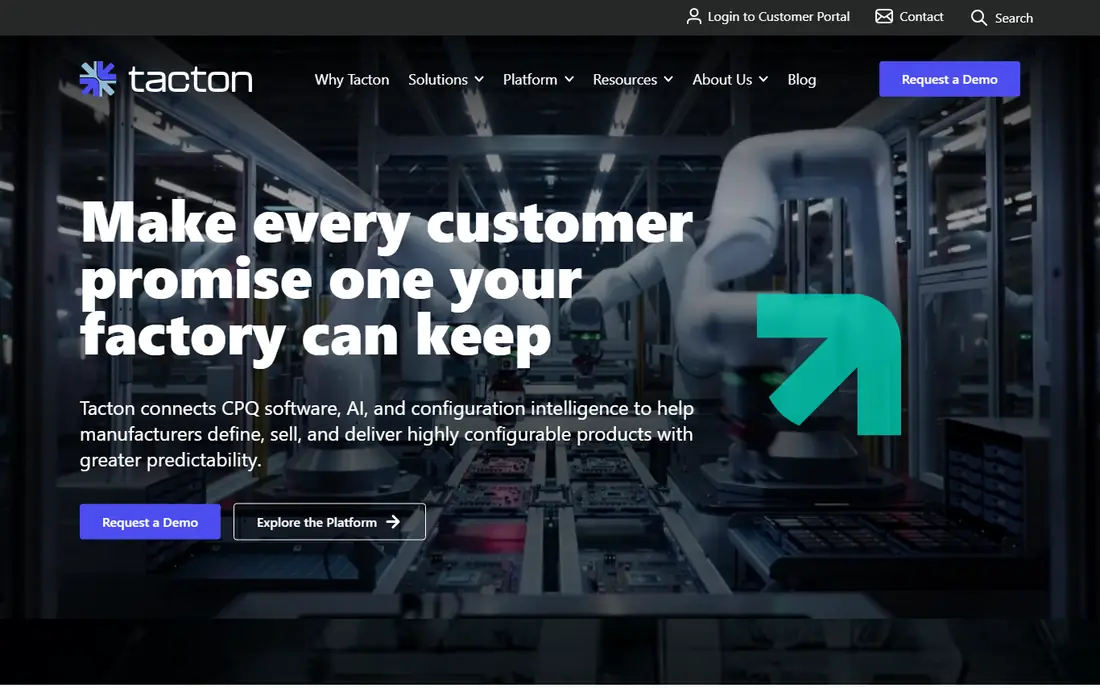
Tacton is built with manufacturers selling engineer-to-order products in mind. Tacton is a Swedish company that has spent over 25 years on one problem: quoting products that are engineered to order. Its constraint-based configuration engine manages the kind of complexity that breaks lesser tools, thousands of interdependent choices across product families, and it links the sold configuration to a factory-ready bill of materials.
Limits to weigh: Overkill for straightforward or services quoting.
That quote-to-manufacturing link is the entire point. This is not a tool for SaaS businesses or straightforward services. Pricing is entirely custom and there is no trial. But if you sell industrial machinery, heavy vehicles or complicated configured systems, Tacton is one of a handful of vendors that can actually do the job, and analysts consistently rank it as a leader for manufacturing CPQ. Pricing for Tacton is not stated here, so ask the vendor for current figures. Tacton has no free plan.
- Decades of manufacturing focus
- Links quoting to bills of materials and manufacturing
- No public pricing and no free trial
Oracle CPQ
Ideal for: Oracle-heavy enterprises needing global quote-to-cash
Oracle CPQ works best for Oracle-heavy enterprises needing global quote-to-cash. Oracle CPQ (the former BigMachines) is the enterprise establishment choice alongside Salesforce.
From a buyer's view, outside that world it is costly and complicated to implement. Oracle CPQ shows no starting price here, so confirm the cost on the vendor site. Oracle CPQ has no permanent free option.
What to check first: Best value only if you already run Oracle systems.
- Deep integration with Oracle's CX and ERP suite
- Recognized as a Leader by Gartner nine years running
- No public pricing
PandaDoc
Ideal for: Small teams needing quotes, proposals and e-signatures quick
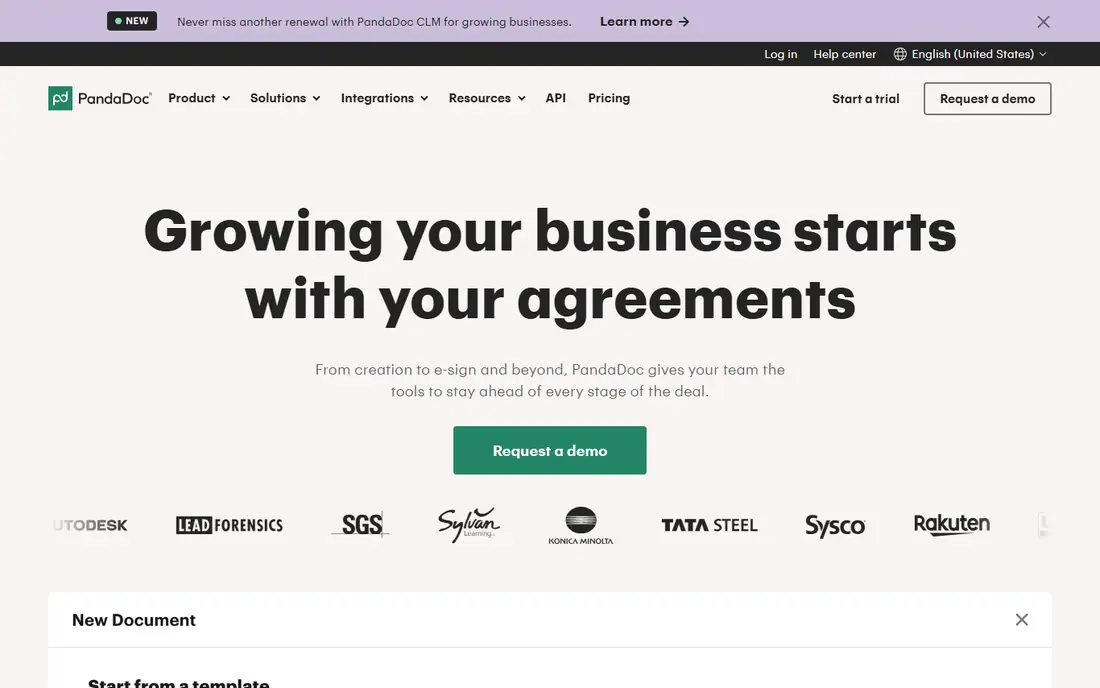
Choose PandaDoc for small teams needing quotes, proposals and e-signatures fast. Reps build proposals with pricing tables in a drag-and-drop editor, send them for e-signature, and collect payment in the same flow. If your quotes need constraint-based configuration or 1,000-line bills of materials, PandaDoc will frustrate you.
Limits to weigh: Not designed for complicated product configuration.
The serious CPQ functionality needs the Enterprise level on a custom quote. But if your problem is that proposals take days and stall at signature, PandaDoc fixes that in a week or two. Worth adding: essentials opens at $19 per user a month, a free plan handles entry-level e-signing, and a 14-day trial handles the premium features. On cost, PandaDoc starts like this: $19 per user/month. PandaDoc includes a free tier.
- Payments and analytics built into quotes
- Drag-and-drop document builder reps actually enjoy
- Real CPQ features (pricing rules, approvals depth) sit on the Enterprise plan
Salesforce Revenue Cloud
Ideal for: Salesforce-based teams wanting quoting, contracts and billing together
Salesforce Revenue Cloud serves Salesforce-based teams wanting quoting, contracts and billing together. Salesforce Revenue Cloud is the current name for what most people still call Salesforce CPQ (originally SteelBrick).
Revenue Cloud Growth lists at $150 per user a month billed yearly, and that sits on top of a required Sales Cloud license. What you pay to start with Salesforce Revenue Cloud: $150 per user/month. Trial and free access: Free trial.
Trade-offs to know: Advanced level needed for consumption billing.
- Native to the Salesforce system
- Largest partner and integrator network in the category
- Needs a Sales Cloud license on top
PROS Smart CPQ
Ideal for: Enterprises with complicated pricing and big catalogs
PROS Smart CPQ is designed for enterprises with complicated pricing and big catalogs. PROS comes from the world of pricing science, and its sweet spot is firms with genuinely complicated pricing: several currencies, customer-specific agreements and large catalogs. Advantage brings constraints-based configuration for engineer-to-order workflows, tiered pricing and quote analytics.
Downsides: AI and price optimization features cost additional.
That transparency is refreshing, but do not mistake it for a self-serve product. In practice, essentials includes guided selling, rule-based configuration and subscription pricing. Smaller teams will find the power unnecessary and the sales process still enterprise-shaped. For everyday use, PROS is the rare enterprise CPQ vendor that publishes its prices: Essentials at $60 per user a month and Advantage at $75, both billed yearly. What you pay to start with PROS Smart CPQ: $60 per user/month. No free plan comes with PROS Smart CPQ.
- Rare in this category
- Capable pricing science and quote analytics
- No free trial or free plan
HubSpot CPQ
Ideal for: HubSpot users who want quoting inside their CRM
In short, HubSpot CPQ is for HubSpot users who want quoting inside their CRM. HubSpot CPQ is the quotes tool inside Sales Hub, so there is nothing new to learn and no integration to maintain. Free CRM tools bundle entry-level quoting; the full experience includes Sales Hub Professional at $90 per seat a month billed yearly.
HubSpot also charges a mandatory $1,500 onboarding fee on Professional, which stings on a small team. There is no real usage-based pricing engine, subscription management is entry-level, billing still happens in another system, and reporting stays shallow compared to dedicated CPQ tools. Price to start with HubSpot CPQ: $90 per seat/month. HubSpot CPQ offers a free plan.
Trade-offs to know: Restricted pricing adaptability and reporting at scale.
- Quick setup with no implementation project
- Quotes live inside the CRM your team already uses
- $1,500 mandatory onboarding on Professional
DealHub
Ideal for: Mid-market teams wanting CPQ, CLM and billing in one deal
Where DealHub fits: mid-market teams wanting CPQ, CLM and billing in one deal. Pricing is entirely quote-based, which cuts both ways.
The main drawbacks: Quote-based pricing with no public rate card.
You will not find a public rate card, so budget time for a sales cycle and get specific about which users need full licenses and which modules are included. Since it is no-code, your RevOps team can change a price book or discount policy without filing a ticket with IT. No starting price is listed for DealHub here; confirm pricing on the vendor site. Free options: Free trial.
- Frequently 4 to 8 weeks
- Digital deal rooms
- One-time implementation fee
Experlogix
Ideal for: Manufacturers and distributors with complicated configuration
Experlogix makes the most sense for manufacturers and distributors with complicated configuration. Its rules engine controls which choices and prices combine validly, and the visual configurator presents changes as they happen. As for the details, the trade-offs are familiar for this segment.
But the integrations are genuinely wide: Dynamics 365, NetSuite, Salesforce, SAP and a long list of ERPs. Beyond that, if your quoting problem is really a configuration problem, Experlogix deserves a demo. Check the vendor site for Experlogix pricing; none is listed in this comparison. Free access: Free trial.
Downsides: Setup is complicated and frequently needs consultants.
- Deep integrations with Dynamics 365
- Logic-based rules engine manages complicated product constraints
- No published pricing
What went into this list
We compared the tools on published pricing, free plan or trial availability, feature coverage for cpq software for simplifying quote to cash, and the limits each vendor documents. Plan names, prices and limits change often. Treat the figures here as a starting point and verify them with the vendor. We ordered the tools by general fit, then by how clearly pricing is shown, then by free access. A buyer with unusual needs may reorder them.
What to confirm before you sign up
- Confirm the entry price on the vendor page. For Tacton, Oracle CPQ, DealHub and Experlogix that means a quote rather than a fixed price.
- Check what the free option really includes: PandaDoc and HubSpot CPQ offer a free plan, and usage caps differ.
- Use real work to test the free trial from Salesforce Revenue Cloud, DealHub and Experlogix, rather than a demo project.
- Read the limits listed for Tacton first: no public pricing and no free trial.
- The entry price of Tacton is only the starting point; model the full cost with seats and extras.
- Confirm minimum seats and billing terms with PROS Smart CPQ before you commit to an annual plan.
Frequently asked questions
Which options for cpq software for simplifying quote to cash have a free plan?
PandaDoc and HubSpot CPQ offer a free plan in this list. Free plans usually cap users, projects or features, so check the limits on the vendor page. Several others offer a trial instead.
How are the tools for cpq software for simplifying quote to cash ordered?
The order follows typical fit for cpq software for simplifying quote to cash, with Tacton first and Experlogix last, then price clarity and free access. It is editorial judgement, not a score, so another team could rank the tools differently.
Is Tacton the right pick for everyone comparing cpq software for simplifying quote to cash?
No single tool suits every team. Tacton comes first because it fits manufacturers selling engineer-to-order products, while Oracle CPQ suits Oracle-heavy enterprises needing global quote-to-cash and PandaDoc suits small teams needing quotes, proposals and e-signatures fast. Match the tool to your own size, budget and workflow before deciding.
What does CPQ stand for?
Configure, price, quote. It is software that helps sales teams build valid product configurations, apply correct pricing and discount rules, and produce professional quotes without errors.
Can I try these tools before paying?
Often, yes. PandaDoc and HubSpot CPQ have a free plan and Salesforce Revenue Cloud, DealHub and Experlogix offer a free trial. Use your own data and a real task during the test, and check what the free tier or trial limits before you rely on it.