Best Crosslisting App in 2026: 8 Apps Compared

- 1
 VendooAll-round resellersVisit
- 2
 List PerfectlyHigh-volume sellersVisit
- 3
 CrosslistBudget crosslistingVisit
- 4
 PrimeListerSimple bulk listingVisit
- 5
 SellHoundFast listing from photosVisit
- Vendoo is our pick for most resellers, with broad marketplace coverage, bulk listing and automatic delisting when an item sells.
- List Perfectly suits high-volume sellers who list across many marketplaces daily and want catalog tools for a large inventory.
- Crosslist and PrimeLister suit budget-conscious resellers, with lower entry prices and straightforward listing workflows.
- Confirm current marketplace support before paying, since marketplace rules and API access change, and a tool that drops your main marketplace loses its value.
Quick comparison
| Product | Ideal for | Price from | Free version | |
|---|---|---|---|---|
| Vendoo | All-round resellers | See website | No | Visit |
| List Perfectly | High-volume sellers | See website | No | Visit |
| Crosslist | Budget crosslisting | See website | No | Visit |
| PrimeLister | Simple bulk listing | See website | No | Visit |
| SellHound | Fast listing from photos | See website | No | Visit |
 Flyp | Consignment-style selling | See website | No | Visit |
 ResellKit | Growing reseller teams | See website | No | Visit |
 OneShop | Multi-marketplace dashboard | See website | No | Visit |
The best crosslisting app
Crosslisting apps let resellers list one item once and publish it to several marketplaces, such as eBay, Poshmark, Mercari and Depop, then remove it everywhere when it sells. That saves hours and prevents double sales, which is the main risk of manual crosslisting. We compared marketplace coverage, bulk tools, delisting, analytics and pricing.
Vendoo
Ideal for: All-round resellers

Vendoo is the all-round pick for resellers who sell across several marketplaces every week. You create a listing once, publish it to your connected marketplaces, and Vendoo removes it everywhere when it sells on one, which prevents the double-sale problem that manual crosslisting creates. Bulk editing and inventory tools help when prices or descriptions need to change across many listings at once.
The catch is cost at volume. Subscription tiers rise with listing counts and features, so a hobby seller with a few items may find a cheaper tool enough. Vendoo earns its fee when crosslisting saves hours every week and when a double sale would cost more in refunds and reputation than the subscription.
- Broad marketplace coverage
- Bulk listing and editing
- Automatic delisting on sale
- Pricing is subscription based and rises with listing volume
- Learning curve for new resellers
List Perfectly
Ideal for: High-volume sellers
List Perfectly suits sellers who treat reselling as a business with daily listings. Its catalog tools, bulk listing and cross-posting workflows handle large inventories, while delisting and sales analytics show which marketplaces and items perform best. That structure helps a seller with hundreds of active listings stay organised.
The weakness is fit for casual sellers. The price and depth make less sense for someone listing a few items a month, who may prefer Crosslist or PrimeLister. List Perfectly fits sellers who list daily and need a system, not just a posting button.
- Built for high-volume multi-marketplace selling
- Catalog and bulk tools
- Delisting and analytics
- Price and feature set suit volume sellers more than casual sellers
- Setup takes time for a large catalog
Crosslist
Ideal for: Budget crosslisting
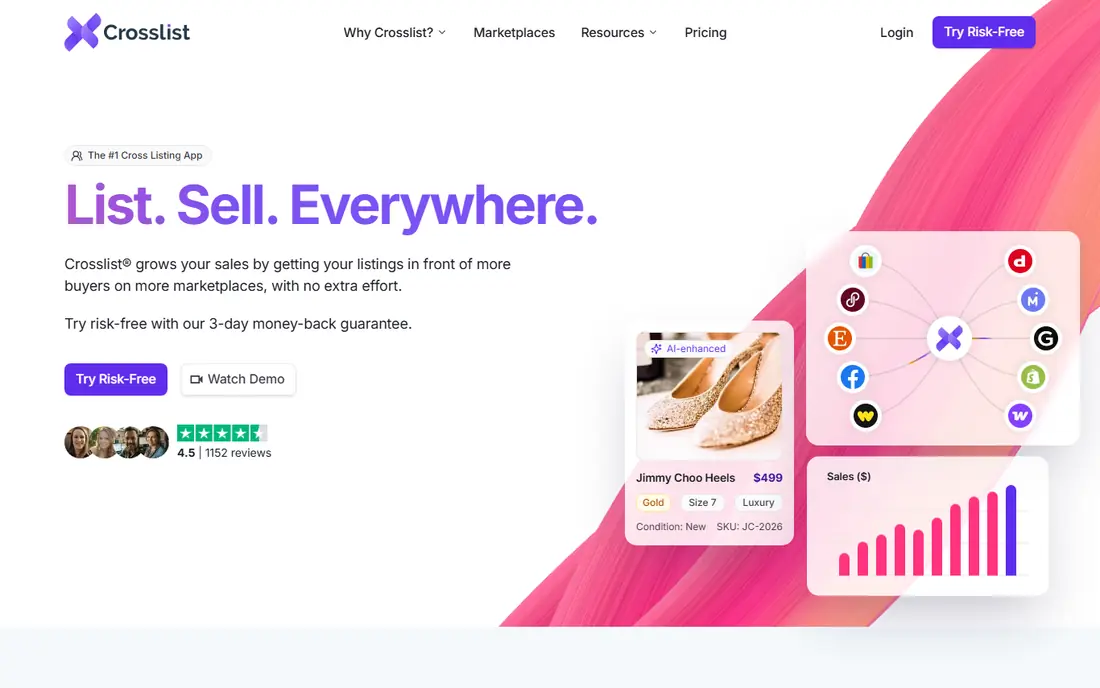
Crosslist is the budget pick. It covers the core job, listing once and publishing to several marketplaces, with a simpler interface and a lower entry price than the volume tools. That simplicity suits part-time resellers who want to save time without learning a full inventory system.
The limit is depth. Catalog management, bulk editing and analytics are lighter than Vendoo or List Perfectly, so high-volume sellers may outgrow Crosslist. For a reseller listing a few dozen items, Crosslist covers the job at a fair price.
- Lower entry cost
- Straightforward listing workflow
- Covers major resale marketplaces
- Fewer advanced catalog features than Vendoo or List Perfectly
- Analytics are lighter
PrimeLister
Ideal for: Simple bulk listing
PrimeLister suits resellers who want simple bulk listing without a complex system. You build listings, push them to connected marketplaces, and rely on delisting to prevent double sales, all through a straightforward dashboard. That focus keeps the learning curve low for new crosslisters.
The drawback is breadth. Advanced inventory, analytics and automation features trail the larger tools, so a growing business may need to upgrade later. PrimeLister fits sellers who value a clear, fast listing flow over a full business platform.
- Simple bulk listing workflow
- Marketplace coverage for major resale platforms
- Delisting support
- Feature set is narrower than Vendoo
- Support and updates vary by plan
SellHound
Ideal for: Fast listing from photos
SellHound suits sellers who want to list fast from a phone. Its flow emphasises photos and quick details, which helps when you source items at thrift stores or estate sales and want them listed the same day. That speed matters for fast flips where days on the shelf cost money.
The caution is coverage. SellHound history and marketplace support have changed over time, so confirm current marketplace coverage and pricing on the vendor site before committing. Use SellHound for speed, and keep Vendoo or List Perfectly in mind if catalog depth becomes more important.
- Fast listing flow from photos
- Marketplace posting support
- Good fit for quick flips
- Availability and marketplace coverage should be confirmed before buying
- Less suited to large catalog management
Flyp
Ideal for: Consignment-style selling
Flyp suits sellers who have inventory but no time to list it. Its consignment model connects you with pro sellers who photograph, list and ship items for a share of the sale, which removes the listing workload entirely. That trade suits busy sellers with quality items who value time over maximum margin.
The limit is control and cost. Consignment fees cut into profit, and you give up direct control over titles, prices and photos. Flyp is not a crosslisting tool in the same sense as Vendoo, but it solves the same time problem from the opposite direction, so it belongs in a reseller comparison.
- Consignment model with pro sellers handling listings
- Good fit for sellers who lack time to list
- Marketplace reach
- Consignment fees reduce your margin
- Less control over pricing and listing details than self-listing tools
ResellKit
Ideal for: Growing reseller teams
ResellKit suits growing resellers who need inventory and team workflows beside crosslisting. It covers listing once, publishing to several marketplaces and removing sold items everywhere, with tools that help a small team share inventory and track sales. That structure fits a reseller moving from solo selling to a small team.
The weakness is scale of presence. ResellKit is less established than Vendoo or List Perfectly, so confirm marketplace coverage, pricing and support responsiveness before building a business on it. For a growing team that likes its workflow, ResellKit is a credible alternative to the bigger names.
- Crosslisting with inventory tools
- Team-friendly workflows
- Delisting support
- Smaller presence than Vendoo or List Perfectly
- Confirm marketplace coverage for your main platforms
OneShop
Ideal for: Multi-marketplace dashboard
OneShop suits resellers who want one dashboard for multi-marketplace selling without a heavy system. Listings, sales and inventory sit in one view, and delisting helps prevent double sales when an item moves on one marketplace. That simplicity appeals to sellers who find larger tools overwhelming.
The catch is depth. Advanced bulk editing, analytics and automation are lighter than Vendoo or List Perfectly, so high-volume sellers may need more. OneShop fits a reseller who wants a clean dashboard and reliable delisting at a straightforward price.
- Single dashboard for listings across marketplaces
- Delisting support
- Simple inventory view
- Feature depth trails larger tools
- Pricing and coverage should be confirmed on the vendor site
How we picked these
We compared marketplace coverage, bulk listing, delisting, inventory tools and pricing for crosslisting and resale tools still operating in October 2026. We kept self-listing tools and one consignment option in the list, since resellers solve the time problem in different ways. We did not run live listings on each marketplace, and marketplace coverage should always be confirmed on the vendor site before paying, since platform access changes.
What to check before you buy
Start with your marketplaces. List the platforms where you actually sell, such as eBay, Poshmark, Mercari, Depop or Etsy, and confirm the tool supports all of them with full listing, editing and delisting, not just posting. A tool that covers four of your five marketplaces still leaves manual work and double-sale risk on the fifth.
Next, test delisting with a real sale. List a low-value item on two marketplaces through the tool, sell it on one, and watch whether it disappears from the other promptly. Delisting speed is the feature that prevents refunds, angry buyers and account strikes, so it matters more than any analytics dashboard.
Finally, price by listings, not by headline fee. Subscription tiers often rise with active listings, team seats or automation features, so count your active listings and monthly new listings before choosing a tier. Also confirm photo, title and description rules for each marketplace, since a listing that works on one platform may need different photos or keywords on another.
Frequently asked questions
What is the best crosslisting app for resellers?
Vendoo is our pick for most resellers because of broad marketplace coverage, bulk tools and automatic delisting. List Perfectly suits high-volume sellers, while Crosslist and PrimeLister suit budget-conscious sellers with simpler needs.
Does crosslisting risk double sales?
Yes, if delisting fails or lags, the same item can sell on two marketplaces at once. Good crosslisting tools remove the item everywhere as soon as it sells on one platform, so test delisting speed before relying on any tool for high-value items.
Which marketplaces do crosslisting apps support?
Most tools support eBay, Poshmark, Mercari and Depop, with varying support for Etsy, Facebook Marketplace and others. Support changes as marketplace rules and access change, so confirm your exact marketplaces on the vendor site before paying.
Is crosslisting allowed by marketplaces?
Crosslisting the same item on several marketplaces is common practice, but each marketplace has its own rules on listing quality, shipping and account standing. Follow each platform rules, keep inventory accurate, and delist promptly when an item sells.
How much do crosslisting apps cost?
Pricing is subscription based and varies by listing volume, team size and features, so most vendors require a site visit for current pricing. Budget-conscious sellers should start on a lower tier, prove the time saving, and only upgrade when listing volume demands it.