Best Crypto Trading Platform in 2026: 8 Platforms Compared for US Traders

- 1
 Kraken Promost US traders who want a full exchange with readable feesVisit
- 2
 Coinbase Advancedtraders who want spot, futures and APIs under one loginVisit
- 3
 Binance.USactive spot traders chasing the lowest listed feesVisit
- 4
 Gemini ActiveTradertraders who put security and compliance firstVisit
- 5
 Interactive Brokersinvestors who want crypto next to stocks, options and bondsVisit
- For active traders, the exchange screen matters more than the brand. Binance.US lists 0% maker and 0.02% taker fees on most pairs, while Gemini's entry tier is 0.60% maker and 1.20% taker.
- Kraken Pro is our overall pick for most US traders: published fees from 0.40% maker and 0.80% taker at the entry tier, falling with volume, and a clear fee schedule.
- Interactive Brokers charges 0.12% to 0.18% of trade value with no added spread, which suits investors who already hold stocks there.
- Simple buy buttons cost more. Kraken's Instant Buy is 1%, Uphold's typical spread on BTC and ETH is 2.05% to 2.2%, and Coinbase adds a spread to simple trades.
- This is not financial advice. Crypto is highly volatile, you can lose everything you put in, and crypto held on these platforms is not FDIC or SIPC insured.
Quick comparison
| Product | Ideal for | Price from | Free version | |
|---|---|---|---|---|
| Kraken Pro | most US traders who want a full exchange with readable fees | Free (0.40% maker, 0.80% taker) | Yes | Visit |
| Coinbase Advanced | traders who want spot, futures and APIs under one login | Free (trading fees apply) | Yes | Visit |
| Binance.US | active spot traders chasing the lowest listed fees | Free (0% maker, 0.02% taker) | Yes | Visit |
| Gemini ActiveTrader | traders who put security and compliance first | Free (0.60% maker, 1.20% taker) | Yes | Visit |
| Interactive Brokers | investors who want crypto next to stocks, options and bonds | 0.12% to 0.18% per trade | Yes | Visit |
 Robinhood Crypto | newer traders who want a simple app and no transfer fees | Free | Yes | Visit |
 Webull | stock traders who want to add some crypto | See website | Yes | Visit |
 Uphold | moving between crypto, dollars, stablecoins and metals | See website | Yes | Visit |
The best crypto trading platforms
This is not financial advice. Trading crypto carries a high risk of loss, prices can fall sharply in minutes, and you should only trade money you can afford to lose. You must be 18 or older, and availability can vary by state.
We focused on platforms that serve US customers, publish their fees, and offer real trading tools such as order books, limit orders or advanced charts. Companies change fees often, so check each fee page before you trade.
Kraken Pro
Ideal for: most US traders who want a full exchange with readable fees
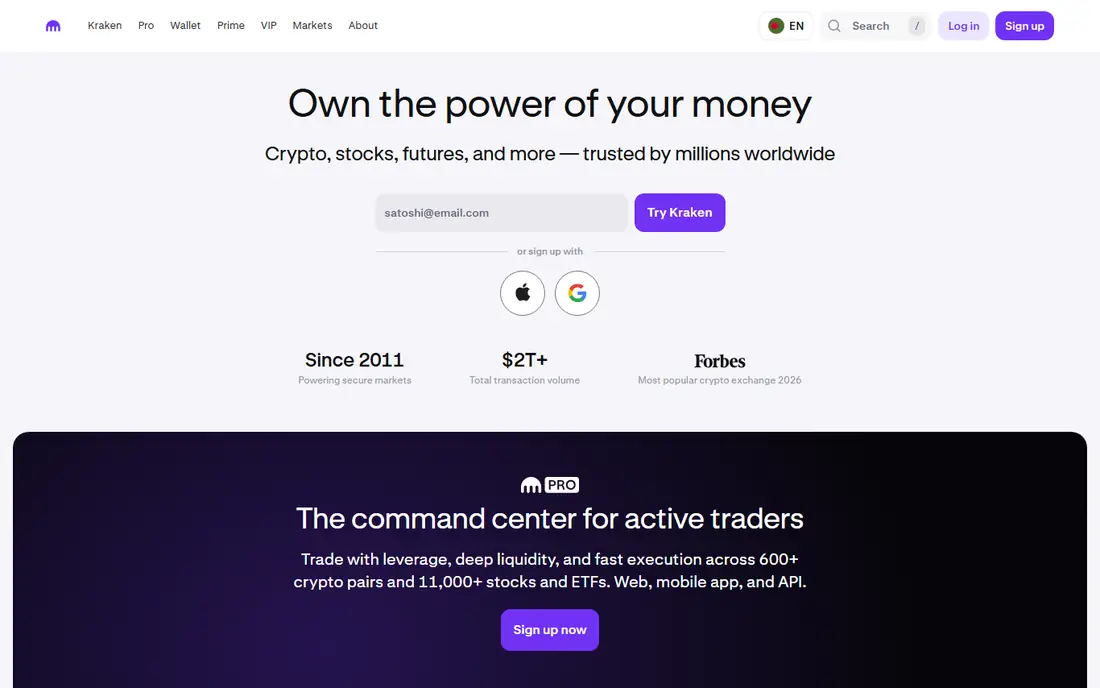
Kraken is our top pick because it tells you exactly what you will pay. Its fee schedule lists Kraken Pro spot fees of 0.40% maker and 0.80% taker at $0 of 30-day volume, dropping to 0.30% and 0.60% from $2,500 and continuing down to 0% maker at the highest tiers.
The simple Kraken app is more expensive. Instant and recurring buys carry a 1% fee, custom orders 1.5%, and spreads still apply. Kraken+ members can skip the trading fee on up to $10,000 a month of simple buys, but that perk does not apply to Kraken Pro.
The main limit for US users is product range. Kraken's fee page states that futures are not available to customers in the US. If you only trade spot, that is not a problem.
- Detailed public fee schedule
- Fees fall quickly with volume (0.30% maker and 0.60% taker from $2,500)
- Commission-free US stock and ETF trading in the same company
- Futures are not available to US users
- Instant Buy in the simple app costs 1%
Coinbase Advanced
Ideal for: traders who want spot, futures and APIs under one login

Coinbase Advanced is the trading screen inside Coinbase, and it is a different experience from the simple buy button. Coinbase says it offers 352 spot pairs, dated futures and perpetuals, advanced charts, real-time order books, customizable workspaces and REST and WebSocket APIs. Futures are offered through Coinbase Financial Markets, a member of the NFA.
Fees depend on your volume tier and on whether you are a maker or taker. Coinbase advertises maker fees as low as 0.0%, but it shows your actual tier only inside your account, so check it before your first trade. Coinbase's help center also states it has no payment-for-order-flow relationships.
The trap for beginners is the simple app. Coinbase's fee page says simple buy and sell orders include a spread in the quoted price, plus a Coinbase fee that depends on payment method and order size. If you are going to trade more than occasionally, use Advanced instead.
- 352 spot pairs plus dated futures and perpetuals on eligible markets
- Advanced charts, real-time order books and APIs
- No payment for order flow
- Fee tier details are shown only after you sign in
- The simple Coinbase app adds a spread on buys and sells
Binance.US
Ideal for: active spot traders chasing the lowest listed fees

On listed fees alone, Binance.US is hard to beat. Its fee page shows 0% maker and 0.02% taker on Tier I pairs, with taker fees dropping to 0.01% at very high volume, and a 0% maker and 0.01% taker rate on BNB/USD. Paying fees in BNB gives a 5% discount.
The site says you can trade 200+ cryptocurrencies and stake 25+ assets. Binance.US describes itself as a separate legal entity from Binance global, registered with FinCEN as a money services business and holding money transmitter licenses in the states it supports.
Two catches. Buy, Sell and Convert orders build their cost into a spread, so use the trading screen to get the listed rates. And debit or credit card deposits cost 3.99%, so fund with a bank transfer instead. Check that your state is supported before you sign up.
- 0% maker and 0.02% taker fees on most pairs
- 200+ cryptocurrencies
- Separate US company registered with FinCEN
- Not available in every state
- Card deposits cost 3.99%
Gemini ActiveTrader
Ideal for: traders who put security and compliance first

Gemini has built its name on compliance. Its site lists Gemini Trust Company, LLC (NMLS #1518126), says it holds US money transmitter licenses, and highlights SOC 2 Type 2 and ISO 27001 certifications.
The ActiveTrader fee schedule starts at 0.600% maker and 1.200% taker at $0 volume, which is expensive for small traders. Tiers are based on your trailing 30-day volume or total balance, whichever gives the lower fee, and some stablecoin pairs such as GUSD/USD trade at 0%. Cancelling an unfilled maker order is free.
Gemini makes sense if you value its compliance record and keep a large balance there. For small, frequent trades, the entry fees will eat into results faster than at Kraken or Binance.US.
- SOC 2 Type 2 and ISO 27001 certified per Gemini
- 0% fees on some stablecoin pairs
- Tiers use volume or balance, whichever gives the lower fee
- High entry-tier fees of 0.60% maker and 1.20% taker
- You need large volume to reach low rates
Interactive Brokers
Ideal for: investors who want crypto next to stocks, options and bonds

Interactive Brokers is a long-established broker, and its crypto offering is built for people who already trade other markets. Its pricing page lists a commission of 0.12% to 0.18% of trade value, with a USD 1.75 minimum per order that is capped at 1% of trade value, and says there are no added spreads, markups or custody fees.
Trades are executed and held by Paxos Trust Company or Zero Hash, not by Interactive Brokers itself, and crypto held there is not protected by SIPC. IBKR passes through a USD 0.15 monthly account fee from Paxos to clients with an open Paxos account.
The minimum order fee makes tiny trades expensive, and the coin list is narrower than on dedicated exchanges. For someone trading a few thousand dollars of bitcoin alongside a stock portfolio, though, the cost structure is among the most transparent we found.
- Commission of 0.12% to 0.18% of trade value with no added spreads or markups
- Professional trading platforms
- One login for many asset classes
- USD 1.75 minimum per order (capped at 1% of trade value)
- Smaller coin selection than crypto exchanges
Robinhood Crypto
Ideal for: newer traders who want a simple app and no transfer fees
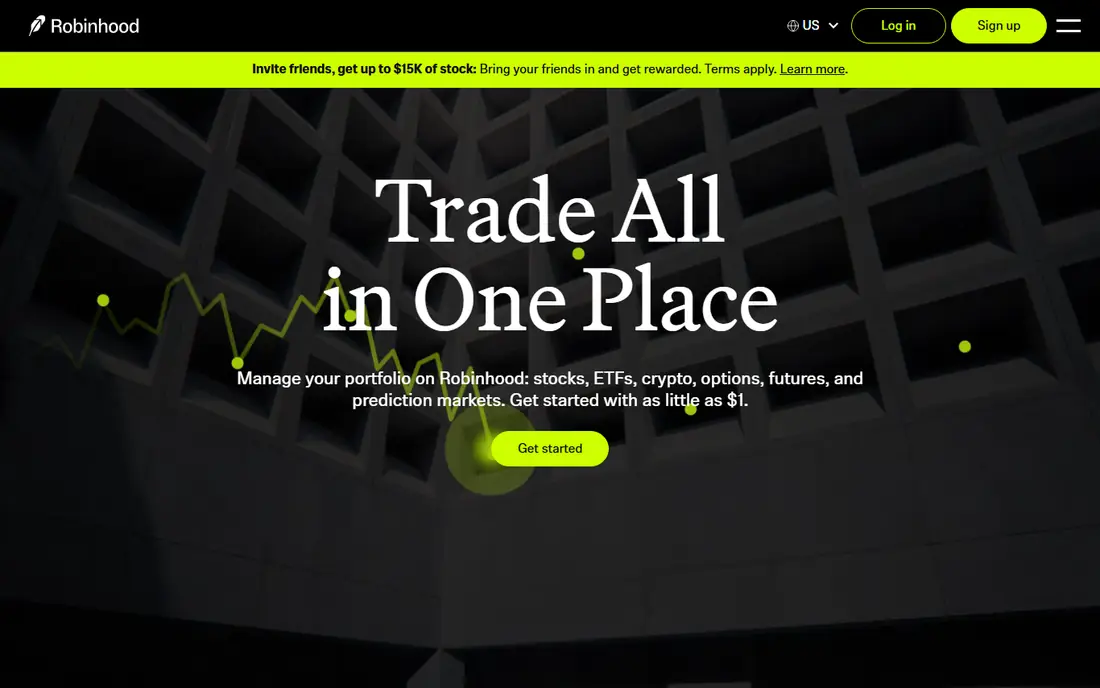
Robinhood Crypto is the easiest place on this list for a newcomer to start trading. Its crypto page says you will never be charged deposit or withdrawal fees, that the service is available in every US state and the District of Columbia, and that Robinhood Crypto, LLC holds a virtual currency license from the New York State Department of Financial Services.
Robinhood publishes a comparison claiming you can get up to 2.2% more crypto than on some rivals, based on third-party-verified quotes from 18 September 2026. Treat that as marketing, since quotes change with market conditions.
On safety, Robinhood says it keeps the majority of coins in cold storage and carries crime insurance that covers only a portion of assets. Crypto there is not FDIC insured or SIPC protected. Traders who want deep order books and complex order types will outgrow it.
- No deposit or withdrawal fees
- Available in every US state and Washington, DC
- Licensed by the New York DFS
- Costs are built into the price rather than shown as a commission
- Fewer pro trading tools than a full exchange
Webull
Ideal for: stock traders who want to add some crypto

Webull's crypto section returned after a break, and its page lists more than 70 coins, including bitcoin, ether and solana, with charts in the same app you use for stocks. Opening a crypto account is free, and you can fund it with as little as $1.
Crypto trading is offered by Webull Pay LLC (NMLS ID 1886762), a separate company from Webull Financial LLC, and some customers are served through partners such as Bakkt Crypto Solutions. Webull notes that crypto is not FDIC or SIPC insured.
Webull points to its fee schedule for crypto pricing rather than stating a rate on the crypto page, so check that before trading. It is a convenient add-on for stock traders, not a dedicated crypto exchange.
- 70+ coins in the same app as stocks and options
- Start with as little as $1 (or $2 for some customers)
- No custody fees
- Crypto pricing sits on a separate fee schedule
- Crypto is handled by partner companies, not Webull's broker-dealer
Uphold
Ideal for: moving between crypto, dollars, stablecoins and metals

Uphold works differently from an order-book exchange. You trade from any asset to any other, and Uphold's price includes a spread rather than a separate commission. Its service fee page, updated 21 September 2026, lists typical US spreads of 2.05% to 2.2% for BTC and ETH, 2.85% to 3.8% for altcoins, and 0.3% for major currency pairs.
There is a bright spot for stablecoin users: conversions between US dollars and supported USD stablecoins are 1:1 with no spread on the first $20,000 per month, as long as the stablecoin stays within 0.2% of $1. The company lists its NMLS number (#1269875) and SOC 2 Type 2 and ISO 27001 certifications.
For active trading, those spreads are high compared with Kraken Pro or Binance.US. Uphold also advertises FDIC coverage on its cash account, but that kind of pass-through coverage comes with conditions, so read the terms before treating it like a bank.
- Trade directly between many asset types
- Limit orders available
- 0% spread on USD and supported USD stablecoin conversions up to $20,000 a month
- Typical spreads of 2.05% to 2.2% on BTC and ETH and 2.85% to 3.8% on altcoins
- Read the cash account fine print carefully
How we picked these
We did not place trades or open accounts for this guide. We compared each platform's official fee schedule, product pages, help center articles and licensing disclosures in October 2026, and we only included companies that state they serve US customers.
We weighed the cost of a typical trade (fees and spreads), the trading tools offered, how clearly fees are published, and the company's stated licenses and security practices. Where a company did not publish a number we could confirm, we wrote "See website" rather than guessing.
How to choose a crypto trading platform
Know whether you are a maker or a taker
A taker order fills right away at the market price. A maker order, such as a limit order below the current price, waits on the order book. Most exchanges charge makers less, so using limit orders can cut your costs noticeably.
Compare the real cost of your usual trade
Add the trading fee, the spread and any deposit or withdrawal fees. A platform with a 0% commission can still cost more if its spread is wide. Always check the order preview before confirming.
Check licensing and state availability
Look for FinCEN registration, state money transmitter licenses or a New York DFS license. Some platforms, such as Binance.US, are not available in every state, while Robinhood Crypto says it serves all states.
Protect your account
Turn on two-factor authentication with an authenticator app or security key, use a unique password, and set a withdrawal allowlist if the platform offers one. Never share your login codes with anyone who contacts you, including people claiming to be support staff.
Keep records for taxes
In the US, crypto is taxed as property, and selling or trading can create taxable gains. Choose a platform that lets you export your full trade history, and talk to a tax professional about your situation.
Frequently asked questions
What is the best crypto trading platform?
For most US traders, our pick is Kraken Pro because of its clear published fees and solid trading tools. Binance.US has the lowest listed spot fees if it is available in your state, and Coinbase Advanced is the strongest choice if you also want futures.
What is the best crypto trading app for beginners?
Robinhood Crypto is the simplest to start with and charges no deposit or withdrawal fees. Once you trade regularly, moving to an exchange screen such as Kraken Pro or Coinbase Advanced usually lowers your costs.
Which crypto platform has the lowest fees?
Binance.US lists 0% maker and 0.02% taker fees on most pairs. Kraken Pro starts at 0.40% maker and 0.80% taker and drops with volume. Interactive Brokers charges 0.12% to 0.18% with a $1.75 minimum per order.
Is crypto trading software safe to use?
Well-known regulated platforms use security measures such as cold storage and two-factor authentication, but no platform is risk-free. Crypto on these platforms is not FDIC or SIPC insured, and insurance policies usually cover only part of customer assets.
Can I trade crypto futures in the US?
Some platforms offer them. Coinbase Advanced offers futures through Coinbase Financial Markets, an NFA member, on eligible markets. Kraken states that its futures are not available to US users. Futures let you trade with borrowed money and can lose value very quickly.
Do I pay taxes on crypto trades?
Yes, in the US selling or trading crypto can trigger capital gains tax. Keep records of every trade and consult a tax professional.
Sources
- https://www.kraken.com/features/fee-schedule
- https://www.coinbase.com/advanced-trade
- https://help.coinbase.com/en/coinbase/trading-and-funding/advanced-trade/advanced-trade-fees
- https://help.coinbase.com/en/coinbase/trading-and-funding/pricing-and-fees/fees
- https://www.binance.us/
- https://www.binance.us/fees
- https://www.gemini.com/
- https://www.gemini.com/fees/activetrader-fee-schedule
- https://www.interactivebrokers.com/en/pricing/commissions-cryptocurrencies.php
- https://robinhood.com/us/en/crypto/
- https://www.webull.com/crypto
- https://uphold.com/en-us/
- https://uphold.com/en-us/service-fees