Best Customs Clearance Software in 2026: 8 Tools Compared

- Descartes and CargoWise lead for large importers and brokers with deep customs workflows.
- Magaya and E2open suit logistics firms that need customs inside wider supply chain tools.
- SAP GTS and Oracle GTM serve enterprises with global trade compliance needs.
- Flexport and Customs4trade suit firms that want broker services plus software.
- Check country coverage, tariff data, and broker links before choosing.
Quick comparison
| Product | Ideal for | Price from | Free version | |
|---|---|---|---|---|
 Descartes | Large customs operations | See website | No | Visit |
 CargoWise | Freight plus customs | See website | No | Visit |
 Magaya | Logistics with customs | See website | No | Visit |
 E2open | Supply chain plus trade | See website | No | Visit |
 SAP Global Trade Services | Enterprise trade compliance | See website | No | Visit |
 Oracle Global Trade Management | Enterprise logistics and trade | See website | No | Visit |
 Flexport | Broker services plus platform | See website | No | Visit |
 Customs4trade | Customs declarations software | See website | No | Visit |
The best customs clearance software
We compared official feature pages, pricing pages, and public reviews for eight customs clearance tools. Customs software handles entries, tariff classification, duties, and compliance checks, and errors can delay shipments or trigger penalties, so country coverage and data accuracy matter most.
Descartes
Ideal for: Large customs operations
Descartes offers customs and trade compliance tools for importers, exporters, and brokers, with entry filing, tariff data, and screening. Large firms value the breadth of country coverage and the way customs data links to logistics workflows. Compliance checks help flag restricted parties and classification issues before filing.
Pricing is quoted, and implementation needs planning for data and broker links. Smaller firms may find Descartes broad. For a large customs operation, Descartes offers depth and scale that smaller tools cannot match.
- Broad customs and trade data
- Broker workflows
- Compliance checks
- Pricing is quoted
- Implementation takes planning
CargoWise
Ideal for: Freight plus customs
CargoWise, from WiseTech Global, combines freight forwarding with customs clearance in one platform used by logistics firms worldwide. Entries, tariffs, and shipment data flow together, reducing retyping between freight and customs tasks. Global coverage suits firms moving goods across many borders.
Pricing is quoted, and the platform takes learning. For a freight forwarder or logistics firm that needs customs inside operations, CargoWise is a leading choice. Confirm country modules for your trade lanes.
- Freight forwarding plus customs
- Global coverage
- Workflow automation
- Pricing is quoted
- Learning curve for new users
Magaya
Ideal for: Logistics with customs
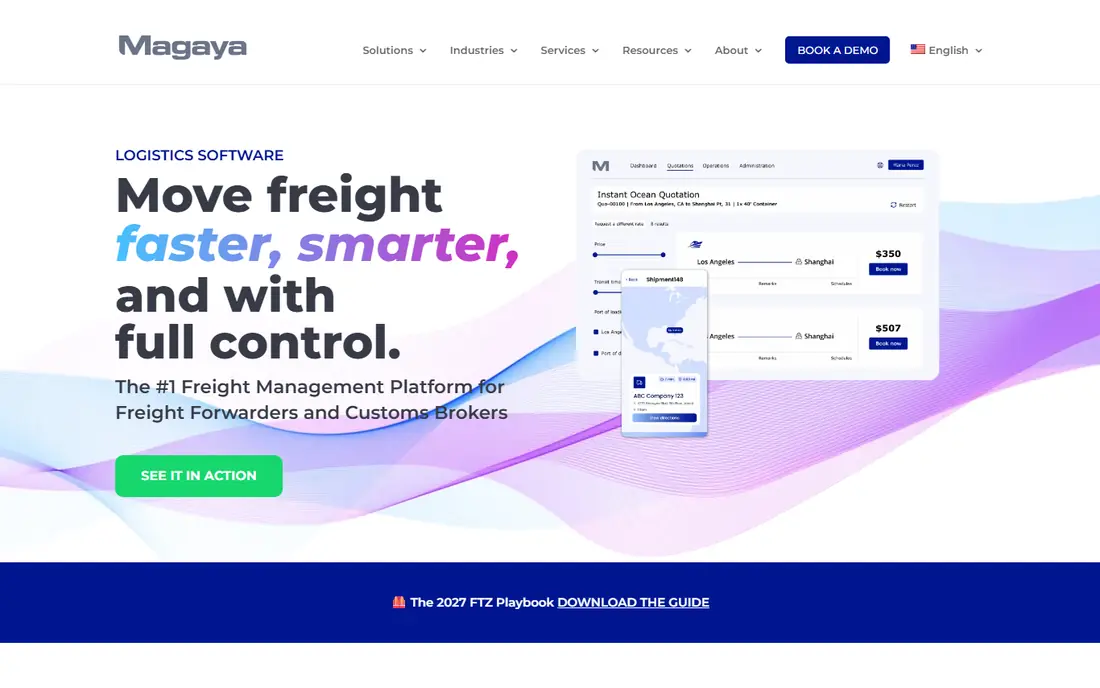
Magaya offers logistics software with customs entry features, plus warehouse and freight tools for mid-size firms. Importers and forwarders can manage shipments, entries, and inventory in one system. The combined approach suits firms that do not want separate customs and logistics tools.
Country coverage varies, so confirm your trade lanes. Advanced compliance depth is lighter than Descartes or SAP GTS. For a mid-size logistics firm that wants customs plus operations, Magaya offers practical value.
- Logistics plus customs entries
- Warehouse links
- Affordable for mid-size firms
- Country coverage varies
- Advanced compliance is lighter than Descartes
E2open
Ideal for: Supply chain plus trade
E2open combines supply chain management with global trade compliance, including customs and tariff tools. Firms get visibility across orders, shipments, and trade documents, with analytics for duty and compliance trends. The network approach suits large shippers and manufacturers.
Pricing is quoted, and implementation is a project. Smaller firms will find E2open broad. For a large shipper that wants trade compliance inside supply chain visibility, E2open offers strong coverage.
- Supply chain network plus trade compliance
- Global trade data
- Analytics
- Pricing is quoted
- Implementation is a project
SAP Global Trade Services
Ideal for: Enterprise trade compliance
SAP Global Trade Services, or SAP GTS, provides enterprise trade compliance with classification, screening, and customs management linked to SAP ERP. Firms running SAP for orders and logistics get trade data in the same system, reducing manual transfers. Compliance features cover embargoes, licenses, and duty management.
Pricing is quoted, and SAP expertise is needed for setup. For an SAP-centered enterprise with global trade, GTS is a natural fit. Confirm modules for your countries and trade volumes.
- Deep trade compliance
- SAP ERP links
- Screening and classification
- Pricing is quoted
- Needs SAP expertise
Oracle Global Trade Management
Ideal for: Enterprise logistics and trade
Oracle Global Trade Management, or Oracle GTM, combines logistics with trade compliance, including customs, tariffs, and screening, linked to Oracle ERP and supply chain tools. Enterprises value the way trade and transport data sit together for landed cost and compliance reporting.
Pricing is quoted, and implementation needs planning. For an Oracle-centered enterprise, GTM offers a coherent trade platform. Smaller firms should consider Descartes or Magaya instead.
- Logistics plus trade compliance
- Oracle ERP links
- Global coverage
- Pricing is quoted
- Implementation takes planning
Flexport
Ideal for: Broker services plus platform
Flexport combines freight forwarding and customs brokerage with a platform for shipment visibility and documents. Shippers get broker expertise plus software tracking, which suits firms that want service and tools together. The platform covers bookings, documents, and customs status in one view.
Firms that only want software, without broker services, may prefer a pure software vendor. For a shipper that wants a broker plus modern platform visibility, Flexport is a strong option. Confirm lane coverage and broker licensing for your countries.
- Freight and customs brokerage
- Platform visibility
- Trade services
- Best as a service plus software
- Pure software buyers may prefer Descartes
Customs4trade
Ideal for: Customs declarations software
Customs4trade, or C4T, offers cloud customs declaration software with a focus on European trade. Importers and brokers can file declarations, manage tariff data, and track customs status. The focused approach suits firms trading mainly within Europe.
Coverage outside Europe is thinner than Descartes or CargoWise. For a European importer or broker that wants focused declaration software, Customs4trade is a practical choice. Confirm country modules for your lanes before buying.
- Focused customs declarations
- EU coverage
- Cloud delivery
- Coverage is EU-focused
- Pricing is quoted
How we picked these
We compared official feature pages, pricing pages, and public reviews for customs tools in October 2026. We favored tools with entry filing, tariff classification, compliance screening, and broker or ERP links, and we mixed pure software with broker-plus-platform options. We did not claim hands-on testing, and we list prices as shown on vendor sites, using See website where pricing is quoted.
What to check before you buy
Start with trade lanes. List every country you import from or export to, then confirm entry filing, tariff data, and broker support for each lane. A tool that covers Europe well may not cover your Asian or American lanes. Next, test classification and duty calculation with real products, since tariff errors create delays and penalties.
Check screening for restricted parties and embargoes, plus audit trails for filings. Confirm links to freight, ERP, and warehouse systems, and clarify who files entries: your team, your broker, or the vendor. Finally, run a pilot with real shipments, measure clearance times and error rates, and confirm support hours for urgent shipments.
A final check before you commit
Security and privacy checks should match the sensitivity of the data you will store, so review access controls, authentication options, and audit logs for each finalist. Ask who at the vendor can access your data, how incidents are reported, and where data is hosted, especially for regulated or client-confidential work. Smaller teams can keep this review short, but it should still be written down, since verbal assurances are hard to rely on later. If a vendor cannot answer plainly, treat that as a signal about transparency.
Implementation planning should start before purchase, with a named owner, a migration checklist, and a date for reviewing whether the tool still fits. Plan data import, user permissions, and training in that order, and keep the old system running in parallel for a short period where possible, so mistakes can be corrected without lost work. Set a review point after thirty and ninety days to check usage, costs, and complaints, and be willing to adjust seats or plans at that point. Tools that are reviewed regularly tend to stay useful, while tools bought and forgotten tend to drift from team needs.
Rollout works best in stages, so plan a pilot group, a feedback round, and a wider launch, rather than switching the whole team at once. The pilot group should include sceptical users as well as enthusiasts, since sceptics find real flaws that fans overlook, and their approval later helps wider adoption. Collect feedback on speed, clarity, and missing features after two weeks, fix what can be fixed through settings or training, and only then expand. A staged rollout takes a little longer, but it avoids the all-at-once disruption that turns teams against a tool before it has a fair chance.
Also check references from firms of similar size and in a similar line of work, since a vendor that serves large enterprises well may still struggle with small-team needs, and the reverse is true as well. Ask references about onboarding time, support responsiveness, and the one feature they wish worked better, since those answers reveal patterns that no demo will show. If a vendor hesitates to provide references, or only offers very large customers, treat that as useful information about fit for your size. Two short reference calls often save weeks of trial and error, and they give your team confidence that the choice rests on real user experience rather than polished sales material alone.
Frequently asked questions
What is customs clearance software?
It helps importers, exporters, and brokers file customs entries, classify goods with tariff codes, calculate duties, and check compliance. It reduces manual paperwork and filing errors.
Do I still need a customs broker with software?
Often yes. Software supports filing, but brokers provide licensed expertise for complex entries and regulations. Some platforms, such as Flexport, bundle broker services with software.
How do tariff codes work in customs software?
Tools suggest or validate Harmonized System codes for products, then calculate duties based on code and origin. Classification still needs human review, since wrong codes cause delays and penalties.
Can customs software handle many countries?
Coverage varies widely. Descartes and CargoWise cover many countries, while Customs4trade focuses on Europe. Confirm each trade lane before buying.
What happens if a customs filing is wrong?
Errors can delay shipments, trigger inspections, fines, or extra duties. Good software adds checks and audit trails, but firms remain responsible for accurate filings.