Best Data Democratization Tools in 2026: 8 Tools Compared

- 1
 AtlanModern data catalog and discoveryVisit
- 2
 AlationEnterprise data catalogVisit
- 3
 CollibraData governance and catalog togetherVisit
- 4
 data.worldCollaborative data catalogVisit
- 5
 ThoughtSpotSelf service search analyticsVisit
- Atlan and Alation are our top picks for data catalogs that make data findable, trusted and accessible.
- Collibra and data.world suit enterprises and teams that need governance alongside access.
- ThoughtSpot, Tableau, Domo and Sigma help business users analyze data themselves without waiting on analysts.
- Data access must pair with governance, since open access without quality and privacy controls creates risk.
- Pricing is usually quote based, so request a demo with your real data stack and user count.
Quick comparison
| Product | Ideal for | Price from | Free version | |
|---|---|---|---|---|
| Atlan | Modern data catalog and discovery | See website | No | Visit |
| Alation | Enterprise data catalog | See website | No | Visit |
| Collibra | Data governance and catalog together | See website | No | Visit |
| data.world | Collaborative data catalog | See website | No | Visit |
| ThoughtSpot | Self service search analytics | See website | Free trial | Visit |
 Tableau | Visual analytics for business teams | See website | Free trial | Visit |
 Domo | Business intelligence platform for companies | See website | Free trial | Visit |
 Sigma | Spreadsheet style analytics on warehouses | See website | Free trial | Visit |
The best data democratization tools
Data democratization means giving business users safe, governed access to data they can understand and use, without waiting weeks for a report. The tools below split into catalogs that make data findable and analytics tools that make it usable, and most companies need one of each.
Atlan
Ideal for: Modern data catalog and discovery
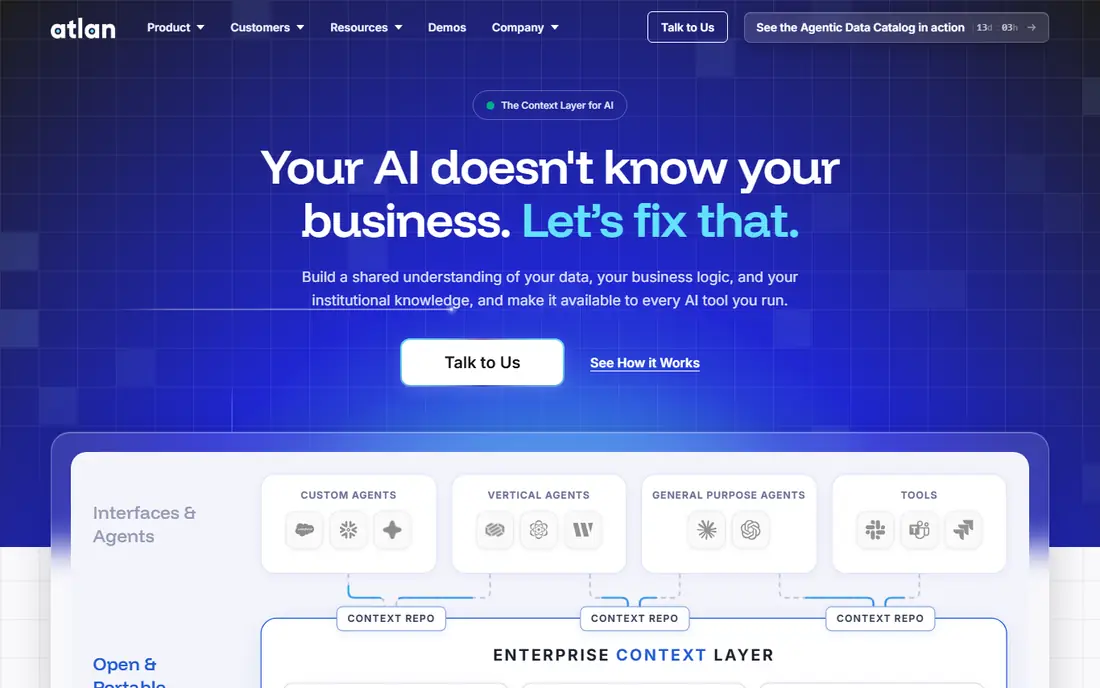
Atlan is a modern data catalog that helps teams discover, understand and trust data, with lineage showing where data came from, who owns it, and how it is used. Its collaborative design lets data teams document, classify and govern data in a tool business users can actually browse.
Enterprise pricing applies, and implementation takes planning for large data stacks. For a company whose analysts spend too long answering where data lives and whether it is trusted, Atlan is a leading choice. Demo it with your warehouse and BI tools connected.
- Modern, collaborative catalog
- Data lineage
- Integrations with warehouses
- Enterprise pricing
- Implementation takes planning
Alation
Ideal for: Enterprise data catalog

Alation is an enterprise data catalog with strong search, machine learning suggestions and broad integrations across warehouses, BI tools and databases. It helps large organizations make data findable and governed, with stewardship workflows for data owners.
Pricing and setup are enterprise level, so smaller teams may find it heavy. For a large company with many data sources and a real governance need, Alation is a proven and widely adopted choice.
- Strong search and discovery
- Machine learning suggestions
- Broad integrations
- Enterprise pricing and setup
- Best for larger data teams
Collibra
Ideal for: Data governance and catalog together
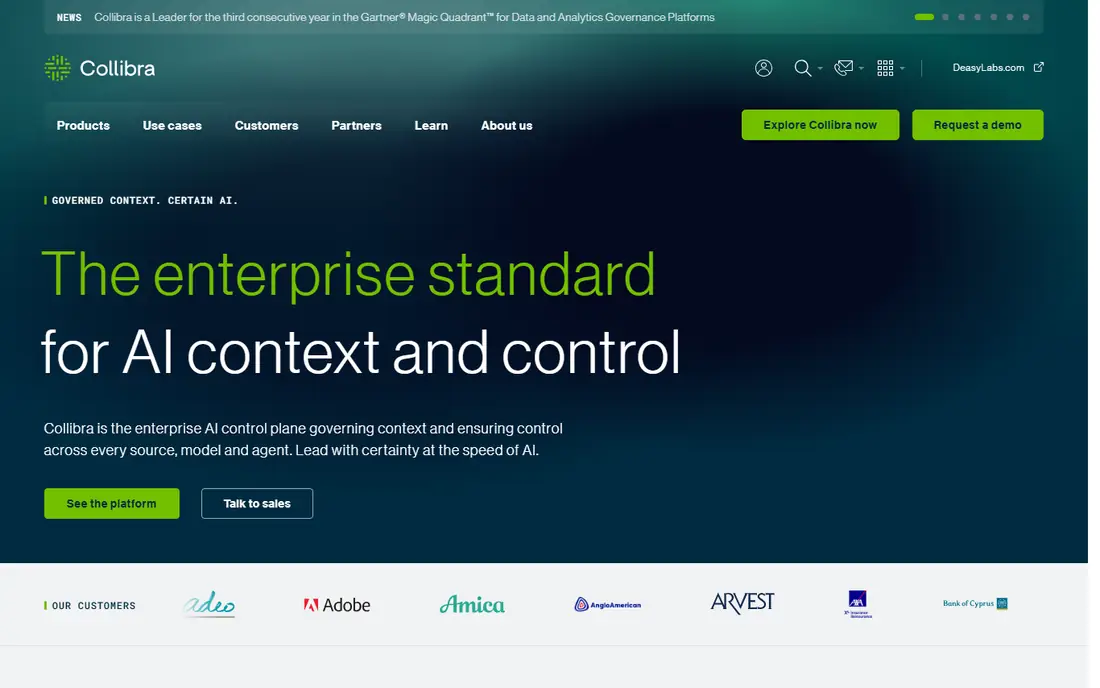
Collibra combines data catalog, governance and quality tools in one platform, helping enterprises define data ownership, policies and standards alongside discovery. That governance depth suits regulated industries where access must be controlled and audited.
Complexity and pricing are enterprise level, and implementation is a project. For a regulated company that needs governance first and democratization second, Collibra is the strongest choice in this list.
- Strong governance workflows
- Catalog and quality tools
- Enterprise scale
- Enterprise complexity and pricing
- Implementation is a project
data.world
Ideal for: Collaborative data catalog
data.world offers a collaborative data catalog built on a knowledge graph, helping teams document, discover and govern data with context about relationships between datasets. Its collaborative features suit data teams that want shared understanding, not just a searchable list.
Pricing is quote based, and it is a smaller vendor than Alation or Collibra. For a data team that values collaboration and context, data.world is a thoughtful alternative worth a demo.
- Collaborative catalog
- Knowledge graph approach
- Good for data teams
- Pricing is quote based
- Smaller vendor than Alation
ThoughtSpot
Ideal for: Self service search analytics
ThoughtSpot lets business users ask questions in plain language and get charts and answers from governed data, without writing SQL or waiting for an analyst. That search based approach suits teams that need fast answers to changing questions.
It needs clean, modeled data to work well, so data preparation matters. Pricing is quote based, with a trial to test. For a company that wants business users to self serve analytics safely, ThoughtSpot is a leading choice.
- Search based analytics
- Natural language questions
- AI assisted insights
- Needs clean, modeled data
- Pricing is quote based
Tableau
Ideal for: Visual analytics for business teams
Tableau is a leading visual analytics platform, letting teams connect to many data sources, build dashboards and explore data interactively. Its visualization strength and large community make it a safe choice for companies standardizing on one BI tool.
Pricing grows with users, and advanced analysis takes learning. For a company that wants polished dashboards and self service exploration, Tableau remains a top choice, especially where visual storytelling matters.
- Powerful visualizations
- Broad data connections
- Large community
- Pricing grows with users
- Learning curve for advanced analysis
Domo
Ideal for: Business intelligence platform for companies
Domo is an all in one business intelligence platform covering data integration, dashboards, alerts and mobile access. Its breadth suits companies that want one platform for data pipelines through executive dashboards, without stitching together several tools.
Pricing is quote based, and complexity can overwhelm a small team. For a midsize or large company that wants a single BI platform, Domo is a strong contender. Test its connectors with your real data sources during a trial.
- All in one BI platform
- Data integration
- Mobile friendly dashboards
- Pricing is quote based
- Complexity for small teams
Sigma
Ideal for: Spreadsheet style analytics on warehouses
Sigma lets users analyze cloud warehouse data with a spreadsheet familiar interface, without moving data or learning SQL. Business users who live in spreadsheets find it natural, while analysts can build governed models underneath.
It needs a cloud data warehouse, so companies without one must adopt that first. Pricing is quote based, with a trial. For a warehouse centered team that wants spreadsheet style self service, Sigma is an excellent choice.
- Spreadsheet familiar interface
- Live warehouse queries
- Good for analysts and business users
- Needs a cloud warehouse
- Pricing is quote based
How we picked these
We compared official feature pages, pricing pages and public reviews for each tool, focusing on products that are still maintained and work in October 2026. We favored tools with real discovery, governance or self service capabilities, plus integrations with modern data stacks. We left out generic BI tools with no catalog or governance story, discontinued products, and tools with no verifiable enterprise customers. Prices are often quote based, so request a demo for your stack.
How to democratize data without creating chaos
Start with a catalog and ownership. Before opening access, document your key datasets, name an owner for each, and record quality notes and definitions. A catalog such as Atlan or Alation makes that documentation findable, which is the foundation of trusted self service.
Next, give business users governed paths, not raw database access. Use analytics tools such as ThoughtSpot, Tableau or Sigma on modeled, permissioned data, so users can explore safely without seeing sensitive fields or breaking production systems. Row and column permissions matter more than most teams expect.
Finally, measure adoption and trust. Track which datasets are used, which questions recur, and where users report bad data. Fix the most used datasets first, and celebrate teams that use data well. Democratization succeeds when business users trust the data and data teams spend less time on repeat requests.
Start with a small set of certified datasets rather than opening everything at once. Pick the ten datasets your business users request most, document them thoroughly, assign owners, and certify them as trusted, then promote only those in the catalog. A small trusted library beats a large untrusted one, because users who find bad data once will stop trusting the catalog entirely. Expand certification gradually as data quality improves, and retire datasets that no longer meet the standard. Also invest in data literacy alongside tools, since access without understanding leads to confident but wrong conclusions. Run short training sessions on reading dashboards, spotting bad joins, and checking sample sizes, aimed at business users rather than analysts. A team that knows how to question a number is safer than a team with a beautiful dashboard and no skepticism, and literacy training is cheaper than fixing decisions made from misunderstood data.
Data quality scoring is worth building into any democratization program, since users need a quick signal for whether a dataset is trustworthy. Simple scores based on freshness, completeness, and known issues help business users decide at a glance, and they give data teams a prioritized list of what to fix. Publish the scoring method openly, so users understand what a score means and data owners know how to improve theirs. A transparent quality score builds trust faster than any catalog marketing claim. Also create a feedback loop from business users back to data owners, so errors and questions reach the people who can fix them. A simple request or issue button on each dataset, routed to its owner with a response time target, turns a catalog from a directory into a living system. Track how many issues are raised and resolved, and celebrate owners who respond quickly. Feedback loops are what keep a democratization program alive after the launch excitement fades.
Frequently asked questions
What is the best data democratization tool?
Atlan and Alation lead for data catalogs, while ThoughtSpot and Tableau lead for self service analytics. Most companies need a catalog plus an analytics tool, so shortlist one of each rather than a single product.
What does data democratization mean?
It means giving business users safe, governed access to data they can understand and use themselves, instead of routing every question through a central analyst team. Governance, quality and permissions are part of it, not an afterthought.
Do I need a data catalog or a BI tool?
You likely need both. A catalog makes data findable and trusted, while a BI tool makes it analyzable. A BI tool without a catalog leaves users guessing which data to trust, and a catalog without BI leaves data undiscovered in practice.
How much do data democratization tools cost?
Most enterprise tools use quote based pricing tied to users, data sources and features, with trials available for analytics tools. Request a quote for your exact stack and user count.
Is data democratization safe?
It is safe when paired with governance: ownership, permissions, quality checks and audit trails. Open access without those controls risks privacy breaches and bad decisions from bad data, so govern first, then open access.