Data Pipeline Software Compared: 6 Tools, Prices and Limits

- The list opens with Estuary, aimed at live CDC pipelines.
- For data integration with reverse ETL, Rivery is worth a look.
- Estuary, Rivery and the 4 others all need a premium plan or a trial, since no free plan is listed.
- One limit worth knowing about dbt: it is the T in ELT, not a full pipeline tool.
Direct answer
Start with Estuary if you need live CDC pipelines. For a different need, dbt covers transformation layer for warehouse data and Fivetran covers managed ELT without connector maintenance. Prices, free plans and limits for all 6 tools follow.
Quick comparison
| Product | Ideal for | Price from | Free version | |
|---|---|---|---|---|
 Estuary | Live CDC pipelines | See website | Not stated | Visit |
 dbt | Transformation layer for warehouse data | See website | Not stated | Visit |
 Fivetran | Managed ELT without connector maintenance | See website | Not stated | Visit |
 Hevo Data | No-code pipelines for analytics teams | See website | Not stated | Visit |
 Matillion | Visual pipelines with deep transformation | See website | Not stated | Visit |
 Rivery | Data integration with reverse ETL | See website | Not stated | Visit |
Tool-by-tool breakdown
This Ainotely guide covers 6 options for data pipeline software. Each profile lists a starting price, free plan details, strengths and drawbacks, so you can drop poor fits quickly.
Estuary
Ideal for: Live CDC pipelines
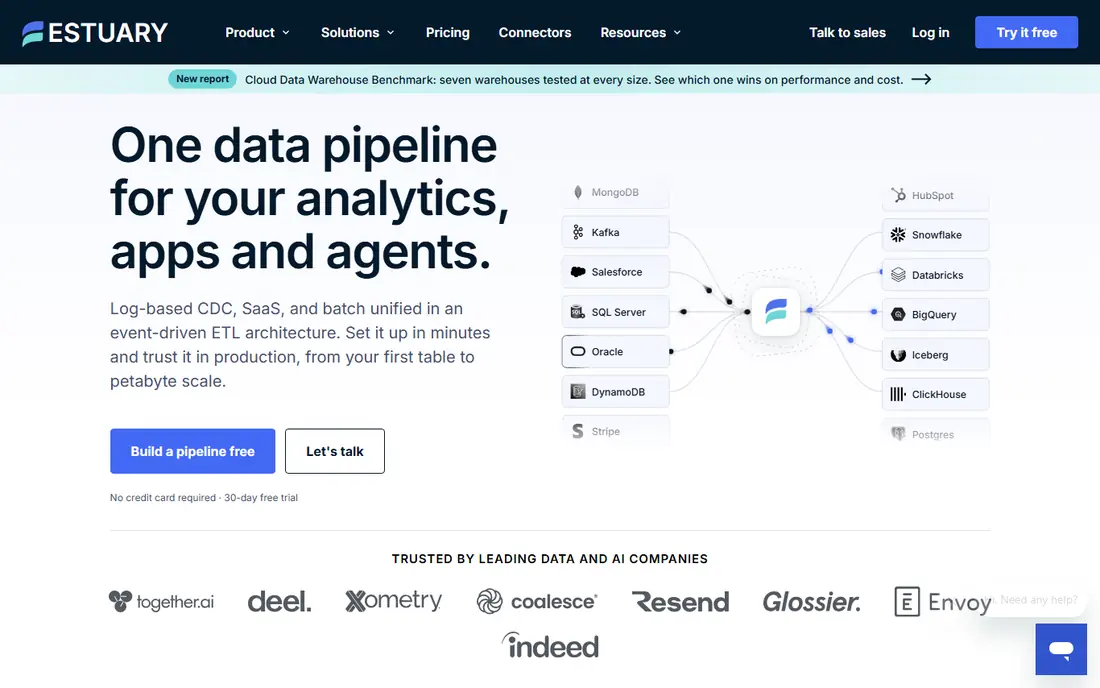
Estuary was built for real-time CDC pipelines. Teams with purely batch needs may find the live machinery unnecessary.
Upsides: Ample free level.
Its change data capture streams database changes to warehouses and lakes with sub-second latency and exactly-once delivery guarantees, a meaningful step beyond batch ELT for operational analytics and event-driven use cases. This comparison lists no price for Estuary; ask the vendor. Free plan details: Not stated.
Limits to weigh: Newer vendor with a smaller ecosystem.
- Exactly-once delivery semantics
- Live change data capture with sub-second latency
- Live focus means less for pure batch shops
dbt
Ideal for: Transformation layer for warehouse data
Where dbt fits: transformation layer for warehouse data. dbt does not move data into your warehouse; it transforms data once it is there. That narrow focus made it the standard: analysts write SQL models with version control, testing, and documentation, turning raw replicated tables into trusted datasets.
Points against: It is the T in ELT.
The package ecosystem and community are unmatched for analytics engineering. And it assumes SQL fluency. This comparison lists no price for dbt; ask the vendor. Free options: Not stated.
- Industry-standard transformation framework with version control
- Huge community and package ecosystem
- Not a full pipeline tool
Fivetran
Ideal for: Managed ELT without connector maintenance
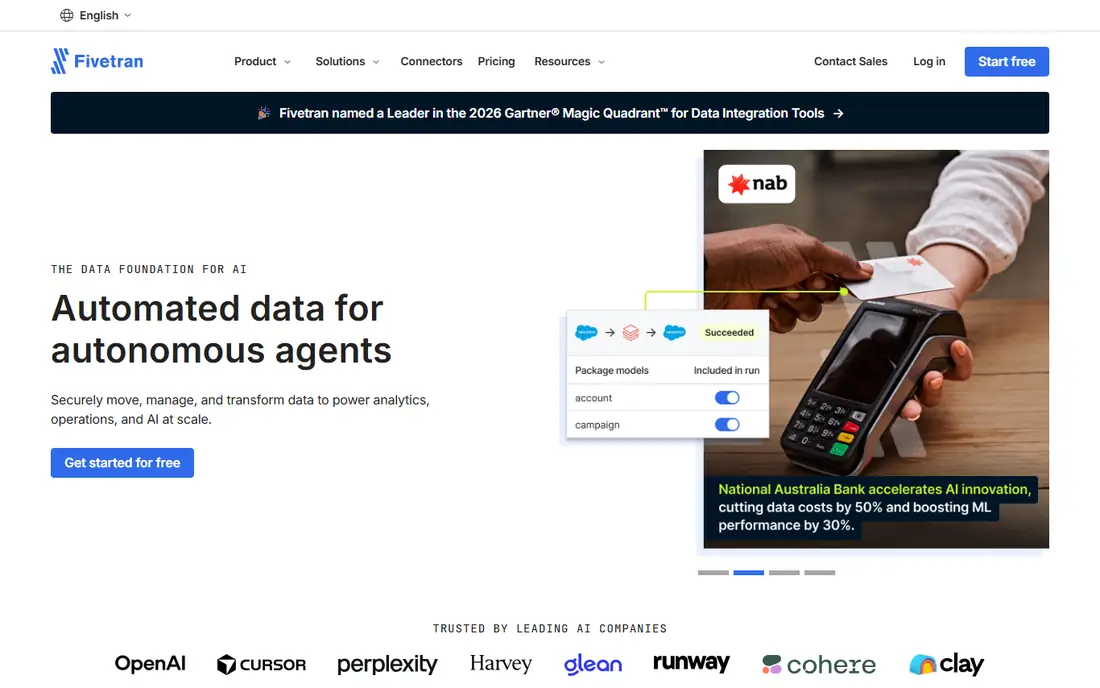
Fivetran is built with managed ELT without connector maintenance in mind. Connectors for hundreds of SaaS sources and databases are completely managed: Fivetran handles API changes, schema drift, and reliability, whereas your team centres on analysis. In practice, the ELT model loads raw data into your warehouse, where dbt or SQL takes care of transformation.
Where it falls short: Consumption-based pricing can surprise at scale.
From a buyer's view, the trade-off is cost and control. In practice, Consumption-based pricing scales with data volume, and heavy pipelines can get pricey. But for teams that would rather pay than maintain connectors, Fivetran's reliability record justifies the premium. Fivetran shows no starting price here, so confirm the cost on the vendor site. As for free access: Not stated.
- Steady and low-maintenance
- Completely managed connectors with automatic schema handling
- Less customization than open-source alternatives
Hevo Data
Ideal for: No-code pipelines for analytics teams
Hevo Data was built for no-code pipelines for analytics teams. Hevo Data targets analytics teams that require pipelines without data engineers.
In practice, pricing is accessible, and the free level lets small teams start without budget approval. This comparison lists no price for Hevo Data; ask the vendor. Free access: Not stated.
Drawbacks to consider: Enterprise governance features trail leaders.
- No-code pipeline setup with 150+ integrations
- Accessible pricing for expanding teams
- Advanced customization is restricted
Matillion
Ideal for: Visual pipelines with deep transformation
Think of Matillion for visual pipelines with deep transformation. Casual users may find it more than they need.
The visual designer spans both ETL and ELT patterns with deep transformation components, appealing to teams that want power without writing everything in code. Matillion shows no starting price here, so confirm the cost on the vendor site. Trial and free access: Not stated.
Downsides: Ramp-up time for the full product.
- Visual pipeline designer with serious transformation depth
- Capable cloud warehouse integrations
- Pricing geared toward serious data teams
Rivery
Ideal for: Data integration with reverse ETL
Choose Rivery for data integration with reverse ETL. Credit-based pricing needs attention as usage grows. And Rivery lacks the name recognition of Fivetran or dbt, which matters for hiring and community support.
Rivery covers the full data lifecycle: ingest into the warehouse, transform, orchestrate, and push data back out to operational systems with reverse ETL. That last piece matters for teams activating warehouse data in CRMs, ad systems, and support tools. The visual orchestration takes care of complicated multi-step workflows. Rivery does not show a starting price in this comparison, so check the vendor site for current pricing. Trial and free access: Not stated.
Points against: Credit-based pricing needs monitoring.
- Decent API and custom source support
- Full data integration plus reverse ETL to operational tools
- Brand recognition trails the biggest names
How we built this list
Each tool was reviewed on what its vendor publishes: price, plan limits, core features and stated drawbacks. We did not run hands-on tests. Seat minimums, billing terms and add-ons can move the real cost, so the starting prices here are a guide and not a quote. We ordered the tools by general fit, then by how clearly pricing is shown, then by free access. A buyer with unusual needs may reorder them.
A buyer's checklist
- Ask each vendor, from Estuary to Rivery, for a written quote; none of them publishes a starting price.
- Before choosing Estuary, weigh its main limit: real-time focus means less for pure batch shops.
- Get the contract term, renewal terms and any onboarding fees from Rivery in writing.
- List the apps you already depend on and check that dbt supports each one on the plan you would buy.
- Compare total cost, not headline price: for Hevo Data, add extra seats, add-ons and any usage-based charges.
Frequently asked questions
What is reverse ETL?
Reverse ETL moves data from the warehouse back into operational tools like CRMs, marketing systems, and support systems. From a buyer's view, Rivery bundles reverse ETL; standalone tools also exist for this job.
Does any tool for data pipeline software here have a free plan?
A permanent free plan is not offered by Estuary, Rivery or the other tools here. Plan a short evaluation period instead.
Do I still need dbt if I have Fivetran?
Normally yes. Fivetran deals with extraction and loading; dbt takes care of transformation. They are meant to work together, and the Fivetran-plus-dbt combination is one of the most typical modern data stacks. As for the details, some products bundle transformation, but dbt remains the standard for the T in ELT.
Can I try these options before paying?
Not by default. None of the tools, from Estuary to Rivery, lists a free plan or a free trial here, so ask each vendor for a demo before committing.
Do these tools publish their prices?
No. None of the tools, from Estuary to Rivery, shows a fixed starting price here, so budget time for quotes.
What is the difference between ETL and ELT?
ETL transforms data before loading it into the destination, whereas ELT loads raw data first and transforms it inside the destination. From a buyer's view, ETL persists for compliance-heavy or legacy scenarios.