Data Quality Software: 7 Tools Worth Comparing in 2026

- 1
 MelissaSMBs verifying addresses, emails and phonesVisit
- 2
 PreciselyEnterprises needing quality plus data enrichmentVisit
- 3
 SodaData engineering teams wanting code-based checksVisit
- 4
 Qlik TalendTeams wanting quality inside integration pipelinesVisit
- 5
 InformaticaLarge enterprises standardizing on one data systemVisit
- Number one here is Melissa, a fit for SMBs verifying addresses, emails and phones.
- Soda, Great Expectations: these are the 2 tools out of 7 that offer a free plan.
- Monte Carlo is the one to check for enterprises wanting ML-based pipeline monitoring.
- Check the limits for Qlik Talend before you commit: now part of Qlik, so the roadmap follows Qlik Talend Cloud.
Direct answer
If you need SMBs verifying addresses, emails and phones, Melissa is the first tool to look at here. For a different need, Precisely covers enterprises needing quality plus data enrichment and Soda covers Data engineering teams wanting code-based checks. Prices, free plans and limits for all 7 tools follow.
Quick comparison
| Product | Ideal for | Price from | Free version | |
|---|---|---|---|---|
| Melissa | SMBs verifying addresses, emails and phones | See website (credit-based pricing) | Free trial (90 days) | Visit |
| Precisely | Enterprises needing quality plus data enrichment | See website (custom quote) | No | Visit |
| Soda | Data engineering teams wanting code-based checks | $0/month (Free plan); $750/month (Team) | Yes | Visit |
| Qlik Talend | Teams wanting quality inside integration pipelines | See website (custom quote) | No | Visit |
| Informatica | Large enterprises standardizing on one data system | See website (custom quote) | No | Visit |
 Great Expectations | Python-native teams wanting free open-source validation | Free (GX Core open source); See website (GX Cloud) | Yes | Visit |
 Monte Carlo | Enterprises wanting ML-based pipeline monitoring | See website (custom quote) | No | Visit |
Every option for data quality software explained
This Ainotely guide covers 7 options for data quality software. Each profile lists a starting price, free plan details, strengths and drawbacks, so you can drop poor fits quickly.
Melissa
Ideal for: SMBs verifying addresses, emails and phones
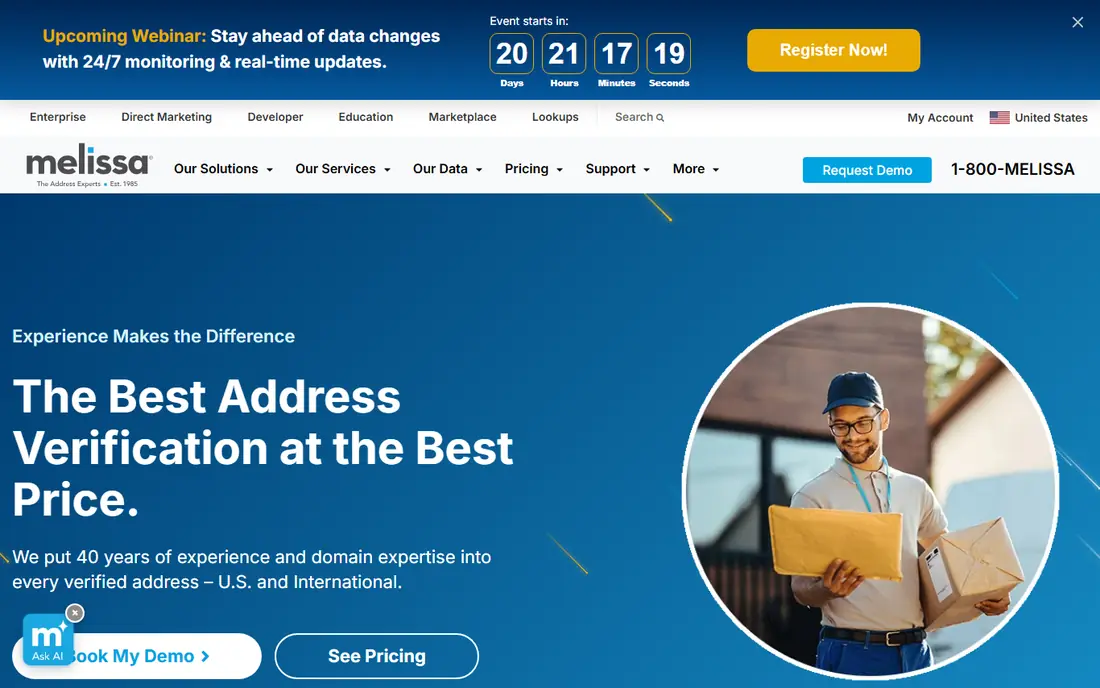
Melissa works best for SMBs verifying addresses, emails and phones. The pricing page lists pay-as-you-go, subscription and unlimited levels, with a 90-day free trial on subscriptions. In daily use, Melissa is the value pick for contact data quality: address verification, email and phone checks, dedupe and geocoding, sold on usage-based credits rather than enterprise contracts.
Where it falls short: Contact-data scope only; not pipeline monitoring or governance.
For a business cleaning a mailing list or validating checkout addresses, the credit model keeps costs proportional to volume. In practice, Melissa cleans the data entering your systems, but it is not a pipeline monitoring or governance system. This comparison lists no price for Melissa; ask the vendor. Free plan details: Free trial (90 days). Highlights: Usage-based credits rather than enterprise contracts.
- Dedupe and geocoding
- 90-day free trial on subscription plans
- Enterprise data teams will outgrow it
Precisely
Ideal for: Enterprises needing quality plus data enrichment

Precisely serves enterprises needing quality plus data enrichment. Precisely frames its product as a Data Integrity Suite: quality, governance, observability, integration and enrichment on one modular cloud product. Beyond that, Precisely's heritage is data quality for large, regulated organizations.
Watch-outs: The suite scope overwhelms teams that only need cleansing.
In practice, the enrichment angle is the differentiator, with pre-linked datasets for addresses, locations and business data ready to append. For everyday use, everything is custom-quoted and enterprise-shaped. For firms that require to clean customer records and then add missing context to them, that combination saves a second vendor. Check the vendor site for Precisely pricing; none is listed in this comparison. Precisely has no permanent free option.
- Modular suite including quality, governance, observability
- Locations and business data
- Consolidation projects take time
Soda
Ideal for: Data engineering teams wanting code-based checks
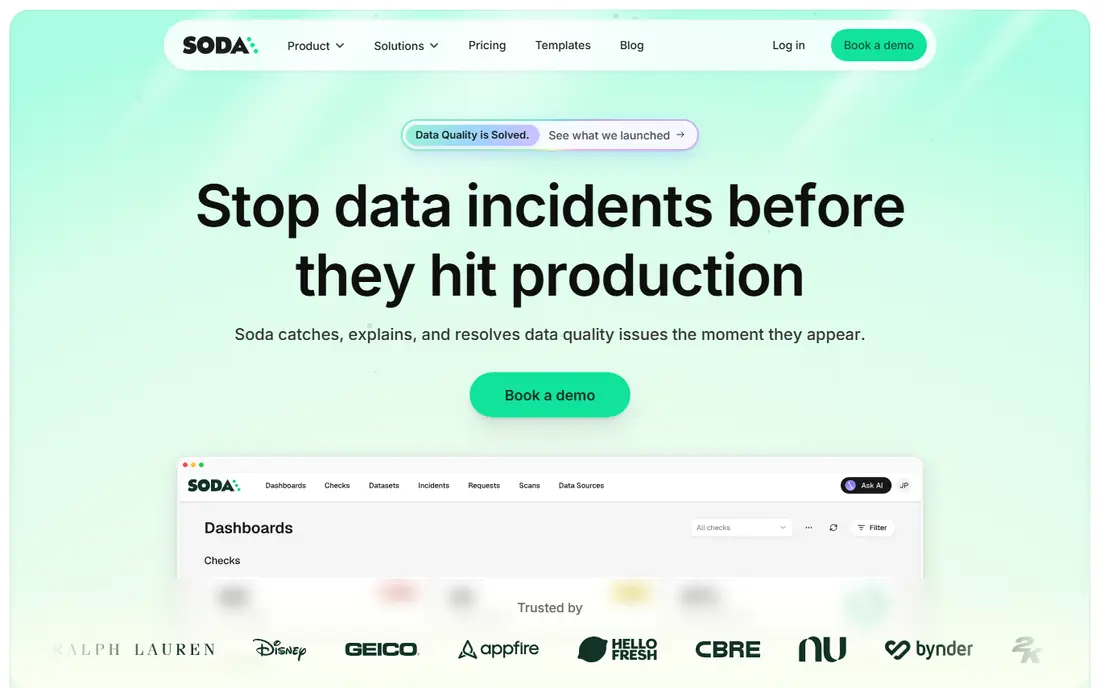
Where Soda fits: Data engineering teams wanting code-based checks. Soda writes data quality checks as code, in a YAML-style language data engineers already understand, and pairs it with a no-code interface so business users share one workflow.
Beyond that, the premium Team level begins at $750 a month, which is steep for a small shop but transparent next to the custom-quote crowd. Soda cost at the entry level: $0/month. Soda has a free plan.
Upsides: rare in this category.
What to check first: Team level at $750/month is steep for a small shop; Newer vendor than the incumbents.
- Free plan spans pipeline testing
- Published pricing
- Concentrated on checks and contracts
Qlik Talend
Ideal for: Teams wanting quality inside integration pipelines
Qlik Talend makes the most sense for teams wanting quality inside integration pipelines. Qlik Talend (Talend is now part of Qlik) is the data quality product inside Qlik Talend Cloud, alongside integration and governance.
Standalone buyers face the usual enterprise trade-offs: custom pricing and a sales-led process. In practice, checking quality inside the pipeline beats finding problems after the data lands. Check the vendor site for Qlik Talend pricing; none is listed in this comparison. Qlik Talend has no free tier.
What to check first: Custom pricing with a sales process.
- Trust scoring rates every dataset in the product
- Wide connector library from its open-source heritage
- Now part of Qlik, so the roadmap follows Qlik Talend Cloud
Informatica
Ideal for: Large enterprises standardizing on one data system
Informatica targets large enterprises standardizing on one data system. Informatica is the incumbent most enterprises compare everything else against. Its data quality capabilities sit inside the Intelligent Data Management Cloud, alongside integration, governance, master data management and observability.
That matters since quality stops being a side project when it shares the same system as the pipelines moving the data. In daily use, note the homepage now brands it as "Informatica from Salesforce," which tells you where the system's roadmap lives. No starting price is listed for Informatica here; confirm pricing on the vendor site. Informatica has no free tier.
Points against: Overkill for small teams. Where Informatica stands out: The safe enterprise default with long track record.
- MDM and observability
- Data quality sits inside a full system with integration, governance
- Implementation generally needs services and in-house data engineers
Great Expectations
Ideal for: Python-native teams wanting free open-source validation
Great Expectations is aimed squarely at Python-native teams wanting free open-source validation. Excellent Expectations, now branded GX, is the open-source standard for data validation: define expectations in Python, run them in your pipeline, and get Data Docs showing what passed and failed in plain language.
What to check first: Real ramp-up time for non-engineers.
GX Cloud brings the managed layer at custom pricing. Free means you build the surrounding infrastructure yourself: scheduling, alerting, dashboards. Great Expectations starts at: Free. Great Expectations offers a free plan.
- Large community and wide integrations
- Apache 2.0 licensed
- You build the surrounding infrastructure (scheduling, alerting, dashboards) yourself
Monte Carlo
Ideal for: Enterprises wanting ML-based pipeline monitoring
Monte Carlo serves enterprises wanting ML-based pipeline monitoring. Monte Carlo created the data observability category, and it still defines it.
From a buyer's view, pricing is custom and enterprise-oriented, and Monte Carlo assumes a modern cloud data stack like Snowflake, Databricks or BigQuery. Monte Carlo does not show a starting price in this comparison, so check the vendor site for current pricing. Monte Carlo has no free plan.
What to check first: Assumes a modern cloud warehouse or lakehouse.
What Monte Carlo does well: schema and distribution anomalies.
- Machine-learning watches catch freshness, volume
- Wide coverage of modern cloud data stacks
- Custom enterprise pricing
How we compared the tools
Selection started from tools commonly considered for data quality software, then narrowed to 7 that have clear pricing information or a clear quote process. Figures are shown as the vendors publish them. Billing terms, seat minimums and add-ons can change the real cost. Order on the page follows fit for the typical buyer first, then price transparency and free access. Your own requirements should decide the final pick.
What to confirm before you sign up
- Ask Melissa, Precisely, Qlik Talend and others for a written quote, since no starting price is shown.
- Look at free plan limits closely: Soda and Great Expectations have one, and the caps decide whether it is usable for real work.
- Use real work to test the free trial from Melissa, rather than a demo project.
- Read the limits listed for Melissa first: no flat starting price published, so budgeting needs a quote.
- Let daily users try Informatica on real work; their feedback beats any feature checklist.
- Confirm the exact Melissa plan that includes your must-have features.
Frequently asked questions
Which options for data quality software have a free plan?
On this list, Soda and Great Expectations include a free plan. Caps on seats, usage or features are common, so test the free plan against your real workload. One other tool offers a trial instead.
Is there a free data quality tool?
Yes. GX Core is free and open source under Apache 2.0, and Soda offers a free plan with pipeline testing and alerting integrations at $0/month with no credit card required.
Which data quality tool is a good match for a small business?
Start with Melissa if you need SMBs verifying addresses, emails and phones. Precisely is the better match for enterprises needing quality plus data enrichment, and Soda for Data engineering teams wanting code-based checks. The best choice depends on budget, team size and workflow.
Can I try these options before paying?
Often, yes. Soda and Great Expectations have a free plan and Melissa offers a free trial. Use your own data and a real task during the test, and check what the free tier or trial limits before you rely on it.
What is the difference between data quality and data observability?
Data observability tools like Monte Carlo watch pipelines and tables for anomalies (freshness, volume, schema changes) and alert owners. They solve different halves of the problem, which is why teams commonly run both.
Do these tools publish their prices?
Not all of them. Melissa, Precisely, Qlik Talend and others publish no starting price, so expect a quote request for those. The rest, Soda included, show a starting price, though seats and billing terms still change the final cost.