6 Best Digital Sales Room Software Options for 2026

- Accord sits first on this list: standardized mutual action plans at scale.
- Aligned is the one to check for straightforward shared spaces for first-time DSR teams.
- GetAccept has the lowest monthly starting price in this list: $25/user/month.
- Accord, Dock, Trumpet, Aligned: these are the 4 tools out of 6 that offer a free plan.
- One limit worth knowing about Accord: $899 per month entry prices out small teams.
Direct answer
Accord leads the list, best for standardized mutual action plans at scale. For a different need, GetAccept covers proposals, contracts and e-sign in one room and DealHub covers enterprise deal playbooks and CPQ. Details, prices and limits for the rest of the 6 tools are below.
Quick comparison
| Product | Ideal for | Price from | Free version | |
|---|---|---|---|---|
 Accord | Standardized mutual action plans at scale | $899/month | Yes | Visit |
 GetAccept | Proposals, contracts and e-sign in one room | $25/user/month (eSign plan) | Free trial (14 days) | Visit |
 DealHub | Enterprise deal playbooks and CPQ | See website (custom quote) | No | Visit |
 Dock | Full-journey workspaces from deal to onboarding | $350/month (Standard plan, 5 seats) | Yes | Visit |
 Trumpet | Collaborative microsites for complicated deals | $45/user/month | Yes | Visit |
 Aligned | Straightforward shared spaces for first-time DSR teams | $29/user/month | Yes | Visit |
The 6 tools in detail
Short on time? The summary and table above give the quick view of 6 tools for digital sales room software, and the profiles that follow give the detail behind each entry.
Accord
Ideal for: Standardized mutual action plans at scale

Where Accord fits: standardized mutual action plans at scale. It standardizes how reps run evaluations, with shared checklists, stakeholder mapping and forecast-friendly structure that hands managers real visibility into deal health. On top of that, beginning at $899 per month, Accord is priced for teams, not individuals.
Trade-offs to know: Narrower feature set than full DSR systems.
It does not try to match Dock's onboarding hubs or GetAccept's contracts. It is a discipline tool for process-driven sales orgs. What you pay to start with Accord: $899/month. Accord includes a free tier.
- Mutual action plans and standardized sales execution are the core specialty
- Solid fit for teams standardizing rep behavior
- $899 per month entry prices out small teams
GetAccept
Ideal for: Proposals, contracts and e-sign in one room
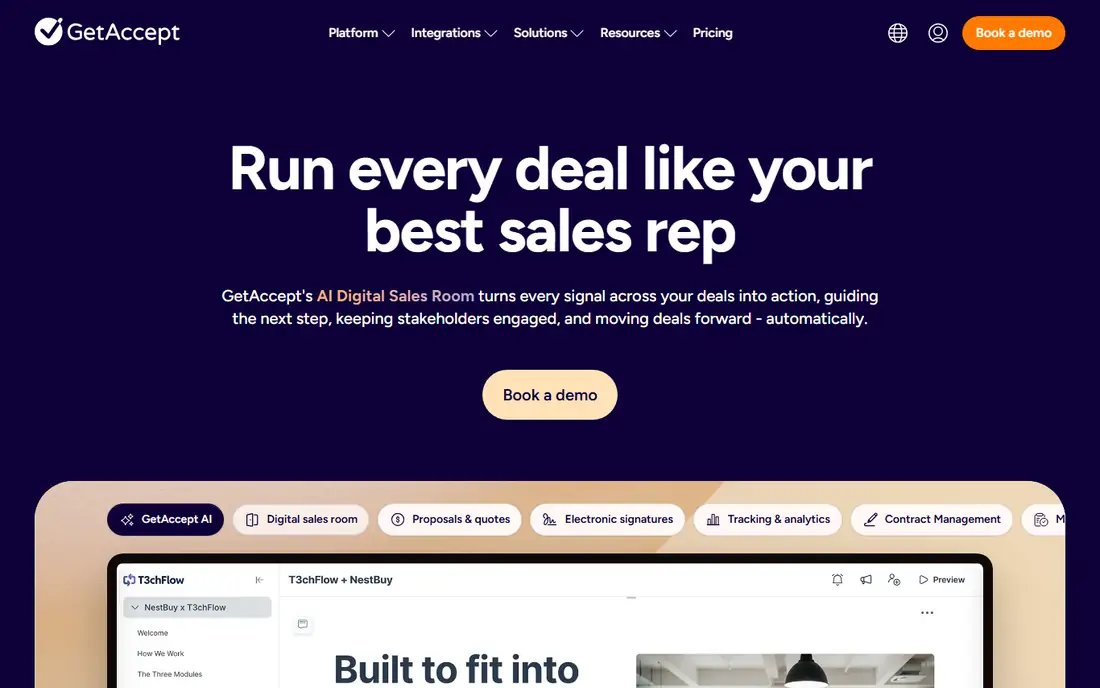
GetAccept works best for proposals, contracts and e-sign in one room. The honest catch is that the full DSR experience costs more than the headline price recommends.
There is no free level to test with. The product's breadth can also feel heavy for teams that just want straightforward rooms. What you pay to start with GetAccept: $25/user/month. As for free access: Free trial (14 days).
Where it is weaker: No free plan; Interface carries the weight of its plenty of modules.
Where it shines: Native e-signatures and contract rooms no competitor matches at this price.
- Modular pricing lets you buy only what you need
- Deep CRM integrations across Salesforce
- Full digital sales room needs the $49+ levels
DealHub
Ideal for: Enterprise deal playbooks and CPQ

Pick DealHub if this describes you: enterprise deal playbooks and CPQ. The honest catch is everything enterprise: custom quotes, implementation projects, and a system whose power is wasted on straightforward deals.
Points against: Implementation is a project, not a signup.
In daily use, if your deals involve CPQ, legal redlines and multi-level approvals, DealHub is aimed at exactly that. This comparison lists no price for DealHub; ask the vendor. There is no free plan with DealHub.
- Contract management and subscription billing
- Interactive deal playbooks guide complex enterprise cycles
- Overkill for teams that just need shared deal spaces
Dock
Ideal for: Full-journey workspaces from deal to onboarding
Dock serves full-journey workspaces from deal to onboarding. It starts with digital sales rooms (mutual action plans, embedded videos, messaging, timelines) and keeps going: the same workspace becomes the customer onboarding hub after the deal closes, with a content management system and learning modules layered on top.
The pricing reflects the ambition. Price to start with Dock: $350/month. Dock has a free plan.
Drawbacks to consider: Breadth means some features feel lighter than focused rivals.
- AI features produce business cases and surface deal guidance
- Free plan with up to 50 workspaces is genuinely usable
- Engagement analytics are entry-level compared with specialists
Trumpet
Ideal for: Collaborative microsites for complicated deals
In short, Trumpet is for collaborative microsites for complicated deals. The honest catch is the climb. Also, Trumpet calls its rooms "pods," and the microsite metaphor is apt: each deal gets a personalized, branded hub with videos, documents, mutual action plans and messaging that feels aimed at that buyer, not templated.
Watch-outs: premium levels climb rapidly (Scale around $60/user/month).
The free plan with up to 10 pods lets a small team run real deals before paying, which is rare in this category. From a buyer's view, pricing is natively in pounds, which layers on friction for US finance teams. Entry price for Trumpet: $45/user/month. A free plan is available with Trumpet.
- Solid stakeholder tracking and engagement signals
- Free plan bundles up to 10 pods for real evaluation
- Enterprise features need the top levels
Aligned
Ideal for: Straightforward shared spaces for first-time DSR teams
Aligned makes the most sense for straightforward shared spaces for first-time DSR teams. At $29 per user a month with a free plan to start, it provides teams their first shared deal spaces in days: content sharing, mutual action plans, stakeholder tracking and CRM integrations with Salesforce, HubSpot, Close and Pipedrive.
Watch-outs: Fewer advanced features than Dock or DealHub.
The tradeoff is ceiling. In daily use, the interface is deliberately straightforward, which is exactly what teams adopting their first DSR need. What you pay to start with Aligned: $29/user/month. Aligned includes a free tier.
- Quick deployment with an easy-to-learn interface
- AI assistance without enterprise complexity
- Smaller integration list
How the list was put together
The comparison looks at four things: starting price, free access, how well the feature set matches digital sales room software, and the main limit of each tool. Where a price is missing, the vendor does not list one publicly or ties it to a quote. Always confirm before budgeting. The order reflects how well each tool fits the most common buying scenario for digital sales room software, then price clarity, then free plan access. It is a starting point, not a verdict.
What to confirm before you sign up
- Ask DealHub for a written quote, since no starting price is shown.
- Read the fine print on the free plans from Accord, Dock, Trumpet and Aligned; seat, project and feature caps differ.
- Use real work to test the free trial from GetAccept, rather than a demo project.
- Read the limits listed for Accord first: $899 a month entry prices out small teams.
- Ask whether Accord integrates with your current software, and whether that comes standard or as an add-on.
- Confirm minimum seats and billing terms with Trumpet before you commit to an annual plan.
Frequently asked questions
How do I get buyers to actually use the room?
Send the room link at the moment the buyer asks for materials, not as a cold follow-up. Put their company name and logo on it, keep the mutual action plan updated, and reference the room on every call.
What is the cheapest option for digital sales room software in this list?
On published monthly entry prices, GetAccept is the lowest here at $25/user/month. Entry price is only part of the cost, because seats, add-ons and billing terms can change the total.
Can a digital sales room replace my CRM?
Every system here links up with Salesforce or HubSpot to sync engagement data, stakeholders and mutual action plan progress back to the opportunity. Buy the room for buyer collaboration and keep the CRM as the system of record.
Can I try these options before paying?
Often, yes. Accord, Dock, Trumpet and Aligned have a free plan and GetAccept offers a free trial. Use your own data and a real task during the test, and check what the free tier or trial limits before you rely on it.
How are the tools for digital sales room software ordered?
The order follows typical fit for digital sales room software, with Accord first and Aligned last, then price clarity and free access. It is editorial judgement, not a score, so another team could rank the tools differently.
How is a digital sales room different from a data room?
A data room (like those used in M&A) is a secure repository for due diligence documents. A digital sales room is a collaborative selling space: it contains mutual action plans, messaging, engagement tracking and frequently proposals and e-signatures.