Best Direct Mail Automation Software in 2026: 7 Tools Compared

- 1
 PostPilotShopify brands doing winback mailVisit
- 2
 SendosoSales teams pairing gifts with mailVisit
- 3
 Thanks.ioHandwritten-style mail with no minimumsVisit
- 4
 PostalyticsMarketers running CRM-triggered campaignsVisit
- 5
 Click2MailOperational mail with no subscriptionVisit
- PostPilot takes the first slot, best suited to Shopify brands doing winback mail.
- For teams needing mail plus address verification in one API, PostGrid is worth a look.
- One limit worth knowing about Postalytics: free plan has the highest per-piece cost (about $1.05 for a 6x9 postcard).
- PostPilot and Sendoso: pricing is by quote only, so plan time for a sales conversation.
- Free plans exist at 4 of 7 tools (Postalytics, Click2Mail, Lob, PostGrid).
Direct answer
Our first pick is PostPilot, best for Shopify brands doing winback mail. Alternatives: Sendoso for sales teams pairing gifts with mail, and Thanks.io for handwritten-style mail with no minimums. Details, prices and limits for the rest of the 7 tools are below.
Quick comparison
| Product | Ideal for | Price from | Free version | |
|---|---|---|---|---|
| PostPilot | Shopify brands doing winback mail | See website | No | Visit |
| Sendoso | Sales teams pairing gifts with mail | See website | No | Visit |
| Thanks.io | Handwritten-style mail with no minimums | Postcards from $0.64/piece (print and postage included) | No | Visit |
| Postalytics | Marketers running CRM-triggered campaigns | Free plan; premium from $199/mo (Marketer) | Yes | Visit |
| Click2Mail | Operational mail with no subscription | No platform fee; 6x11 postcards from $0.73 per piece | Yes | Visit |
 Lob | Engineering teams mailing at scale | Free Developer plan; premium from $260/mo (Startup) | Yes | Visit |
 PostGrid | Teams needing mail plus address verification in one API | Free Starter tier; per-piece from ~$0.86/postcard | Yes | Visit |
Our 7 picks for direct mail automation software
Short on time? The summary and table above give the quick view of 7 tools for direct mail automation software, and the profiles that follow give the detail behind each entry.
PostPilot
Ideal for: Shopify brands doing winback mail
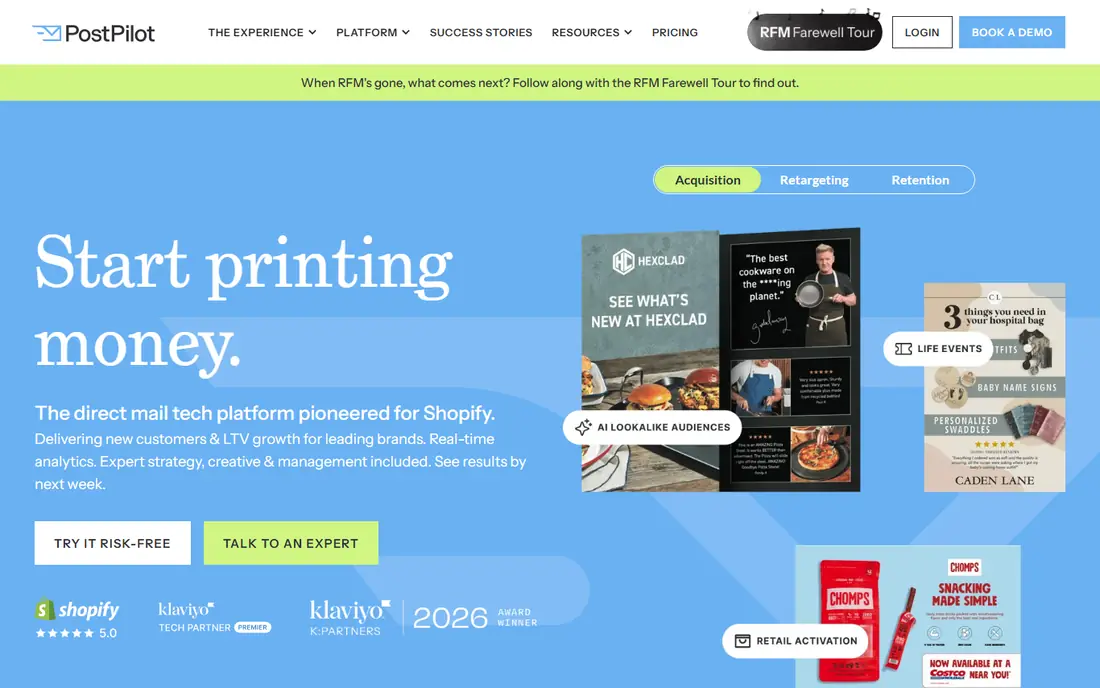
PostPilot serves Shopify brands doing winback mail. PostPilot treats direct mail as a retention channel for online keeps.
The main drawbacks: Centred on ecommerce; Per-piece costs can climb on large catalogs.
On top of that, the pitch is winback revenue from customers who stopped opening emails. The customer wall on its homepage is full of DTC founders. No starting price is listed for PostPilot here; confirm pricing on the vendor site. PostPilot has no free plan.
Upsides: Includes acquisition, retargeting.
- Purpose-built for Shopify and ecommerce
- MailMatch audience features
- No published pricing
Sendoso
Ideal for: Sales teams pairing gifts with mail
Sendoso is designed for sales teams pairing gifts with mail. Sales and marketing teams use it to send eGifts, branded merchandise, handwritten notes, and direct mail from one place, with address confirmation so packages do not go to stale addresses.
Trade-offs to know: Per-send costs add up on large campaigns.
In practice, if your use case is "mail twenty thousand postcards per month at the lowest per-piece cost," the API systems will be less expensive and more straightforward. No starting price is listed for Sendoso here; confirm pricing on the vendor site. Sendoso has no permanent free option.
- In-house fulfillment with custom packaging
- Native Salesforce and Marketo integrations
- No published pricing
Thanks.io
Ideal for: Handwritten-style mail with no minimums
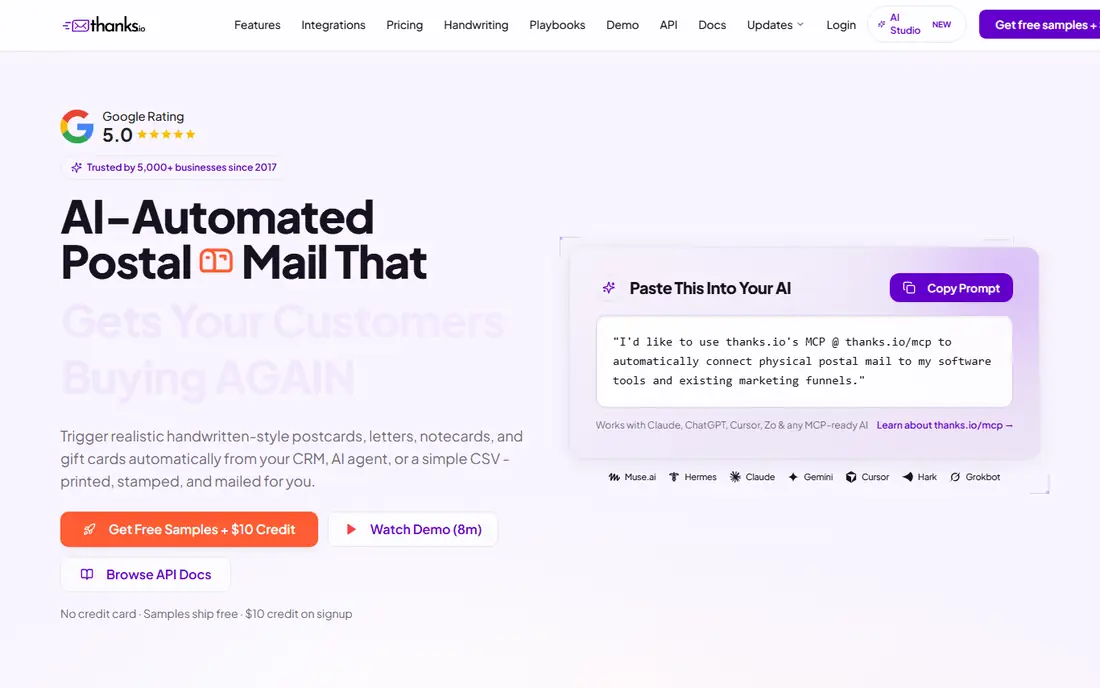
Thanks.io is a good fit for handwritten-style mail with no minimums. Teams and agencies sending over 1,000 pieces per month can ask for custom rates and get a dedicated account manager. Prices were last updated on its site in July 2026.
What to check first: Gift card sends need Business plans or higher.
Highlights: QR tracking and automatic drip campaigns; Zapier, HubSpot, Salesforce.
In practice, the differentiator is the handwritten look. Its engine produces postcards, letters, and notecards that read as personally written, with QR tracking, automated drip campaigns for birthdays and milestones. An AI studio that drafts campaigns from a plain-English description. In practice, there are no minimums, no monthly product fee. Pricing is published plainly: postcards from $0.64 a piece, letters from $0.79, and premium folded notecards from $1.49, with print, handwriting rendering, and US postage all included. What you pay to start with Thanks.io: Postcards from $0.64/piece. Thanks.io does not include a free plan.
- All-in per-piece pricing with postage included
- No minimums
- Handwritten style limits design adaptability
Postalytics
Ideal for: Marketers running CRM-triggered campaigns
Postalytics makes the most sense for marketers running CRM-triggered campaigns. Postalytics is the friendliest choice for a marketing team that wants direct mail to behave like email automation. More specifically, mailing lists are sold separately, so budget for data on top of the system fee.
Where it is weaker: Full Salesforce integration needs the $399/mo Pro and Agency plans.
The free plan is genuinely handy for pilots, but check the per-piece math before you scale: it carries the highest per-piece rates of any level. The $199/month Marketer plan brings one user login and most integrations, whereas the $399/month Pro and Agency plans add multi-touch flows, unlimited user logins, and agency white labeling. You design postcards and letters in a visual editor, link your CRM, and set triggers for birthdays, abandoned carts, or lifecycle stages. Entry price for Postalytics: Free plan. Postalytics offers a free plan.
Where it shines: Designed for marketers.
- Not developers
- Unlimited IMB tracking plus personalized QR codes and pURLs
- Free plan has the highest per-piece cost (about $1.05 for a 6x9 postcard)
Click2Mail
Ideal for: Operational mail with no subscription
Click2Mail is built with operational mail with no subscription in mind. Click2Mail is the workhorse pick for firms that mail statements, invoices, legal notices, and marketing postcards without wanting another monthly bill. Also, a 6x11 postcard begins at $0.73, and smaller 4.25x6 postcards run lower.
What to check first: Design services cost additional.
More specifically, the product range is broad: postcards, letters, certified mail with proof of delivery, EDDM neighborhood saturation, flyers, booklets, and reply mail. Volume discounts apply automatically as quantities grow. There is no software fee at all; you pay only when mail goes out. On top of that, free address validation and change-of-address updates are included, saving roughly the cost of a returned piece each time they catch a bad address. Entry price for Click2Mail: No platform fee. Click2Mail includes a free tier.
- No subscription fees and no minimum volumes
- Free CASS-certified address validation and NCOA updates
- The interface displays its age
Lob
Ideal for: Engineering teams mailing at scale
Choose Lob for engineering teams mailing at scale. Developers tend to pick Lob first because the API behaves the way APIs should. When you go live, the system routes each piece through the most efficient USPS entry point and prints it near its destination, which keeps delivery times predictable.
The main drawbacks: Monthly product fees start at $260.
What works well: Supports HIPAA, GDPR.
In daily use, on the free Developer plan (up to 500 mailings per month), a postcard starts around $0.81 before volume discounts. On the $260/month Startup plan it drops to about $0.55, and on the $550/month Growth plan to about $0.52. If you mail thousands of pieces per month, those gaps add up quick. Extras like US address verification are billed separately, and the free plan contains only a small monthly allotment. More specifically, test keys simulate the full mail lifecycle at no cost, so you can build and debug without printing a single piece. On cost, Lob starts like this: Free Developer plan. Lob offers a free plan.
- Postal IQ routing picks efficient USPS entry points
- Well-documented APIs with test keys
- Per-piece rates are highest on the free plan
PostGrid
Ideal for: Teams needing mail plus address verification in one API
Pick PostGrid if this describes you: teams needing mail plus address verification in one API. Its address verification API checks US, Canadian, and international addresses against postal standards, which cuts down on undeliverable pieces that cost you full postage. The print and mail API includes letters, postcards, checks, and self-mailers.
What to check first: SSO and express mailing need the Enterprise plan.
What PostGrid does well: Print and mail API plus address verification APIs in one account.
As for the details, if you also need continuing verification, those plans run from $18/month for 2,000 US and Canada lookups, with annual billing saving about 10 percent. For everyday use, the Starter level is free with up to 500 mailings per month, letters from about $1.02 and postcards from about $0.86 per piece, all print and postage included. Price to start with PostGrid: Free Starter tier. PostGrid includes a free tier.
- Free level lets up to 500 mailings per month
- Live delivery tracking
- Address verification plans are billed separately
How we built this list
We compared the tools on published pricing, free plan or trial availability, feature coverage for direct mail automation software, and the limits each vendor documents. Prices and plan limits come from vendor pages and can change, so confirm them on the vendor site before you buy. We ordered the tools by general fit, then by how clearly pricing is shown, then by free access. A buyer with unusual needs may reorder them.
Questions to settle before buying
- Get a written quote from PostPilot and Sendoso; the list shows no starting price for them.
- Read the fine print on the free plans from Postalytics, Click2Mail, Lob and PostGrid; seat, project and feature caps differ.
- Before choosing PostPilot, weigh its main limit: no published pricing.
- Look at the renewal terms for Click2Mail: auto-renewal, notice periods and price changes can matter more than the first-year price.
- Add up seats, add-ons and usage charges for PostGrid before comparing it with cheaper entries.
Frequently asked questions
Which options for direct mail automation software have a free plan?
On this list, Postalytics, Click2Mail, Lob and PostGrid include a free plan. Caps on seats, usage or features are common, so test the free plan against your real workload.
Is PostPilot the right pick for everyone comparing direct mail automation software?
No single tool suits every team. PostPilot comes first because it fits Shopify brands doing winback mail, while Sendoso suits sales teams pairing gifts with mail and Thanks.io suits handwritten-style mail with no minimums. Match the tool to your own size, budget and workflow before deciding.
Can I try these options before paying?
Often, yes. Postalytics, Click2Mail, Lob and PostGrid have a free plan. Use your own data and a real task during the test, and check what the free tier or trial limits before you rely on it.
How are the tools for direct mail automation software ordered?
PostPilot sits first and PostGrid last because the order follows typical fit for direct mail automation software, then price clarity and free access. It is a judgement call, so read each profile for fit and limits.