Document Collaboration Software: 7 Options Side by Side (2026)

- 1
 NuclinoSmall teams wanting a quick, straightforward wiki with minimal setupVisit
- 2
 SliteExpanding teams wanting a self-maintaining AI knowledge baseVisit
- 3
 Microsoft 365Firms needing desktop Office apps and enterprise compatibilityVisit
- 4
 ConfluenceOrganizations, particularly Jira users, needing structured team documentationVisit
- 5
 BoxRegulated industries needing secure file collaboration with complianceVisit
- This list starts with Nuclino, which is built for small teams wanting a quick, straightforward wiki with minimal setup.
- Notion fits teams wanting an adaptable wiki plus docs, databases, and AI in one workspace.
- Before buying Microsoft 365, weigh this: SharePoint complexity can overwhelm small teams.
- 3 of 7 tools offer a free plan: Nuclino, Confluence, Notion.
Direct answer
For small teams wanting a quick, straightforward wiki with minimal setup, Nuclino is where this list starts. Slite is better for expanding teams wanting a self-maintaining AI knowledge base, and Microsoft 365 is better for businesses needing desktop Office apps and enterprise compatibility. Details, prices and limits for the rest of the 7 tools are below.
Quick comparison
| Product | Ideal for | Price from | Free version | |
|---|---|---|---|---|
| Nuclino | Small teams wanting a quick, straightforward wiki with minimal setup | $6 per user/month | Yes | Visit |
| Slite | Expanding teams wanting a self-maintaining AI knowledge base | $10 per user/month (billed yearly) | Free trial (14 days) | Visit |
| Microsoft 365 | Firms needing desktop Office apps and enterprise compatibility | $7 per user/month (billed yearly) | Free trial (30 days) | Visit |
| Confluence | Organizations, particularly Jira users, needing structured team documentation | $5.42 per user/month | Yes | Visit |
| Box | Regulated industries needing secure file collaboration with compliance | $5 per user/month (billed yearly) | Free trial | Visit |
 Google Workspace | Teams wanting email, docs, and Drive that just work together | $7 per user/month (billed yearly) | Free trial (14 days) | Visit |
 Notion | Teams wanting an adaptable wiki plus docs, databases, and AI in one workspace | $10 per user/month (billed yearly) | Yes | Visit |
Our 7 picks for document collaboration software
If you are comparing document collaboration software, this page covers 7 tools in one place: what each is best for, what it costs to start, whether it has a free plan, and the main limit to know about.
Nuclino
Ideal for: Small teams wanting a quick, straightforward wiki with minimal setup

Nuclino is designed for small teams wanting a quick, simple wiki with minimal setup. The honest catch is ceiling. The free plan spans up to 50 items with live collaboration, and premium plans start at $6 per user a month with unlimited items, version history, and 10 GB storage per user.
Nuclino is the wiki for teams that looked at Notion and Confluence and thought "too much." Setup takes minutes, pages open immediately. The editor stays out of the way. On top of that, the integration list is shorter, and the AI Sidekick costs additional. But if your team has been avoiding documentation since the tools felt heavy, Nuclino removes every excuse, and the free plan means you can prove the habit before spending anything. Entry price for Nuclino: $6 per user/month. A free plan is available with Nuclino.
Where it is weaker: Fewer integrations than rivals. Best features of Nuclino: List, board, table.
- Very quick and straightforward with near-zero learning curve
- Graph views in one tool
- AI Sidekick is a premium add-on
Slite
Ideal for: Expanding teams wanting a self-maintaining AI knowledge base
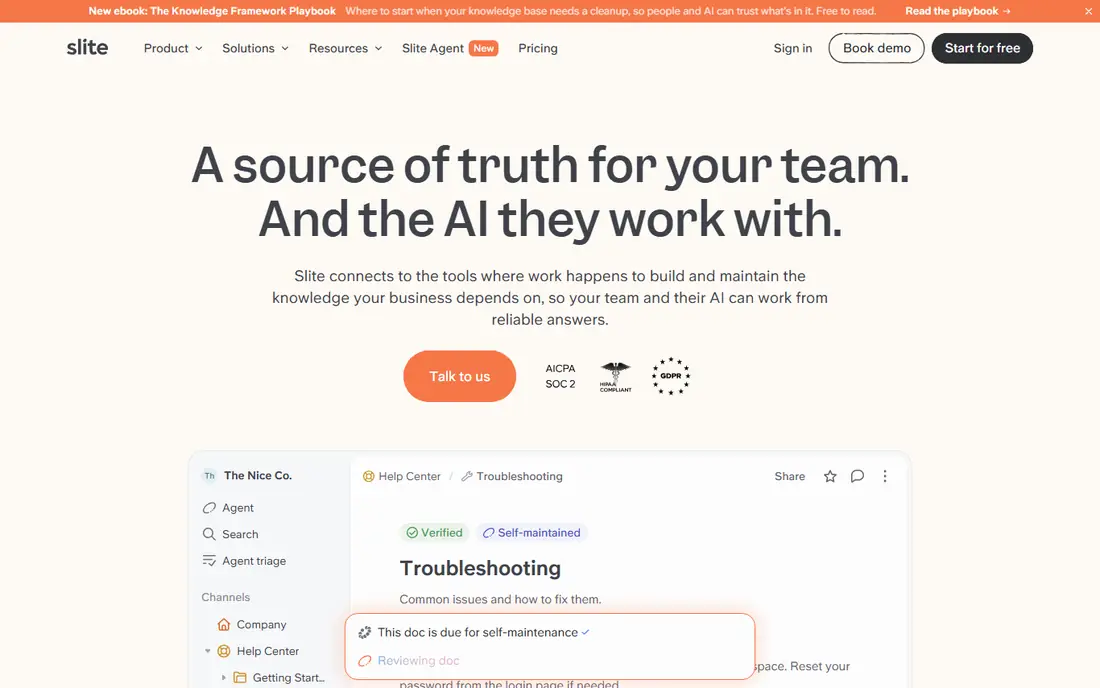
Slite is designed for growing teams wanting a self-maintaining AI knowledge base. Its AI agent watches your tools, spots when documentation has drifted from reality, drafts the fix, and routes it to the right person for approval. Beyond that, a 14-day trial handles both levels.
What Slite does well: AI search across docs and connected tools.
Drawbacks to consider: No permanent free level. As for the details, the honest catch is that Slite dropped its free level, so there is no way to start without paying eventually. It is also a younger, smaller company than its rivals, which matters if vendor longevity is on your checklist. But for teams whose documentation constantly rots, the self-maintaining pitch addresses the actual failure mode of every wiki. Slite pricing: $10 per user/month. Free access: Free trial (14 days).
- AI agent detects stale docs and drafts updates for human approval
- Focused writing experience
- Newer and smaller than Notion or Confluence
Microsoft 365
Ideal for: Firms needing desktop Office apps and enterprise compatibility
For businesses needing desktop Office apps and enterprise compatibility, Microsoft 365 is a natural candidate. Business Basic ($7/user/month annually) handles web and mobile apps, Teams, Exchange email, and 1 TB of OneDrive. Business Standard ($14) brings the desktop apps; Business Premium ($22) brings the security and device-management stack.
Honest limits: July 2026 price raises raised Basic and Standard.
Microsoft raised Business Basic from $6 to $7 and Standard from $12.50 to $14 on July 1, 2026. The honest catch is that Microsoft's power includes weight. Price to start with Microsoft 365: $7 per user/month. Free options: Free trial (30 days).
Where it shines: OneDrive deeply integrated.
- PowerPoint on Standard and up
- Most solid enterprise compatibility
- SharePoint complexity can overwhelm small teams
Confluence
Ideal for: Organizations, particularly Jira users, needing structured team documentation
In short, Confluence is for organizations, notably Jira users, needing structured team documentation. Confluence is the documentation system of the software world, and it displays in both directions. Pricing is free for up to 10 users, with Standard at $5.42 per user a month and Premium at $10.44.
Rovo AI now drafts, summarizes, and answers questions across the workspace. The honest catch is the editor and the ecosystem tax. But for engineering organizations and regulated industries that require permissions, audit trails, and scale, Confluence remains the safe, proven pick. Confluence cost at the entry level: $5.42 per user/month. Confluence includes a free tier.
Limits to weigh: Editor feels dated next to Notion.
- Free for up to 10 users
- Deep Jira and Rovo AI integration
- Best value needs the Atlassian ecosystem
Box
Ideal for: Regulated industries needing secure file collaboration with compliance
Box targets regulated industries needing secure file collaboration with compliance. Box is the file collaboration system for businesses where security is not optional. Business Starter begins at $5 per user a month billed yearly (3-user minimum) with 100 GB storage.
Business at $15 brings unlimited storage, Box AI, and unlimited e-signatures. For everyday use, the honest catch is the user experience. It is also priced and aimed at organizations instead of individuals. But when your contracts, patient records, or financial documents have to be shared and co-edited under real compliance requirements, Box is the category leader for a reason. Healthcare, financial services, and government-adjacent teams choose it for compliance certifications, granular access controls, and audit logging, plus Box AI for summarizing and extracting data from documents and unlimited e-signatures built in. Starting cost for Box: $5 per user/month. Free access: Free trial.
Trade-offs to know: Business Starter's 100 GB storage is modest.
- Enterprise-grade security with HIPAA, FedRAMP
- GDPR compliance
- Less easy-to-learn for casual users than Dropbox
Google Workspace
Ideal for: Teams wanting email, docs, and Drive that just work together
Google Workspace is a good fit for teams wanting email, docs, and Drive that just work together. Storage on Business Starter is 30 GB per user, pooled, which fills quick with video. But for teams that live in the browser and value speed over power, Workspace remains the easiest suite to buy, deploy, and actually get people using.
From a buyer's view, if your work relies on complicated Excel models, tracked changes in Word, or desktop apps for offline work, Workspace will frustrate you. For everyday use, Google Workspace is what most small and mid-sized teams mean when they say "we collaborate on documents." Gmail on your own domain, Drive for files, and Docs, Sheets, and Slides for live co-editing, all under one login with shared drives that survive employee departures. Starting cost for Google Workspace: $7 per user/month. Free access: Free trial (14 days).
Downsides: Advanced security sits on higher levels.
- Simplest admin of any suite here
- One login across Gmail, Drive, Docs, Meet, Chat
- No desktop Office apps
Notion
Ideal for: Teams wanting an adaptable wiki plus docs, databases, and AI in one workspace
Notion is aimed squarely at teams wanting an adaptable wiki plus docs, databases, and AI in one workspace. Notion's adaptability is its weakness: without naming conventions and an owner, workspaces grow into tangled nests of duplicate pages. As for the details, pages, databases, kanban boards, and docs live in one workspace with a block editor anyone can learn, and the free level provides individuals unlimited pages and blocks.
Reasons to shortlist it: project tracking.
Where it is weaker: Can become messy without conventions.
From a buyer's view, premium plans start with Plus at $10 per user a month billed yearly, with Business at $20 adding the full AI suite: agents, meeting notes, and enterprise search. From a buyer's view, complicated databases with heavy relations and rollups can also slow down. More specifically, over 100 million users and adoption by 62% of the Fortune 100 speak to how far it has come. On cost, Notion starts like this: $10 per user/month. Notion has a free plan.
- Ample free level for individuals
- AI agents and meeting notes now bundled on Business
- Databases get slow at large scale
How we chose
We compared the tools on published pricing, free plan or trial availability, feature coverage for document collaboration software, and the limits each vendor documents. Where a vendor does not publish a price, the entry says quote. Where a price depends on seats or billing term, the entry says so. Tools are placed by general fit for document collaboration software, with price clarity and free access as tie-breakers. A different team can reasonably rank them differently.
A buyer's checklist
- Confirm the entry price on the vendor page: Box starts at $5 per user/month, but seat counts and billing terms change the total.
- Read the fine print on the free plans from Nuclino, Confluence and Notion; seat, project and feature caps differ.
- Run a trial of Slite, Microsoft 365, Box and Google Workspace with real work before paying for a year; your own workflow is the best test.
- Read the limits listed for Nuclino first: restricted for complicated database needs.
- Read the plan comparison for Confluence carefully; key features often start on a higher tier.
- Ask the daily users to test Google Workspace on a live task before you roll it out to everyone.
Frequently asked questions
Do these tools publish their prices?
Yes. Every tool from Nuclino to Notion shows a starting price, though seats, add-ons and billing terms still change the final cost.
What is the cheapest option for document collaboration software in this list?
On published monthly entry prices, Box is the lowest here at $5 per user/month. Entry price is only part of the cost, because seats, add-ons and billing terms can change the total.
Is Nuclino the right pick for everyone comparing document collaboration software?
No single tool suits every team. Nuclino comes first because it fits small teams wanting a fast, simple wiki with minimal setup, while Slite suits growing teams wanting a self-maintaining AI knowledge base and Microsoft 365 suits companies needing desktop Office apps and enterprise compatibility. Match the tool to your own size, budget and workflow before deciding.
Do we need a wiki if we already have Google Docs or SharePoint?
Probably, if knowledge keeps getting lost. Docs and SharePoint are well suited to working on files; wikis are a decent match for organizing knowledge so people can find it later.
Which options for document collaboration software have a free plan?
On this list, Nuclino, Confluence and Notion include a free plan. Caps on seats, usage or features are common, so test the free plan against your real workload. Several others offer a trial instead.
What about AI features?
Every vendor now bundles AI: Notion's agents and meeting notes on Business, Rovo AI in Confluence, Box AI for document analysis, Copilot across Microsoft 365, and Gemini in Workspace. AI cannot fix a wiki nobody opens.