7 Strong Email Marketing Platforms for Newsletters in 2026

- 1
 KitCreators who sell through email funnels and automationVisit
- 2
 MailerLiteSmall firms wanting automation on a budgetVisit
- 3
 beehiivNewsletter operators building a real media businessVisit
- 4
 MailchimpSmall companies that want the familiar all-rounderVisit
- 5
 SubstackWriters who want to publish free without paying anythingVisit
- Kit takes the first slot, best suited to creators who sell through email funnels and automation.
- Starting prices begin at $12/month with Constant Contact.
- Only 5 of the 7 tools have a free plan (Kit, MailerLite, beehiiv, Mailchimp, Substack), so check the caps.
- A fair warning about beehiiv: scale pricing climbs with list size ($109/month at 10,000 subs).
- For publishers who want to own their platform outright, Ghost is worth a look.
Direct answer
Start with Kit if you need creators who sell through email funnels and automation. MailerLite is better for small businesses wanting automation on a budget, and beehiiv is better for newsletter operators building a real media business. All 7 tools are compared below on price, free plan and limits.
Quick comparison
| Product | Ideal for | Price from | Free version | |
|---|---|---|---|---|
| Kit | Creators who sell through email funnels and automation | Free to 10,000 subscribers (Newsletter plan); Creator from $29/month | Yes | Visit |
| MailerLite | Small firms wanting automation on a budget | Free (500 subscribers, 12,000 emails/month); Growing Business from $10/month | Yes | Visit |
| beehiiv | Newsletter operators building a real media business | Free to 2,500 subscribers (Launch); Scale from $49/month | Yes | Visit |
| Mailchimp | Small companies that want the familiar all-rounder | Free (250 contacts, 500 sends/month); Essentials from $13/month | Yes | Visit |
| Substack | Writers who want to publish free without paying anything | Free (10% fee on premium subscriptions plus Stripe fees) | Yes | Visit |
 Constant Contact | Non-technical firms that value human support | $12/month (Lite, 500 contacts) | Free trial (60 days) | Visit |
 Ghost | Publishers who want to own their product outright | $15/month (Starter, 500 members) | Free trial (14 days) | Visit |
7 email marketing platforms for newsletters in detail
Ainotely compared 7 email marketing platforms for newsletters. The goal is a practical shortlist: published prices, free plan facts, best-fit use cases and honest limits for every entry.
Kit
Ideal for: Creators who sell through email funnels and automation
Kit works best for creators who sell through email funnels and automation. Kit, formerly ConvertKit, rebuilt its free plan into a genuine growth tool: up to 10,000 subscribers can receive broadcasts free, which no competitor matches. Beyond that, Kit fits creators whose newsletter exists to sell something.
Where it is weaker: Hitting 10,001 subscribers jumps you to a much pricier premium level.
In practice, premium Creator plans from $29 per month add automatic sequences, visual automation builders and deeper segmentation for product launches and onboarding funnels. The cliff is real. Cross 10,000 subscribers and you jump straight to Kit's higher premium levels (around $139 per month annually at the 10k-15k band), with no cheap intermediate step. And the free plan limits you to one automation and one sequence. Kit pricing: Free to 10,000 subscribers. A free plan is available with Kit.
- Automation-first design made for creators who sell courses and products
- The most ample free level here: 10,000 subscribers for broadcasts
- Landing pages and forms are functional, not beautiful
MailerLite
Ideal for: Small firms wanting automation on a budget
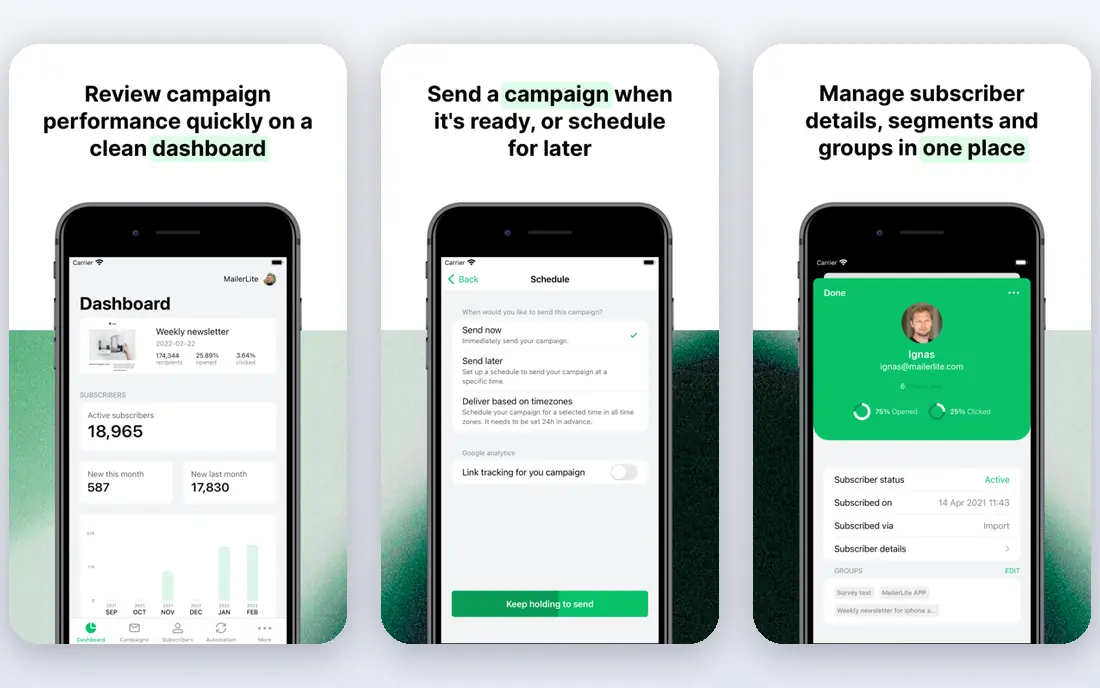
For small companies wanting automation on a budget, MailerLite is a natural candidate. MailerLite is the budget pick that does not feel cheap. Worth adding: for a small business newsletter with welcome sequences and light segmentation, MailerLite provides 80 percent of Mailchimp at a fraction of the price.
Downsides: Advanced automation triggers and AI features need the $20 Advanced plan.
In practice, Expanding Business from $10 per month removes branding, adds templates, RSS campaigns and dynamic content, with unlimited sends. As for the details, the free plan includes 500 subscribers and 12,000 emails per month with real automation, signup forms and landing pages. Starting cost for MailerLite: Free. You can start on MailerLite without paying.
Upsides: The most feature-dense free level for business email: automation.
- Unlimited emails on premium plans
- Clean
- Free plan cut to 500 subscribers in 2025
beehiiv
Ideal for: Newsletter operators building a real media business
For newsletter operators building a real media business, beehiiv is a natural candidate. Launch is genuinely free to 2,500 subscribers with unlimited email sends, a website, custom domain and the recommendation network. Worth adding: scale opens at $49 per month for up to 1,000 subscribers and layers on monetization, automations, the ad network and surveys, with 0 percent taken from your premium subscriptions.
What works well: boosts and referral program built in.
Trade-offs to know: Free plan excludes automations and monetization features. The main limit is the climb: Scale hits $109 per month at 10,000 subscribers and $199 at 50,000. The math favors beehiiv the moment you charge readers: its flat fee beats Substack's 10 percent once subscription revenue passes roughly $490 per month at small list sizes. What you pay to start with beehiiv: Free to 2,500 subscribers. beehiiv has a free plan.
- Ad network
- 0% take rate on premium subscriptions from Scale up
- Scale pricing climbs with list size ($109/month at 10,000 subs)
Mailchimp
Ideal for: Small companies that want the familiar all-rounder
Mailchimp serves small firms that want the familiar all-rounder. Two 2026 realities to know.
Downsides: Bills for unsubscribed contacts except when you archive them.
And Mailchimp counts unsubscribed contacts toward your billing level until you manually archive them. Mailchimp cost at the entry level: Free. You can start on Mailchimp without paying.
- The deepest template library and 300-plus integrations
- Landing pages and forms included
- Free plan slashed to 250 contacts and 500 sends with no automation
Substack
Ideal for: Writers who want to publish free without paying anything
Think of Substack for writers who want to publish free without paying anything. Writers also complain about restricted templates and thin automation. In daily use, Substack takes 10 percent of premium subscription revenue on top of Stripe's processing fees.
For everyday use, the price appears when you monetize. More specifically, publishing is free, the archive and website are included. The network effect is real: readers discover your publication inside Substack's app and recommendations. On top of that, at $1,000 per month in subscriptions, that is $100 to Substack. Starting cost for Substack: Free. Substack offers a free plan.
What to check first: 10% revenue cut on premium subscriptions layers on up quick.
- Built-in discovery network brings readers you did not find yourself
- Fully free at any list size at no cost newsletters
- Restricted design customization and automation compared to email systems
Constant Contact
Ideal for: Non-technical firms that value human support
Constant Contact makes the most sense for non-technical firms that value human support. Constant Contact is the oldest name here, and its pitch has not changed: email marketing for people who do not think of themselves as marketers. The 60-day free trial is the longest in the category, but there is no free level since mid-2025.
Watch-outs: No permanent free plan.
Pick it when simplicity and a human on the phone matter more than features per dollar. From a buyer's view, nonprofits get up to 30 percent off with annual prepay, which softens the blow. Constant Contact cost at the entry level: $12/month. Free options: Free trial (60 days).
What users get: Genuinely beginner-friendly editor and templates.
- Phone support on all premium plans
- Event management and social tools bundled in
- Automation depth lags behind rivals
Ghost
Ideal for: Publishers who want to own their product outright
Choose Ghost for publishers who want to own their product outright. Ghost Pro's Starter plan at $15 per month handles 500 members with unlimited email sends; Publisher at $29 brings premium memberships and automation. The 2026 price rise moved Starter from $9 to $15, and the member-based scaling gets steep at large lists.
On top of that, Ghost fits publishers playing the long game who refuse to rent their audience from a system. For everyday use, the escape hatch is self-hosting: Ghost is open source, so a VPS plus Mailgun hands you the full product for server costs. Price to start with Ghost: $15/month. Free options: Free trial (14 days).
Drawbacks to consider: Pricing scales steeply with member count ($199/month at 100,000 members).
- Website
- Blog and newsletter in one open-source system
- No permanent free hosted level
What went into this list
We compared the tools on published pricing, free plan or trial availability, feature coverage for email marketing platforms for newsletters, and the limits each vendor documents. Seat minimums, billing terms and add-ons can move the real cost, so the starting prices here are a guide and not a quote. The sequence is a judgement call: typical use case first, then pricing transparency, then free access. Use the profiles to check fit.
Things to verify first
- Prices are a starting point; Constant Contact shows $12/month to start, so verify what your seat count would cost.
- Look at free plan limits closely: Kit, MailerLite, beehiiv and others have one, and the caps decide whether it is usable for real work.
- Take the trial from Constant Contact and Ghost and push a live task through it before you pay.
- Read the limits listed for Kit first: Hitting 10,001 subscribers jumps you to a much pricier premium level.
- Ask whether MailerLite integrates with your current software, and whether that comes standard or as an add-on.
- Get the contract term, renewal terms and any onboarding fees from beehiiv in writing.
Frequently asked questions
Which options for email marketing platforms for newsletters have a free plan?
Kit, MailerLite, beehiiv, Mailchimp and Substack offer a free plan in this list. Free plans usually cap users, projects or features, so check the limits on the vendor page. Several others offer a trial instead.
Should I use Substack or beehiiv?
Use Substack if you want the simplest free start with built-in discovery and no plans to charge readers soon. Use beehiiv if you plan to monetize: its 0 percent take rate and growth tools (ad network, boosts, referrals) beat Substack's 10 percent cut once revenue passes a handful of hundred dollars per month.
Can I try these tools before paying?
Often, yes. Kit, MailerLite, beehiiv and others have a free plan and Constant Contact and Ghost offer a free trial. Use your own data and a real task during the test, and check what the free tier or trial limits before you rely on it.
How are the tools for email marketing platforms for newsletters ordered?
Kit sits first and Ghost last because the order follows typical fit for email marketing platforms for newsletters, then price clarity and free access. It is a judgement call, so read each profile for fit and limits.
Do these tools publish their prices?
Yes. Every tool from Kit to Ghost shows a starting price, though seats, add-ons and billing terms still change the final cost.
Which newsletter system is best for a small business?
The first pick on this list is Kit, because it suits creators who sell through email funnels and automation. MailerLite is better for small firms wanting automation on a budget, and beehiiv for newsletter operators building a real media business. Check price and limits against your own needs before choosing.