Best Email Newsletter Platforms for Creators

- Substack costs nothing to start and takes 10% of subscription revenue, so it suits writers who want zero monthly cost while they build a list.
- Kit has the largest free plan in this list, up to 10,000 subscribers, but automations and sequences start on the Creator plan.
- Beehiiv and Ghost take 0% of subscription revenue, while their monthly fees rise as your list grows.
- Flodesk now sells two flat plans on its live pricing page, Email at $38 a month billed annually, with unlimited subscribers and unlimited sends.
- Mailchimp and MailerLite free plans are now small, at 250 contacts or subscribers, so check the free limits before you build on them.
Quick comparison
| Product | Ideal for | Price from | Free version | |
|---|---|---|---|---|
 Substack | Writers who want zero monthly cost | $0 per month, plus 10% of subscription revenue | Yes | Visit |
 Beehiiv | Growth and monetisation in one place | $49 per month (billed annually) | Yes | Visit |
 Kit | Creators who sell products and courses | $39 per month (billed monthly) | Yes | Visit |
 Mailchimp | Small businesses that want many integrations | $13 per month (Essentials, 500 contacts) | Yes | Visit |
 Ghost | Publications that want their own website | $18 per month (billed annually) | Free trial (14 days) | Visit |
 Buttondown | Minimal writing in Markdown | $9 per month (up to 1,000 subscribers) | Yes | Visit |
 MailerLite | Simple campaigns on a low budget | $12 per month (Comfort, 500 subscribers) | Yes | Visit |
 Flodesk | Design-led emails at a flat price | $38 per month (billed annually) | Yes | Visit |
The best email newsletter platforms for creators
Substack
Ideal for: Writers who want zero monthly cost
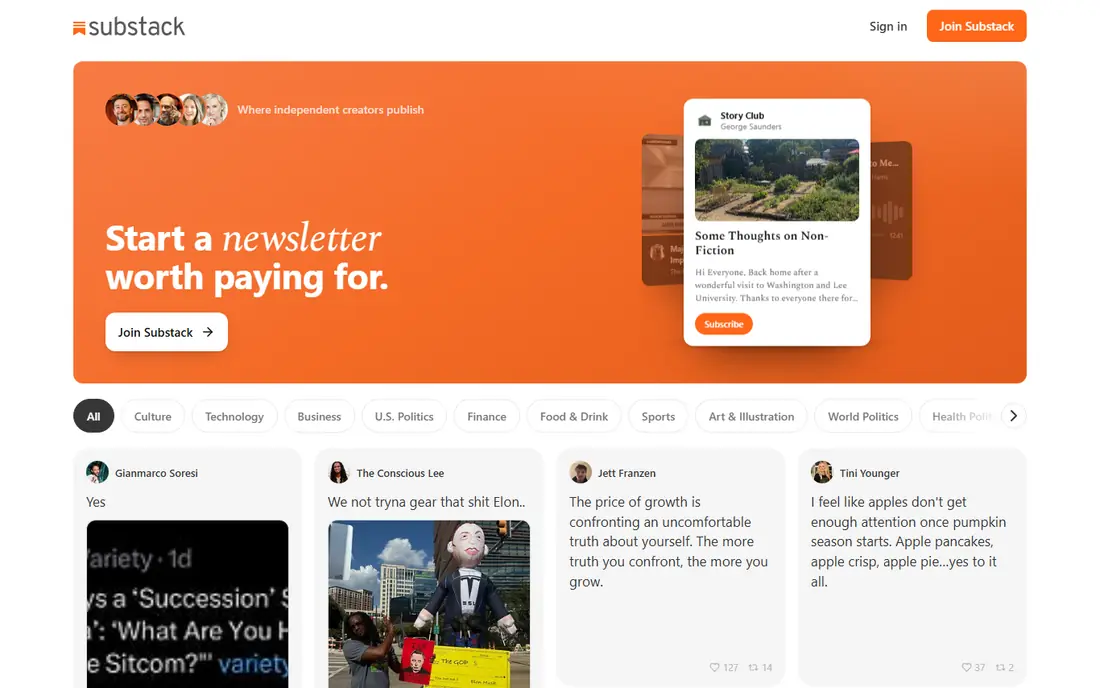
Substack is the simplest start on this list. Publishing is free no matter how many subscribers you have, and there is no monthly bill, no subscriber cap, and no send limit on free newsletters. The minimum price is $5 a month or $30 a year on US dollar Stripe accounts.
The cost appears only when readers start to pay. Substack keeps 10% of each subscription payment, and Stripe adds its own card processing fee of about 2.9% plus $0.30 per US card payment, plus a 0.7% recurring billing fee. On a $10 monthly subscription, that leaves the writer with about $8.34. A custom domain costs $50 as a one-time fee. You get distribution and a reader network, and you give up a fixed share of every payment forever.
- Free publishing at any list size
- Built-in reader discovery through Notes and the app
- The 10% fee never falls as revenue grows
- There is no flat monthly option
Beehiiv
Ideal for: Growth and monetisation in one place
Beehiiv pairs a newsletter with a website, a podcast, a community, and digital products in one account. The Free plan costs $0 for up to 2,500 subscribers, with unlimited email sends, landing pages, templates, the recommendation network, and API access.
The Lite plan starts at $49 a month billed annually, or $59 a month billed monthly, at up to 1,000 subscribers. It adds subscription revenue tools, the ad network, automations, polls, and A/B testing, and beehiiv takes 0% of subscription and digital product revenue. The Pro plan starts at $95 a month billed annually, or $109 a month billed monthly, and adds branding removal, advanced analytics, webhooks, dynamic content, and up to 10 publications. Lite rises to $119 a month billed annually at 10,000 subscribers, so check the price at your own list size.
- Free plan covers up to 2,500 subscribers
- 0% take on subscription revenue
- Monthly fees rise with subscriber count
- Removing beehiiv branding needs the Pro plan
Kit
Ideal for: Creators who sell products and courses
Kit, formerly ConvertKit, is built for creators who sell something to their list. The Free plan costs $0 for up to 10,000 subscribers, with unlimited landing pages, forms, and broadcasts, plus tagging, segmentation, and selling digital products.
The Creator plan starts at $39 a month billed monthly, or $33 a month billed annually, at up to 1,000 subscribers. It adds unlimited visual automations and sequences, integrations, and A/B testing. The Pro plan starts at $79 a month billed monthly, or $66 a month billed annually, and adds subscriber scoring, deliverability reporting, a referral system, and unlimited users. Selling through Kit carries a fee of 3.5% plus $0.30 per transaction on every plan, including Free, and Kit says that figure already includes card processing. At 10,000 subscribers Creator costs $139 a month billed monthly, so the bill grows fast once you pass the free plan.
- Free plan covers up to 10,000 subscribers
- Built-in commerce for digital products
- Free plan has no automations or sequences
- The monthly fee climbs steeply with list size
Mailchimp
Ideal for: Small businesses that want many integrations
Mailchimp is the best known name in this list, and its strength is breadth. It combines email campaigns, landing pages, forms, surveys, and automation in one place, with more than 300 integrations listed on its pricing page.
The Free plan now stops at 250 contacts and 500 sends a month, with a daily cap of 250 sends, one seat, and one audience. Email support on Free lasts for the first 30 days only, and email scheduling is not included. The Essentials plan starts at $13 a month for 500 contacts, with 10 times your contact count in monthly sends, and the Standard plan starts at $20 a month for 500 contacts, with 12 times your contact count. Premium starts at $350 a month. The billing rule to check is that Mailchimp counts subscribed, unsubscribed, and non-subscribed contacts toward your total, so a list with many inactive contacts costs more than the subscriber count alone suggests.
- More than 300 integrations
- A familiar editor with templates and landing pages
- Free plan covers only 250 contacts
- Mailchimp bills for unsubscribed contacts too
Ghost
Ideal for: Publications that want their own website
Ghost is an open source publishing platform, and Ghost(Pro) is its managed hosting. One account gives you a website, a blog, email newsletters, and member subscriptions, with your own domain and full export of your member list. Ghost takes 0% of subscription revenue on the plans that include it.
The Starter plan costs $18 a month billed annually for up to 1,000 members, with one staff user, a free custom domain, and a newsletter, but it does not include subscription revenue tools, tips, or custom themes. The Publisher plan costs $29 a month billed annually at 1,000 members, and adds subscription revenue tools, custom themes, three staff users, and advanced analytics. Business costs $199 a month billed annually. The software itself is free to self-host, but self-hosting needs a separate email delivery service, which adds cost and setup.
- Your own website, newsletter, and memberships in one product
- 0% transaction fees
- Starter has no subscription revenue tools or custom themes
- There is no free hosted plan
Buttondown
Ideal for: Minimal writing in Markdown
Buttondown is a small, independent newsletter tool for writers who want the software to stay out of the way. You write in Markdown or a rich text editor, send from a custom domain, and keep a hosted archive of past issues. It charges for active subscribers only, so people who are not actively receiving your emails do not count toward your bill. A 50% discount is available for registered nonprofits.
The first 100 subscribers cost nothing. The base price then starts at $9 a month for up to 1,000 subscribers, $29 a month for up to 5,000, and $79 a month for up to 10,000, with about 18% off on annual billing. Features sit in add-on groups: tagging and segmentation, subscription revenue tools, comments and surveys, analytics, and RSS to email are $9 a month each, while sponsorships, custom domain archives, and multiple newsletters are $29 a month each. A newsletter with subscription revenue, analytics, and tagging costs $27 a month more than the base price, so check the add-ons you need first.
- Free for the first 100 subscribers
- You only pay for active subscribers
- Key features are separate add-ons
- The template choice is small
MailerLite
Ideal for: Simple campaigns on a low budget
MailerLite is a low cost email tool with a clean editor and a full feature set on its entry plans. The Free plan costs $0 for up to 250 active subscribers and 2,500 monthly emails, with 2 user seats, 3 automations, 1 website, 1 landing page, 3 signup forms, and all 3 email editors. Going over 250 subscribers or 2,500 emails pauses sending until you remove subscribers or upgrade.
The Comfort plan starts at $12 a month, or $10.80 a month billed annually, at 500 subscribers, and rises to $19 a month at 1,000 subscribers and $33 a month at 2,500. It adds 50 automations, 10 websites and landing pages, AI writing help, and removal of the MailerLite logo. Monthly sends on Comfort are capped at 10 times your subscriber tier, so a list near the top of its tier can send about two emails a week. The Power plan starts at $25 a month, or $22.50 a month billed annually, and removes the send cap, with unlimited emails, automations, forms, and seats.
- Three editors, automations, and a website on the free plan
- Annual billing saves 10%
- Free plan covers only 250 subscribers and 2,500 emails a month
- Comfort sends are capped
Flodesk
Ideal for: Design-led emails at a flat price
Flodesk is built for creators who care how an email looks. The live pricing page read on 12 November 2026 lists two flat plans with unlimited subscribers and unlimited emails, so the bill never grows as your list grows. The Email plan costs $38 a month billed annually, or $46 a month billed monthly, and adds workflow automations, A/B testing, and removal of the Flodesk footer. The Everything plan costs $79 a month billed annually, or $99 a month billed monthly, and adds unlimited sales pages, checkout flows, subscriptions, payment plans, and abandoned cart emails.
The Free plan costs $0 and covers forms, landing pages, and link in bio pages for building a list, but it does not include email sending or workflow automations. A free trial is available with no card required, and your subscriber data is kept if you move to the Free plan. Checkout is included on the Everything plan only, for businesses in the US, Canada, UK, Australia, New Zealand, and Euro Area countries. There is no RSS to email, so creators who want blog posts sent to email automatically need another route.
- Unlimited subscribers and unlimited sends on both entry plans
- Designer templates
- Free plan cannot send emails
- Selling subscriptions needs the Everything plan
How we chose
We read each vendor pricing page and plan comparison on 12 November 2026, and we checked the free plan limits, the entry plan price, the fee on subscription revenue, and the send or subscriber caps. Prices are in US dollars at each tool's entry tier, and we state the list size behind each figure so you can compare like with like. Where a pricing page hid its figures behind a slider, we used the vendor's own text version of the page or a dated third-party read of the same vendor page. We did not claim hands-on testing, and we did not use review scores, customer counts, or awards, because none of those can be checked from the outside.
What to check before you buy
Start with the free plan ceiling, because the gap is wide: Kit allows up to 10,000 subscribers for free, Beehiiv allows 2,500, and Mailchimp and MailerLite stop at 250. Next, work out the fee on subscription revenue at your own numbers. On $100 of subscription revenue, Substack takes $10, Kit takes $3.50 plus $0.30 per transaction, and Beehiiv and Ghost take nothing, though Stripe card fees still apply on every tool. Then check the send caps and whether the features you need are bundled or sold as add-ons, because Buttondown add-ons and Ghost plan steps change the real monthly cost.
| List size and goal | Pick first | Why |
|---|---|---|
| Under 100 subscribers, simple writing | Buttondown or Substack | Both cost $0 at this size, and Buttondown includes a custom sending domain |
| Under 2,500 subscribers, want growth tools | Beehiiv Free | Free to 2,500 subscribers with unlimited sends and a recommendation network |
| Up to 10,000 subscribers, free start | Kit Free | The largest free plan here, with landing pages, forms, and commerce |
| Design-led newsletter, flat monthly cost | Flodesk Email | $38 a month billed annually, unlimited subscribers and sends |
| Own website plus newsletter | Ghost Publisher | $29 a month billed annually, with subscription revenue tools and 0% fees |
| Small business, many integrations | Mailchimp Essentials | $13 a month at 500 contacts, with more than 300 integrations |
Use this checklist before you enter card details: confirm the free subscriber cap and the monthly send cap, confirm the fee on subscription revenue at your price point, confirm whether scheduling, automations, and A/B testing sit on your plan, confirm the cost at 1,000 and at 10,000 subscribers, and confirm that you can export your subscriber list in full. If a tool fails any of those checks for your list, move to the next row in the table above rather than paying to work around the limit.
Frequently asked questions
Which newsletter platform is free for creators?
Substack, Beehiiv, Kit, Mailchimp, Buttondown, MailerLite, and Flodesk all have a free plan, but the limits differ a lot. Kit allows up to 10,000 subscribers for free, Beehiiv allows 2,500, Buttondown allows 100, and Mailchimp and MailerLite stop at 250. Flodesk has a free plan for list building only, with no email sending. Ghost has no free hosted plan, only a 14-day trial.
Which platform takes the smallest cut of subscription revenue?
Beehiiv and Ghost take 0% of subscription revenue, so you keep the full amount before Stripe card fees. Kit charges 3.5% plus $0.30 per transaction, and that figure already includes card processing. Substack takes the largest share at 10% of each payment, plus Stripe fees of about 2.9% plus $0.30 and a 0.7% billing fee. Check the maths at your own price point.
What does Flodesk cost now?
Flodesk Email costs $38 a month billed annually, or $46 a month billed monthly, with unlimited subscribers and unlimited sends. The Everything plan costs $79 a month billed annually, or $99 a month billed monthly, and adds checkout, sales pages, subscriptions, and abandoned cart emails. The Free plan costs $0 but cannot send emails. These are the figures on the live Flodesk pricing page read on 12 November 2026.
Is Mailchimp still free?
Yes, but the free plan is now small. It covers up to 250 contacts and 500 sends a month, with a daily cap of 250 sends, one seat, and one audience. Email support lasts for the first 30 days only, and email scheduling is not included. Once you pass 250 contacts, sending pauses until you upgrade or shrink the list. The Essentials plan starts at $13 a month for 500 contacts.
Which platform suits a creator who wants their own website?
Ghost is the strongest fit, because it gives you a website, a blog, newsletters, and member subscriptions in one product, with 0% transaction fees. The Publisher plan costs $29 a month billed annually at 1,000 members and adds subscription revenue tools and custom themes. Beehiiv also includes a website on every plan, and Kit includes a newsletter site with landing pages, so compare those three before you decide.