Best Emissions Management Software in 2026: 8 Options Compared

- 1
 Persefonienterprise carbon accounting and reportingVisit
- 2
 Watershedlarge companies needing fast, detailed measurementVisit
- 3
 Sweepmid-sized companies wanting collaborative reductionVisit
- 4
 Emitwisecompanies with complex supply-chain emissionsVisit
- 5
 Greenlysmaller companies starting carbon accountingVisit
- Persefoni and Watershed lead for enterprise carbon accounting and audit-ready reporting.
- Sweep and Greenly suit mid-sized companies that want faster setup.
- Emitwise fits companies with complex supply-chain emissions.
- Check scope 3 coverage early, since that is where most emissions and most work sit.
Quick comparison
| Product | Ideal for | Price from | Free version | |
|---|---|---|---|---|
| Persefoni | enterprise carbon accounting and reporting | See website | No | Visit |
| Watershed | large companies needing fast, detailed measurement | See website | No | Visit |
| Sweep | mid-sized companies wanting collaborative reduction | See website | No | Visit |
| Emitwise | companies with complex supply-chain emissions | See website | No | Visit |
| Greenly | smaller companies starting carbon accounting | See website | No | Visit |
 Sinai Technologies | companies linking emissions to decarbonization scenarios | See website | No | Visit |
 Net0 | companies wanting an all-in-one climate platform | See website | No | Visit |
 CarbonChain | commodity and supply-chain carbon tracking | See website | No | Visit |
The best emissions management software
Emissions management software helps companies measure greenhouse gas emissions, track reduction targets, and prepare reports for customers, investors, and regulators. Tools differ in scope coverage, data automation, and reporting frameworks. We compared platforms used by companies that must report credibly, not just estimate once a year.
Persefoni
Ideal for: enterprise carbon accounting and reporting
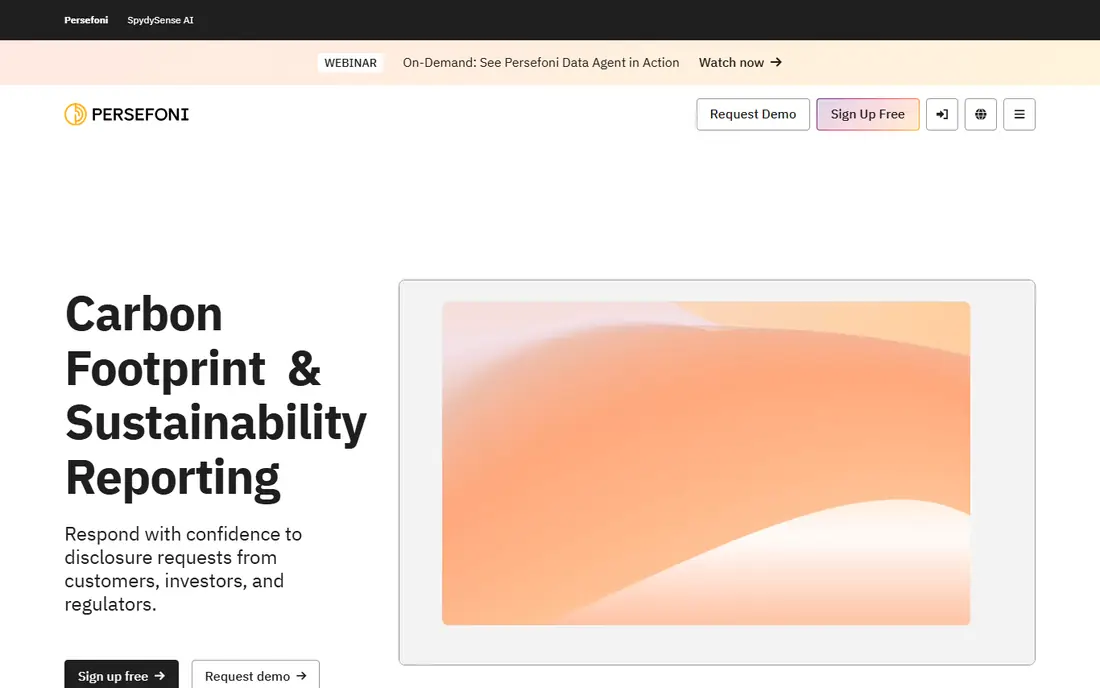
Persefoni is built for enterprise carbon accounting with audit trails, controls, and reporting across common frameworks. It suits listed companies and large suppliers facing customer and investor disclosure demands. Pricing is quoted, and rollout needs finance involvement. That focus makes it a practical match for enterprise carbon accounting and reporting. On pricing, the starting point is see website, and the free plan status is no. Its strengths include audit-ready carbon accounting; broad framework support; strong finance integration. The trade-off to weigh is enterprise pricing by quote; implementation takes planning. We suggest checking the current plan limits on the vendor site before you commit, since tiers and trial terms change, and confirming that the plan you pick covers the seats, storage, or usage your team actually needs.
- Audit-ready carbon accounting
- Broad framework support
- Strong finance integration
- Enterprise pricing by quote
- Implementation takes planning
Watershed
Ideal for: large companies needing fast, detailed measurement
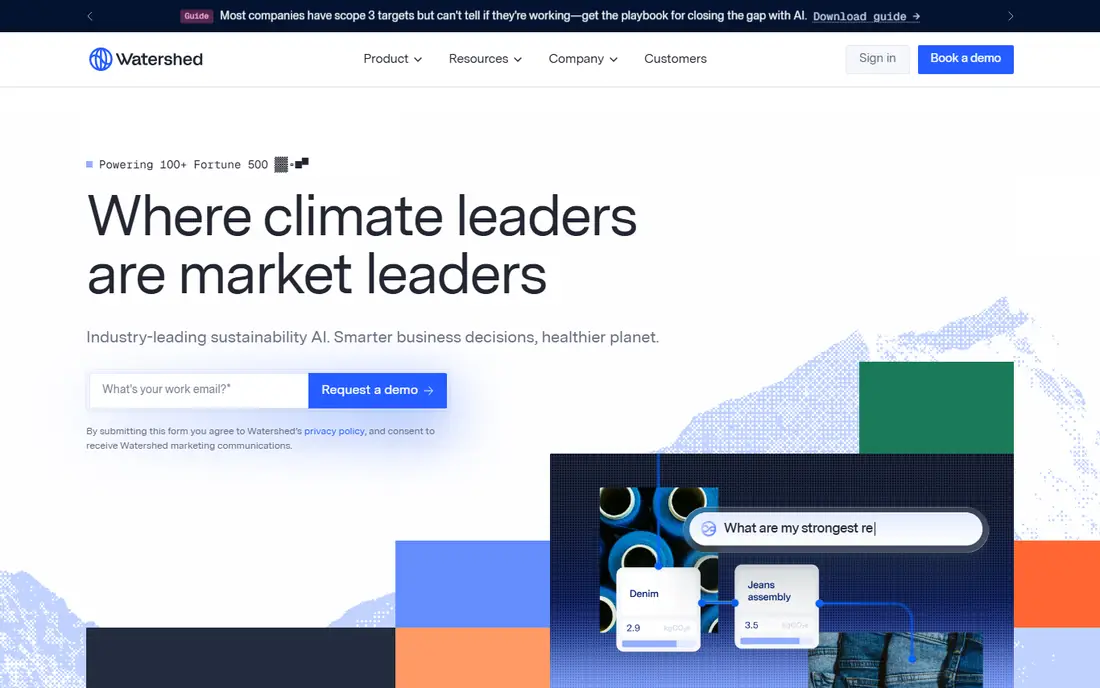
Watershed measures emissions in detail and pairs measurement with reduction planning, helping large companies move from a footprint to a plan. Its data automation reduces manual collection from finance and operations systems. Smaller companies should check whether the platform fits their scale. That focus makes it a practical match for large companies needing fast, detailed measurement. On pricing, the starting point is see website, and the free plan status is no. Its strengths include detailed measurement and reduction planning; strong data automation; corporate customers. The trade-off to weigh is enterprise pricing by quote; best at larger scale. We suggest checking the current plan limits on the vendor site before you commit, since tiers and trial terms change, and confirming that the plan you pick covers the seats, storage, or usage your team actually needs.
- Detailed measurement and reduction planning
- Strong data automation
- Corporate customers
- Enterprise pricing by quote
- Best at larger scale
Sweep
Ideal for: mid-sized companies wanting collaborative reduction
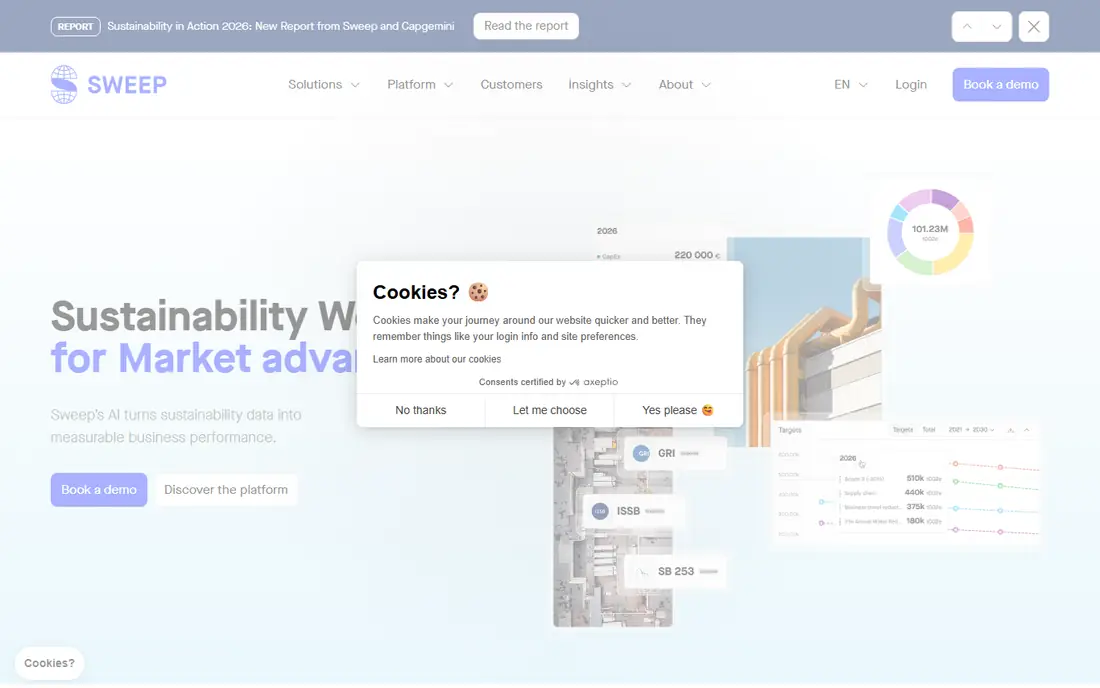
Sweep helps companies measure emissions and run reduction actions across teams, with dashboards that show progress against targets. It suits mid-sized companies that want sustainability staff and business units working in one system. Pricing is quoted. That focus makes it a practical match for mid-sized companies wanting collaborative reduction. On pricing, the starting point is see website, and the free plan status is no. Its strengths include collaborative reduction tools; clear dashboards; growing framework coverage. The trade-off to weigh is pricing by quote; some advanced features vary by plan. We suggest checking the current plan limits on the vendor site before you commit, since tiers and trial terms change, and confirming that the plan you pick covers the seats, storage, or usage your team actually needs.
- Collaborative reduction tools
- Clear dashboards
- Growing framework coverage
- Pricing by quote
- Some advanced features vary by plan
Emitwise
Ideal for: companies with complex supply-chain emissions
Emitwise focuses on supply-chain emissions, helping companies collect supplier data and estimate product-level footprints. It suits manufacturers and retailers whose emissions sit mostly in the value chain. Supplier engagement remains work, even with automation. That focus makes it a practical match for companies with complex supply-chain emissions. On pricing, the starting point is see website, and the free plan status is no. Its strengths include strong scope 3 and supplier focus; ai-assisted data work; audit support. The trade-off to weigh is pricing by quote; supplier onboarding takes effort. We suggest checking the current plan limits on the vendor site before you commit, since tiers and trial terms change, and confirming that the plan you pick covers the seats, storage, or usage your team actually needs.
- Strong scope 3 and supplier focus
- AI-assisted data work
- Audit support
- Pricing by quote
- Supplier onboarding takes effort
Greenly
Ideal for: smaller companies starting carbon accounting
Greenly targets smaller and mid-sized companies with accounting integrations that build a footprint from spend and activity data. It lowers the barrier to a first credible report. Companies needing deep audit assurance should verify coverage before committing. That focus makes it a practical match for smaller companies starting carbon accounting. On pricing, the starting point is see website, and the free plan status is no. Its strengths include faster setup for smaller firms; accounting integrations; clear reporting. The trade-off to weigh is depth varies by plan; enterprise assurance needs checking. We suggest checking the current plan limits on the vendor site before you commit, since tiers and trial terms change, and confirming that the plan you pick covers the seats, storage, or usage your team actually needs.
- Faster setup for smaller firms
- Accounting integrations
- Clear reporting
- Depth varies by plan
- Enterprise assurance needs checking
Sinai Technologies
Ideal for: companies linking emissions to decarbonization scenarios
Sinai Technologies, often shortened to Sinai, helps companies model decarbonization scenarios and set targets alongside emissions measurement. It suits firms that need to test pathways, not just report last year. Pricing is quoted. That focus makes it a practical match for companies linking emissions to decarbonization scenarios. On pricing, the starting point is see website, and the free plan status is no. Its strengths include scenario and target modeling; decarbonization pathways; enterprise focus. The trade-off to weigh is pricing by quote; narrower brand recognition than larger rivals. We suggest checking the current plan limits on the vendor site before you commit, since tiers and trial terms change, and confirming that the plan you pick covers the seats, storage, or usage your team actually needs.
- Scenario and target modeling
- Decarbonization pathways
- Enterprise focus
- Pricing by quote
- Narrower brand recognition than larger rivals
Net0
Ideal for: companies wanting an all-in-one climate platform
Net0 combines carbon measurement, reduction planning, and supplier engagement in one platform. It suits companies that want a single climate system rather than separate tools for measurement and action. Check which modules sit in the quoted price. That focus makes it a practical match for companies wanting an all-in-one climate platform. On pricing, the starting point is see website, and the free plan status is no. Its strengths include carbon accounting plus reduction planning; supplier tools; reporting support. The trade-off to weigh is pricing by quote; feature depth varies by module. We suggest checking the current plan limits on the vendor site before you commit, since tiers and trial terms change, and confirming that the plan you pick covers the seats, storage, or usage your team actually needs.
- Carbon accounting plus reduction planning
- Supplier tools
- Reporting support
- Pricing by quote
- Feature depth varies by module
CarbonChain
Ideal for: commodity and supply-chain carbon tracking
CarbonChain tracks carbon through commodity supply chains, from extraction and production to transport and trade. It suits metals, energy, and agriculture companies whose emissions follow physical shipments. General corporate reporters will find its niche focus too narrow. That focus makes it a practical match for commodity and supply-chain carbon tracking. On pricing, the starting point is see website, and the free plan status is no. Its strengths include commodity supply-chain focus; asset-level tracking; trade and logistics coverage. The trade-off to weigh is niche focus limits general corporate use; pricing by quote. We suggest checking the current plan limits on the vendor site before you commit, since tiers and trial terms change, and confirming that the plan you pick covers the seats, storage, or usage your team actually needs.
- Commodity supply-chain focus
- Asset-level tracking
- Trade and logistics coverage
- Niche focus limits general corporate use
- Pricing by quote
How we picked these
We compared official feature pages, pricing pages, app store listings, privacy policies, and public reviews for each option, and we kept only products that exist, work in October 2026, and fit the topic directly. We did not claim hands-on testing we did not do, and we left out products whose fit was weak even when they are well known in a nearby category. Price and plan details change often, so where a vendor does not publish a clear price we write See website rather than guessing. The notes below reflect what each vendor publishes about its own product, not a promise about results for any single team.
How to choose emissions management software
Start with the reporting you must produce, including the frameworks, assurance level, and deadlines your customers or regulators require. A tool built for voluntary estimates will struggle under audit, while an enterprise platform may overwhelm a small team with a simple footprint. Ask vendors how they handle scope 1, 2, and 3, and which emission factors they use. Data collection is the real work, so check integrations with accounting, energy, travel, and supplier systems, and ask how much manual entry remains. A platform that automates utility and spend data will save months of spreadsheet work each year. Also check whether the vendor supports target setting, reduction planning, and restatement when methods change. Run a pilot on one year of data and one reporting framework before committing, and involve finance and sustainability staff together. Agree on who owns each data source, how estimates are documented, and how results will be reviewed, since credible reporting depends on process as much as software.
Frequently asked questions
What is emissions management software?
It measures, tracks, and reports greenhouse gas emissions across a company, covering direct emissions, purchased energy, and value-chain emissions. It helps companies set targets, plan reductions, and prepare disclosures.
What are scope 1, 2, and 3 emissions?
Scope 1 covers direct emissions from owned sources, scope 2 covers purchased energy, and scope 3 covers value-chain emissions such as suppliers, travel, and product use. Scope 3 is usually the largest and hardest to measure.
Do small companies need emissions software?
Small companies with simple footprints can start with spreadsheets, but software helps once customers ask for data, reporting grows, or scope 3 work begins. Mid-market tools now target that step up.
How much does emissions software cost?
Pricing is usually by quote and varies with company size, entities, and scope 3 depth. Expect a sales conversation rather than a public price for enterprise platforms.
Can software guarantee accurate emissions data?
No software can guarantee accuracy on its own, since results depend on activity data and emission factors. Good platforms document methods, flag gaps, and support audit review, which matters more than a single headline number.