8 Best Equipment Rental Management Software Tools for 2026

- 1
 RentmanAV, event, and media production rental companiesVisit
- 2
 EZRentOutConstruction, oil and gas, and industrial equipment rentalVisit
- 3
 BooqableSmall and growing rental businesses that want online bookings fastVisit
- 4
 TWICEBusinesses combining rental, resale, and subscriptionsVisit
- 5
 QuipliIndependent tool and heavy equipment rental companies in North AmericaVisit
- Live availability is the core feature: every tool here stops double bookings by tying bookings, returns, and maintenance to one inventory record.
- Construction and tool rental shops should weigh maintenance, dispatch, and accounting integrations most heavily.
- Event and AV rental teams should weigh crew scheduling, subrentals, and packing lists, where Rentman and Current RMS stand out.
- Online booking pages and customer portals now matter as much as back-office features, because customers expect to reserve and pay without a phone call.
- Price structures differ widely, from per-month subscriptions to per-location annual fees, so compare total cost for your location count before deciding.
Quick comparison
| Product | Ideal for | Price from | Free version | |
|---|---|---|---|---|
| Rentman | AV, event, and media production rental companies | See website | No | Visit |
| EZRentOut | Construction, oil and gas, and industrial equipment rental | See website | No | Visit |
| Booqable | Small and growing rental businesses that want online bookings fast | $29 per month | No | Visit |
| TWICE | Businesses combining rental, resale, and subscriptions | See website | No | Visit |
| Quipli | Independent tool and heavy equipment rental companies in North America | $6,000 per location per year | No | Visit |
 Rentrax | Rental businesses that also run tours and activities | See website | No | Visit |
 Point of Rental | Multi-location rental companies that need deep operational control | See website | No | Visit |
 Current RMS | AV, lighting, and production rental companies | See website | No | Visit |
The best equipment rental management software
Rentman
Ideal for: AV, event, and media production rental companies
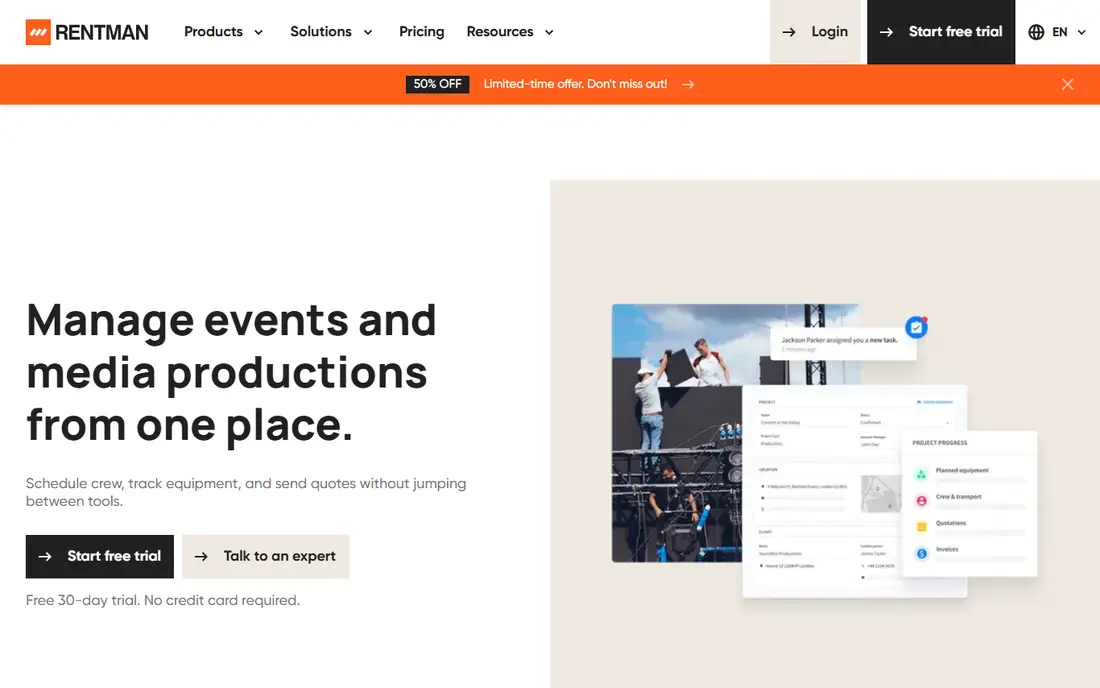
Rentman is built for the events and media production industries, where a rental is rarely just a single item: it is a project with equipment, crew, transport, and a schedule. The platform covers availability in a timeline view, equipment tracking with QR codes and barcodes, digital packing lists, and crew scheduling with availability requests and hour tracking. Subrentals, a common need when a job needs gear the company does not own, are handled inside the same workflow rather than in a side spreadsheet. Quotes and invoices can be generated with company branding and signed digitally. For AV and event companies, that combination is hard to beat, because the project view keeps equipment, people, and paperwork aligned. Construction-focused yards may find the industry fit less direct, and there is no free tier, so smaller shops should test the trial carefully before committing.
- Equipment, crew, and projects in one place, QR and barcode tracking, subrental handling
- AV and event focus may not suit heavy equipment yards, no free tier
EZRentOut
Ideal for: Construction, oil and gas, and industrial equipment rental
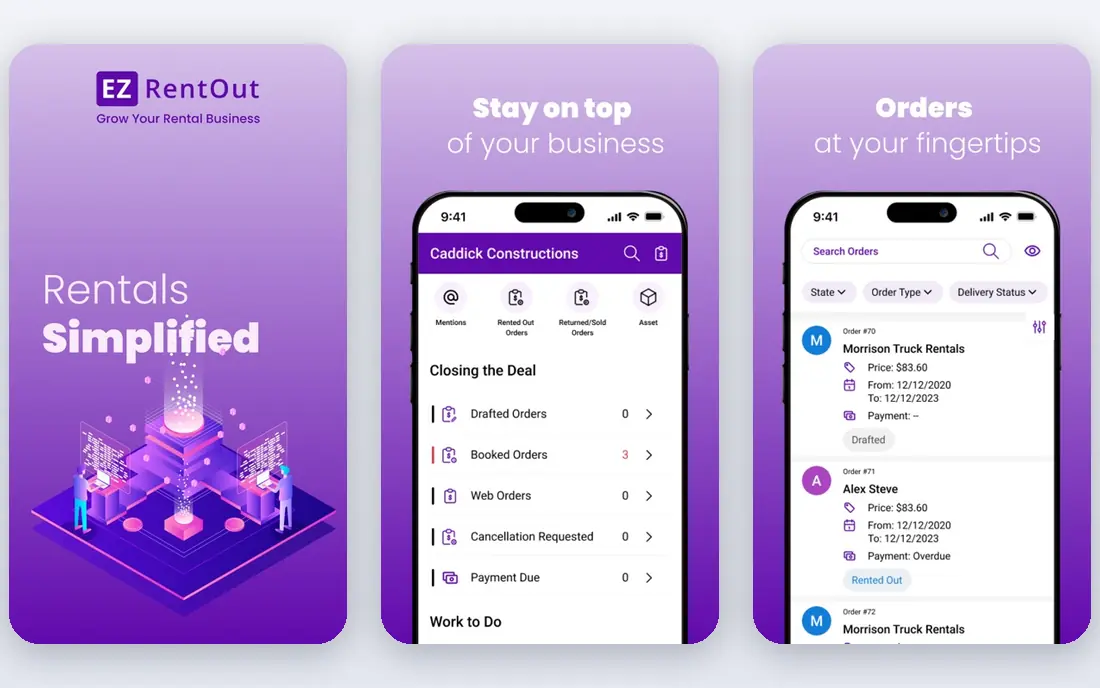
EZRentOut connects availability, orders, returns, maintenance, damage records, billing, and accounting into a single loop, so every unit carries a complete story: what is out, what is due back, what it needs before it can go out again, and whether the money side is settled. That design solves the most expensive rental mistake, which is sending out a unit that should be in the shop. Maintenance work orders can be scheduled by time, usage, or return trigger, and a unit flagged for damage cannot be rented until it is cleared. The mobile app supports rent-outs, returns, scanning, and damage photos from a phone in the yard, with offline logs that sync when signal returns. Integrations cover QuickBooks Online and Desktop, payment gateways, and GPS and telematics tools. Multiple stores and locations can be managed in one account with role-based access. Pricing is quote-based, so budget planning needs a conversation with the vendor.
- Live availability across locations, maintenance tied to availability, QuickBooks sync, offline mobile app
- Feature depth takes onboarding time, pricing requires a quote
Booqable
Ideal for: Small and growing rental businesses that want online bookings fast
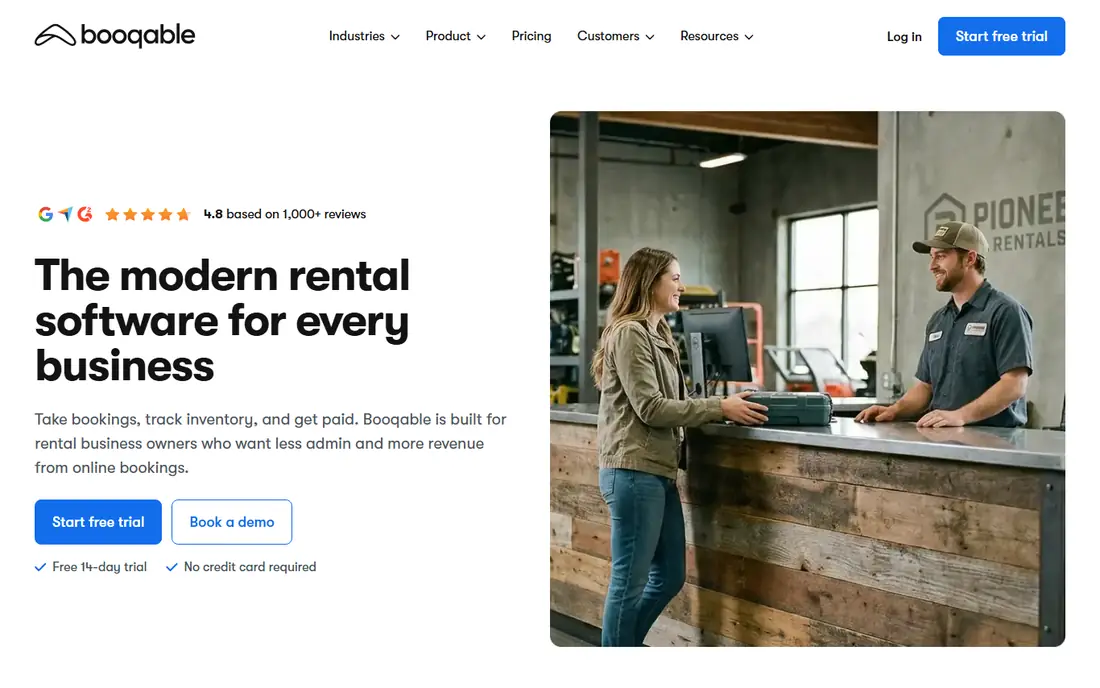
Booqable is rental software for businesses of all sizes that want to take bookings, track inventory, and get paid without a long implementation. Its standout feature for smaller operators is the path to online selling: a ready-made booking page where customers can browse, book, and pay, a website builder with rental templates, or integration with an existing WordPress, Shopify, or Squarespace site. Orders, inventory, quotes, contracts, and invoices live in one place, with real-time availability tracking to prevent double bookings. A mobile app covers in-store, delivery, and warehouse work, and an AI assistant answers questions about the platform. All plans include unlimited inventory and orders with no commission on bookings, and the Start plan is listed at $29 per month on yearly billing. There is a 14-day trial but no permanent free tier, and the most advanced reporting and extra locations sit on higher plans.
- Ready-made booking page, website builder with rental templates, 14-day trial
- No permanent free tier, advanced reporting sits on higher plans
TWICE
Ideal for: Businesses combining rental, resale, and subscriptions
TWICE, formerly known as Rentle, is a circular commerce platform for rental, resale, and product-as-a-service businesses, and its rental features fit equipment rental well. Every stock item is tracked individually with its own condition, costs, revenue, and history, so a business can see whether a specific unit earns its keep across many rental cycles. The same listing can be offered for rent, for sale, or as a subscription, with seasonal and duration-based pricing rules and availability computed automatically. Orders, customers, waivers, and payments live in one system, and stock counts update as items are reserved, picked up, returned, or set aside for maintenance. The platform suits businesses that rent and also sell used equipment, which is common in sports, tools, and specialty gear. Buyers should note the rebrand from Rentle to TWICE when reading older reviews, and should confirm current pricing on the vendor site.
- Serialized item tracking, rental plus resale in one catalog, flexible pricing rules
- Newer brand name can confuse research, pricing varies by setup
Quipli
Ideal for: Independent tool and heavy equipment rental companies in North America
Quipli is built for independent rental companies, with general tool and light equipment rental plus heavy equipment as its core markets. The platform unifies rentals, inventory, dispatch, maintenance, and payments, with a customer portal and mobile-friendly storefront so customers can browse, reserve, and pay at any hour. Accounting syncs with QuickBooks Online in real time, and on-account billing with purchase orders supports the contractor customers that heavy equipment yards serve. Built-in rental protection covers ID verification, GPS tracking, and damage waiver tools. Pricing is unusually simple: a flat fee of $6,000 per rental location per year, with unlimited users and unlimited inventory and no implementation fees, according to the vendor site. That simplicity makes budgeting easy, but the annual per-location fee is a serious commitment for a single-location shop, and event rental businesses are generally not a good fit, by the vendor's own account.
- Flat per-location pricing, QuickBooks Online sync, dispatch and maintenance included
- Construction focus limits fit for event rental, annual per-location fee is a big commitment
Rentrax
Ideal for: Rental businesses that also run tours and activities
Rentrax is an all-in-one rental and tour management tool that handles bookings, inventory, payments, and staff scheduling in one place. That combination suits businesses that rent bikes, boats, cameras, or outdoor gear and also sell guided tours or activities, where the same customer, calendar, and payment flow covers both sides of the business. The dashboard gives a real-time view of business performance, and the vendor emphasizes simple plans without hidden fees, with custom pricing for larger operations. Rentrax was created by a former rental business owner, which shows in its focus on daily operational problems rather than abstract features. The trade-offs are a smaller public profile than the largest vendors and pricing that is not published on the homepage, so buyers need a demo and a quote to compare costs. For rental-plus-tour operators, the combined workflow is worth that extra step.
- Bookings, inventory, payments, and staff in one tool, simple plans, tour support
- Smaller vendor profile than larger rivals, pricing not published on the homepage
Point of Rental
Ideal for: Multi-location rental companies that need deep operational control
Point of Rental is one of the longest-established names in rental software, serving general tool, construction, and event rental companies from a single platform. Its strength is operational depth for multi-location businesses: centralized inventory, rental contracts, dispatch, service and maintenance, purchasing, and accounting, with role-based access per location. Companies that have grown past a single yard often value that depth, because it covers the back-office work that simpler tools leave to spreadsheets. The product family includes cloud and on-premises options, which matters for businesses with strict IT policies. The interface can feel dated compared with newer tools, and pricing is quote-based, so comparing total cost takes a vendor conversation. For established multi-location operators, Point of Rental remains a safe and proven choice.
- Long track record in rental, strong multi-location support, broad integrations
- Interface feels dated in places, pricing requires a quote
Current RMS
Ideal for: AV, lighting, and production rental companies
Current RMS is rental management software built around projects, which is how AV, lighting, and production companies actually work: a job has a date range, a venue, a set of equipment, crew, transport, and a client, and all of it needs to stay together. The platform handles availability, quoting, orders, subhire from other rental houses, invoicing, and asset tracking in that project frame, so a production company can see the full shape of a job rather than a pile of disconnected line items. Its heritage in the live events and production world gives it credibility with rental houses that serve concerts, theater, and corporate events. Construction and general tool yards will find the project framing less natural than a fleet-first tool such as EZRentOut or Quipli. Pricing is quote-based, and buyers should run a real job through the trial to judge the workflow before deciding.
- Project-based rental workflows, subhire handling, quoting and invoicing built in
- AV focus narrows fit for construction yards, pricing requires a quote
How we picked these
We looked for tools that cover the full rental cycle rather than a single piece of it: availability, booking, checkout, return, maintenance, and billing. We favored products with a clear rental focus and a live vendor site, and we balanced the list across construction, general tool, AV and event, and rental-plus-tour businesses, because the right tool depends heavily on what you rent. We compared official feature pages, pricing pages, and public reviews, and we left out generic inventory tools that lack rental-specific features such as date-based availability and return handling. Where a vendor did not publish a current price, we wrote "See website" rather than repeat a third-party figure.
What to check before you buy rental software
Start with your busiest rental week and walk it through the trial: a booking, a change of dates, a partial return, a damaged item, and an invoice. If any of those steps needs a spreadsheet, the tool is not finished for your business. Check how availability behaves when a unit is in maintenance, because that rule alone prevents the most expensive mistakes. Ask about data import from your current system, and about how multi-location stock and pricing work if you plan to grow. Confirm which accounting and payment tools integrate directly, and test the mobile app in the yard, not just at a desk. Finally, compare total cost honestly: a low monthly fee with per-user charges can cost more than a flat per-location fee once your team grows, and a quote-based price is only comparable once you have the same scope in writing from each vendor.
Frequently asked questions
What is equipment rental management software?
It is software that tracks rental inventory by date, manages bookings and returns, handles maintenance and damage records, and connects billing and payments, so a rental business runs on one record instead of spreadsheets.
Do I need rental software for a small fleet?
A small fleet can run on spreadsheets, but the case for software strengthens as soon as double bookings, missed maintenance, or billing errors start costing money or customers. A trial on a busy week usually settles the question.
How does rental software prevent double bookings?
It ties every booking to dated availability for specific units or pools, and it updates that availability the moment a booking, return, extension, or maintenance hold is recorded, so the whole team sees the same live picture.
Can rental software handle online bookings?
Most modern tools offer a booking page, a customer portal, or a website integration so customers can browse availability, reserve, sign documents, and pay online without a phone call.
What integrations matter most for rental businesses?
Accounting sync, payment processing, and, for heavy equipment, GPS or telematics. Accounting sync keeps invoices and payments consistent, and telematics helps track high-value units in the field.
How long does it take to switch to rental software?
Most vendors quote days to a few weeks for setup and onboarding, depending on fleet size, data import, and how many locations and integrations are involved. A phased rollout by location reduces risk.