Which Exposure Management Platforms Fits You? 7 Tools Compared

- 1
 WizCloud-native teams managing cloud exposuresVisit
- 2
 BalbixAI-driven exposure prioritizationVisit
- 3
 XM CyberAttack path management and validationVisit
- 4
 CrowdStrike Falcon Exposure ManagementCrowdStrike customers adding exposure contextVisit
- 5
 Tenable OneEnterprises standardizing exposure managementVisit
- Wiz sits first on this list: cloud-native teams managing cloud exposures.
- None of the 7 tools, from Wiz to Qualys, has a free plan, so budget for a subscription or use a trial.
- For full VM plus exposure management, Qualys is worth a look.
- Wiz, Qualys and the 5 others all sell by quote; expect sales conversations before you see a price.
Direct answer
This list puts Wiz first for cloud-native teams managing cloud exposures. Alternatives: Balbix for AI-driven exposure prioritization, and XM Cyber for attack path management and validation. The full list of 7 tools follows, with prices and free plan facts.
Quick comparison
| Product | Ideal for | Price from | Free version | |
|---|---|---|---|---|
| Wiz | Cloud-native teams managing cloud exposures | See website | No | Visit |
| Balbix | AI-driven exposure prioritization | See website | No | Visit |
| XM Cyber | Attack path management and validation | See website | No | Visit |
| CrowdStrike Falcon Exposure Management | CrowdStrike customers adding exposure context | See website | No | Visit |
| Tenable One | Enterprises standardizing exposure management | See website | No | Visit |
 Palo Alto Networks (Cortex Xpanse) | External attack surface plus exposure management | See website | No | Visit |
 Qualys | Full VM plus exposure management | See website | No | Visit |
Exposure Management Platforms profiles
This Ainotely guide covers 7 exposure management platforms. Each profile lists a starting price, free plan details, strengths and drawbacks, so you can drop poor fits quickly.
Wiz
Ideal for: Cloud-native teams managing cloud exposures
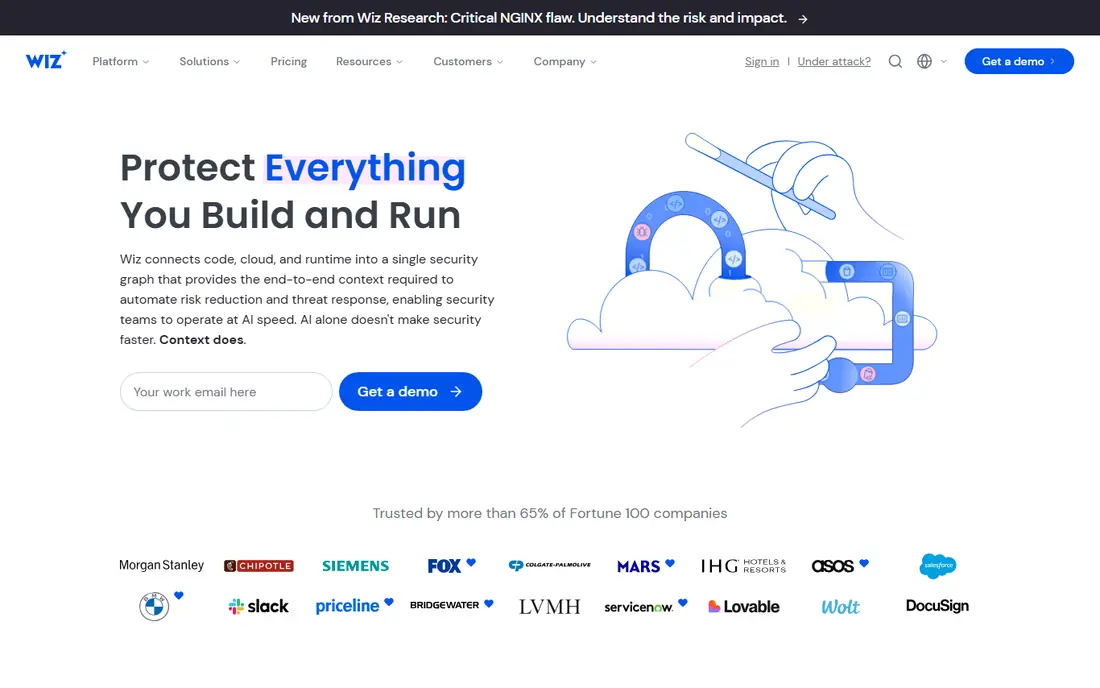
Wiz is built with cloud-native teams managing cloud exposures in mind. Wiz provides cloud teams complete visibility without agents: link cloud accounts and see every resource, vulnerability, misconfiguration, and identity risk in one graph.
In daily use, for cloud exposure management, Wiz defined the modern approach. Prioritization cuts through the noise of thousands of findings. Wiz shows no starting price here, so confirm the cost on the vendor site. There is no free plan with Wiz.
The main drawbacks: Pricing scales with cloud spend.
- Loved by cloud teams
- Agentless cloud visibility
- Cloud-focused, less for on-prem
Balbix
Ideal for: AI-driven exposure prioritization
Balbix is a good fit for AI-driven exposure prioritization. Balbix applies AI to unify asset inventory and prioritize exposures by predicted breach risk, with reporting that translates technical findings into business risk language boards understand. For AI-driven prioritization with board reporting, Balbix is innovative.
Drawbacks to consider: Ecosystem less mature.
The risk modeling goes beyond CVSS scores to consider exploitability and business context. Beyond that, the automation cuts analyst toil. CISOs like the executive-ready view of the program. This comparison lists no price for Balbix; ask the vendor. Balbix has no free tier.
- Innovative approach
- Unified asset inventory
- Pricing is quote-based
XM Cyber
Ideal for: Attack path management and validation

XM Cyber is aimed squarely at attack path management and validation. XM Cyber models attack paths continuously: given current vulnerabilities, misconfigurations, and identities, which routes could attackers actually take to crown jewels. That path-centric view prioritizes fixes by real risk.
Beyond that, the system validates exposures instead of just listing them, cutting the false-positive fatigue of traditional scanning. From a buyer's view, enterprise security teams use it to focus remediation where it matters. It is an enterprise tool with enterprise process needs. Check the vendor site for XM Cyber pricing; none is listed in this comparison. XM Cyber has no free tier.
The main drawbacks: Needs integration effort. Reasons to shortlist it: Very good attack path modeling.
- A decent match for prioritizing
- Continuous validation
- Pricing is quote-based
CrowdStrike Falcon Exposure Management
Ideal for: CrowdStrike customers adding exposure context
CrowdStrike Falcon Exposure Management is designed for CrowdStrike customers adding exposure context. Falcon Exposure Management layers exposure assessment onto CrowdStrike's endpoint product, showing which vulnerabilities actually matter given real endpoint context and threat intelligence. Attack path analysis reveals how exposures chain toward critical assets.
Limits to weigh: Standalone value less.
What works well: Links up with Falcon product.
On top of that, for Falcon customers, the integration means exposures appear alongside detections in one console. More specifically, outside the Falcon ecosystem the value proposition thins. No starting price is listed for CrowdStrike Falcon Exposure Management here; confirm pricing on the vendor site. There is no free plan with CrowdStrike Falcon Exposure Management.
- Attack path analysis
- Capable threat intelligence
- Pricing is enterprise-grade
Tenable One
Ideal for: Enterprises standardizing exposure management
Tenable One is aimed squarely at enterprises standardizing exposure management. Tenable One brings together vulnerability management, cloud security, and attack surface data into exposure scores that tell teams what to fix first. The Nessus heritage means the scanning depth is proven.
Limits to weigh: Can be complicated.
For everyday use, for organizations standardizing exposure management, Tenable One is the category reference. On top of that, the prioritization, weighing exploitability against asset criticality, is the core value. This comparison lists no price for Tenable One; ask the vendor. Tenable One has no free plan.
- Broadest asset coverage
- Capable vulnerability heritage
- Enterprise pricing
Palo Alto Networks (Cortex Xpanse)
Ideal for: External attack surface plus exposure management
For external attack surface plus exposure management, Palo Alto Networks (Cortex Xpanse) is a natural candidate. The approach complements inside-out vulnerability management. Remediation workflows assign exposures to owners with context, and the Cortex system integration links external findings to internal security operations.
Watch-outs: Complexity.
Unknown assets get found and assessed automatically. Pricing is enterprise and the full value includes Palo Alto adoption. Pricing for Palo Alto Networks (Cortex Xpanse) is not stated here, so ask the vendor for current figures. Palo Alto Networks (Cortex Xpanse) does not include a free plan.
- Very good external attack surface discovery
- Solid remediation workflows
- Enterprise pricing
Qualys
Ideal for: Full VM plus exposure management
Qualys is a good fit for comprehensive VM plus exposure management. Compliance and policy auditing are solid, which matters for regulated industries.
Where it is weaker: The suite can overwhelm.
Qualys shows no starting price here, so confirm the cost on the vendor site. There is no free plan with Qualys.
- Deep vulnerability management
- Decent compliance features
- Interface dated
Worth knowing about exposure management platforms
Exposure management is the continuous practice of finding every way an attacker could reach your critical assets, then fixing the riskiest paths first. It brings together vulnerability management, attack surface monitoring, and security validation into one program, commonly called Continuous Threat Exposure Management. Point-in-time assessments miss what continuous systems catch.
Beyond that, demos and proof-of-value pilots are the standard path.
How we built this list
For each of the 7 tools we noted price, free plan or trial, fit for exposure management platforms and the main limit, using vendor pages and documentation. Where a price is missing, the vendor does not list one publicly or ties it to a quote. Always confirm before budgeting. The ranking is editorial: typical fit first, then clear pricing, then free access. If your needs are unusual, read the profiles rather than relying on position.
A buyer's checklist
- Confirm the entry price with every vendor: no tool from Wiz to Qualys shows a fixed starting price.
- Before choosing Wiz, weigh its main limit: cloud-focused, less for on-prem.
- Add up seats, add-ons and usage charges for XM Cyber before comparing it with cheaper entries.
- Look at which plan of Wiz unlocks the features you need; entry tiers are often cut down.
- A short pilot of Qualys with your real workflow tells you more than a feature table.
Frequently asked questions
How are the tools for exposure management platforms ordered?
The order follows typical fit for exposure management platforms, with Wiz first and Qualys last, then price clarity and free access. It is editorial judgement, not a score, so another team could rank the tools differently.
Is Wiz the right pick for everyone comparing exposure management platforms?
No single tool suits every team. Wiz comes first because it fits cloud-native teams managing cloud exposures, while Balbix suits AI-driven exposure prioritization and XM Cyber suits attack path management and validation. Match the tool to your own size, budget and workflow before deciding.
How long does deployment take?
Cloud-native tools like Wiz deploy in hours to days. Also, enterprise suites usually take weeks to months for full rollout across complicated estates.
Can I try these options before paying?
Not by default. None of the tools, from Wiz to Qualys, lists a free plan or a free trial here, so ask each vendor for a demo before committing.
Does any tool for exposure management platforms here have a free plan?
A permanent free plan is not offered by Wiz, Qualys or the other tools here. Plan a short evaluation period instead.