Best Feature Flag Management Software in 2026: 8 Tools Compared

- LaunchDarkly remains the leading feature flag platform, with deep targeting, rollouts, and integrations for teams of all sizes.
- Statsig combines feature flags with experimentation and analytics, which suits product teams that test and measure every release.
- Flagsmith and ConfigCat are the best value options, with open source or low-cost plans that suit smaller teams.
- Unleash suits teams that want open source flags they can self-host, while Optimizely suits enterprises that pair flags with large-scale testing.
- DevCycle and PostHog cover flags plus developer and product analytics, which suits teams that want one platform for releases and insights.
Quick comparison
| Product | Ideal for | Price from | Free version | |
|---|---|---|---|---|
 LaunchDarkly | Full feature flag platform | See website | Free trial | Visit |
 Statsig | Flags plus experimentation | See website | Free | Visit |
 Flagsmith | Open source value flags | See website | Free | Visit |
 ConfigCat | Simple low-cost flags | See website | Free | Visit |
 Unleash | Self-hosted open source flags | See website | Free | Visit |
 Optimizely | Enterprise flags and testing | See website | Free trial | Visit |
 DevCycle | Developer-friendly flags | See website | Free | Visit |
 PostHog | Flags plus product analytics | See website | Free | Visit |
The best feature flag management software
We compared official feature pages, documentation, pricing pages, and public reviews for the tools below. Our pick for most teams is LaunchDarkly, because it offers the deepest targeting, safest rollouts, and broadest integrations in a platform proven at scale.
LaunchDarkly
Ideal for: Full feature flag platform

LaunchDarkly is the standard for feature flags. Teams can target flags by user, segment, or percentage, roll out gradually, kill a bad release instantly, and run experiments, all with SDKs for most languages and frameworks. Governance tools track flag ownership and clean up old flags.
Pricing grows with usage and team size, and the full platform takes time to learn. For teams that release often and need safe, controlled rollouts, LaunchDarkly is our pick.
- Deep targeting rules and percentage rollouts
- Integrations across languages and frameworks
- Flag cleanup and governance tools
- Pricing scales with usage and seats
- Breadth takes time to learn
- Smaller teams may find it heavy
Statsig
Ideal for: Flags plus experimentation
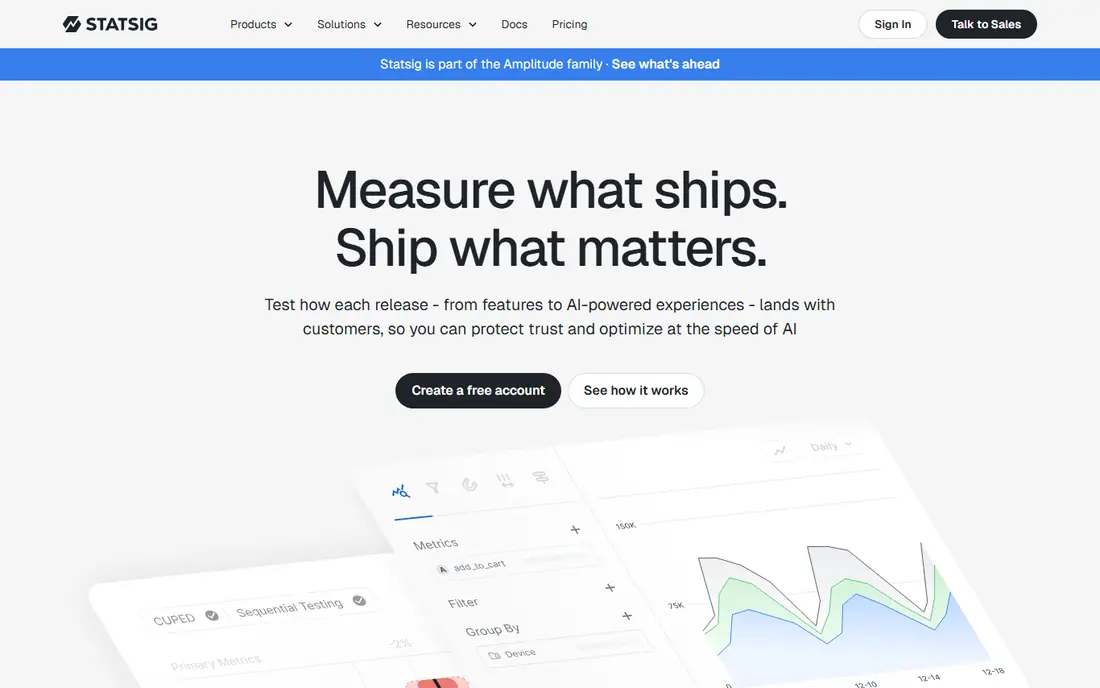
Statsig combines feature flags with experimentation and product analytics, so teams can roll out a feature to a percentage of users, measure its impact, and decide with data. The free tier is generous, and edge evaluation keeps flag checks fast.
Teams that only need simple flags may find the analytics side more than they want, and event-based pricing can grow with traffic. For product teams that test every release, Statsig is an excellent choice.
- Feature gates plus A/B testing and analytics in one platform
- Generous free tier
- Fast SDKs and edge evaluation
- Analytics depth can feel large for flag-only teams
- Pricing scales with events
- Setup needs product thinking
Flagsmith
Ideal for: Open source value flags
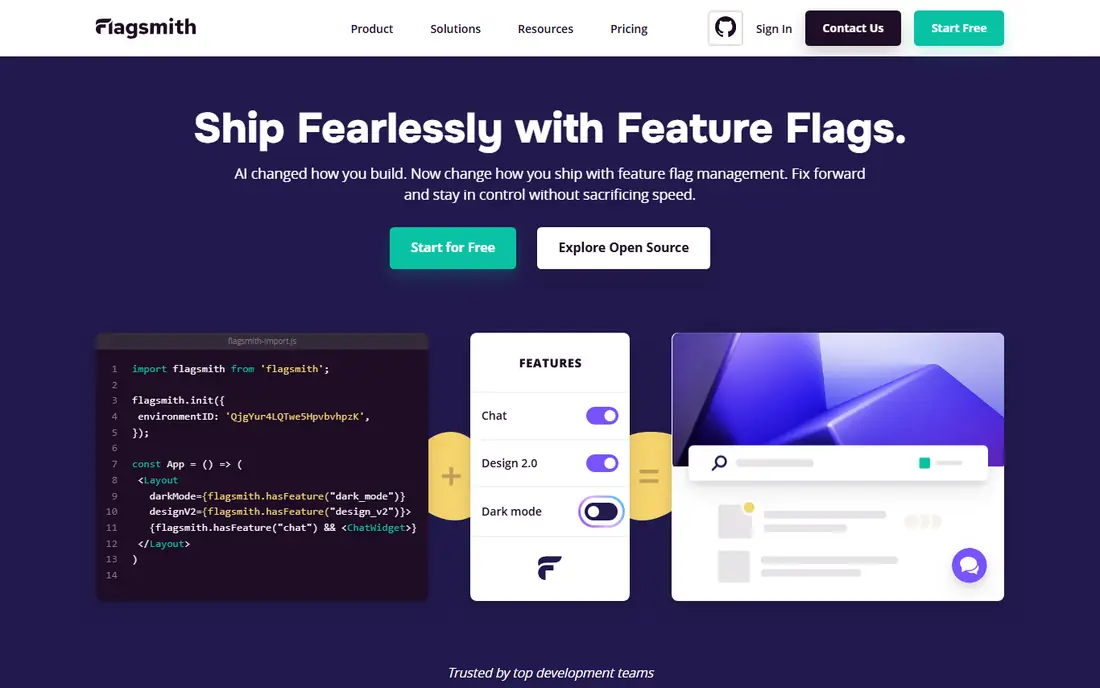
Flagsmith is an open source feature flag platform with a free cloud tier and a self-hosting option. It covers flags, remote config, segments, and A/B testing, with SDKs for major languages. That combination makes it one of the best value options for small and mid-sized teams.
The ecosystem and integrations are smaller than LaunchDarkly, and enterprise features sit on paid plans. For teams that want capable flags without enterprise pricing, Flagsmith is hard to beat.
- Open source flags with a free cloud tier
- Remote config and A/B testing
- Self-hosting option
- Smaller ecosystem than LaunchDarkly
- Enterprise features need paid plans
- Interface is simpler
ConfigCat
Ideal for: Simple low-cost flags
ConfigCat keeps feature flags simple and affordable. Setup is fast, config delivery is quick, and the free tier covers small projects, with paid plans that stay cheaper than enterprise platforms. Targeting covers users, segments, and percentages for most common rollout needs.
Experimentation and governance features are lighter than larger rivals, so big product teams may outgrow it. For small teams that want reliable flags at a low price, ConfigCat is a strong pick.
- Simple, low-cost flags with a free tier
- Fast config delivery
- Easy setup for small teams
- Experimentation features are lighter
- Targeting rules are simpler than LaunchDarkly
- Larger enterprises may outgrow it
Unleash
Ideal for: Self-hosted open source flags
Unleash is an open source feature management platform that teams can self-host for full control, or use as a managed cloud service. It supports flexible activation strategies, constraints, and segments, with SDKs for many languages and a strong community.
Self-hosting adds operational work, and experimentation features are lighter than Statsig or Optimizely. For teams that want open source flags with data control, Unleash is the best self-hosted option.
- Open source flags you can self-host
- Flexible strategies and constraints
- Strong community and SDKs
- Self-hosting needs engineering effort
- Managed cloud costs more
- Experimentation is lighter than Statsig
Optimizely
Ideal for: Enterprise flags and testing
Optimizely pairs feature flags with enterprise experimentation, letting large teams roll out features and test them with statistical rigor. Targeting, analytics, and governance suit organizations with many teams and strict release processes.
Pricing and setup are enterprise-oriented, so smaller teams will find faster, cheaper options. For large product organizations that already invest in experimentation, Optimizely is a proven platform.
- Feature flags plus enterprise experimentation
- Strong targeting and analytics
- Trusted by large organizations
- Enterprise pricing and sales process
- Setup is heavier than smaller tools
- Best value at scale
DevCycle
Ideal for: Developer-friendly flags
DevCycle is built for developers, with fast edge evaluation, clean SDKs, and a dashboard that stays simple. The free tier is generous, and the platform covers flags, targeting, and rollouts without the complexity of enterprise tools.
The ecosystem is smaller than LaunchDarkly, and experimentation features are newer. For developer teams that want fast, simple flags with a good free tier, DevCycle is an appealing choice.
- Developer-friendly flags with edge evaluation
- Generous free tier
- Clean SDKs and dashboard
- Smaller ecosystem than LaunchDarkly
- Experimentation is growing but newer
- Enterprise features are limited
PostHog
Ideal for: Flags plus product analytics
PostHog is a product analytics platform that includes feature flags alongside session replay, surveys, experiments, and user analytics. That combination lets teams roll out a feature and watch how users actually use it, all in one place.
Flags alone are simpler here than in LaunchDarkly, and the platform covers a lot beyond flags. For product teams that already use or want PostHog analytics, its flags are a natural and cost-effective addition.
- Feature flags plus analytics, session replay, and surveys
- Open source core
- Generous free tier
- Flags are one part of a large platform
- Setup covers more than flags
- Pricing scales with events
How we picked these
We compared official feature pages, documentation, pricing pages, and public reviews for each tool, and we favored products still operating in October 2026 that manage feature flags in production, not just config files. We left out basic config libraries with no dashboard or targeting, and A/B tools with no flag management. Note that homepage checks for this article were limited by a browser rate-limit error during our work, so readers should confirm current pricing and features on each vendor site.
Running feature flags without creating debt
Name flags clearly and assign an owner to each one. A flag called new_checkout_v2 with an owner and a removal date is easy to clean up, while a flag called test_flag stays in code for years. Review flags regularly and remove them once a rollout is complete.
Roll out gradually and watch metrics. Start with internal users, then a small percentage, then wider groups, checking errors and key metrics at each step. A kill switch only helps if someone is watching, so pair rollouts with alerts for the metrics that matter.
Flag hygiene is what separates teams that move fast from teams that drown in old toggles. Every flag should have an owner, a purpose, and a removal date, because flags left on after a rollout become hidden configuration that nobody understands. Review stale flags each sprint, remove ones that are fully rolled out, and archive experiments with their results, so the flag list stays short enough to reason about. A flag dashboard that nobody cleans becomes a risk, since an old flag flipped by accident can change behavior in production without a code deploy.
Targeting rules need care too. Rollouts by percentage, by user group, or by plan let you test with a small audience first, but rules must be predictable and testable, or debugging becomes guesswork. Keep flag evaluations fast and local where possible, since a slow flag check on every request adds latency across the whole app. Finally, treat flags as part of code review: new flags, changed rules, and removals all deserve a second pair of eyes, just like any other production change. Experimentation with feature flags needs honest analysis. Before launching an experiment, decide what success looks like, how long the test will run, and how many users it needs, since short tests on tiny audiences produce noise rather than answers. Segment results by meaningful groups, such as new versus returning users, and watch for side effects beyond the headline metric, since a change that lifts clicks but hurts retention is not a win. Document experiment outcomes, including failed tests, so teams do not repeat the same experiment a year later.
Performance monitoring around flags is equally important. A flag system that adds latency or fails open during an outage can harm the whole app, so test failure modes: what happens if the flag service is unreachable, and does the app fall back to a safe default? Cache flag values sensibly, avoid checking flags in tight loops, and log flag evaluations during incidents, so you can tell whether a flag change contributed to a problem. Teams that treat flags as production infrastructure, with monitoring and runbooks, get the speed benefits without the midnight surprises.
Frequently asked questions
What is the best feature flag management software?
LaunchDarkly is our pick for most teams, with deep targeting, safe rollouts, and broad integrations. Statsig suits teams that pair flags with experimentation, while Flagsmith and ConfigCat suit smaller budgets.
Are feature flags free?
Several tools offer free tiers, including Flagsmith, ConfigCat, DevCycle, PostHog, Statsig, and Unleash. Free tiers cover small projects, while larger teams usually need paid plans.
Can I self-host feature flags?
Yes. Flagsmith and Unleash both offer open source self-hosting, which gives you full data control. Managed cloud versions are easier to run but store flag data with the vendor.
Do feature flags slow down an app?
Well-built flag SDKs evaluate locally or at the edge with minimal latency, so the impact is usually tiny. Avoid checking flags in tight loops, and cache evaluations where your SDK supports it.
How do feature flags differ from A/B testing?
Feature flags control who sees a feature, while A/B testing measures which version performs better. Many platforms combine both: flags roll out a feature, and experiments measure its impact.