Best Feedback Analytics Software in 2026: 8 Tools Compared

- Qualtrics and Medallia lead for enterprise experience management, while Thematic, Chattermill, and Kapiche focus specifically on analyzing open-ended feedback.
- MonkeyLearn suits teams that want to build custom text classifiers, while Enterpret and Dovetail help product teams connect feedback to decisions.
- Feedback analytics only helps if themes reach owners with actions, so check dashboards, alerts, and integrations, not just analysis quality.
- Test with your own feedback, since models trained on general text can miss industry language, product names, and slang.
Quick comparison
| Product | Ideal for | Price from | Free version | |
|---|---|---|---|---|
 Qualtrics | Enterprise experience management | See website | Free trial | Visit |
 Medallia | Enterprise customer experience | See website | No | Visit |
 Thematic | Feedback theme analysis | See website | Free trial | Visit |
 Chattermill | Unified feedback analytics | See website | Free trial | Visit |
 Kapiche | Feedback analysis for CX teams | See website | Free trial | Visit |
 MonkeyLearn | Custom text classifiers | See website | Free trial | Visit |
 Enterpret | Product feedback intelligence | See website | Free trial | Visit |
 Dovetail | Research and feedback repository | See website | Free trial | Visit |
The best feedback analytics software
Feedback analytics software collects comments from surveys, reviews, support tickets, and social posts, then groups them into themes, sentiment, and trends, so teams can see what customers care about without reading every message. The best tools also route insights to the teams that can act on them. We compared official feature pages, pricing pages, and public reviews, focusing on theme accuracy, sentiment, dashboards, and integrations.
Qualtrics
Ideal for: Enterprise experience management
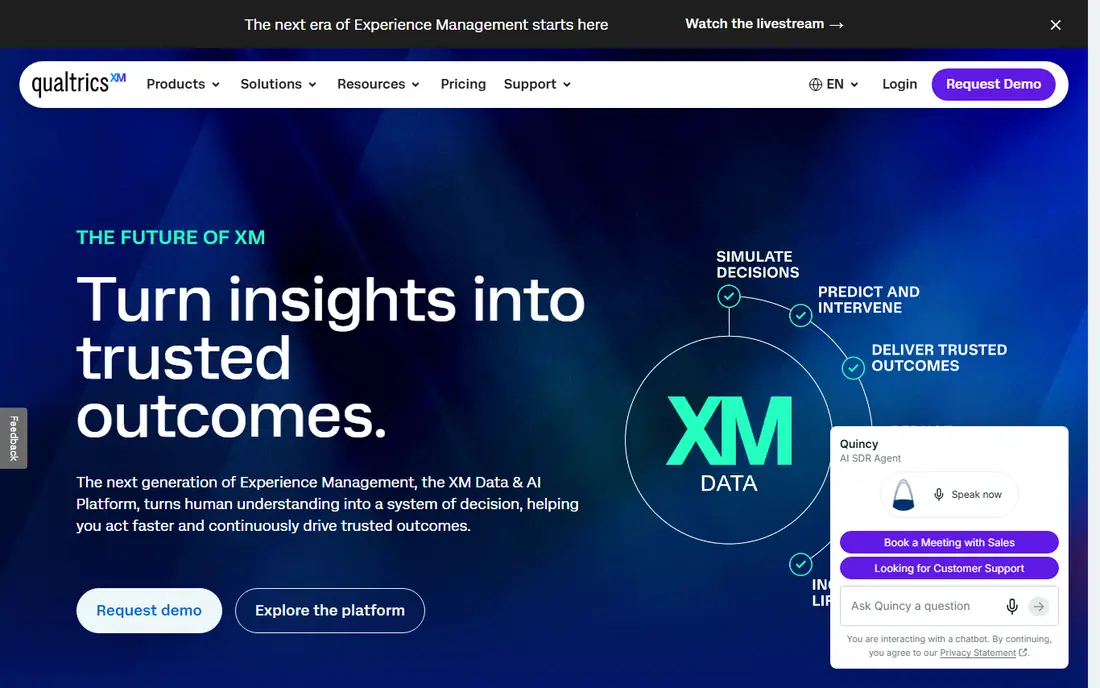
Qualtrics is a leading experience management platform covering customer, employee, product, and brand feedback, with surveys, analytics, dashboards, and action workflows. Its text analytics features surface themes and sentiment from open-ended responses, alongside structured survey data, so teams can see both scores and reasons behind them. That breadth suits large organizations running many feedback programs.
Pricing is enterprise, and the platform's breadth means implementation and training take effort. Smaller teams may prefer a focused feedback tool. For enterprise experience programs, Qualtrics is a top-tier choice.
- Broad survey and experience platform
- Strong analytics and dashboards
- Enterprise scale
- Enterprise pricing and complexity
- Feedback analysis is part of a wider suite
Medallia
Ideal for: Enterprise customer experience

Medallia is an enterprise customer experience platform that collects feedback across surveys, digital, contact center, and social channels, then analyzes text for themes and sentiment and routes actions to teams. Its strength is connecting feedback to operations: a theme about delivery, for example, can trigger follow-up with the relevant team. Large brands in retail, hospitality, and telecom use Medallia at scale.
Pricing and implementation are enterprise-level, and smaller organizations will find it heavy. For large CX programs, Medallia is a leading platform.
- Enterprise CX platform with strong text analytics
- Omnichannel feedback
- Action workflows
- Enterprise pricing
- Implementation effort for large programs
Thematic
Ideal for: Feedback theme analysis

Thematic turns surveys, reviews, and support tickets into themes, sentiment, and trends, with visualizations that CX and research teams can share with stakeholders. Its models are tuned for feedback language, helping surface themes such as pricing, delivery, or onboarding without manual coding. That focus makes results easier to act on than generic text analysis.
Thematic is an analysis layer rather than a full survey platform, so teams still need tools to collect feedback. Pricing is quote-based. For feedback analysis specifically, Thematic is a strong, focused pick.
- Built for feedback themes and sentiment
- Clear visualizations
- Good for CX and research teams
- Feedback-focused, less of a full survey platform
- Pricing by quote
Chattermill
Ideal for: Unified feedback analytics
Chattermill unifies feedback from surveys, reviews, support tickets, and other sources into one analytics platform, with AI themes, sentiment, and dashboards that track trends over time. Alerts can notify teams when a theme spikes, which helps catch emerging issues early. Integrations with support and survey tools keep feedback flowing automatically.
Pricing is quote-based, and brand presence is smaller than the enterprise giants, so buyers should check references in their sector. For mid-size CX teams that want unified feedback analytics, Chattermill is a capable choice.
- Unifies surveys, reviews, and tickets
- AI themes and sentiment
- Good dashboards and alerts
- Pricing by quote
- Smaller brand than Qualtrics or Medallia
Kapiche
Ideal for: Feedback analysis for CX teams
Kapiche analyzes customer feedback from surveys, reviews, and support channels, producing themes, sentiment, and trends with reporting that CX teams can share. Its speed is a selling point: teams can upload feedback and see themes quickly, without long model training. That suits teams that need regular insight from ongoing feedback programs.
Survey creation depth is lighter than Qualtrics, since Kapiche focuses on analysis rather than collection. Pricing is quote-based. For CX teams that already collect feedback and need better analysis, Kapiche is a practical pick.
- Fast feedback theme analysis
- Survey and review integration
- Clear reporting
- Pricing by quote
- Less survey creation depth than Qualtrics
MonkeyLearn
Ideal for: Custom text classifiers
MonkeyLearn lets teams build custom text classifiers and extractors without code, tagging feedback by topic, sentiment, intent, or any custom category. Integrations with forms, spreadsheets, and support tools mean analyzed feedback can flow into dashboards and workflows. That flexibility suits teams with specific categories that generic theme tools miss.
Custom models need labeled examples and review to perform well, and usage-based pricing should be modeled at full volume. For teams that want control over how feedback is categorized, MonkeyLearn is our pick for flexibility.
- No-code custom classifiers and extractors
- Integrations with common tools
- Flexible for many text types
- Needs labeled examples for custom models
- Usage pricing needs monitoring
Enterpret
Ideal for: Product feedback intelligence
Enterpret is built for product teams, unifying feedback from support tickets, surveys, reviews, community posts, and sales calls into themes and trends tied to product areas. That product lens helps teams prioritize roadmaps based on what customers actually request and complain about, rather than the loudest single channel. Dashboards and alerts keep product managers close to feedback.
General CX teams outside product may prefer Chattermill or Thematic. Pricing is quote-based. For product-led companies, Enterpret is a strong and focused choice.
- Built for product teams
- Unifies feedback from many sources
- Connects themes to product decisions
- Product focus limits general CX use
- Pricing by quote
Dovetail
Ideal for: Research and feedback repository
Dovetail is a research repository where teams store interviews, surveys, feedback, and observations, then tag, analyze, and share themes across the organization. Its strength is making research reusable: insights from one study can inform later decisions, and stakeholders can explore evidence rather than reading a static report. AI tagging and summaries speed up analysis.
Dedicated analytics depth is lighter than Thematic or Chattermill, since Dovetail is a research platform first. Pricing scales with seats. For research teams that want feedback and insights in one searchable home, Dovetail is an excellent choice.
- Central repository for research and feedback
- Tagging and theme analysis
- Good for research teams
- Analysis is part of a research platform, not a dedicated analytics engine
- Pricing scales with seats
How we picked these
We compared official feature pages, pricing pages, and public reviews for software that analyzes customer feedback at scale, not survey tools without analysis or generic dashboards. We looked at theme and sentiment quality, source coverage, dashboards, alerts, and integrations, and we included both enterprise platforms and focused analysis tools. Pricing for most is quote-based, so we marked those accordingly.
What to check before you choose feedback analytics software
Start with your feedback sources. A tool that only analyzes surveys will miss reviews and tickets, while a tool that unifies sources gives a fuller picture. Test theme accuracy on your own feedback, including product names and industry terms, since generic models can misclassify domain language. Check sentiment handling for mixed and sarcastic comments, which are common failure points.
Next, check the action workflow. Themes should reach owners through dashboards, alerts, tickets, or reports, with trends over time so teams can see whether fixes work. Finally, confirm data handling and retention, since feedback often contains personal information. A tool that analyzes well but never triggers action is just an expensive dashboard, so judge vendors on the decisions their insights support.
Also consider closed-loop follow-up, since feedback analysis should lead to contacting unhappy customers and fixing root causes, not just reporting themes. Check whether the tool can trigger alerts, create tickets, or send follow-up surveys when sentiment drops or a critical theme appears. A platform that closes the loop will improve retention and trust, while one that only reports will leave customers feeling ignored even when their feedback was counted.
Frequently asked questions
What is feedback analytics software?
Feedback analytics software collects customer comments from surveys, reviews, tickets, and social channels, then analyzes them for themes, sentiment, and trends. It helps teams understand what customers care about at scale, without reading every message manually.
What is the best feedback analytics software?
Qualtrics and Medallia lead for enterprise programs, Thematic and Chattermill suit focused feedback analysis, and Enterpret suits product teams. The best choice depends on program size, feedback sources, and whether you need survey creation or only analysis.
How is feedback analytics different from survey software?
Survey software collects responses, while feedback analytics software analyzes open-ended text across many sources, including surveys, reviews, and tickets. Many teams use both: a survey tool to collect, and an analytics tool to understand themes.
Can feedback analytics handle support tickets and reviews?
Yes, most tools in this list unify feedback from surveys, reviews, support tickets, and other channels. Check the specific integrations for your support and review platforms before buying, since coverage varies.
How accurate is AI theme analysis?
Accuracy varies by domain and data quality, and it improves when models are tuned to your product language and reviewed by humans. Use AI themes as a starting point, sample results regularly, and refine categories over time rather than trusting output blindly.