Best Fertility Apps in 2026: 8 Apps Compared

- Flo and Clue suit cycle and fertility tracking with large content libraries, while Ovia is free and carries tracking into pregnancy.
- Natural Cycles uses temperature-based algorithms and is FDA cleared for birth control, which is a different job from conception tracking.
- Premom suits users testing with ovulation strips, because it reads strip photos and charts LH curves.
- These apps do not replace medical advice. Talk to a clinician if cycles are irregular, conception takes over a year, or you have a known fertility condition.
Quick comparison
| Product | Ideal for | Price from | Free version | |
|---|---|---|---|---|
 Flo | Cycle and fertility tracking with a large community | See website | Yes | Visit |
 Clue | Science-led cycle and fertility tracking | $39.99 per year | Yes | Visit |
 Ovia | Free fertility tracking that continues into pregnancy | Free | Yes | Visit |
 Natural Cycles | Temperature-based fertility tracking | $149.99 per year | No | Visit |
 Premom | LH strip reading and ovulation charting | Free | Yes | Visit |
 Glow | Fertility tracking with community and BBT charts | $59.99 per year | Yes | Visit |
 Stardust | Daily-ritual cycle tracking with friend syncing | See website | Yes | Visit |
 Kindara | Fertility awareness charting for serious trackers | See website | Yes | Visit |
The best fertility apps
We compared official feature pages, pricing pages, app store listings, privacy policies and public reviews to build this list of 8 options for best fertility apps. Prices were checked in October 2026 and can change, so confirm the current price on the vendor site before you buy. Our pick for most people is the first option that fits your budget and workflow, not necessarily the most expensive tool on the list. Read the quick comparison first to narrow the field, then read the full write-ups for the two or three options that fit your needs best.
Flo
Ideal for: Cycle and fertility tracking with a large community
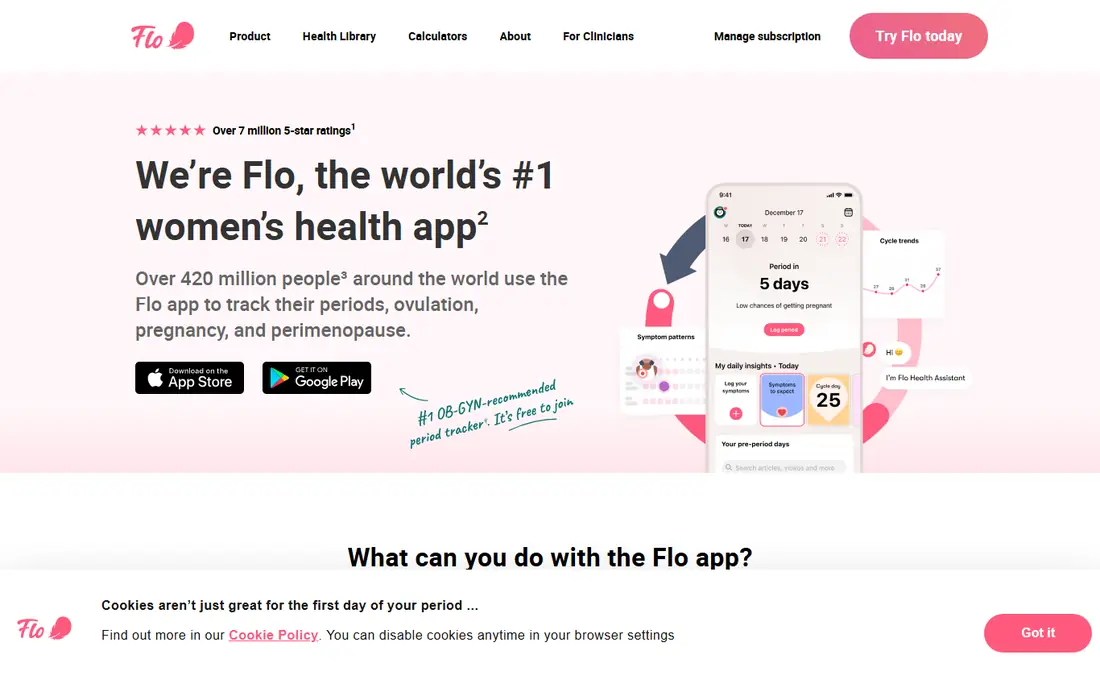
Flo is the largest fertility and cycle app, with a TTC mode, symptom tracking and a large community for questions. Its content library covers conception, pregnancy and cycle health in depth. For users who want community support alongside tracking, Flo is the biggest option.
Flo Premium adds full features, and its privacy history includes an FTC settlement, though it now offers an anonymous mode. Wearable temperature integration is also basic. Read the current privacy policy before logging sensitive data, and use anonymous mode if it fits your needs.
- Large community and content library
- TTC mode
- Symptom and mood tracking
- Premium needed for full features
- Past FTC settlement on privacy
- Wearable integration is basic
Clue
Ideal for: Science-led cycle and fertility tracking

Clue takes a science-led approach to cycle and fertility tracking, with careful logging for irregular cycles and clear explanations of predictions. Being based in Berlin, it operates under European privacy law, which reassures many users handling sensitive data. The interface is calm and focused.
Deeper analysis needs Clue Plus, and there is no large TTC community comparable to Flo. Wearable sync also needs a paid plan. For privacy-conscious, science-minded tracking, Clue is a strong pick.
- Science-focused design
- Irregular cycle logging
- European privacy governance
- Full analysis needs Plus
- No dedicated TTC community like Flo
- Wearable sync needs Plus
Ovia
Ideal for: Free fertility tracking that continues into pregnancy

Ovia offers free fertility tracking with forecasting, symptom and mood logging, and a large article library. When conception happens, tracking carries into the Ovia Pregnancy app, which keeps history in one place. For a fully free tracker, Ovia is hard to beat.
Ovia is owned by Labcorp, which concerns some users about health data ownership, so read the privacy policy first. Wearable integration is limited, and the merged app can feel busy. For free tracking with pregnancy continuity, Ovia is a practical pick.
- Free with no in-app purchases listed
- Fertility forecasting
- Transitions to pregnancy app
- Owned by Labcorp
- Wearable integration is limited
- Interface can feel busy
Natural Cycles
Ideal for: Temperature-based fertility tracking
Natural Cycles uses daily temperature data and an algorithm to identify fertile days, and it is FDA cleared for birth control when used as directed. It also offers a conception mode. Wearable support through Apple Watch, Oura and Garmin makes logging easier than manual thermometers.
There is no free tier, and accuracy depends on consistent temperature logging. Irregular cycles also reduce reliability. For users who want a temperature-based, regulated method, Natural Cycles is unique on this list.
- FDA-cleared algorithm
- Temperature-based ovulation confirmation
- Wearable support
- No free tier
- Needs daily temperature logging
- Less suited to irregular cycles
Premom
Ideal for: LH strip reading and ovulation charting
Premom is built around ovulation testing: photograph a test strip and the app reads the LH value and charts the curve. That gives a clearer surge signal than calendar prediction alone, especially for irregular cycles. BBT, symptoms and community features sit alongside strip reading.
Full value needs test strips, and the free tier has limits. Premom also faced an FTC order over data practices, so check the current policy. For strip-based ovulation tracking, Premom is the specialist pick.
- Reads ovulation test strip photos
- LH curve charting
- BBT and symptom logging
- Needs test strips for full value
- Free tier has limits
- Privacy history includes an FTC order
Glow
Ideal for: Fertility tracking with community and BBT charts
Glow offers fertility tracking with BBT charts, community forums and modes for conception and pregnancy. The community is active, and charting tools suit users who track temperature and cervical signs in detail. For users who want both charts and peer support, Glow covers both.
Advanced BBT charts need Premium, and Glow faced a past privacy settlement, so read its current policy. The interface can also feel crowded with features. For chart-focused tracking with community, Glow is a solid option.
- BBT charting
- Community forums
- Fertility and pregnancy modes
- Advanced charts need Premium
- Past privacy settlement
- Interface can feel crowded
Stardust
Ideal for: Daily-ritual cycle tracking with friend syncing
Stardust offers cycle and fertility tracking with a daily-ritual feel, including hormone narratives and friend syncing for shared cycles. The design is clean and modern, which appeals to younger users who find larger apps overwhelming. For a lighter daily habit, Stardust is distinctive.
Full features need a premium plan, and the content library is smaller than Flo or Clue. Its privacy record also deserves a read before signing up. For design-led, social cycle tracking, Stardust is worth a look.
- Daily hormone narratives
- Friend cycle syncing
- Clean design
- Premium needed for full features
- Smaller content library than Flo
- Privacy record needs checking
Kindara
Ideal for: Fertility awareness charting for serious trackers
Kindara suits fertility awareness users who chart BBT, cervical fluid and symptoms in detail. Its charting is built for the fertility awareness method, not just calendar prediction, which gives more control to experienced trackers. Community features add peer support.
The user base is smaller than Flo or Clue, and premium features need a subscription. The interface is also less polished. For detailed fertility awareness charting, Kindara is a respected specialist pick.
- Detailed fertility awareness charting
- Cervical fluid and BBT tracking
- Community
- Smaller user base
- Premium features need a subscription
- Interface is less polished
How we picked these
We started from the topic and shortlisted products that exist and work today, then checked each vendor homepage, pricing page and free tier. We compared feature pages, app store listings, privacy policies and public reviews, and we dropped any product whose homepage could not be verified or whose price could not be checked. Where a price was unclear or varied by region, we wrote See website rather than guessing a number. That rule kept the list honest, even where a neat price would have made the comparison table look tidier.
We also weighed fit over fame. A well-known product stayed on the list only if it truly fits the topic, and smaller tools earned a place when they served a clear use case better. No product here was tested hands-on for this article, and no vendor paid for placement.
Price and free-tier details matter most when plans change often, so we favoured products with clear published pricing and a trial or free tier where one exists. If a vendor changed a plan after our check, the vendor site is the correct source, and the ranking here still reflects fit, not just price. That check takes extra time, but it prevents a shortlist built on outdated pricing or a product that no longer exists.
Choosing a fertility app by tracking method and privacy
Decide how you want to track: calendar predictions suit regular cycles, temperature tracking suits retrospective ovulation confirmation, and LH strip reading suits users who want a clear surge signal. Then read the privacy policy, because fertility data is sensitive: check data sales, retention, account deletion and whether an anonymous mode exists.
Before you pay, run a trial on a real task from your own work, not a demo file. Check export formats, mobile access and support hours, because those details decide whether a tool survives daily use. Also check renewal terms and cancellation steps, since a cheap first year can become an expensive second year if renewal jumps. Finally, ask who will own setup and training, because a tool nobody is responsible for tends to fall out of use within a few months. Keep a short note on why you picked the winner, so a future review can judge it against the same criteria instead of starting from scratch.
A useful final test is to imagine the tool in six months, when the first excitement has faded and the work is routine. If the daily steps are still quick, the cost is still clear, and the support route is still obvious, the choice is likely sound. If any of those three answers is unclear, use the trial period to get a clear answer before committing to an annual plan.
Frequently asked questions
What is the best fertility app for getting pregnant?
Flo, Ovia and Premom all suit conception tracking, with Flo offering the largest community and content library. Premom suits users who test with LH strips, while Ovia is free and transitions to pregnancy tracking.
Are fertility apps accurate at predicting ovulation?
Predictions are estimates based on logged cycles, temperature or LH data, and accuracy varies with cycle regularity. Temperature methods confirm ovulation after it happens, while LH tests predict it before.
Is Natural Cycles suitable for trying to conceive?
Natural Cycles is FDA cleared as birth control when used as directed, and it also offers a conception mode. Read its instructions carefully, because correct daily temperature logging matters.
How private are fertility apps?
Privacy varies widely. Check whether the app sells data, how long it retains data, and whether it offers anonymous mode or full deletion. Clue is governed by European privacy law, while Flo offers an anonymous mode after past regulatory action.