Best Financial Planning Software for Financial Advisors in 2026: 8 Tools Compared

- 1
 eMoneyComprehensive advisor planningVisit
- 2
 MoneyGuideProGoal-based planningVisit
- 3
 RightCapitalModern planning for growing firmsVisit
- 4
 OrionPlanning plus portfolio managementVisit
- 5
 AdvyzonAll-in-one advisor platformVisit
- eMoney and MoneyGuidePro lead for comprehensive financial planning, with deep goal, retirement, and cash flow tools advisors trust.
- RightCapital suits growing firms that want modern planning, tax-aware tools, and a smooth client experience at a fair price.
- Orion and Advyzon pair planning with portfolio management and billing, which suits firms that want one platform for advice and investments.
- Asset-Map, Nitrogen, and Holistiplan cover visual planning, risk, and tax analysis, which pair well with a main planning tool.
- This is not financial advice. Planning software supports an advisor's work, but recommendations still depend on the advisor's judgment and each client's situation.
Quick comparison
| Product | Ideal for | Price from | Free version | |
|---|---|---|---|---|
| eMoney | Comprehensive advisor planning | See website | Free trial | Visit |
| MoneyGuidePro | Goal-based planning | See website | Free trial | Visit |
| RightCapital | Modern planning for growing firms | See website | Free trial | Visit |
| Orion | Planning plus portfolio management | See website | Free trial | Visit |
| Advyzon | All-in-one advisor platform | See website | Free trial | Visit |
 Asset-Map | Visual financial picture | See website | Free trial | Visit |
 Nitrogen | Risk tolerance and proposals | See website | Free trial | Visit |
 Holistiplan | Tax planning analysis | See website | Free trial | Visit |
The best financial planning software for financial advisors
We compared official feature pages, pricing pages, advisor reviews, and public documentation for the tools below. Our pick for most advisory firms is RightCapital, because it combines modern planning, tax-aware analysis, and a client-friendly experience at a price growing firms can justify.
eMoney
Ideal for: Comprehensive advisor planning
eMoney is the comprehensive planning platform many large firms rely on. It covers goal planning, retirement projections, cash flow, estate basics, and what-if scenarios, with a client portal that aggregates accounts and shows progress. Enterprise support and integrations suit big firms.
The price is higher than newer competitors, and the interface can feel dense for new users. For established firms that need depth and scale, eMoney remains a trusted standard.
- Deep planning across goals, retirement, and cash flow
- Client portal and aggregation
- Strong enterprise support
- Pricing is higher than newer rivals
- Interface feels dense
- Setup and training take time
MoneyGuidePro
Ideal for: Goal-based planning
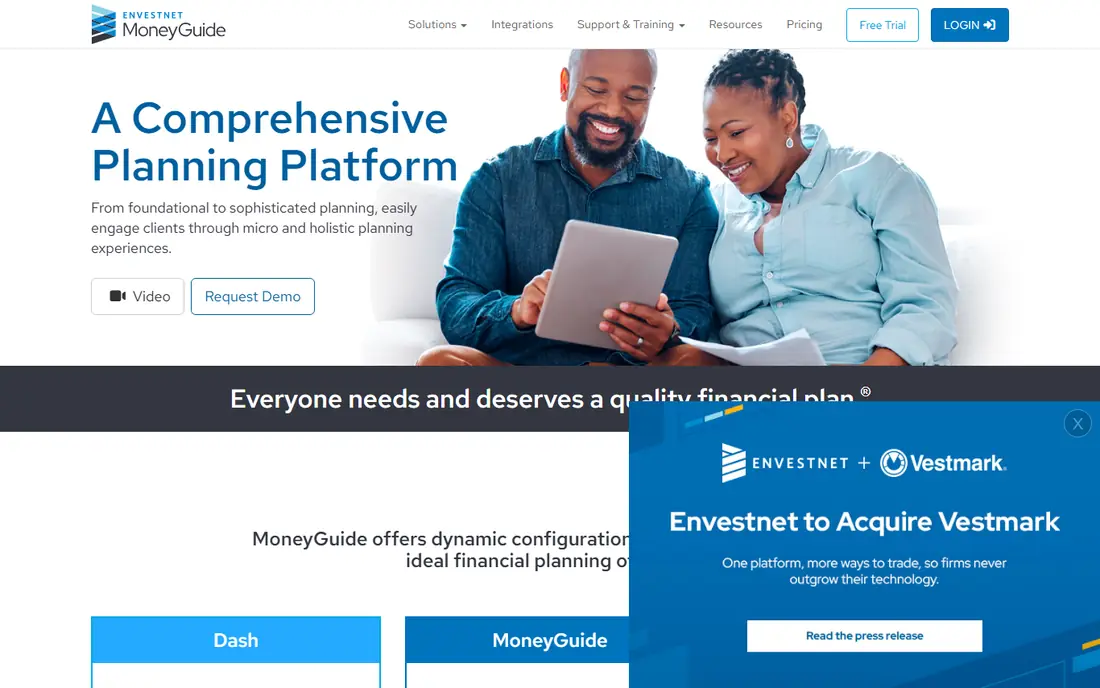
MoneyGuidePro built its reputation on goal-based planning that clients can follow: set goals, fund them, and see confidence levels for each one. Retirement and Social Security analysis are strong, and the tool is widely used, so many advisors already know it.
The interface looks older than RightCapital, and deeper tax planning often needs additional tools. For advisors who want proven, client-friendly goal planning, MoneyGuidePro is a safe and popular choice.
- Clear goal-based planning clients understand
- Strong retirement and Social Security tools
- Widely used by advisors
- Interface feels dated in places
- Advanced tax planning needs add-ons
- Pricing is per advisor
RightCapital
Ideal for: Modern planning for growing firms
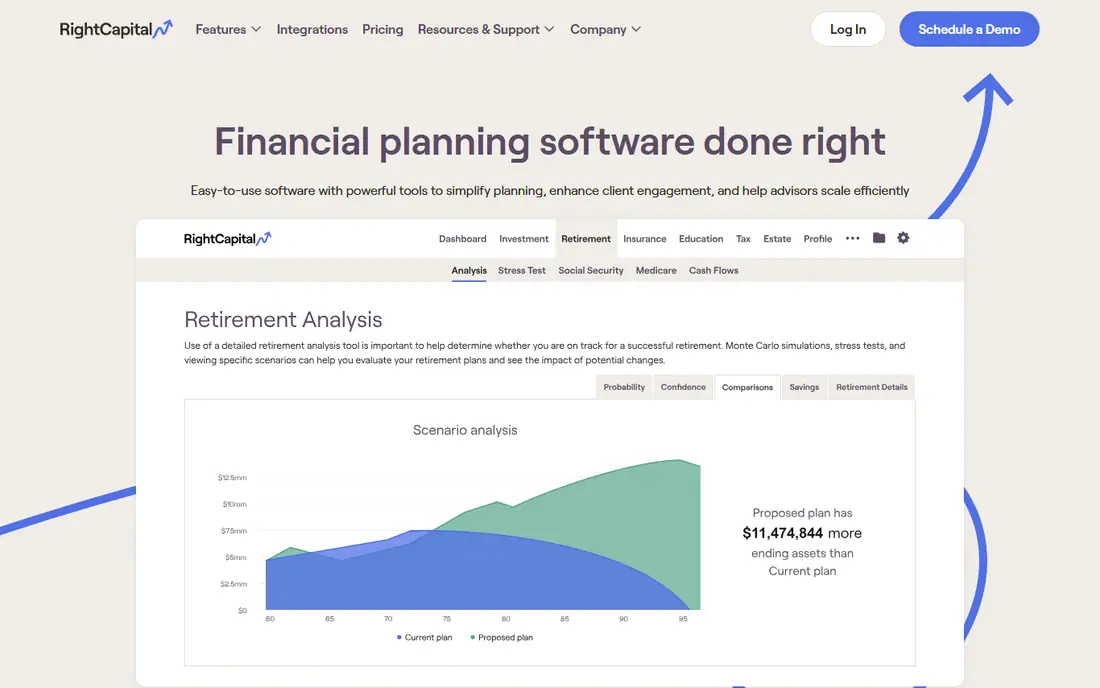
RightCapital is the modern choice for growing firms. Planning covers retirement, tax-aware strategies like Roth conversions, and cash flow in an interface clients actually enjoy using, with proposal generation and digital onboarding built in. That combination shortens the path from first meeting to signed plan.
Very complex estate cases may still need eMoney-level depth, and pricing grows with advisor count. For most firms that want strong planning plus a great client experience, RightCapital is our pick.
- Modern interface clients enjoy
- Tax-aware planning including Roth conversions
- Strong proposal and onboarding tools
- Depth is less than eMoney for complex estates
- Pricing rises with advisor count
- Some advanced features need higher tiers
Orion
Ideal for: Planning plus portfolio management
Orion combines portfolio accounting, billing, reporting, and financial planning in one advisor platform. That breadth suits firms that want investments and plans in the same system, with consistent data and fewer integrations to maintain.
The platform is broad, so learning it takes time, and pricing is handled by quote. For firms that want one home for portfolio management and planning, Orion is a leading choice.
- Portfolio management, billing, and planning in one platform
- Strong reporting
- Integrations across the advisor stack
- Platform breadth takes time to learn
- Pricing is quote-based
- Smaller firms may find it heavy
Advyzon
Ideal for: All-in-one advisor platform
Advyzon packs portfolio management, CRM, billing, reporting, and planning into one cloud platform at competitive pricing. For firms tired of stitching together five vendors, that consolidation saves time and reduces data errors.
Planning depth is lighter than dedicated tools like eMoney or MoneyGuidePro, so complex plans may need a companion tool. For firms that want one modern platform for most of the business, Advyzon is an attractive option.
- Portfolio management, CRM, billing, and planning in one system
- Cloud-based and modern
- Competitive pricing
- Planning depth is lighter than eMoney
- Some features are newer
- Support quality varies by topic
Asset-Map
Ideal for: Visual financial picture
Asset-Map turns a client's finances into a single visual map showing household members, assets, liabilities, income, and insurance. That picture makes first meetings faster and clearer, and it highlights gaps, such as missing coverage or untitled assets, that lead to deeper planning conversations.
It is not a full planning engine with projections and scenarios, so most firms pair it with eMoney, RightCapital, or MoneyGuidePro. As a discovery and communication tool, Asset-Map is excellent.
- Visual one-page map of a client's finances
- Fast discovery in first meetings
- Highlights gaps and opportunities
- Not a full planning engine
- Best as a companion tool
- Pricing is per advisor
Nitrogen
Ideal for: Risk tolerance and proposals
Nitrogen, formerly Riskalyze, measures a client's risk tolerance with a simple questionnaire and aligns portfolios to that risk number. Proposal generation shows clients how a recommended portfolio matches their comfort with risk, which makes difficult conversations easier.
It is a risk and proposal tool, not a full financial plan, so firms pair it with a planning platform. For risk-first advice and clear client proposals, Nitrogen is the standard many advisors use.
- Risk tolerance measurement clients understand
- Proposal generation with risk alignment
- Portfolio analytics
- Risk-focused, not a full planning tool
- Pricing is per advisor
- Best paired with a planning platform
Holistiplan
Ideal for: Tax planning analysis
Holistiplan reads a client's tax return and turns it into planning insights, flagging Roth conversion opportunities, tax bracket strategies, and missing planning moves. Reports are client-ready, which makes tax conversations concrete instead of abstract.
It needs tax returns to work, and it does not replace a full planning engine. For advisors who want to add real tax planning to their service, Holistiplan is the best specialist tool here.
- Fast tax return analysis with planning insights
- Roth conversion and tax bracket tools
- Client-ready reports
- Tax-focused, not a full planning tool
- Needs client tax returns to work
- Pricing is per advisor
How we picked these
We compared official feature pages, pricing pages, advisor reviews, and public documentation for each tool, and we favored products still operating in October 2026 that serve financial advisors with real planning work. We left out consumer budgeting apps and generic CRM tools with no planning features. Note that homepage checks for this article were limited by a browser rate-limit error during our work, so readers should confirm current pricing and features on each vendor site.
Building a planning stack that works
Most firms need two or three tools, not one. A main planning engine like RightCapital or eMoney handles projections and scenarios, while Asset-Map opens discovery, Nitrogen handles risk, and Holistiplan covers tax. Pick tools that share data cleanly, since re-entering client information wastes time and creates errors.
Test the client experience before you commit. A plan clients cannot understand will not get implemented, no matter how deep the math is. Run a real client case through each finalist, share the portal and reports with a colleague, and judge clarity as well as features.
Client trust starts with clear, honest plans. A good planning tool should show assumptions openly, such as growth rates, inflation, and tax treatment, so clients understand what a projection depends on and what would change it. Scenario modeling is where advisors earn their fees: show clients how retiring a year earlier, saving a little more, or changing investment mix shifts outcomes, and let them compare scenarios side by side. Plans that only show a single rosy path mislead, while plans that show ranges help clients make calmer decisions.
Compliance and record keeping sit behind every client meeting. The tool should log plan versions, capture client approvals, and store meeting notes where they can be found during an audit. A client portal also helps, giving clients a safe place to view plans, upload documents, and message their advisor without emailing sensitive files. When comparing tools, ask how data moves in and out, since switching platforms later is painful if client data is locked inside one vendor format. Tax-aware planning is where advisor software adds real value beyond simple projections. Modeling Roth conversions, capital gains timing, and withdrawal order across taxable, tax-deferred, and tax-free accounts can change retirement outcomes meaningfully, and a tool that shows those effects helps clients understand why advice matters. Keep assumptions visible and update them yearly, since tax rules, contribution limits, and client circumstances all change, and a plan built on last year's rules can mislead. Stress tests also help: show clients how their plan holds up if markets fall, if they live longer than expected, or if a spouse needs care, since resilient plans beat optimistic ones.
Documenting advice protects both client and advisor. Record what was recommended, what alternatives were discussed, and what the client chose, with dates, so later questions have clear answers. A planning tool that stores this history alongside plan versions makes reviews faster and audits calmer. During annual reviews, revisit goals before numbers, since life changes, such as a new child, a career change, or a health event, matter more than market moves. The best planning software supports conversations, not just calculations, and advisors who use it that way keep clients longer.
Frequently asked questions
What is the best financial planning software for advisors?
RightCapital is our pick for most firms, with modern planning, tax-aware tools, and a strong client experience. eMoney suits larger firms that need maximum depth, while MoneyGuidePro suits goal-based planning.
Is eMoney or RightCapital better?
eMoney offers deeper planning and enterprise scale, while RightCapital offers a more modern interface and faster onboarding at a lower price. Growing firms often prefer RightCapital, while large firms often stay with eMoney.
Do advisors need separate tax planning software?
Not always, but specialist tools help. RightCapital covers tax-aware basics, while Holistiplan adds deep tax return analysis that most planning tools do not match.
What is the best risk tolerance tool for advisors?
Nitrogen is the standard risk tolerance tool, with a client-friendly questionnaire and proposal generation that aligns portfolios to risk. It pairs well with any main planning platform.
How much does advisor planning software cost?
Pricing is usually per advisor per month and varies by platform and tier, so check vendor sites for current plans. Expect dedicated planning tools to cost more than single-purpose tools like Asset-Map or Holistiplan.