Best Fintech-Ready Support AI Platforms Compared

- Intercom starts at $29 per seat per month billed annually, with Fin AI Agent at $0.99 per outcome, and it is the easiest entry point with a published price.
- Zendesk AI starts at $19 per agent per month billed annually, while the AI focused Suite Team plan starts at $55 per agent per month billed annually.
- Freshdesk starts at $19 per agent per month billed annually, with 500 Freddy AI Agent sessions included once per account and extra sessions at $49 per 100 sessions.
- Ada, Sierra, Decagon, Forethought, and Kustomer publish no starting price on 12 November 2026, so fintech buyers must request a written quote and a security review before budgeting.
- Fintech teams should test the AI on account access, card disputes, failed payments, and fraud reports first, because those are the cases where a wrong answer carries the most risk.
Quick comparison
| Product | Ideal for | Price from | Free version | |
|---|---|---|---|---|
 Intercom | Small fintech teams that want fast setup | $29 per seat/month (billed annually) | Free trial (14 days) | Visit |
 Zendesk AI | Large support teams on a full helpdesk | $19 per agent/month (billed annually) | Free trial (14 days) | Visit |
 Ada | Enterprise teams with multilingual support | quote only | No | Visit |
 Sierra | Large brands that need strict guardrails | quote only | No | Visit |
 Decagon | High volume chat, voice, and email teams | quote only | No | Visit |
 Forethought | Teams that want a full AI agent suite | quote only | No | Visit |
 Kustomer | Teams that want one customer timeline | quote only | No | Visit |
 Freshdesk | Budget teams that want Freddy AI on a helpdesk | $19 per agent/month (billed annually) | Free trial (14 days) | Visit |
The best fintech-ready support ai platforms
Intercom
Ideal for: Small fintech teams that want fast setup
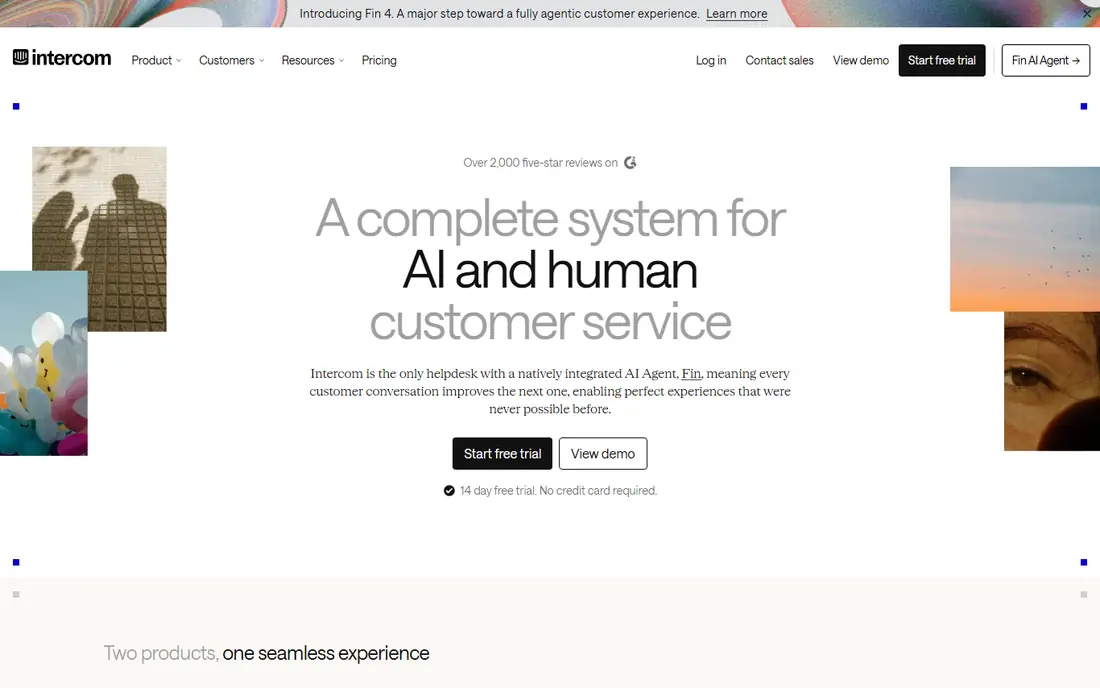
Intercom pairs a shared inbox and help center with Fin, its AI agent, and the combination fits a fintech startup that needs to answer common questions fast while keeping people in charge of money movement. The pricing page checked on 12 November 2026 lists Essential at $29 per seat per month billed annually, with a $19 new customer price shown on the page, Advanced at $85, and Expert at $132. Fin costs $0.99 per outcome on every plan, and an outcome counts when a customer confirms resolution, stops asking for more help, or Fin completes a set workflow.
For a fintech team, the Expert plan matters because it adds single sign on, service level agreements, and HIPAA support, while Advanced adds workflow automation and 20 free Lite seats. Set Fin to answer balance, card status, and payment status questions first, and keep transfers, refunds, and account closures on a human path with clear approval steps.
- Fin AI Agent is included on every plan and bills only per outcome
- 14 day trial needs no credit card
- Phone, SMS, and WhatsApp are usage based extras on top of seat prices
- Fin outcomes add cost as volume grows
Zendesk AI
Ideal for: Large support teams on a full helpdesk
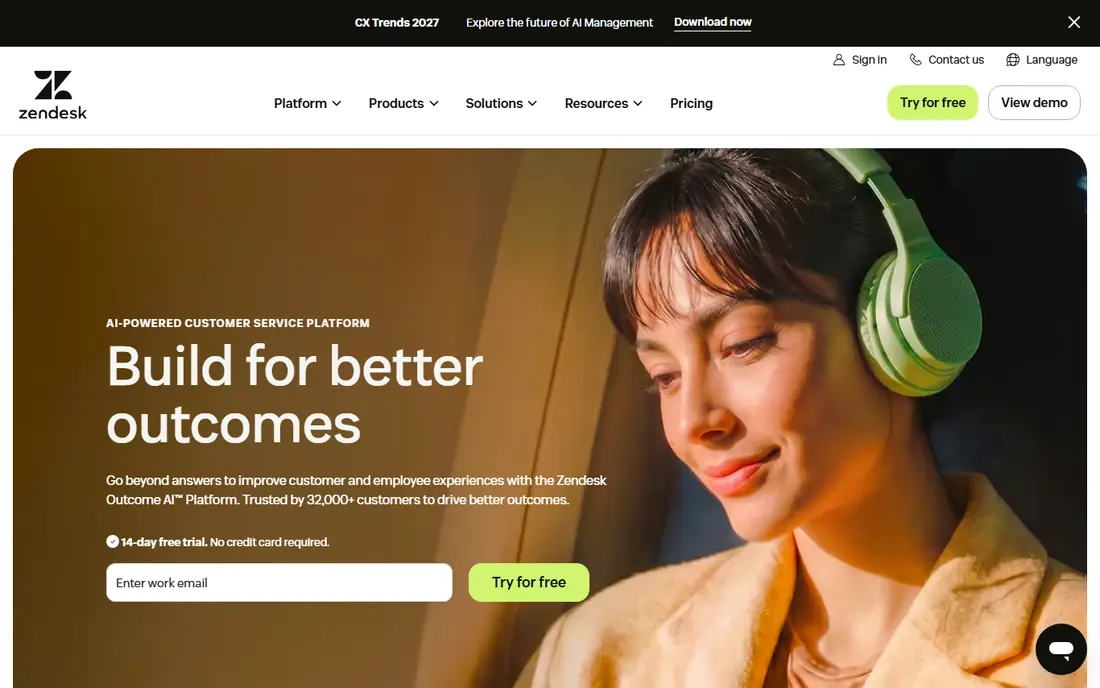
Zendesk AI is the AI layer inside Zendesk, with autonomous AI agents, Copilot for agents, and quality tools that score interactions. The pricing page checked on 12 November 2026 lists Support Team at $19 per agent per month billed annually, Suite Team at $55, and Suite Professional at $115, with Suite Enterprise plus Copilot sold through sales. Suite Team is the real entry point for fintech AI work because it adds the knowledge base, Action Builder, omnichannel routing, messaging, live chat, and telephony, while Support Team covers email ticketing only.
Fintech buyers should read the allowance rules with care. Each plan includes a small dollar allowance for automated resolutions, and extra resolutions are billed on top. The strength here is control: intelligent triage classifies tickets, skills based routing sends sensitive cases to trained agents, and Enterprise adds approval workflows, a sandbox, and custom agent roles.
- AI agents are built into the Resolution Platform across 80 plus languages
- Suite Professional adds skills based routing and an app builder
- Copilot costs $50 per agent per month billed annually as an add-on
- AI resolutions beyond the plan allowance add usage charges
Ada
Ideal for: Enterprise teams with multilingual support

Ada is an AI native customer service platform that works across chat, email, voice, and social channels, and it is built for large teams that need to automate common questions in many languages. Its homepage, checked on 12 November 2026, lists HIPAA, SOC 2, GDPR, PCI DSS, and AIUC-1 compliance, plus safety controls to limit wrong answers, zero data retention policies with language model providers, and independent annual penetration testing.
The trade off is price transparency. Ada publishes no rate, and third party procurement data points to enterprise contracts that start well above the published prices in this guide, so a small team should not plan a budget from a guess. Ada also works best when a team already runs Zendesk, Salesforce, or another helpdesk, because Ada is the AI layer rather than the full inbox.
- No code builder supports 50 plus languages
- Homepage lists HIPAA, SOC 2, GDPR, PCI DSS, and AIUC-1 compliance
- No public price and no self-serve trial, so budgeting needs a sales quote
- It sits on top of an existing helpdesk
Sierra
Ideal for: Large brands that need strict guardrails
Sierra is an enterprise conversational AI platform founded in 2023, and it is built around outcome based pricing, where the buyer pays when the AI agent reaches an agreed outcome such as a resolved conversation. Its homepage, checked on 12 November 2026, shows trust badges for SOC 2, ISO 27001, ISO 42001, HIPAA, GDPR, PCI DSS, FedRAMP, and the EU AI Act, which is a strong set for a fintech buyer that must pass vendor security review.
The limits are cost and scope. Sierra publishes no price, and third party buyer guides place year one enterprise costs in the hundreds of thousands of dollars once platform fees and setup are counted, so it is not a fit for a small team. Sierra also does not include a helpdesk, inbox, ticketing system, or help center, so a fintech team must keep Zendesk, Salesforce, or another desk for human work.
- Agent Studio and Ghostwriter build agents from plain language instructions
- Homepage lists SOC 2, ISO 27001, ISO 42001, HIPAA, GDPR, PCI DSS, and FedRAMP
- No public price and no self-serve signup
- It has no native helpdesk, so a separate ticketing system is still needed
Decagon
Ideal for: High volume chat, voice, and email teams
Decagon builds autonomous AI agents for chat, voice, email, and SMS, and it is aimed at large firms with high support volume. Its homepage, checked on 12 November 2026, names Chime among its customers, which is a useful signal for fintech buyers because Chime is a consumer finance brand with strict member service needs. Decagon uses Agent Operating Procedures, written in natural language and code, to define how the agent should act, and it offers testing, observability, and analytics so teams can check agent logic before it goes live.
Decagon publishes no rate and has no pricing page with a number, so every deal is a custom enterprise contract through sales. Third party procurement data points to a platform fee plus per conversation or per resolution usage, with annual contracts that vary widely by volume, so buyers should treat any outside figure as a planning guess only.
- One intelligence layer covers chat, voice, and email with Agent Operating Procedures in plain language
- Chime is named as a customer on the homepage
- No public price, no trial, and no free tier
- It has no native helpdesk, so human ticketing stays on another system
Forethought
Ideal for: Teams that want a full AI agent suite
Forethought is an enterprise AI platform with five linked products: Solve for customer facing resolution, Triage for routing and classification, Assist for agent help, Discover for finding missing help content, and Agent QA for scoring interactions. Its homepage, checked on 12 November 2026, says the agents learn from past tickets and help center content, reason through business policies, and take action to resolve cases end to end.
Forethought publishes no price. Its pricing page describes a blend of platform access fees and outcome based pricing, with every tier sold through a quote, and third party procurement data points to a median annual contract near $74,500. Zendesk completed its acquisition of Forethought on 26 March 2026, and Zendesk says it plans to fold Forethought into its Resolution Platform, so a fintech team that does not use Zendesk should ask for a written commitment on support and integrations.
- Solve, Triage, Assist, Discover, and Agent QA cover resolution, routing, agent help, and quality in one suite
- It learns from past tickets and help center content
- No public price and no self-serve trial
- Zendesk acquired Forethought in March 2026, so its future on non Zendesk stacks needs a written answer
Kustomer
Ideal for: Teams that want one customer timeline
Kustomer is a CRM native customer service platform that puts a full customer timeline at the center of support, so an agent or an AI agent can see past orders, chats, calls, and account notes in one view. Kustomer offers AI Agents for Customers to resolve common cases, AI Agents for Reps to help human agents, plus omnichannel support, workflows, and real time reporting in the same workspace.
The pricing page checked on 12 November 2026 says Kustomer does not post one size fits all pricing and asks buyers to complete an assessment before a sales call, so this guide lists the starting price as quote only. Earlier published seat prices are no longer on the public page, and buyers should not budget from them.
- One timeline shows the full customer history for AI and human agents
- AI Agents for Customers and AI Agents for Reps are built for the same workspace
- The pricing page checked on 12 November 2026 posts no seat price and routes buyers to a sales assessment
- AI features are billed as add-ons on top of seats
Freshdesk
Ideal for: Budget teams that want Freddy AI on a helpdesk
Freshdesk is the helpdesk from Freshworks, and Freddy AI is its AI layer, split into Freddy AI Agent for autonomous resolution, Freddy AI Copilot for agent help, and Freddy AI Insights for analytics. The pricing page checked on 12 November 2026 lists Growth at $19 per agent per month billed annually, Pro at $55, and Enterprise at $89. Every plan includes 500 Freddy AI Agent sessions once per account, and extra sessions cost $49 per 100 sessions.
For a fintech team on a tight budget, Growth is a low cost way to test AI on email cases, while Pro is the first plan that can add Copilot at $29 per agent per month billed annually. Enterprise is the plan for regulated work because it adds Freddy AI Insights, skill based routing, a sandbox, audit logs, and allowed domains with IP whitelisting.
- Freddy AI Agent is included on Growth with 500 sessions once per account
- Enterprise adds audit logs, sandbox, and IP allowlisting
- Freddy AI Copilot costs $29 per agent per month and is only sold on Pro and Enterprise
- Extra AI sessions cost $49 per 100 sessions
How we chose
We compared vendor pricing pages, product pages, and help documentation checked on 12 November 2026, and we did not claim hands-on testing. A platform made the list only if its homepage loaded, its AI could answer customer questions or help agents, and it had a clear security or compliance position that a fintech team could review. We gave weight to audit logs, single sign on, data controls, and clean handoff to a human agent, because those controls matter more in finance than in general retail support.
What to check before you buy
Ask each vendor for a written security pack before you sign, including SOC 2, ISO 27001, PCI DSS, GDPR handling, data residency, subprocessor list, and data retention rules. Test the AI on your hardest cases, not your easiest ones: a locked account, a failed payment, a disputed charge, a fraud report, and a request to change contact details. Check what the AI can and cannot do on its own, and confirm that money movement, refunds, and account closures need human approval or a clear policy rule. Read the billing meter with care, because per outcome, per conversation, per resolution, and per session are not the same unit.
| Team size and budget | Best first pick | Why it fits | Budget note | | 1 to 5 agents, under $500 a month | Intercom Essential or Freshdesk Growth | Low entry price, trial, fast setup | Model Fin outcomes or Freddy sessions on top of seats | | 6 to 20 agents, $500 to $3,000 a month | Zendesk Suite Team or Freshdesk Pro | Full helpdesk, routing, knowledge base | Add Copilot cost before you compare totals | | 21 to 100 agents, $3,000 to $15,000 a month | Zendesk Suite Professional or Kustomer | Skills routing, audit controls, one timeline | Get a written quote and a security review | | Over 100 agents, enterprise budget | Ada, Sierra, Decagon, or Forethought | Custom guardrails, multilingual AI, voice | Allow weeks for setup and a proof of value |
Frequently asked questions
What makes a support AI platform fintech ready?
A fintech ready platform keeps money and identity actions inside clear limits, logs every AI step, hands off to a person for disputes and fraud, and supports controls such as single sign on, audit logs, and data residency. It should also work from your help center and past tickets, so answers stay consistent with your current policies.
Which platform is best for a small fintech startup?
Intercom is the best first pick for most small fintech startups, because it starts at $29 per seat per month billed annually, includes Fin AI Agent at $0.99 per outcome, and offers a 14 day trial. Freshdesk Growth is a close second at $19 per agent per month billed annually, with Freddy AI Agent sessions included once per account.
Why do Ada, Sierra, Decagon, and Forethought hide their prices?
These vendors sell custom enterprise contracts, so the price depends on volume, channels, integrations, and the level of support. A published list price would not cover that range. Ask for a written quote that names the platform fee, the usage rate, the outcome or resolution definition, and the setup cost.
How should a fintech team test an AI support platform?
Run a proof of concept on your own past tickets, with cases for locked accounts, failed payments, disputed charges, fraud reports, and address changes. Score the AI on accuracy, handoff quality, and audit clarity, not only on how many chats it closed. Check the answers against your current policy documents.
Does Zendesk AI or Freshdesk Freddy AI replace human agents?
No, neither platform replaces human agents for fintech support. Both handle common questions and draft replies, while people stay in charge of disputes, fraud, refunds, and account closures. The best result is a mix where AI clears routine work and agents spend their time on cases that need judgment.
What should we budget beyond the seat price?
Budget for AI usage on top of seats, because Fin, Freddy, and Zendesk AI all bill by outcome, session, or resolution beyond an allowance. Add Copilot or agent assist fees where they are sold separately, plus voice and messaging usage, onboarding, and security review time.