Best Free Period Tracking Apps in 2026: 8 Apps Compared

- Clue is our pick for most people who want a solid free tracker with a science-first approach and a strong privacy stance.
- Flo offers the largest content library and community, but many features sit behind its paid plan.
- Apple Health Cycle Tracking is the most private basic option for iPhone users, since data stays on the device and in your account.
- None of these apps is birth control, and none should replace medical advice for irregular cycles or fertility concerns.
- Read the privacy policy before logging health data, and use anonymous or private modes where the app offers them.
Quick comparison
| Product | Ideal for | Price from | Free version | |
|---|---|---|---|---|
 Clue | Science-first free tracking | Free | Yes | Visit |
 Flo | Content and community | Free | Yes | Visit |
 Apple Health | Private basic tracking on iPhone | Free | Yes | Visit |
 Stardust | Daily hormone and cycle ritual | Free | Yes | Visit |
 Glow | Trying to conceive community | Free | Yes | Visit |
 Ovia | Pregnancy and fertility tracking | Free | Yes | Visit |
 Natural Cycles | Temperature-based fertility awareness | $89.99 per year | No | Visit |
 Veya | All-in-one free tracking | Free | Yes | Visit |
The best free period tracking apps
A free period tracker should do three things well: predict your cycle from your own history, let you log symptoms without paywalling the basics, and handle sensitive health data with care. The apps below differ in privacy, predictions and extras, so the right pick depends on what you value most. We compared official app store listings, privacy policies, feature pages and public reviews. This article is general information, not medical advice.
Clue
Ideal for: Science-first free tracking
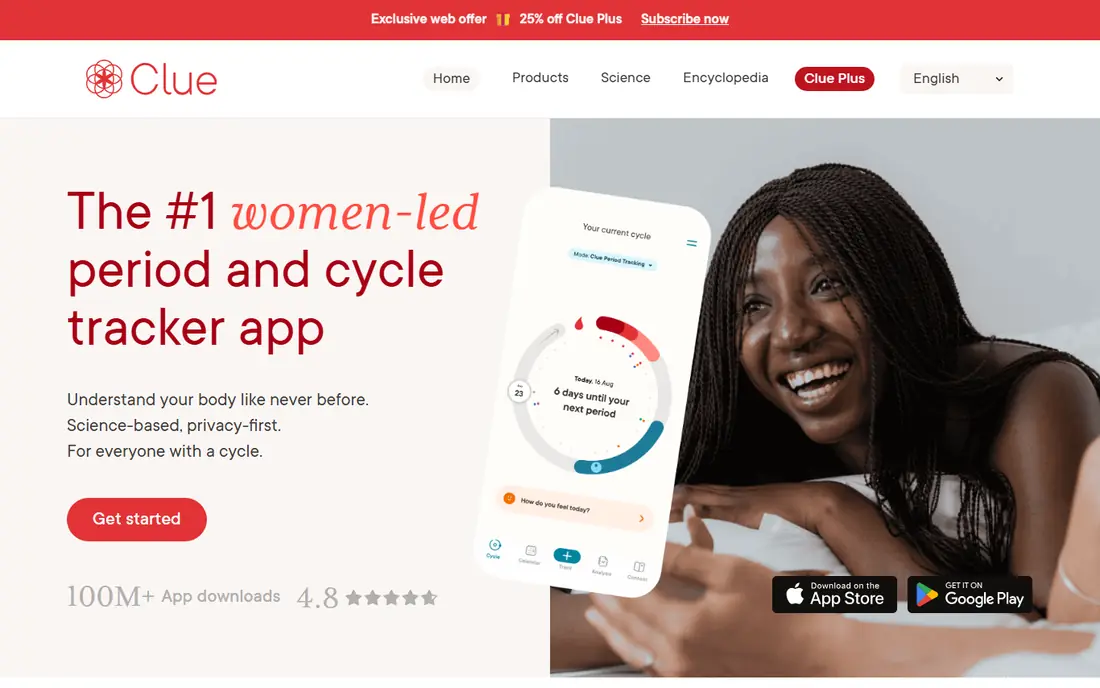
Clue is our pick for most people because its free tier covers the core job well: log periods, symptoms and moods, and see predictions based on your history. The app is built in Berlin and governed by European privacy law, and it does not run ads, which is a meaningful difference in a category where health data is sensitive. Its language is inclusive, and it lets you track symptoms even when bleeding is irregular.
The catch is that the deeper analysis lives behind Clue Plus, which costs around $39.99 per year or $9.99 per month on app store listings in October 2026. Free users will also see upgrade prompts. If you want solid predictions and a privacy-first build without paying, start here and only upgrade if the extra insights earn it.
- Usable free cycle tracking
- Science-led content
- Berlin-based under GDPR
- Deeper predictions and analysis sit behind Clue Plus
- Regular upgrade prompts
Flo
Ideal for: Content and community

Flo is the most feature-complete tracker in this list, with a deep library of health articles, symptom logging, and a large community. Its predictions use your logged history, and a pregnancy mode covers a later stage without switching apps. For someone who wants education and community alongside tracking, Flo offers more content than any free rival.
Privacy is the reason to pause. Flo faced an FTC settlement in 2021 over sharing health data, and a related class action reached preliminary settlement approval in 2026. Flo has since added an Anonymous Mode, and many users will want to use it. Read the current privacy policy, decide what you are comfortable sharing, and weigh the content library against that history.
- Large article library
- Community features
- Pregnancy mode for later stages
- Many features behind Premium
- Privacy history worth reading before you trust it with data
Apple Health
Ideal for: Private basic tracking on iPhone
Apple Health Cycle Tracking is the quiet, private option. It is built into the iPhone, so there is no separate account, no ads, and no third-party tracker company holding your cycle data. You can log periods, symptoms and spotting, see a fertile window estimate, and get notifications for upcoming periods. For someone whose main concern is privacy, that simplicity is the feature.
It is also the most limited app here. There is no community, little educational content, and predictions are basic compared with Clue or Flo. If you want rich insights or a trying-to-conceive community, pair it with another app or choose one of those instead, and accept the privacy trade-off that comes with them.
- Built into iPhone
- No extra account or ads
- Data stays within Apple Health
- Basic predictions only
- No community or rich content
- IPhone only
Stardust
Ideal for: Daily hormone and cycle ritual
Stardust appeals to people who want tracking to feel like a daily habit rather than a spreadsheet. It pairs cycle predictions with daily hormone-stage explanations and moon-phase content, and it lets you share your cycle with friends or a partner. A postpartum mode added in 2026 broadens it beyond basic period tracking.
The trade-off is depth. Stardust does not match Flo on article volume or Clue on science-led analysis, and some features require payment. It is a good pick if design and daily ritual keep you logging consistently, because a tracker you actually use beats a powerful one you abandon.
- Daily hormone-stage content
- Cycle sharing with friends
- Distinctive design
- Smaller feature set than Flo
- Some content and features are paid
Glow
Ideal for: Trying to conceive community
Glow is built around trying to conceive, with fertility charting, ovulation predictions and one of the largest TTC communities in this category. Separate Glow Pregnancy and Glow Baby apps carry you through later stages without starting over. If conception is the goal, the community alone can be worth the download, since other users share timelines, symptoms and questions.
The free tier covers the basics, but Glow Premium, listed around $59.99 per year after a trial, opens deeper insights. The interface can also feel busy compared with Clue. Read the current privacy policy before logging fertility data, as with any app in this category.
- Large trying-to-conceive community
- Separate pregnancy and baby apps
- Fertility charting
- Premium costs around $59.99 per year
- Interface can feel busy
Ovia
Ideal for: Pregnancy and fertility tracking
Ovia covers fertility, pregnancy and parenting through a family of apps, with detailed pregnancy tools such as kick counting and contraction timing. Some employers and health plans sponsor Ovia, which can make coaching and premium features effectively free, so check your benefits portal before paying for another app.
Sponsorship is also the thing to check. If an employer or plan pays, understand what data, if any, is shared back in aggregate and what stays private. For a free, detailed pregnancy tracker without sponsor involvement, Ovia still works, but the privacy details deserve a read.
- Fertility, pregnancy and parenting apps in one family
- Employer and health plan coverage sometimes available
- Detailed pregnancy tools
- Data sharing with employers or plans needs checking
- Best value depends on sponsor coverage
Natural Cycles
Ideal for: Temperature-based fertility awareness
Natural Cycles is the only app in this list cleared by the FDA as a contraception method, and it works differently from the free trackers above. It uses daily basal body temperature to identify fertile days, giving a daily fertility status rather than a calendar guess. For someone seeking hormone-free contraception or fertility awareness, that method is the point.
It is not a free period tracker, and it is not casual. The annual plan costs around $89.99, daily measurement is required, and effectiveness depends on correct and consistent use. Talk to a clinician first if your cycles are irregular, you have recently stopped hormonal birth control, or you are relying on it to prevent pregnancy.
- FDA-cleared contraception method
- Daily fertility status from temperature data
- Learns your unique cycle
- No free tier
- Requires daily temperature measurement
- Not suited to irregular cycles without clinician advice
Veya
Ideal for: All-in-one free tracking
Veya is worth trying if you want one free app for cycle, mood, sleep, fitness and nutrition tracking instead of several apps. Its free tier is broader than most rivals, and it can use temperature data from a wearable you already own for fertility awareness. Its stated stance is that it does not sell user data to third parties.
The trade-off is maturity. Veya has a smaller community and shorter track record than Flo or Clue, and the full app experience is iPhone focused, with a web app for other devices. Try it for a month alongside your current tracker and compare predictions before switching fully.
- Free cycle, mood, sleep, fitness and nutrition tracking
- Wearable temperature input
- No data selling stated
- Smaller user base than Flo or Clue
- Full app is iPhone focused
How we picked these
We compared official app store listings, feature pages and privacy policies, plus public reviews, for period tracking apps available in the US in October 2026. We favored apps with a genuinely usable free tier, clear privacy statements, and predictions based on logged data. We note honestly where an app has a known privacy problem rather than hiding it.
What to check before you choose
Privacy comes first with health data. Check where data is stored, whether it is sold or shared with advertisers, whether an anonymous mode exists, and what happens to data if you delete your account. A Berlin-based app under GDPR and an on-device iPhone tracker offer stronger starting positions than an ad-supported app, but the current policy is what counts, not the marketing page.
Predictions are estimates, not promises
Every app here predicts from your past cycles, so predictions are rough when cycles vary. Log consistently for two to three months before judging accuracy, and do not rely on a prediction alone for contraception unless the app is cleared for that use and you follow its method exactly. For irregular cycles, pain, or fertility worries, a clinician can help more than any app.
Frequently asked questions
What is the best free period tracking app?
Clue is our pick for most people, because its free tier covers cycle and symptom tracking well and its privacy stance is stronger than most rivals. Flo suits people who want more articles and community, and Apple Health suits iPhone users who want basic private tracking.
Are free period tracking apps safe for my data?
Safety varies by app. Read the privacy policy, check whether data is sold or shared, and use anonymous or private modes where offered. Apps based in Europe under GDPR, and on-device tracking such as Apple Health, generally collect and share less.
Can a period tracker be used as birth control?
No, except for Natural Cycles, which is FDA-cleared as a contraception method when used exactly as directed with daily temperature measurement. Other trackers in this list are not birth control, and their predictions alone should not be relied on to prevent pregnancy.
How accurate are period predictions?
Predictions improve with consistent logging over several cycles, but they stay estimates, especially when cycles are irregular. A prediction is a planning aid, not a medical result, and it should not replace advice from a clinician.
Do I need to pay for a good period tracker?
Not necessarily. Clue, Flo, Stardust, Glow and Veya all offer usable free tiers. Paid plans add deeper insights, content and community features, so pay only if you use those extras regularly.