Best Free Time Tracking Software for Businesses in 2026: 8 Tools Compared

- Toggl Track is our first suggestion for most buyers, because its balance of features, pricing clarity, and support is hard to beat for the topic at hand.
- Clockify suits buyers who want a lower starting price or a simpler setup, while TimeCamp fits teams that need more depth in one specific area.
- Prices and free tiers vary widely, so check the vendor pricing page for the plan that includes the features you actually need, rather than judging by the headline price alone.
- Run a trial with your own data and your own workflow before you pay for a year, since setup effort and day-to-day ease only show up in real use.
Quick comparison
| Product | Ideal for | Price from | Free version | |
|---|---|---|---|---|
 Toggl Track | Teams wanting simple, reliable timers | Free | Yes | Visit |
 Clockify | Businesses wanting a generous free plan | Free | Yes | Visit |
 TimeCamp | Teams wanting free tracking plus invoicing | Free | Yes | Visit |
 Hubstaff | Remote teams wanting activity tracking | Free | Yes | Visit |
 Paymo | Small teams wanting tracking plus projects | Free | Yes | Visit |
 Everhour | Teams already using Asana or Trello | Free | Yes | Visit |
 TrackingTime | Small teams wanting simple team timesheets | Free | Yes | Visit |
 TMetric | Teams wanting free tracking with budgets | Free | Yes | Visit |
The best free time tracking software for businesses
These eight tools offer free plans or free tiers for tracking time, from simple timers for freelancers to team timesheets with reporting. We compared official feature pages, pricing pages, app-store listings, privacy policies, and public reviews to sort out where each option earns its place.
Toggl Track
Ideal for: Teams wanting simple, reliable timers
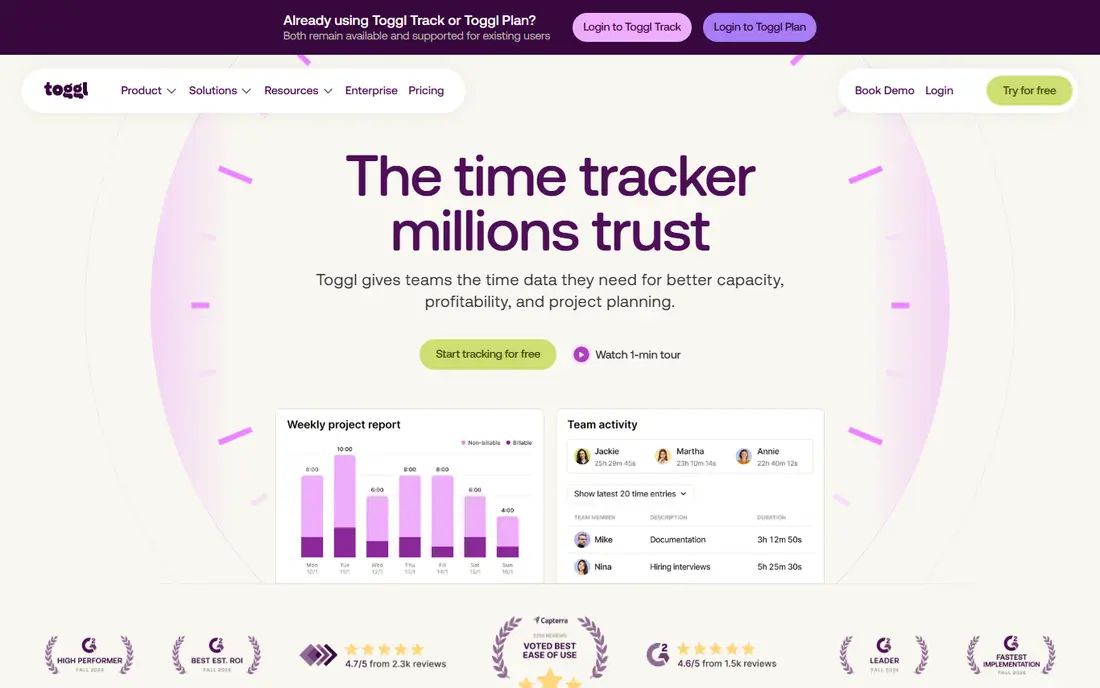
Toggl Track is the simplest reliable time tracker for teams that just want timers and reports. Its one-click timer and clean reports make it easy for staff to actually use daily. For most buyers, the deciding factor is not the longest feature list but the fit with daily work, the total price, and how much setup the team can handle. The catch is free-plan limits: advanced reporting and features need paid plans. If that trade-off fits your budget and your tolerance for setup, it is worth a trial before you commit the whole team. For a business, a free time tracker must be easy enough that staff actually use it, or the data will be useless no matter how good the reports look.
- Simple timer with reports
- Free plan for small teams
- Good integrations
- Free plan limits features
- Advanced reporting needs paid plans
Clockify
Ideal for: Businesses wanting a generous free plan
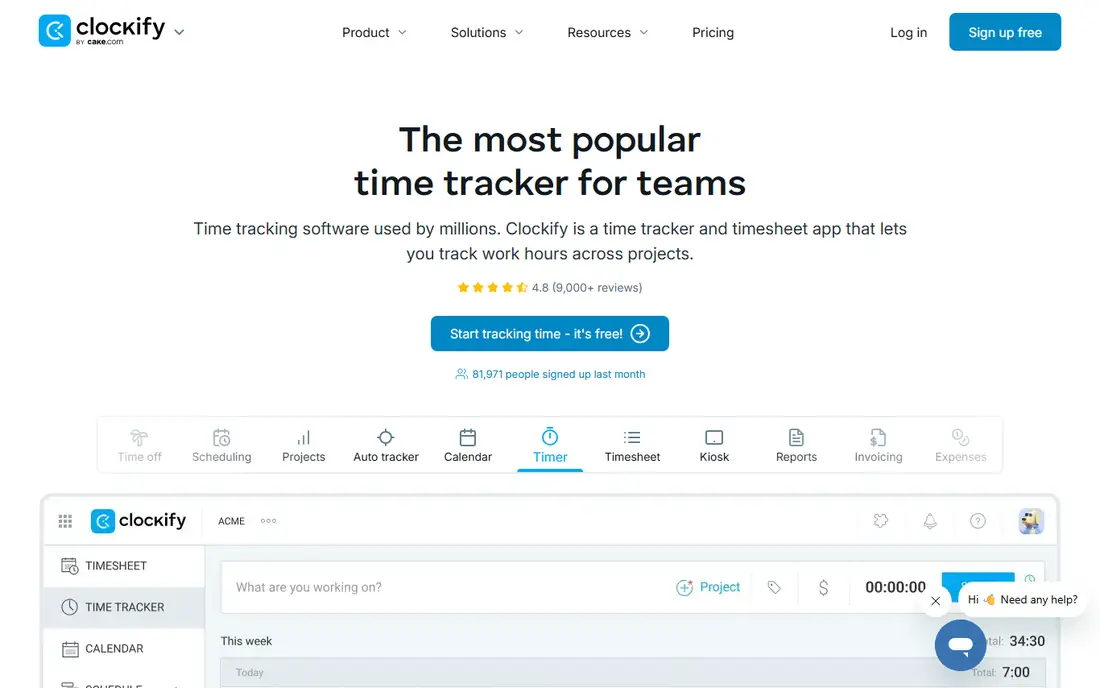
Clockify stands out for a genuinely generous free plan with unlimited users. Its timesheets, timers, and reports cover most business needs without payment. A tool that looks strong on a pricing page can still disappoint if onboarding is slow, support is thin, or the plan that holds the needed feature sits two tiers up. The catch is polish: the interface is functional rather than fancy, and advanced features need paid plans. Put it on a shortlist if its strengths match your main use case, and test it with real data during the trial period. For a business, a free time tracker must be easy enough that staff actually use it, or the data will be useless no matter how good the reports look.
- Generous free plan with unlimited users
- Timesheets and reports
- Good integrations
- Advanced features need paid plans
- Interface is functional rather than fancy
TimeCamp
Ideal for: Teams wanting free tracking plus invoicing
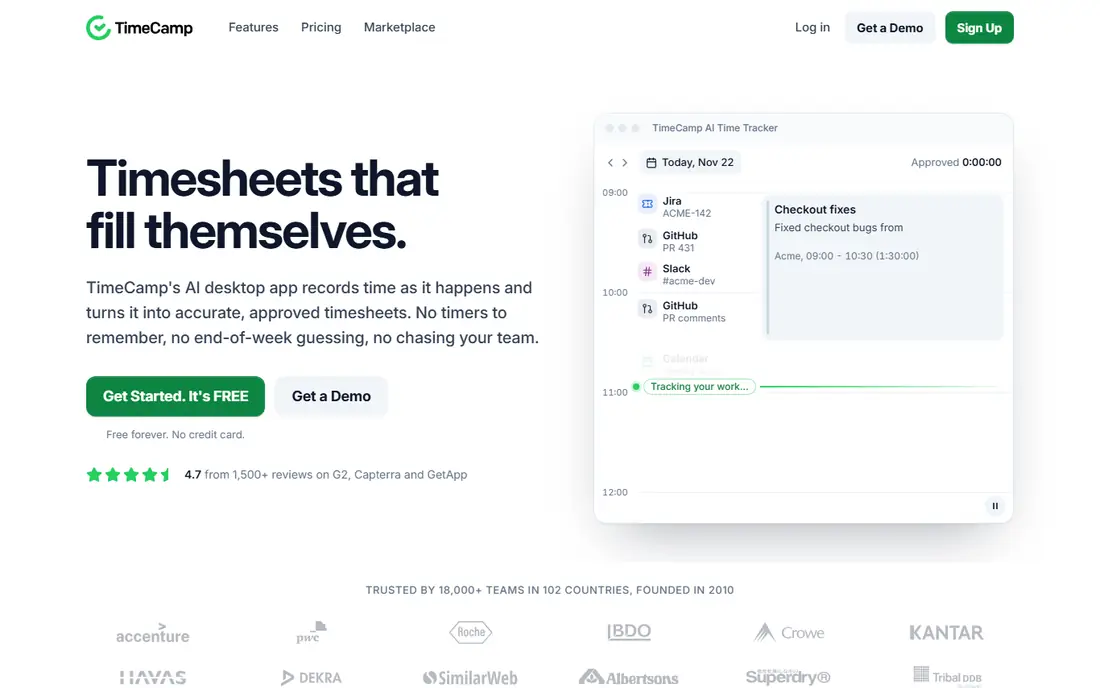
TimeCamp suits teams that want free time tracking plus invoicing in one tool. Its automatic tracking and invoicing help turn tracked time into bills. We gave extra weight to clear pricing, honest limits, and products that explain what happens to your data when you leave. The catch is free-plan limits: user and feature caps apply, and the interface takes learning. It earns a place on the shortlist when its main strength lines up with the job you will ask it to do every week. For a business, a free time tracker must be easy enough that staff actually use it, or the data will be useless no matter how good the reports look.
- Free plan with invoicing
- Automatic tracking
- Good reports
- Free plan limits users and features
- Interface takes learning
Hubstaff
Ideal for: Remote teams wanting activity tracking
Hubstaff suits remote teams that want time tracking with activity visibility. Its timers, activity levels, and optional screenshots help managers see remote work patterns. For most buyers, the deciding factor is not the longest feature list but the fit with daily work, the total price, and how much setup the team can handle. The catch is culture: activity monitoring does not suit every workplace, and the free plan is limited. Try it first with a small group, so you learn how it behaves before you roll it out more widely. For a business, a free time tracker must be easy enough that staff actually use it, or the data will be useless no matter how good the reports look.
- Time tracking with activity levels
- Screenshots optional
- Good for remote teams
- Activity monitoring may not suit every workplace culture
- Free plan limited
Paymo
Ideal for: Small teams wanting tracking plus projects
Paymo combines time tracking with project management for small teams. Its tasks, timers, and invoicing suit agencies and service businesses. A tool that looks strong on a pricing page can still disappoint if onboarding is slow, support is thin, or the plan that holds the needed feature sits two tiers up. The catch is free-plan limits: user caps apply, and advanced features need paid plans. If that trade-off fits your budget and your tolerance for setup, it is worth a trial before you commit the whole team. For a business, a free time tracker must be easy enough that staff actually use it, or the data will be useless no matter how good the reports look.
- Time tracking with project management
- Free plan
- Good invoicing
- Free plan limits users
- Advanced features need paid plans
Everhour
Ideal for: Teams already using Asana or Trello
Everhour suits teams already living in Asana, Trello, or similar project tools. Its tracking sits inside those tools, so staff do not need another app open. We gave extra weight to clear pricing, honest limits, and products that explain what happens to your data when you leave. The catch is dependency: it delivers most value inside supported tools, and the free plan is limited. Put it on a shortlist if its strengths match your main use case, and test it with real data during the trial period. For a business, a free time tracker must be easy enough that staff actually use it, or the data will be useless no matter how good the reports look.
- Time tracking inside Asana, Trello, and other tools
- Good reports
- Easy timers
- Best inside supported tools
- Free plan limited
TrackingTime
Ideal for: Small teams wanting simple team timesheets
TrackingTime is the simple team timesheet pick for small businesses. Its clean timesheets and free plan cover basic team tracking well. For most buyers, the deciding factor is not the longest feature list but the fit with daily work, the total price, and how much setup the team can handle. The catch is depth: advanced features and integrations are fewer than the leaders. It earns a place on the shortlist when its main strength lines up with the job you will ask it to do every week. For a business, a free time tracker must be easy enough that staff actually use it, or the data will be useless no matter how good the reports look.
- Simple team timesheets
- Free plan
- Good for small teams
- Fewer advanced features
- Smaller integration library
TMetric
Ideal for: Teams wanting free tracking with budgets
TMetric suits teams that want free time tracking with project budgets attached. Its timers, budgets, and reports help small teams track profitability, not just hours. A tool that looks strong on a pricing page can still disappoint if onboarding is slow, support is thin, or the plan that holds the needed feature sits two tiers up. The catch is free-plan limits: advanced features need paid plans. Try it first with a small group, so you learn how it behaves before you roll it out more widely. For a business, a free time tracker must be easy enough that staff actually use it, or the data will be useless no matter how good the reports look.
- Free plan with time and budget tracking
- Good reports
- Integrations
- Free plan limits features
- Interface takes learning
How we picked these
We started from the vendor's own feature and pricing pages, then checked app-store listings and public reviews for signs of trouble, such as slow support, confusing pricing, or features that only appear on higher plans. Products that no longer exist, that had no working official homepage, or that did not truly fit the topic were left out, even when they were well known in a nearby category. We also weighed who each product is built for. A strong enterprise tool can be a poor pick for a small team, and a simple free tool can be a poor pick for a regulated workplace. The list below mixes well-known leaders with smaller options, so you can match the pick to your size, budget, and tolerance for setup work.
How to choose free time tracking software
Check what the free plan actually includes: user limits, projects, reports, and integrations. A free plan that caps you at three users will not survive a growing team. Test the timer on desktop and mobile, and check whether idle detection, reminders, and manual entry suit how your team really works.
Shortlist checklist
- Write down the two or three jobs the tool must do every week, and test exactly those jobs in the trial.
- Check the total price for your team size, including any add-ons, seats, or usage charges that sit outside the headline plan.
- Ask how you export your data, what happens at cancellation, and how support responds when something breaks.
- Confirm privacy, security, and compliance terms fit your workplace rules before you move real customer or staff data into the tool. Confirm export options before you commit, so your time data is not trapped if you later move to a paid tool.
Frequently asked questions
What should I look for first when comparing best free time tracking software for businesses?
Start with the job you need done most often, then check whether the plan you can afford includes it. Look at total price for your team size, setup effort, and how data can be exported. A trial with real work will tell you more than a feature list, so test the exact workflow you will use every week.
Is there a good free option for best free time tracking software for businesses?
Some products on this list offer a free plan or a free trial, but free plans usually limit seats, storage, or advanced features. Check the free plan line for each product above, and treat a free tier as a way to test fit rather than a promise that it will cover a growing team.
How much should I expect to pay?
Pricing varies by seats, usage, and plan tier, and several vendors on this list only publish custom quotes. Use the starting price column as a guide, then get a written quote for your team size before you budget. Watch for add-ons that are charged separately from the headline plan.
Can I switch later if I pick the wrong one?
In most cases yes, but switching costs time and effort, especially if your data is hard to export. Before you buy, confirm export options and contract length, and keep a copy of your data in a format you control. A short initial term lowers the risk of being stuck with a poor fit.
How do I know a vendor is trustworthy?
Look for clear pricing, a readable privacy policy, security documentation, and responsive support. Check recent public reviews for repeated complaints about billing or support, and prefer vendors that explain data handling in plain language rather than hiding it in vague terms.