Best Fund Accounting Software in 2026: 7 Options Compared

- 1
 Blackbaud Financial EdgeNonprofits needing fund accountingVisit
- 2
 Sage IntacctGrowing nonprofits and fund managersVisit
- 3
 Fund EZSmall nonprofits wanting fund focusVisit
- 4
 AplosSmall nonprofits and churchesVisit
- 5
 AccuFundNonprofits and government fundsVisit
- We compared 7 real options for best fund accounting software, checking official feature pages, pricing pages, and app store listings where available.
- The best choice depends on fund tracking, grant reporting, and audit-ready records, not on brand size alone, so match the tool to the work you actually do.
- Prices change often, so confirm the current plan and renewal cost on the vendor website before you buy.
- Start with a trial or a small order where possible, and test it with your real workflow before a long commitment.
- Fund accounting differs from regular accounting, so confirm a tool tracks restrictions by fund, not just by account.
Quick comparison
| Product | Ideal for | Price from | Free version | |
|---|---|---|---|---|
| Blackbaud Financial Edge | Nonprofits needing fund accounting | See website | Free trial | Visit |
| Sage Intacct | Growing nonprofits and fund managers | See website | Free trial | Visit |
| Fund EZ | Small nonprofits wanting fund focus | See website | Free trial | Visit |
| Aplos | Small nonprofits and churches | See website | Free trial | Visit |
| AccuFund | Nonprofits and government funds | See website | Free trial | Visit |
 MIP Fund Accounting | Nonprofits needing established fund tools | See website | Free trial | Visit |
 FastFund | Small nonprofits wanting simple funds | See website | Free trial | Visit |
The best fund accounting software
We looked at official feature pages, pricing, app store listings, privacy policies, and public reviews to build this list. Our pick for most people is the option that balances useful features, clear pricing, and honest limits, but the right choice still depends on your budget, team size, and daily workflow. The options below cover well known leaders and strong smaller choices, so you can compare them side by side before deciding.
Blackbaud Financial Edge
Ideal for: Nonprofits needing fund accounting
For nonprofits needing fund accounting, Blackbaud Financial Edge is a strong starting point. Financial Edge is built for nonprofits, with fund tracking and grant reporting at its core. We compared its official feature pages and pricing against the other options in this list, and it stood out for fund tracking, grant reporting, and audit-ready records. Readers who do that kind of work regularly will notice the difference in daily use, while occasional users may care less about depth and more about price and simplicity.
Quote-based pricing and a learning curve mean budgeting time and cost for implementation. That balance makes it a sensible pick for buyers who value that strength over a broader feature list. Check the current pricing page before you commit, since plans and limits change, and use a trial or small order to confirm it fits your workflow.
- Fund accounting focus
- Grant tracking
- Nonprofit reporting
- Pricing by quote
- Learning curve
Sage Intacct
Ideal for: Growing nonprofits and fund managers

If growing nonprofits and fund managers is the priority, Sage Intacct deserves a close look. Sage Intacct uses dimensions to track funds, which gives flexible reporting for growing organizations. We compared its official feature pages and pricing against the other options in this list, and it stood out for fund tracking, grant reporting, and audit-ready records. Readers who do that kind of work regularly will notice the difference in daily use, while occasional users may care less about depth and more about price and simplicity.
Setup needs expertise, so implementation help is worth budgeting. Buyers who need that specific strength will likely accept the trade-off, while others may prefer a broader option. Check the current pricing page before you commit, since plans and limits change, and use a trial or small order to confirm it fits your workflow.
- Cloud accounting
- Fund dimensions
- Strong reporting
- Pricing by quote
- Setup needs expertise
Fund EZ
Ideal for: Small nonprofits wanting fund focus
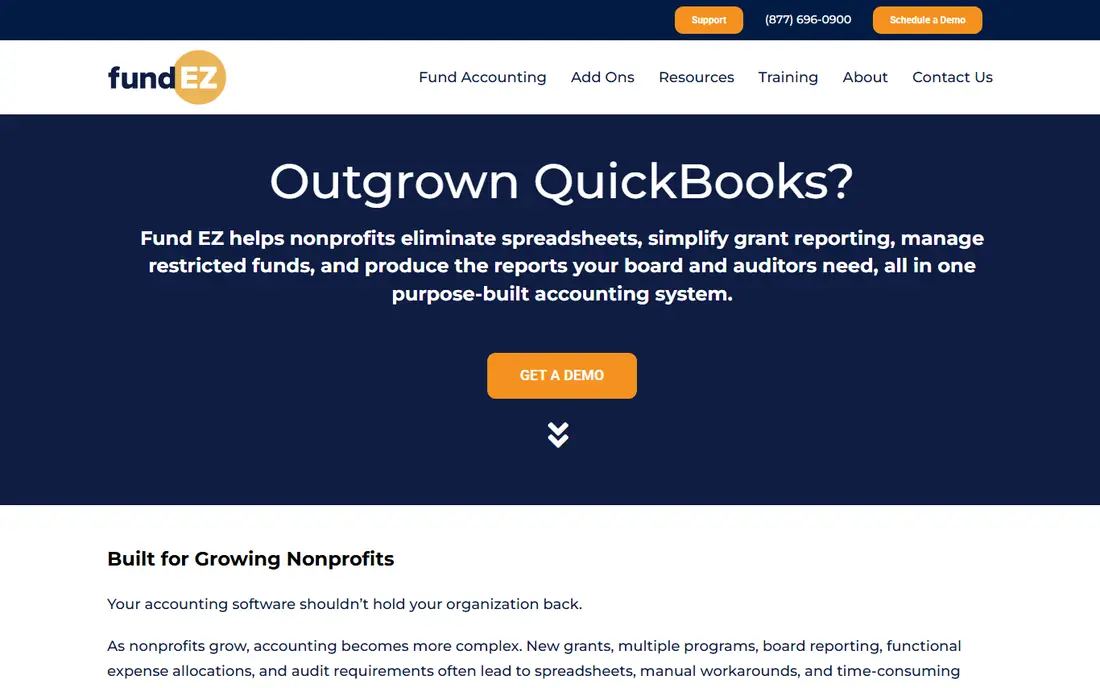
Teams focused on small nonprofits wanting fund focus will find Fund EZ worth considering. Fund EZ focuses on fund accounting for smaller nonprofits at an affordable entry point. We compared its official feature pages and pricing against the other options in this list, and it stood out for fund tracking, grant reporting, and audit-ready records. Readers who do that kind of work regularly will notice the difference in daily use, while occasional users may care less about depth and more about price and simplicity.
Larger organizations may need deeper reporting and integrations. It is a good fit when that strength matches your daily work, and less so when you need the missing pieces. Check the current pricing page before you commit, since plans and limits change, and use a trial or small order to confirm it fits your workflow.
- Fund accounting focus
- Grant management
- Affordable entry
- Smaller feature range
- Interface is functional
Aplos
Ideal for: Small nonprofits and churches
When small nonprofits and churches matters most, Aplos stands out in this list. Aplos pairs fund accounting with donor tracking in a simple setup for small nonprofits. We compared its official feature pages and pricing against the other options in this list, and it stood out for fund tracking, grant reporting, and audit-ready records. Readers who do that kind of work regularly will notice the difference in daily use, while occasional users may care less about depth and more about price and simplicity.
Larger funds with complex reporting may outgrow it. Weigh that strength against the catch before deciding, since the right choice depends on which side matters more to you. Check the current pricing page before you commit, since plans and limits change, and use a trial or small order to confirm it fits your workflow.
- Fund accounting
- Donor tracking
- Simple setup
- Smaller scale features
- Limited advanced reporting
AccuFund
Ideal for: Nonprofits and government funds
For buyers who need nonprofits and government funds, AccuFund offers a practical option. AccuFund offers fund accounting with government reporting in a modular design. We compared its official feature pages and pricing against the other options in this list, and it stood out for fund tracking, grant reporting, and audit-ready records. Readers who do that kind of work regularly will notice the difference in daily use, while occasional users may care less about depth and more about price and simplicity.
The dated interface may feel old, but the fund focus is solid. If that trade-off fits your workflow, it is easy to recommend. If not, another option in this list may suit you better. Check the current pricing page before you commit, since plans and limits change, and use a trial or small order to confirm it fits your workflow.
- Fund accounting
- Government reporting
- Modular design
- Interface feels dated
- Pricing by quote
MIP Fund Accounting
Ideal for: Nonprofits needing established fund tools
If your shortlist centers on nonprofits needing established fund tools, MIP Fund Accounting belongs on it. MIP Fund Accounting is an established nonprofit tool with grant tracking and reporting. We compared its official feature pages and pricing against the other options in this list, and it stood out for fund tracking, grant reporting, and audit-ready records. Readers who do that kind of work regularly will notice the difference in daily use, while occasional users may care less about depth and more about price and simplicity.
Being part of a larger suite means packaging and pricing need a sales conversation. That profile suits buyers who prioritize the strength, while buyers who need the missing features should keep looking. Check the current pricing page before you commit, since plans and limits change, and use a trial or small order to confirm it fits your workflow.
- Established fund accounting
- Grant tracking
- Reporting
- Part of a larger suite
- Pricing by quote
FastFund
Ideal for: Small nonprofits wanting simple funds
For small nonprofits wanting simple funds, FastFund brings a focused set of tools to the table. FastFund keeps fund accounting simple for small nonprofits at affordable pricing. We compared its official feature pages and pricing against the other options in this list, and it stood out for fund tracking, grant reporting, and audit-ready records. Readers who do that kind of work regularly will notice the difference in daily use, while occasional users may care less about depth and more about price and simplicity.
Organizations with complex reporting needs should trial its reports first. For the right buyer, the strength outweighs the catch. For others, the catch is a reason to compare further. Check the current pricing page before you commit, since plans and limits change, and use a trial or small order to confirm it fits your workflow.
- Simple fund accounting
- Grant tracking
- Affordable pricing
- Smaller integration range
- Basic reporting
How we picked these
We started with products that exist and work in October 2026 and truly fit best fund accounting software. We checked official feature pages, pricing pages, app store listings, privacy policies, and public reviews, and we left out products that did not fit the topic even if they were popular elsewhere. We favored options with clear pricing, honest limits, and a track record of serving real users, and we mixed well known leaders with strong smaller options so readers are not pushed toward one brand.
We did not claim hands-on testing that did not happen. Instead, we compared what vendors publish against what users report, and we noted honest weaknesses where they matter. If a price could not be verified from the vendor website or an app store listing, we wrote See website rather than guessing a number.
What to check before you choose
Start with budget, but look at the full cost. A low headline price can hide per-user fees, add-on charges, or renewal increases, so read the pricing page carefully and add up the cost for your real team size or volume. A trial period is useful here, since it shows whether the daily workflow feels natural or forced.
Next, check the features that matter for best fund accounting software: fund tracking, grant reporting, and audit-ready records. Make a short list of must-have features before you trial anything, and score each option against that list. A tool with many features you never use is not better than a focused tool that does your core job well.
Then think about scale and support. A tool that works for one person may struggle with a team, and a tool built for enterprises may feel heavy for a small operation. Check support hours, documentation, and integration options, since help matters most when something goes wrong.
Finally, Fund accounting differs from regular accounting, so confirm a tool tracks restrictions by fund, not just by account. Test with real work, not just a demo, and keep notes on what worked and what did not. That short trial record will make the final choice much clearer than a feature list alone.
Frequently asked questions
What is the best option for best fund accounting software?
There is no single best option for every buyer. Our pick for most people balances features, pricing, and ease of use, but the right choice depends on your budget and on fund tracking, grant reporting, and audit-ready records. Use the comparison table above to narrow the list to two or three options, then trial them with real work.
Are there free options for best fund accounting software?
Some options in this list offer a free plan or a free trial, and the table above shows which ones do. Free plans usually limit features or volume, so check those limits against your needs. For paid tools, a trial is often the best way to judge value before committing.
How much do these options cost?
Prices vary widely, and vendors change plans often, so we list See website where a price could not be verified at the time of writing. Always check the vendor pricing page for the current cost, including renewal prices and any per-user or per-volume fees, before you buy.
How do I choose between these options?
Start with your must-have features for best fund accounting software, then filter by budget and team size. Trial the top two or three options with real tasks, and pay attention to support quality and ease of use. Fund accounting differs from regular accounting, so confirm a tool tracks restrictions by fund, not just by account.
Can I switch later if I pick the wrong option?
In most cases, yes, but switching costs time and effort, especially if you have stored data or trained a team on one tool. Check export options and contract terms before you commit, and avoid long contracts until you are sure the tool fits your workflow.