Best fundraising platforms in 2026: 8 Compared

- 1
 GoFundMeCrowdfunding campaignsVisit
- 2
 GivebutterFree fundraising and eventsVisit
- 3
 DonorboxDonation forms and recurring givingVisit
- 4
 ClassyEnterprise nonprofit campaignsVisit
- 5
 DonorPerfectFull donor managementVisit
- Zeffy and Givebutter are the lowest cost starting points because both run on optional donor contributions rather than a monthly fee for core fundraising.
- Donorbox is a strong choice when a polished donation form and recurring giving matter more than a full donor database.
- Bloomerang and DonorPerfect suit larger teams that need donor records, reporting and stewardship in one system.
- Fundraise Up is worth a close look when online donation conversion is the main problem to solve.
Quick comparison
| Product | Ideal for | Price from | Free version | |
|---|---|---|---|---|
| GoFundMe | Crowdfunding campaigns | Free | Yes | Visit |
| Givebutter | Free fundraising and events | Free | Yes | Visit |
| Donorbox | Donation forms and recurring giving | Free | Yes | Visit |
| Classy | Enterprise nonprofit campaigns | See website | No | Visit |
| DonorPerfect | Full donor management | See website | No | Visit |
 Bloomerang | Donor retention | See website | No | Visit |
 Fundraise Up | Donation conversion | See website | No | Visit |
 Zeffy | Zero-fee fundraising | Free | Yes | Visit |
The best fundraising platforms
We compared official feature pages, pricing pages, app store listings, privacy policies and public reviews to build this list, focusing on products that fit the topic closely and are still available in October 2026.
GoFundMe
Ideal for: Crowdfunding campaigns

For buyers who want a clear fit, GoFundMe is aimed at nonprofits and causes that need a fast public campaign. Its public campaign pages are easy to share and easy for donors to understand. Donors can give from a phone in a few steps, and campaign updates keep supporters in the loop. In practice, that means the product earns its place by doing one job well for that audience, rather than trying to cover every possible use case at once. We compared its official feature page, pricing and public reviews against the other options here, and its best-for label reflects where it looked strongest, not where its marketing claims are loudest.
The trade-off is worth naming plainly. It is not a full donor database, so teams that need detailed stewardship reporting will need another system beside it. On price, the starting point listed above is free, and the free plan entry is Yes. If that combination fits your budget and your main use case, GoFundMe is a sensible shortlist choice. If the catch above is a deal breaker, move to another entry in this list whose strength matches your priority instead.
- Huge donor recognition
- Simple campaign setup
- Social sharing built in
- Platform is geared to individual and cause campaigns rather than a full nonprofit CRM
- Processing fees still apply
Givebutter
Ideal for: Free fundraising and events

If that use case sounds familiar, Givebutter is aimed at small nonprofits that want free core tools. Givebutter combines donation pages, events, peer-to-peer pages and a basic CRM without a monthly fee for core use. The free model is supported by optional donor tips, which keeps the headline cost at zero for many teams. In practice, that means the product earns its place by doing one job well for that audience, rather than trying to cover every possible use case at once. We compared its official feature page, pricing and public reviews against the other options here, and its best-for label reflects where it looked strongest, not where its marketing claims are loudest.
On the other side of that strength, Some advanced features sit on the paid Plus plan, so larger teams should check which tools are included before committing. On price, the starting point listed above is free, and the free plan entry is Yes. If that combination fits your budget and your main use case, Givebutter is a sensible shortlist choice. If the catch above is a deal breaker, move to another entry in this list whose strength matches your priority instead.
- Free core fundraising
- Events and peer-to-peer campaigns
- Built-in donor CRM
- Paid Plus features are needed for some advanced tools
- Tip-funded model needs donor participation
Donorbox
Ideal for: Donation forms and recurring giving
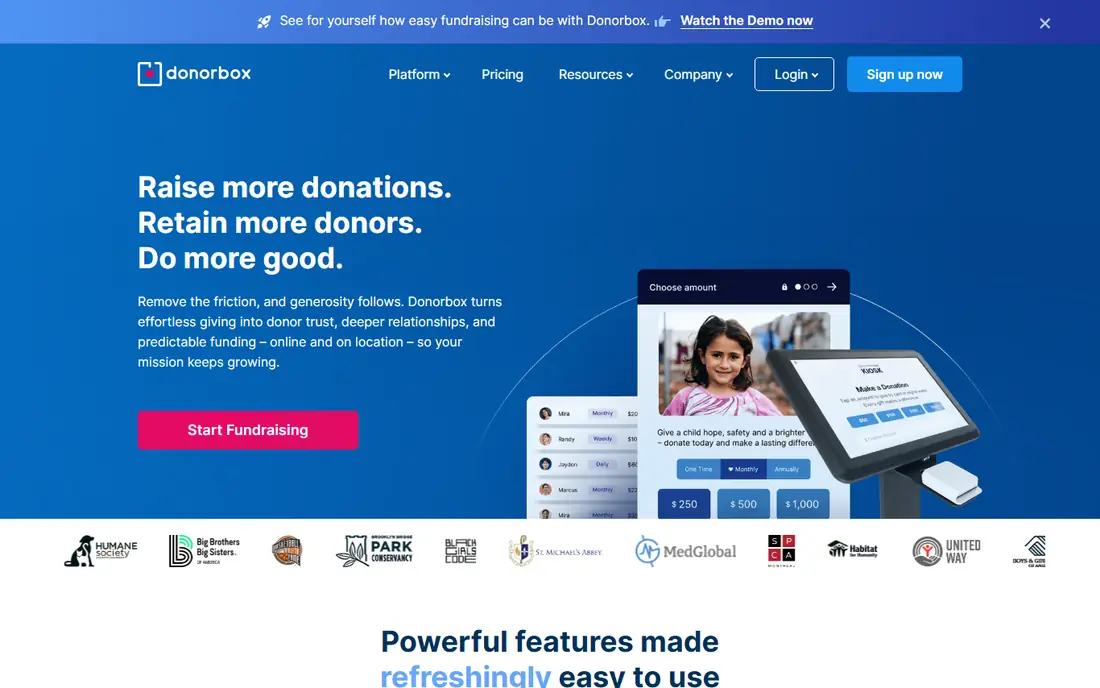
Among the options here, Donorbox is aimed at teams that need a strong form quickly. Donorbox is known for donation forms that can be embedded on a website and for recurring gift options. Its integrations cover common CRMs and email tools, which helps a small team connect giving data to follow-up. In practice, that means the product earns its place by doing one job well for that audience, rather than trying to cover every possible use case at once. We compared its official feature page, pricing and public reviews against the other options here, and its best-for label reflects where it looked strongest, not where its marketing claims are loudest.
Before you commit, weigh this part. The free plan platform fee adds up at volume, and the paid Pro plan is a step up in monthly cost. On price, the starting point listed above is free, and the free plan entry is Yes. If that combination fits your budget and your main use case, Donorbox is a sensible shortlist choice. If the catch above is a deal breaker, move to another entry in this list whose strength matches your priority instead.
- Fast donation form setup
- Strong recurring giving
- Many integrations
- Free plan charges a platform percentage
- Advanced features need paid plans
Classy
Ideal for: Enterprise nonprofit campaigns
For a team or household weighing this choice, Classy is aimed at larger nonprofits running major campaigns. Classy, now part of GoFundMe Pro, is built for larger campaigns with peer-to-peer fundraising and events. Its reporting and campaign tools suit teams that run several campaigns at once. In practice, that means the product earns its place by doing one job well for that audience, rather than trying to cover every possible use case at once. We compared its official feature page, pricing and public reviews against the other options here, and its best-for label reflects where it looked strongest, not where its marketing claims are loudest.
The honest catch comes next. Custom pricing means a sales conversation is needed, and small teams may find it more platform than they need. On price, the starting point listed above is not published clearly, so check the vendor site, and the free plan entry is No. If that combination fits your budget and your main use case, Classy is a sensible shortlist choice. If the catch above is a deal breaker, move to another entry in this list whose strength matches your priority instead.
- Strong peer-to-peer and event campaigns
- Enterprise reporting
- GoFundMe network reach
- Custom pricing makes cost hard to compare
- More than a small team needs
DonorPerfect
Ideal for: Full donor management
When the main need is the one above, DonorPerfect is aimed at established nonprofits with complex donor records. DonorPerfect is a long-standing donor management system with gift tracking, pledges and reporting. It suits teams that manage many donors, grants and campaigns and need board-ready reports. In practice, that means the product earns its place by doing one job well for that audience, rather than trying to cover every possible use case at once. We compared its official feature page, pricing and public reviews against the other options here, and its best-for label reflects where it looked strongest, not where its marketing claims are loudest.
Pricing and limits deserve a second look. Quoted pricing and a longer setup mean it is a poor fit for a team that only needs a donation page this week. On price, the starting point listed above is not published clearly, so check the vendor site, and the free plan entry is No. If that combination fits your budget and your main use case, DonorPerfect is a sensible shortlist choice. If the catch above is a deal breaker, move to another entry in this list whose strength matches your priority instead.
- Mature donor CRM
- Gift and pledge tracking
- Reporting for boards
- Pricing is quoted rather than published
- Setup takes time
Bloomerang
Ideal for: Donor retention
For readers who put this factor first, Bloomerang is aimed at growing nonprofits focused on keeping donors. Bloomerang pairs a donor CRM with giving forms, so gifts and donor history live in one record. Its retention tools highlight lapsed donors and giving patterns, which helps stewardship work. In practice, that means the product earns its place by doing one job well for that audience, rather than trying to cover every possible use case at once. We compared its official feature page, pricing and public reviews against the other options here, and its best-for label reflects where it looked strongest, not where its marketing claims are loudest.
A smaller drawback can still matter. Pricing is based on contacts, so a fast-growing list can push costs up, and teams should confirm the tier that includes the tools they need. On price, the starting point listed above is not published clearly, so check the vendor site, and the free plan entry is No. If that combination fits your budget and your main use case, Bloomerang is a sensible shortlist choice. If the catch above is a deal breaker, move to another entry in this list whose strength matches your priority instead.
- Retention-focused donor CRM
- Integrated giving forms
- Clear donor timelines
- Contact-based pricing can rise with list size
- Some features need higher tiers
Fundraise Up
Ideal for: Donation conversion
In a crowded field, Fundraise Up is aimed at nonprofits that want more completed donations. Fundraise Up focuses on the checkout itself, with optimisation, payment options and recurring prompts. That focus can lift completed gifts without changing the campaign story, which is valuable for teams with steady traffic. In practice, that means the product earns its place by doing one job well for that audience, rather than trying to cover every possible use case at once. We compared its official feature page, pricing and public reviews against the other options here, and its best-for label reflects where it looked strongest, not where its marketing claims are loudest.
What to check before paying is simple. Its fee model is transaction based and not published as a simple price, so total cost depends on volume and needs a quote. On price, the starting point listed above is not published clearly, so check the vendor site, and the free plan entry is No. If that combination fits your budget and your main use case, Fundraise Up is a sensible shortlist choice. If the catch above is a deal breaker, move to another entry in this list whose strength matches your priority instead.
- Optimised checkout
- Recurring giving tools
- Personalisation options
- Exact transaction rate is not published plainly
- Enterprise focus
Zeffy
Ideal for: Zero-fee fundraising
For a first purchase in this category, Zeffy is aimed at budget-conscious nonprofits. Zeffy stands out because eligible nonprofits pay no platform or processing fees, with optional donor contributions funding the service. It also covers events, memberships and raffles, so a small team can run several income types in one place. In practice, that means the product earns its place by doing one job well for that audience, rather than trying to cover every possible use case at once. We compared its official feature page, pricing and public reviews against the other options here, and its best-for label reflects where it looked strongest, not where its marketing claims are loudest.
The limit to keep in mind is this. Eligibility and the donor-contribution prompt are the conditions to check, since not every organisation or campaign type will fit the model. On price, the starting point listed above is free, and the free plan entry is Yes. If that combination fits your budget and your main use case, Zeffy is a sensible shortlist choice. If the catch above is a deal breaker, move to another entry in this list whose strength matches your priority instead.
- No platform or processing fees for eligible nonprofits
- Events and memberships
- Donor CRM
- Eligibility rules apply
- Funded by optional donor contributions
How we picked these
We compared official feature pages, pricing pages, app store listings, privacy policies and public reviews for each product, and we kept only products that are still available in October 2026 and that fit the topic closely. Where a vendor did not publish a clear starting price on its own site, we wrote See website rather than guessing. Prices can change, so check the vendor page linked in each product block before you buy.
Choosing a fundraising platform without overpaying
Start with the fee math, not the feature list. Add the platform fee and the card processing fee together, then multiply by your expected monthly volume. A free plan with a percentage fee can cost more than a paid plan once volume grows. Next, check whether recurring giving, tax receipts and donor records are included or sold as add-ons. Finally, test the donor checkout on a phone, since many gifts now arrive from a link shared by text or social media. A short checkout with clear amounts tends to raise more than a long form, even when the longer form has more options.
Frequently asked questions
What is the best free fundraising platform for a small nonprofit?
Zeffy and Givebutter are the usual starting points, since both offer core fundraising without a monthly fee and are funded in part by optional donor contributions. Donorbox also starts free, but it charges a platform percentage on its free plan.
Do fundraising platforms charge processing fees on top of platform fees?
In most cases, yes. Card processing is usually charged by the payment processor in addition to any platform fee, so read both numbers before you compare plans.
Which platform is best for recurring donations?
Donorbox, Givebutter and Fundraise Up all support recurring gifts, with donor portals or retry handling that helps keep monthly gifts active. Check how donors update a card before you choose.
Can a small team run events and peer-to-peer campaigns on one platform?
Givebutter and Classy cover events and peer-to-peer fundraising well, while Zeffy also includes events and memberships. Larger event programs may need the custom plans from Classy or Fundraise Up.
Should we pick a fundraising platform or a donor CRM first?
If gifts are the urgent need, pick the fundraising platform first. If donor retention and reporting are the bottleneck, a CRM such as Bloomerang or DonorPerfect may matter more, with fundraising forms connected to it.