6 Strong Governance Risk Compliance Software Options in 2026

- 1
 DrataEngineering-led teams that want structured complianceVisit
- 2
 SprintoMulti-framework compliance with solid supportVisit
- 3
 SecureframeStartups that want the fastest path to audit readinessVisit
- 4
 VantaExpanding businesses automating SOC 2 and ISO 27001Visit
- 5
 ArcherLarge enterprises standardizing integrated riskVisit
- Drata sits first on this list: engineering-led teams that want structured compliance.
- A permanent free plan is missing from all 6 tools, Drata and LogicGate included; plan for a trial or a premium start.
- Drata, LogicGate and the 4 others all sell by quote; expect sales conversations before you see a price.
- LogicGate suits teams that want to build their own risk workflows.
Direct answer
Start with Drata if you need engineering-led teams that want structured compliance. Sprinto is the stronger choice for multi-framework compliance with strong support, while Secureframe suits startups that want the fastest path to audit readiness. Details, prices and limits for the rest of the 6 tools are below.
Quick comparison
| Product | Ideal for | Price from | Free version | |
|---|---|---|---|---|
| Drata | Engineering-led teams that want structured compliance | See website | No | Visit |
| Sprinto | Multi-framework compliance with solid support | See website | No | Visit |
| Secureframe | Startups that want the fastest path to audit readiness | See website | No | Visit |
| Vanta | Expanding businesses automating SOC 2 and ISO 27001 | See website | No | Visit |
| Archer | Large enterprises standardizing integrated risk | See website | No | Visit |
 LogicGate | Teams that want to build their own risk workflows | See website | No | Visit |
The full governance risk compliance software list
This Ainotely guide covers 6 options for governance risk compliance software. Each profile lists a starting price, free plan details, strengths and drawbacks, so you can drop poor fits quickly.
Drata
Ideal for: Engineering-led teams that want structured compliance
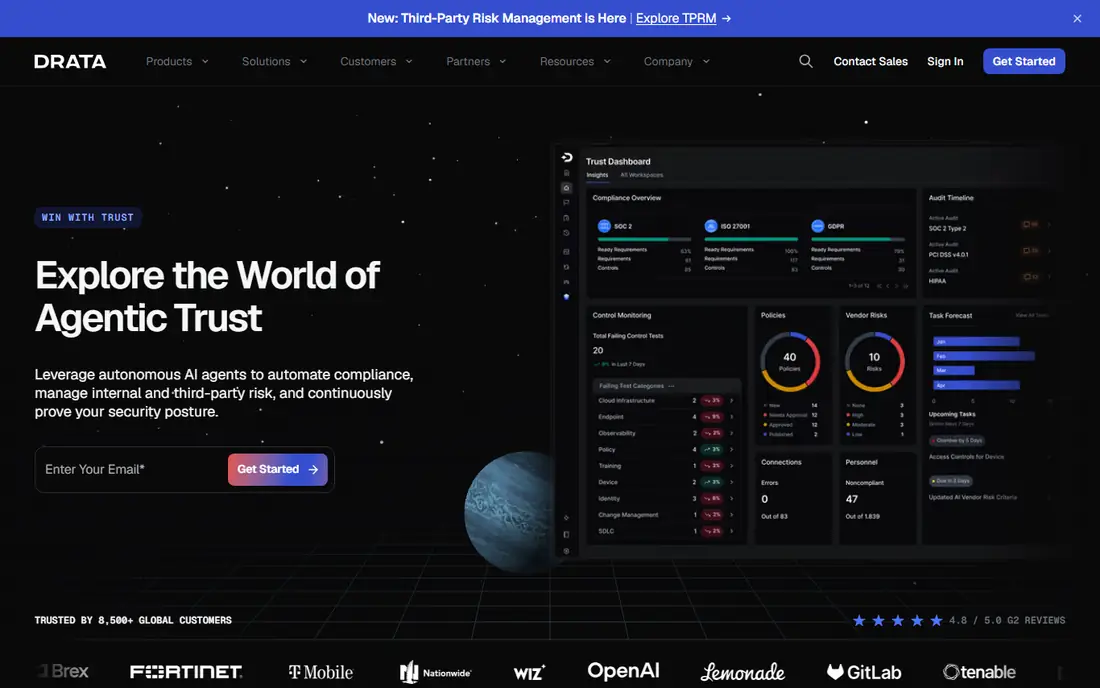
Think of Drata for engineering-led teams that want structured compliance. Like Vanta, pricing is entirely quote-based, driven by employee count, frameworks and integrations.
Trade-offs to know: Renewal spikes reported when frameworks grow.
Drata competes head-to-head with Vanta on automatic security and compliance: continuous control monitoring, evidence collection and audit preparation across major frameworks. From a buyer's view, public buyer data places entry levels in the five-figure range annually, with large rollouts exceeding six figures. Pricing for Drata is not stated here, so ask the vendor for current figures. No free plan comes with Drata.
- Tiered plans from Essential to Advanced
- Capable automation and monitoring
- No public pricing
Sprinto
Ideal for: Multi-framework compliance with solid support

Where Sprinto fits: multi-framework compliance with strong support. Sprinto is the value challenger in compliance automation: it maps your controls once and reuses them across standards, which cuts duplicate work when you pursue SOC 2 plus ISO 27001 plus HIPAA. In practice, buyer reviews consistently praise its support and implementation guidance, and it positions below incumbent pricing.
Where it shines: Praised support.
Pricing is quote-based. For cloud-first teams adding frameworks over time, the control-mapping approach genuinely cuts continuing effort. Also, pick Sprinto when you want guided multi-framework compliance and value practical support over the largest integration catalog. Pricing for Sprinto is not stated here, so ask the vendor for current figures. Sprinto does not include a free plan. Points against: Smaller ecosystem than Vanta.
- Competitive value positioning
- Reuses across frameworks
- No public pricing
Secureframe
Ideal for: Startups that want the fastest path to audit readiness
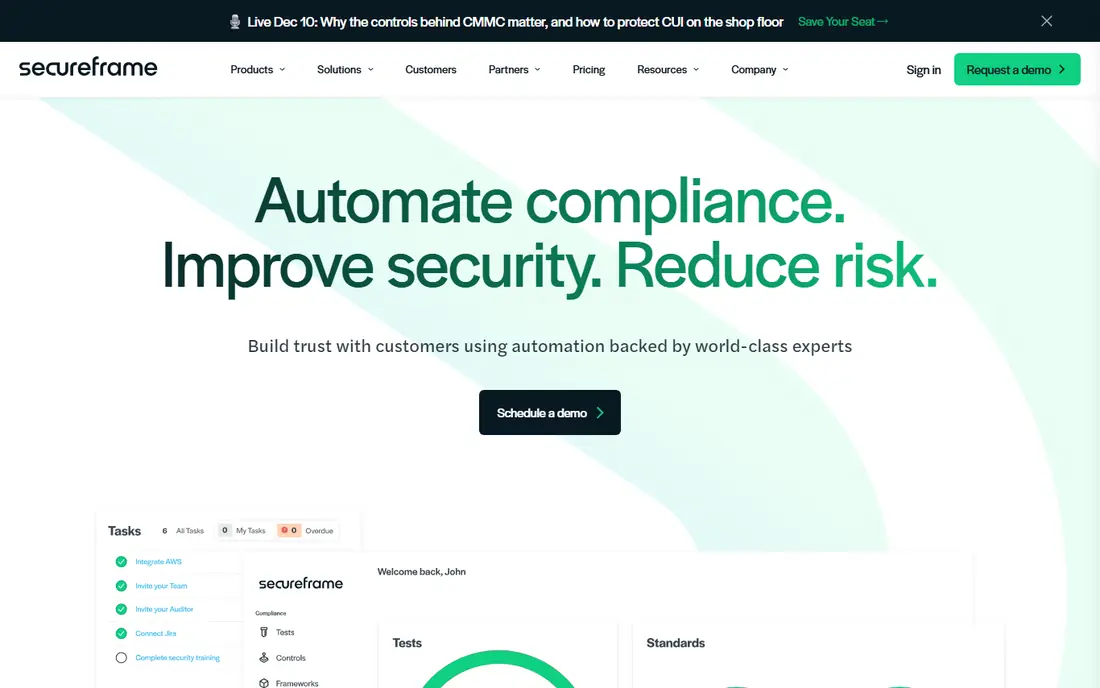
Secureframe is a good fit for startups that want the fastest path to audit readiness. Implementation is fast, commonly a handful of weeks to link integrations and reach audit readiness.
The main drawbacks: Less customizable than enterprise GRC.
It has particular strength in federal frameworks for teams selling to government-adjacent buyers. For everyday use, pricing is quote-based, moving with framework count, seat count and extras like the trust center and vendor risk. This comparison lists no price for Secureframe; ask the vendor. Secureframe does not include a free plan.
- Solid federal framework support
- Quick implementation (weeks, not months)
- No public pricing
Vanta
Ideal for: Expanding businesses automating SOC 2 and ISO 27001
Vanta makes the most sense for expanding firms automating SOC 2 and ISO 27001. Deal data recommends young teams start in the low five figures annually, rising as frameworks and headcount grow. Its integration library is the deepest in the category, and the trust center module lets you share your security posture with prospects.
The main drawbacks: Costs scale with headcount and frameworks.
Discounts for annual and multi-year terms are typical, but buyers report renewal raises when scope expands. Worth adding: pricing is quote-based, scaling with employee count, frameworks and modules. Check the vendor site for Vanta pricing; none is listed in this comparison. There is no free plan with Vanta.
- Largest compliance automation ecosystem
- Trust center included
- No public pricing
Archer
Ideal for: Large enterprises standardizing integrated risk
Archer is aimed squarely at large enterprises standardizing integrated risk. Archer (RSA Archer) is the veteran of enterprise integrated risk management: decades of deployments in banks, insurers and large enterprises, with deep modules for operational risk, IT risk, external risk and compliance. Worth adding: mid-market businesses will find it heavyweight.
Points against: Heavyweight for mid-market.
But for regulated enterprises with mature risk functions, its depth and track record are unmatched. It belongs on the shortlist for large, regulated organizations building enterprise-wide risk programs. On top of that, when a large organization standardizes GRC globally, Archer is often the answer. Pricing for Archer is not stated here, so ask the vendor for current figures. Archer does not include a free plan.
- Deep risk quantification
- Longest-running enterprise GRC system
- Enterprise-only pricing and implementation
LogicGate
Ideal for: Teams that want to build their own risk workflows
LogicGate targets teams that want to build their own risk workflows. Implementation relies on configuration depth; a working program generally takes multiple weeks to a handful of months.
LogicGate's Risk Cloud is a customizable workflow engine for risk and compliance, not a fixed compliance template. LogicGate shows no starting price here, so confirm the cost on the vendor site. No free plan comes with LogicGate.
Trade-offs to know: Needs an owner to configure.
- Customizable Risk Cloud workflow engine
- Solid mid-market fit
- Quote-based pricing
What went into this list
Ainotely looked at what each vendor publishes: pricing, plan limits, feature coverage for governance risk compliance software and stated drawbacks. No hands-on testing is claimed. Plan names, prices and limits change often. Treat the figures here as a starting point and verify them with the vendor. We ordered the tools by general fit, then by how clearly pricing is shown, then by free access. A buyer with unusual needs may reorder them.
Before you commit
- Ask each vendor, from Drata to LogicGate, for a written quote; none of them publishes a starting price.
- Before choosing Drata, weigh its main limit: no public pricing.
- Look at which plan of Archer unlocks the features you need; entry tiers are often cut down.
- A short pilot of Drata with your real workflow tells you more than a feature table.
- Check whether Sprinto bills monthly or annually, and what cancelling early costs.
Frequently asked questions
How are the tools for governance risk compliance software ordered?
The order follows typical fit for governance risk compliance software, with Drata first and LogicGate last, then price clarity and free access. It is editorial judgement, not a score, so another team could rank the tools differently.
What is the difference between GRC and compliance automation?
Compliance automation (Vanta, Drata) concentrates on getting certified to frameworks quick. GRC products (LogicGate, Optro, Archer) handle the broader risk program: risk registers, audits, issues and controls across the enterprise.
Do these tools publish their prices?
No. None of the tools, from Drata to LogicGate, shows a fixed starting price here, so budget time for quotes.
Is Drata the right pick for everyone comparing governance risk compliance software?
No single tool suits every team. Drata comes first because it fits engineering-led teams that want structured compliance, while Sprinto suits multi-framework compliance with strong support and Secureframe suits startups that want the fastest path to audit readiness. Match the tool to your own size, budget and workflow before deciding.
Does any tool for governance risk compliance software here have a free plan?
A permanent free plan is not offered by Drata, LogicGate or the other tools here. Plan a short evaluation period instead.
Do I need GRC software for SOC 2?
Not strictly, but automation products cut audit preparation from months to weeks by continuously collecting evidence. For a first SOC 2 with a small team, they are typically worth it.