8 Gtm Platform Powered by AI Options Ranked for 2026

- 1
 SalesforceAI agents running on the CRM of recordVisit
- 2
 WarmlyActing on website visitors in liveVisit
- 3
 HubSpot BreezeHubSpot-standardized teams wanting AI across marketing, sales and serviceVisit
- 4
 DemandbaseAccount-based GTM combining intent, ads and sales intelligenceVisit
- 5
 ClayGTM engineers building custom enrichment and outbound workflowsVisit
- Number one here is Salesforce, a fit for AI agents running on the CRM of record.
- For the cheapest start, look at Salesforce: From $25/user/month.
- For inbound capture, qualification and routing, Default is worth a look.
- 2 of 8 tools offer a free plan: Warmly, Clay.
Direct answer
Our first pick is Salesforce, best for AI agents running on the CRM of record. Warmly is better for acting on website visitors in live, and HubSpot Breeze is better for HubSpot-standardized teams wanting AI across marketing, sales and service. The other 5 tools in the list cover narrower or pricier cases.
Quick comparison
| Product | Ideal for | Price from | Free version | |
|---|---|---|---|---|
| Salesforce | AI agents running on the CRM of record | From $25/user/month | Free trial | Visit |
| Warmly | Acting on website visitors in live | Free; premium from ~$900/month | Yes | Visit |
| HubSpot Breeze | HubSpot-standardized teams wanting AI across marketing, sales and service | Bundled with HubSpot | Free trial | Visit |
| Demandbase | Account-based GTM combining intent, ads and sales intelligence | Custom | No | Visit |
| Clay | GTM engineers building custom enrichment and outbound workflows | Free; premium from $185/month | Yes | Visit |
 Common Room | Product-led firms acting on product and community signals | From $2,100/month | No | Visit |
 6sense | Enterprises predicting which accounts are in-market | Custom | No | Visit |
 Default | Inbound capture, qualification and routing | From $750/month | No | Visit |
The 8 tools in detail
Choosing gtm platform powered by AI usually comes down to price, fit and limits. This Ainotely guide sets 8 tools side by side on those three points, with the facts kept short and checkable.
Salesforce
Ideal for: AI agents running on the CRM of record
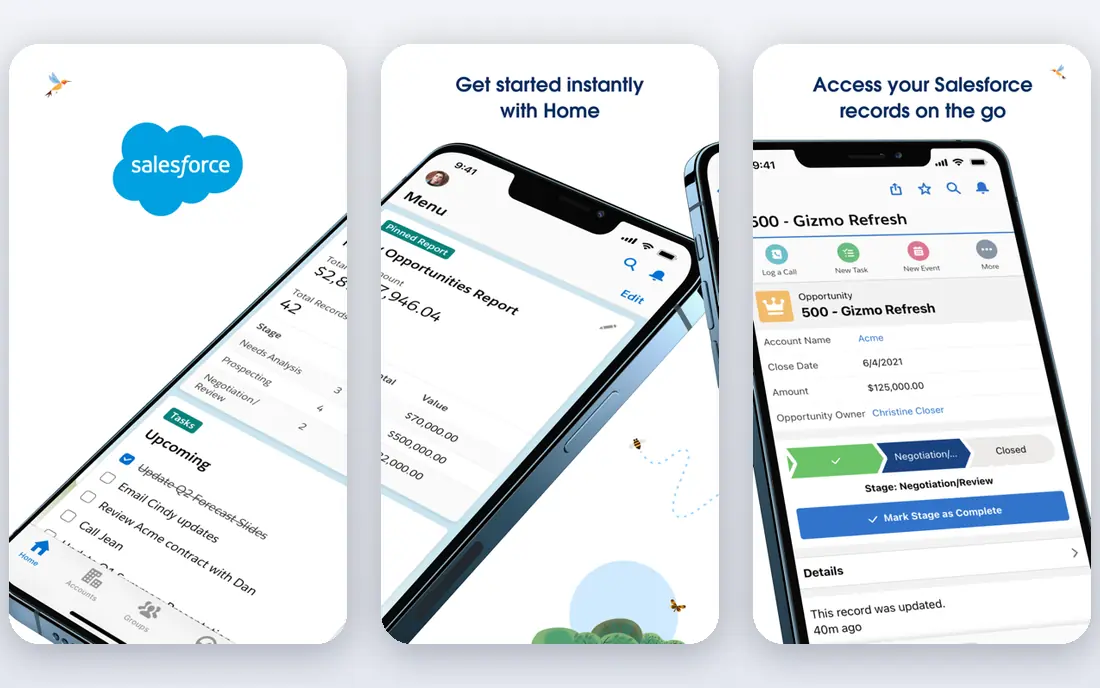
Think of Salesforce for AI agents running on the CRM of record. Salesforce's GTM AI story is Agentforce: AI agents that research accounts, draft outreach, update records and guide sellers, running natively where the customer data already lives. The system's complexity is legendary.
But data gravity decides: when the CRM holds the truth, AI agents closest to it have structural advantages. In daily use, for the enormous Salesforce installed base, CRM-native AI avoids the integration tax of bolting external agents onto the system of record. What you pay to start with Salesforce: From $25/user/month. Free options: Free trial.
Limits to weigh: Complexity.
- Huge ecosystem
- Agentforce AI agents native to the CRM
- Best value inside Salesforce commitment
Warmly
Ideal for: Acting on website visitors in live
In short, Warmly is for acting on website visitors in live. Warmly converts anonymous website traffic into pipeline: identifying visiting businesses in live, engaging with AI chat, routing hot accounts to reps immediately. Beyond that, the free level lets teams test; premium plans from around $900 a month need real traffic to justify.
Reasons to shortlist it: Free tier to start; Live visitor identification and orchestration.
It is not an outbound system. But as the inbound capture and orchestration layer, it closes the gap between visitor arrival and human follow-up. On top of that, for inbound-heavy GTM motions, speed to lead is the conversion lever, and Warmly automates it. Warmly pricing: Free. Warmly includes a free tier.
Limits to weigh: premium entry around $900/month is significant; Outbound features thinner.
- AI chat and routing
- A decent match for inbound-heavy motions
- Value tied to website traffic volume
HubSpot Breeze
Ideal for: HubSpot-standardized teams wanting AI across marketing, sales and service

Think of HubSpot Breeze for HubSpot-standardized teams wanting AI across marketing, sales and service. Evaluate what Breeze spans before buying point tools that duplicate it. As for the details, for the millions of SMBs standardized on HubSpot, it gives AI GTM without new vendors or integrations.
More specifically, specialists beat it on depth: Clay on enrichment, 6sense on intent. But the zero-integration story and bundled pricing make it the pragmatic AI upgrade for HubSpot shops. The starting price for HubSpot Breeze: Bundled with HubSpot. Free options: Free trial.
Limits to weigh: Advanced features need higher levels and extras. Strengths: Good for SMB to mid-market.
- AI woven through the HubSpot product
- Familiar interface
- AI depth trails specialists
Demandbase
Ideal for: Account-based GTM combining intent, ads and sales intelligence
Demandbase is built with account-based GTM combining intent, ads and sales intelligence in mind. Teams choosing between Demandbase and 6sense normally split on advertising depth compared with predictive modeling.
Pricing for Demandbase is quote based, so budget talks start with the vendor. Demandbase has no permanent free option.
Honest limits: Advertising-centric heritage.
- Capable enterprise customer base
- Integrated ABM: intent, advertising
- Complexity for smaller teams
Clay
Ideal for: GTM engineers building custom enrichment and outbound workflows
Clay makes the most sense for GTM engineers building custom enrichment and outbound workflows. GTM engineers build the exact motion their business needs rather than accepting a vendor's template. Also, the free level lets teams prototype; premium plans start around $185 a month with data credits on top.
Highlights: Adaptable table workflows.
Points against: Needs technical operators. For teams with that skill, Clay brings together data, signals and actions better than any packaged alternative. Beyond that, the requirement is talent: someone must design and maintain the workflows. On cost, Clay starts like this: Free. A free plan is available with Clay.
- Free level for building
- Claygent AI agents for research
- Usage-based costs need monitoring
Common Room
Ideal for: Product-led firms acting on product and community signals
In short, Common Room is for product-led firms acting on product and community signals. Teams without meaningful community or product signal volume get less value.
Downsides: Entry around $2,100 to $2,500 per month prices out small teams.
Person360 resolves those signals to people and accounts, and RoomieAI agents research, personalize and guide outreach with governance controls on how agents execute. The starting price for Common Room: From $2,100/month. Common Room has no free plan.
- Captures product
- Community and web activity
- Signal value relies on community presence
6sense
Ideal for: Enterprises predicting which accounts are in-market
6sense was built for enterprises predicting which accounts are in-market. 6sense defined predictive GTM: its AI models analyze intent signals across the web to predict which accounts are in-market and what stage they are in, then orchestrate ads, SDR prioritization and personalization around those predictions. In daily use, pricing is custom and substantial, and the system demands marketing operations maturity to configure and sales discipline to act on the predictions.
The signal is only as valuable as the speed of follow-up. In practice, enterprise ABM teams run their account selection and timing on it. Pricing for 6sense is quote based, so budget talks start with the vendor. No free plan comes with 6sense.
Drawbacks to consider: ROI relies on sales follow-through.
- Leading AI intent and predictive models
- Anonymous buyer-stage prediction
- Custom pricing usually five to six figures annually
Default
Ideal for: Inbound capture, qualification and routing
Pick Default if this describes you: inbound capture, qualification and routing. Revenue teams drowning in inbound chaos get structure without the bloat of a full marketing automation suite. In daily use, for inbound-led GTM, the focused feature set beats generalist tools.
Limits to weigh: Newer vendor with smaller ecosystem.
Worth adding: pricing from $750 a month plus per-user fees positions it for firms with real inbound volume. It does not do outbound. Entry price for Default: From $750/month. Default has no permanent free option.
- Decent scheduling and handoff
- Clean analytics
- Inbound-focused only
A closer look at gtm platform powered by AI
AI GTM products unify those parts so AI agents and workflows run the repetitive loop whereas humans manage relationships and judgment. Each leads a different motion, which is why the shortlist relies on how you actually sell.
What went into this list
For each of the 8 tools we noted price, free plan or trial, fit for gtm platform powered by AI and the main limit, using vendor pages and documentation. Where a price is missing, the vendor does not list one publicly or ties it to a quote. Always confirm before budgeting. We ordered the tools by general fit, then by how clearly pricing is shown, then by free access. A buyer with unusual needs may reorder them.
Things to verify first
- Confirm the entry price on the vendor page. For Demandbase and 6sense that means a quote rather than a fixed price.
- Check what the free option really includes: Warmly and Clay offer a free plan, and usage caps differ.
- Run a trial of Salesforce and HubSpot Breeze with real work before paying for a year; your own workflow is the best test.
- Read the limits listed for Salesforce first: AI features add cost on top of licenses.
- Ask Default whether prices are locked for the first term and what happens at renewal.
- Find out whether the entry plan of Common Room covers your must-haves or only a trimmed-down version.
Frequently asked questions
Can I try these tools before paying?
Often, yes. Warmly and Clay have a free plan and Salesforce and HubSpot Breeze offer a free trial. Use your own data and a real task during the test, and check what the free tier or trial limits before you rely on it.
How are the tools for gtm platform powered by AI ordered?
Salesforce sits first and Default last because the order follows typical fit for gtm platform powered by AI, then price clarity and free access. It is a judgement call, so read each profile for fit and limits.
Do these tools publish their prices?
Not all of them. Demandbase and 6sense publish no starting price, so expect a quote request for those. The rest, Salesforce included, show a starting price, though seats and billing terms still change the final cost.
Which options for gtm platform powered by AI have a free plan?
Warmly and Clay offer a free plan in this list. Free plans usually cap users, projects or features, so check the limits on the vendor page. Several others offer a trial instead.