Best HR Analytics Tools for Small Business

- BambooHR and Zoho People give small teams the lowest published entry prices, at $10.25 and $3 per person per month, with Zoho People the only one here with a free edition.
- Lattice and ChartHop suit teams that want analytics built around performance and headcount planning, with Foundations at $13 and Core at $5 per person per month.
- HiBob and Visier hide their prices behind a sales quote, and Visier is an enterprise tool with an annual floor near $50,000, so both sit outside most small business budgets.
- Rippling and Gusto price payroll first, so their analytics value depends on the modules you add on top.
- Ask for a written quote that includes implementation, add-ons and the renewal rate before you sign, because the headline price rarely covers the first year.
Quick comparison
| Product | Ideal for | Price from | Free version | |
|---|---|---|---|---|
 BambooHR | Small team HR records and reporting | $10.25 per employee/month (Core, billed monthly) | Free trial (7 days) | Visit |
 ChartHop | Headcount planning and org charts | $5 per employee/month (Core, billed annually) | Yes | Visit |
 Lattice | Performance and engagement analytics | $13 per seat/month (Foundations, billed annually) | No | Visit |
 Rippling | Payroll plus workforce data in one system | $8 per user/month (platform, plus $40 monthly base fee) | No | Visit |
 Gusto | US payroll with basic HR reports | $49 per month plus $6 per person/month (Simple) | No | Visit |
 Zoho People | Lowest cost HR records and reports | $3 per user/month (Essential HR, US, billed annually) | Yes | Visit |
 HiBob | Mid-market culture and people analytics | quote only | No | Visit |
 Visier | Enterprise workforce analytics | quote only | No | Visit |
The best HR analytics tools for small business
BambooHR
Ideal for: Small team HR records and reporting
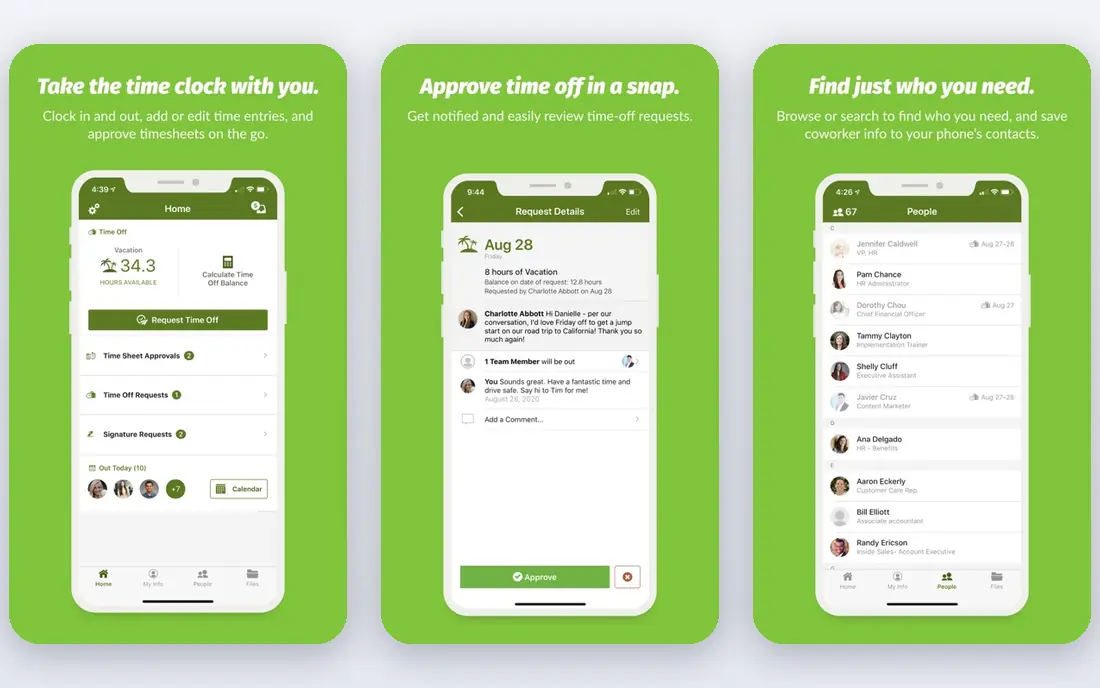
BambooHR is a human resources system for small and mid-size companies, and reporting sits at the center of the product. Core records hold employee data, time off, onboarding and hiring in one place, and the reporting tools let a small HR team build standard and custom reports. The pricing FAQ gives $10.25 for companies with more than 25 employees, while the plan cards show $10, so this article uses the FAQ figure as the list price. Teams with 25 or fewer employees pay a flat $250 a month for Core, which makes the effective cost $25 per person for a 10-person team.
The analytics grow with the plan. Pro at $17.50 per employee per month adds performance management, 360-degree feedback and goals, while Elite at $25 adds compensation planning, salary benchmarking, custom dashboards and HR benchmark data. The deeper benchmarking earns its keep once the team passes 50 people. The vendor offers a 15 percent discount when payroll and benefits administration are bought together with any plan for US employees.
- Publishes plan prices on its own pricing page
- Flat monthly rate for teams of 25 or fewer
- Payroll, benefits and time tracking are quoted add-ons
- Custom dashboards need the Elite plan
ChartHop
Ideal for: Headcount planning and org charts
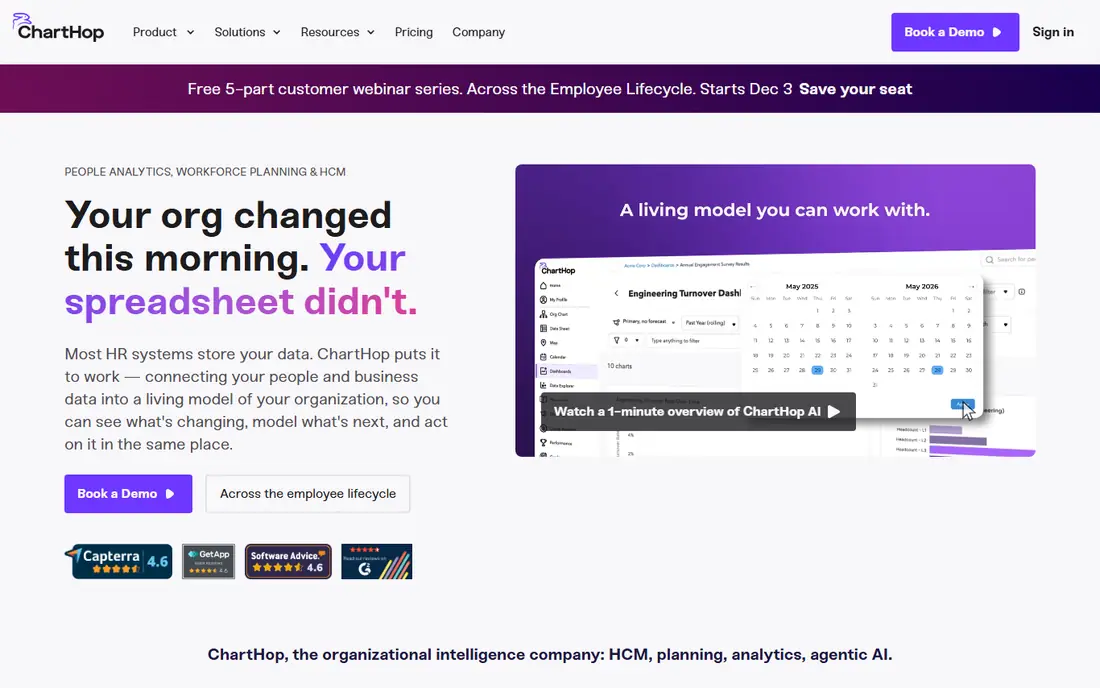
ChartHop is a people analytics platform built around connected employee data, and its strongest feature is turning that data into org charts and headcount plans. A small business can see reporting lines, open roles, compensation bands and planned hires in one view, which is the view a founder needs when deciding whether the team can afford three new hires. The vendor publicly lists Core at $5 per employee per month billed annually, and Headcount Planning at an additional $4, based on a pricing check dated July 29, 2026. Older directory listings still show a $2 Basic tier, and that figure does not match the current Core price, so treat it as out of date.
Core plus Headcount Planning totals $9 per employee per month before volume pricing, and further modules add more per person. A team that only needs org charts and basic reporting can stay on Core, while a team planning a hiring surge will want the headcount module. ChartHop offers a free plan, which makes it one of the few analytics-first tools a very small team can try without a sales call, though the free tier covers only the basics and the subscription modules hold the planning features.
- Org charts and headcount planning are the core product, not an add-on
- Free plan available
- Advanced modules cost extra per employee per month
- Older $2 Basic tier no longer matches current pricing
Lattice
Ideal for: Performance and engagement analytics
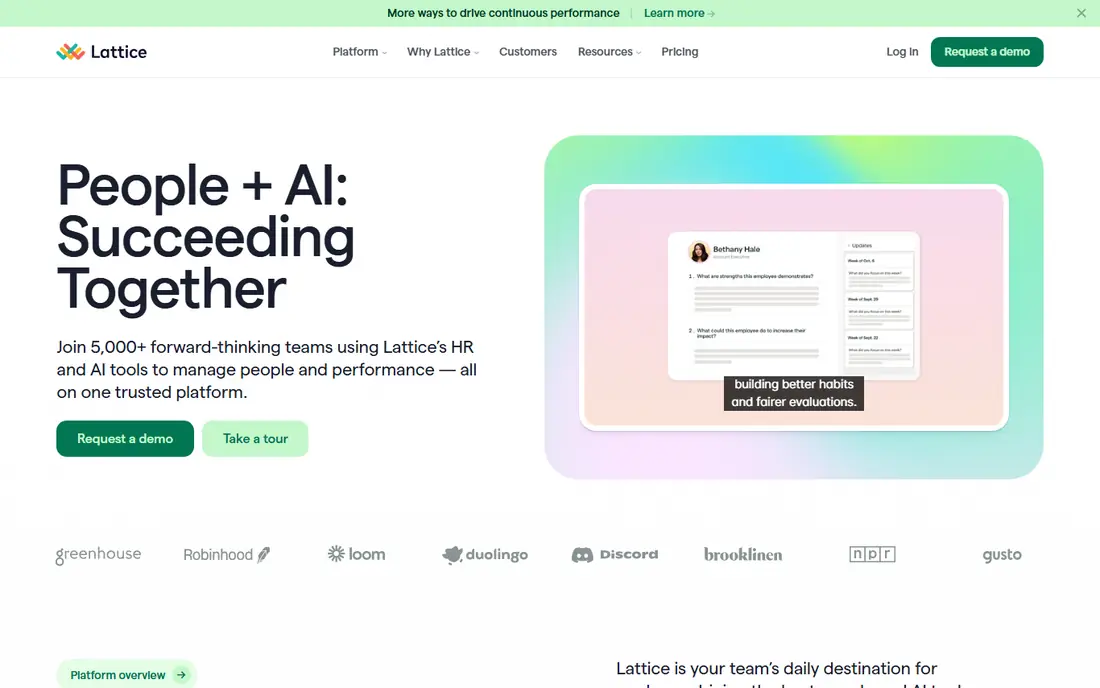
Lattice started as a performance management tool and now sells a people management platform built around reviews, goals, engagement surveys and analytics. Its analytics focus on the human side of HR: engagement survey sentiment, review completion, goal progress and team-level patterns that warn a manager before disengagement turns into resignations. The vendor sells three base products, Performance at $10, Goals and OKRs at $8 and Engagement at $4 per seat per month, with the Foundations bundle combining Performance and Goals at $13. Compensation adds $6 and Grow adds $4 per seat per month.
Two facts change the math for a small business. Lattice has a $4,000 minimum annual agreement, so a team below about 26 seats on Foundations pays the minimum rather than the per-seat rate, which makes the effective cost far higher for a 10-person team. Lattice also shut down its HRIS on July 31, 2026, after ending payroll on March 31, 2026, so it no longer holds employee records and works best beside a separate HR system.
- Analytics and the AI Agent are included with every base product
- No extra implementation fees for performance products
- $4,000 annual minimum agreement prices out very small teams
- HRIS shut down July 31, 2026
Rippling
Ideal for: Payroll plus workforce data in one system
Rippling builds its analytics on a single employee record that feeds HR, payroll, IT and spend tools, so a report on headcount cost can pull payroll, benefits and device data without exports. The vendor publishes one price: the platform starts at $8 per user per month plus a $40 monthly base fee. US payroll is also listed at $8 per user per month billed annually, or $10 billed monthly, while benefits, time tracking, IT device management and spend tools are each quoted. A 10-person team therefore starts at $120 a month for payroll on the platform, before any analytics module is added.
The analytics value depends on which modules you buy, and Rippling gives no published price for the analytics layer itself, so the quote sets the real budget. Third-party estimates put a payroll plus HR plus time tracking setup near $15 to $25 per employee per month, and a full HR, IT and spend stack near $30 to $65, but those figures come from buyer reports, so treat them as a planning range. Rippling launched Rippling AI in March 2026, which answers questions from live workforce data and acts across HR, IT and finance.
- One employee record feeds HR, payroll, IT and finance
- US payroll starts at $8 per user per month
- Every module beyond the platform is a custom quote
- No free trial, only guided demos
Gusto
Ideal for: US payroll with basic HR reports
Gusto is a US payroll and HR platform for small businesses, and its analytics are the reporting layer on top of payroll rather than a standalone people analytics product. The vendor publishes three plans: Simple at $49 a month plus $6 per person, Plus at $80 plus $12 per person, and Premium at $180 plus $22 per person. Simple covers single-state payroll, unlimited payroll runs, tax filings, contractor payments and basic PTO, while Plus adds multi-state payroll, time tracking, workforce costing and performance management. A 10-person team pays $109 a month on Simple, $200 on Plus and $400 on Premium, before add-ons.
The reporting most small teams need is present on Plus, while Premium adds custom reports, a dedicated service advisor and certified HR experts. Workforce costing and time-off reports arrive at the Plus tier. Gusto bills monthly in arrears and charges the per-person fee for every active employee even in a month when that employee received no pay, so headcount, not payroll runs, drives the bill.
- Published base fee plus per-person pricing
- Month-to-month terms with no long-term contract
- Single-state payroll only on Simple
- Deeper HR tools need the Plus or Premium plan
Zoho People
Ideal for: Lowest cost HR records and reports
Zoho People is the HR system inside the Zoho suite, and it is the cheapest published option in this list. The vendor pricing page lists Essential HR at $3 per user per month billed annually for US buyers, with Workforce and Talent at $5 and Enterprise at $8, and a free edition for up to 3 users. Prices vary by region, and non-US pages show lower rates starting near $1.25 per user per month, so a buyer outside the US should check the pricing page for their own region. Every plan includes self-service access, standard HR analytics and mobile apps, and all subscription plans carry a 30-day free trial.
The analytics on the entry plans cover standard and custom reports, dashboards, attendance trends, leave patterns and headcount changes. Higher tiers add performance appraisals, 360-degree feedback and a 9-box matrix, while advanced analytics through Zoho Analytics is a separate subscription on every plan. That is the main limit: the deeper custom analysis a growing team wants sits outside the plan price. US payroll is also not native, so a US team pairs Zoho People with a separate payroll product.
- Free edition for very small teams
- Lowest published entry price in this list
- Advanced analytics needs a separate Zoho Analytics subscription
- US payroll is not native
HiBob
Ideal for: Mid-market culture and people analytics
HiBob, also sold as Bob, is a cloud HR system for mid-size and growing companies that want HR to feel less like paperwork and more like a people function. Its analytics cover engagement surveys, performance reviews, compensation planning and workforce planning, with custom reports and an API. The platform is modular: Core HR is the base, and performance, engagement, compensation and hiring modules are priced separately and added on top. The vendor publishes no list price, and every plan starts with a sales conversation and a custom quote.
Buyer-reported data gives a planning range rather than a price. Vendr data puts the core platform near $5 to $10 per employee per month, with most buyers landing near $8 to $16 once common modules are added, and implementation often runs 10 to 20 percent of the first year. Some reports put the all-in cost higher, near $16 to $25 per employee per month for a full module set. HiBob has no free trial, so evaluation starts with a demo, and several reviewers note that it is a weak fit below about 100 employees because the per-person cost and the implementation effort do not match a small team budget.
- Strong engagement, performance and workforce planning modules
- Modern interface that employees actually use
- No published prices and no free trial
- Generally not aimed at teams under 100 employees
Visier
Ideal for: Enterprise workforce analytics
Visier is a dedicated people analytics platform, and it is the deepest analytics product in this list. It ships pre-built models for attrition risk, hiring demand, workforce cost and pay equity, plus a natural-language assistant called Vee that answers workforce questions. The platform connects to HR systems such as Workday, SAP SuccessFactors and Oracle HCM, and it is built for HR teams that report to the CFO. That depth is why large employers in healthcare, financial services and pharmaceuticals use it.
The price is the reason most small businesses should not buy it. Visier publishes no prices and sells through custom enterprise quotes, with third-party estimates putting annual contracts near $50,000 at the low end and $80,000 to $170,000 in other estimates, before implementation and add-ons. Reviewers consistently flag cost as the main concern, and the vendor is clear that it suits organisations with 1,000 or more employees.
- Pre-built people analytics models for attrition, hiring demand and pay equity
- Strongest depth in this list
- Enterprise pricing near $50,000 a year puts it out of reach for small business
- Implementation is complex
How we chose
We compared vendor pricing pages, plan pages and documentation checked on November 12, 2026, and we used third-party buyer data only where the vendor hides its price, flagging those figures as reported rather than published. Every tool here has an official homepage that loads and a real analytics or reporting feature, and every tool carries at least one real limit from vendor docs or plan pages. We did not claim hands-on testing, and we did not invent prices, ratings, customer counts or test results.
What to check before you buy
Start with the price that applies to your headcount, not the headline rate. BambooHR charges a flat $250 a month below 26 employees, Lattice has a $4,000 annual minimum, and Gusto charges per active employee even in a month with no payroll run, so the same rate produces very different bills at 10, 25 and 50 people. Next, ask which analytics live in the base plan and which need an add-on or a higher tier: custom dashboards sit on BambooHR Elite, advanced analytics sit outside Zoho People in a separate subscription, and Rippling quotes every module beyond the platform. Then confirm the contract terms in writing, including the implementation fee and the renewal rate, because several vendors here raise prices on renewal. Finally, check the integrations with your payroll and accounting tools before you sign, since a tool that cannot read your payroll data will miss the cost half of the picture.
Year-one cost at list prices, before add-ons and taxes, for the four tools with published per-person rates:
| Tool | 10 people | 25 people | 50 people | | Zoho People Essential HR | $360 | $900 | $1,800 | | BambooHR Core | $3,000 | $3,000 | $6,150 | | ChartHop Core | $600 | $1,500 | $3,000 | | Lattice Foundations | $4,000 | $4,000 | $7,800 |
Frequently asked questions
What is the cheapest HR analytics tool for a small business?
Zoho People is the cheapest published option here, with Essential HR at $3 per user per month billed annually for US buyers and a free edition for up to 3 users. BambooHR Core at $10.25 per employee per month is the next lowest published HRIS price, though its flat $250 monthly rate for teams of 25 or fewer makes it $25 per person for a 10-person team. ChartHop Core at $5 sits between them for analytics-first buyers.
Do I need a separate analytics tool if I already have an HRIS?
Most small teams do not, because modern HR systems already include standard reports, dashboards, headcount tracking and turnover views. A separate tool earns its place when you need headcount planning, attrition prediction, pay equity analysis or benchmarking data that your HRIS does not offer. Lattice and ChartHop add that depth beside an existing HRIS, while Visier is the enterprise version of the same idea.
Which HR analytics tool is best for a team under 25 people?
BambooHR Core or Zoho People fit best, because both publish prices that work at small headcount and both cover records, time off and reporting. Zoho People costs less and has a free edition, while BambooHR offers a simpler interface and a 7-day trial. Lattice is a poor fit under 25 people because its $4,000 annual minimum makes the effective per-seat cost far higher than the $13 headline rate.
Is HiBob worth the price for a small business?
HiBob is usually not worth it below about 100 employees, because the vendor publishes no prices, requires a sales quote and an implementation fee, and buyer reports put the all-in cost near $8 to $16 per employee per month with common modules. Its engagement and culture tools are strong, so a fast-growing team heading toward 100 people can shortlist it, but a small team should get the written quote before booking a demo.
How much should a small business budget for HR analytics in year one?
A 25-person team can expect roughly $900 a year on Zoho People Essential HR at $3 per person, $3,000 a year on BambooHR Core at the flat $250 monthly rate, or $3,900 a year on Lattice Foundations at $13 per seat, before add-ons and taxes. Add 10 to 20 percent for implementation where the vendor charges it, and confirm the renewal rate in writing, because the first-year price is often the lowest you will ever pay.