8 Best In-Memory Database Software

- Redis is the safest default for caching and real-time features, with a free tier and Essentials from $5 per month.
- Memcached, Apache Ignite, and KeyDB cost $0 to self-host, which suits teams that want a simple cache or a full SQL layer without a subscription.
- Dragonfly is the strongest Redis-compatible option for high throughput on fewer nodes, with managed service from $36 per month.
- Hazelcast, Aerospike, and VoltDB do not publish a starting price, so ask for a quote and compare the free or community edition first.
- Pick by data model first.
Quick comparison
| Product | Ideal for | Price from | Free version | |
|---|---|---|---|---|
 Redis | Caching, sessions, and real-time apps | $5 per month | Yes | Visit |
 Memcached | Simple distributed caching | $0 | Yes | Visit |
 Hazelcast | Distributed caching and in-memory compute | quote only | Yes | Visit |
 Apache Ignite | Distributed SQL and in-memory transactions | $0 | Yes | Visit |
 Dragonfly | High-throughput Redis-compatible caching | $36 per month | Yes | Visit |
 KeyDB | Multi-threaded Redis-compatible caching | $0 | Yes | Visit |
 Aerospike | Large-scale real-time transactions | quote only | Yes | Visit |
 VoltDB | In-memory SQL with strict consistency | quote only | Yes | Visit |
The best in-memory database software
Redis
Ideal for: Caching, sessions, and real-time apps
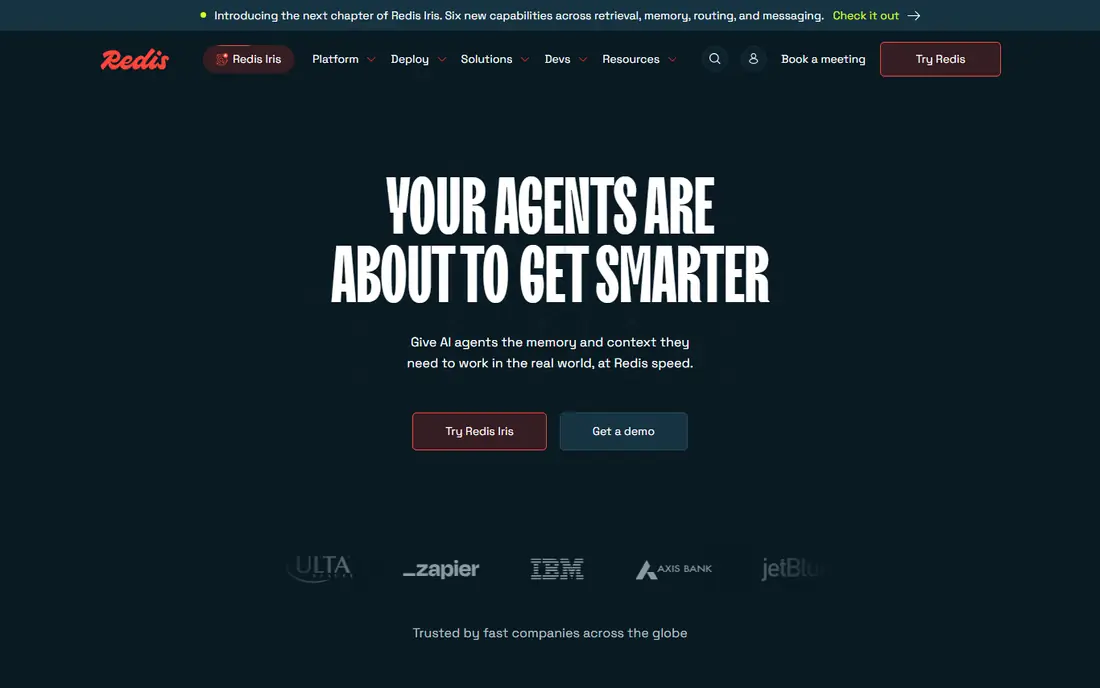
Redis is the best known in-memory database, and that familiarity is a practical advantage. It stores data in memory, so reads and writes are fast, and it supports strings, lists, sets, sorted sets, hashes, streams, and search and vector features in the same system.
Redis Cloud has a free tier of 30 MB, and the Essentials tier starts at $5 per month for 250 MB. The Pro tier starts from $0.014 per hour with a $200 per month minimum, and it adds dedicated infrastructure and active-active replication.
The main limits are size and cost at the entry level. A 250 MB Essentials database suits a demo or a small app, but a busy cache can outgrow it quickly, and the 1,000 operations per second cap can become a ceiling.
- Wide data structure support
- Large ecosystem and client libraries
- Entry Essentials tier is small at 250 MB
- Pro has a $200 per month minimum
Memcached
Ideal for: Simple distributed caching
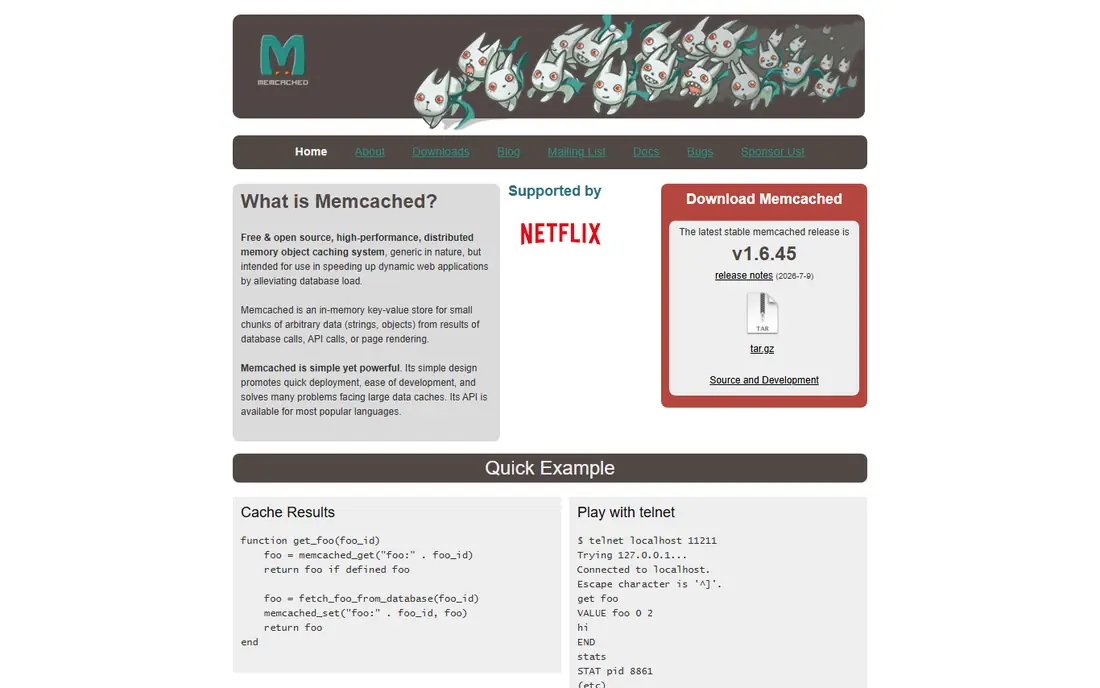
Memcached is a distributed memory object caching system, and it does one job with very little fuss. It stores small chunks of arbitrary data, such as strings and objects, in memory as key-value pairs, and it serves them back at high speed.
Memcached is free and open source under a revised BSD licence, so the software itself costs $0 to self-host. There is no vendor pricing page to check, because there is no vendor subscription to buy.
The trade-off is that Memcached is a cache, not a full database. It has no persistence, so all cached data is lost if a server restarts or crashes, and it has no built-in authentication or encryption in the core product. It also lacks the rich data types and queries that Redis offers. If you need persistence or access control, look at Redis or Dragonfly instead.
- Very simple to deploy and use
- Free and open source
- No data persistence, so cached data is lost on restart
Hazelcast
Ideal for: Distributed caching and in-memory compute
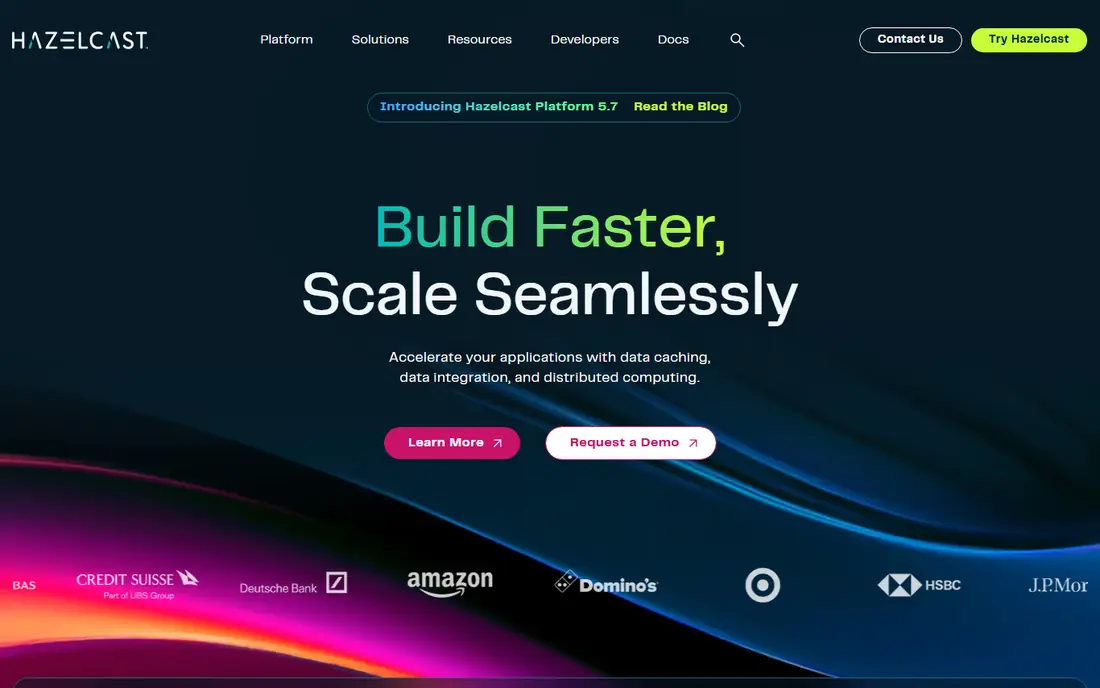
Hazelcast is a unified real-time data platform that combines a distributed cache with in-memory compute and stream processing. Data is spread across the nodes of a cluster, so capacity grows as nodes are added, and the platform offers distributed maps, queues, sets, and other Java data structures.
The Hazelcast pricing page, checked on 2026-11-12, describes two licensing routes and publishes no starting price, so the starting price here is quote only. The self-managed platform is licensed on an annual subscription basis, while Hazelcast Cloud is a managed service that can be used on a pay-as-you-go basis or through credits. A free tier and an open source edition exist, so you can try the core platform before talking to sales.
Hazelcast suits teams that need more than a cache, such as in-memory compute across a cluster, stream processing, or geo replication for disaster recovery. The limits to weigh are complexity and cost opacity: enterprise features such as persistence sit behind the subscription, and teams outside the Java world should check client support for their language first.
- Distributed data structures and stream processing in one platform
- Strong Kubernetes support
- Enterprise features need a subscription, and no starting price is published
Apache Ignite
Ideal for: Distributed SQL and in-memory transactions
Apache Ignite is a distributed database for high-velocity applications that need in-memory performance with SQL access. It presents itself as a memory-first distributed SQL database, so teams that know SQL can query in-memory data with JDBC, ODBC, and client APIs for Java, C#, C++, Python, and other languages.
Ignite is an Apache open source project, so the software itself costs $0 to download and run. There is no vendor pricing page, because the project is community run, and commercial support is available separately through other providers.
The main cost is operational. Ignite is a full distributed system, so cluster topology, memory configuration, persistence, and failover all need care, and the learning curve is steeper than a simple cache. It is best for teams that already run distributed systems. If your need is only caching, Memcached or Redis will be simpler.
- Memory-first distributed SQL with ACID transactions
- Scales across memory and disk
- Complex to operate and tune at scale
Dragonfly
Ideal for: High-throughput Redis-compatible caching
Dragonfly is an in-memory data store built for data-intensive caching, feature stores, and job queues. Its shared-nothing, thread-per-core design uses every core on every machine, which is the core difference from single-threaded Redis. The vendor reports up to 25 times more throughput than Redis in its own comparisons, and it states that one Dragonfly instance can do the work of a Redis cluster.
Dragonfly is API compatible with Redis, Valkey, and Memcached, so many existing clients and scripts can move across with little change. The pricing page, checked on 2026-11-12, lists a Flex tier from $36 per month for a fully managed service on AWS, GCP, or Azure, and a Business tier from $2,000 per month. Dragonfly Enterprise is free for production use up to 100 vCPUs, with a commercial licence above that limit.
The limits are maturity and coverage. Dragonfly is a newer project than Redis, so its ecosystem of tools and community answers is smaller, and it implements more than 200 Redis commands rather than the full set. Check that every command your app uses is supported before you migrate.
- Multi-threaded design for high throughput
- API compatible with Redis, Valkey, and Memcached
- Newer project with a smaller ecosystem than Redis
KeyDB
Ideal for: Multi-threaded Redis-compatible caching
KeyDB is a high-performance fork of Redis with a focus on multithreading, memory efficiency, and high throughput. It maintains full compatibility with the Redis protocol, modules, and scripts, so it can act as a drop-in replacement for existing Redis deployments in many cases.
KeyDB is open source under a BSD licence, so the software itself costs $0 to self-host. There is no vendor pricing page, because the project is community run, and the main site at keydb.dev now points to documentation that has moved to a new home under Snapchat.
KeyDB suits teams that like Redis but want multi-threaded performance without a managed service bill. The limits are support and momentum: the community is smaller than the Redis community, and some advanced features are tied to specific editions. Test your workload on KeyDB, and check that your Redis modules work as expected.
- Multi-threaded fork of Redis with full protocol compatibility
- Active replication support
- Smaller community and documentation has moved, so support resources are thinner
Aerospike
Ideal for: Large-scale real-time transactions
Aerospike is a real-time, high-performance NoSQL database built for applications that cannot tolerate downtime and need high read and write throughput. It uses a shared-nothing design, keeps indexes in memory, and can store data in memory, in hybrid memory and flash, or in all-flash form. The database supports key-value, JSON document, graph, and vector search models on a single core engine, and version 8 adds strict serializability for distributed ACID transactions.
Aerospike does not publish a starting price, so the starting price here is quote only. The vendor site has no public pricing page, and third-party listings describe custom pricing, so you need to contact sales for a figure that matches your data size and throughput. The Community Edition is free and open source under AGPL, and it has the same developer API as the enterprise builds, except for multi-record transactions, durable deletes, and some admin commands.
Aerospike suits large teams with demanding real-time workloads, such as fraud prevention, recommendations, instant payments, and session stores at very high scale. The limits to weigh are cost opacity and the Community Edition gaps listed above, plus a data modelling style that takes time to learn.
- Predictable sub-millisecond latency at petabyte scale
- Key-value, document, graph, and vector models in one engine
- Enterprise pricing is not published, and the Community Edition lacks some enterprise features
VoltDB
Ideal for: In-memory SQL with strict consistency
VoltDB, now sold as Volt Active Data, is a horizontally scalable, in-memory SQL database designed for applications that need strong consistency, high throughput, and low, predictable latency. It is an ACID-compliant relational system with a shared-nothing design, and it is built for workloads where a decision must be made on data that is accurate right now, such as telecom charging and financial transactions.
VoltDB does not publish a starting price, so the starting price here is quote only. The vendor site has no public pricing page, and the commercial editions are sold on a subscription basis. The Community Edition is fully open source under AGPL, and the commercial editions include a free 30-day trial licence. That combination lets you test the open source edition first, then trial the commercial edition if you need its extra features.
The main limit is the programming model. SQL access runs from within pre-compiled Java stored procedures, which is efficient for high-throughput transactions but restrictive for teams that expect ad hoc SQL. VoltDB is best for teams with a clear transactional workload and Java skills.
- In-memory SQL RDBMS with ACID guarantees and single-digit millisecond decisions
- Strong consistency for transactional apps
- Commercial pricing is not published, and SQL runs through pre-compiled Java stored procedures
How we chose
We compared vendor pricing pages, product documentation, and feature lists for each tool, and we checked every homepage on 2026-11-12. Prices in this guide come from the vendor pricing page where one exists: Redis lists Essentials from $5 per month, and Dragonfly lists its Flex tier from $36 per month. Where a vendor publishes no starting price, we wrote quote only rather than copying a third-party figure. Hazelcast, Aerospike, and VoltDB fall in that group, and each has a free or community edition you can test first. Memcached, Apache Ignite, and KeyDB are open source projects with no vendor subscription, so their starting price is $0. Prices were checked on 2026-11-12 and can change, so confirm the current figure on the vendor pricing page before you buy. Last verified: 2026-11-12.
What to check before you buy
Check the data model first, because it decides the shortlist. A simple cache needs key-value storage and expiry, while a transactional app needs SQL and ACID guarantees, and a real-time analytics app may need document, graph, or vector support. Next, check persistence: Memcached loses cached data on restart, while the other tools here offer persistence or durability options that vary by edition.
Check the true cost, not just the headline price. Redis Essentials starts at $5 per month but is capped at 250 MB and 1,000 operations per second, and Pro has a $200 per month minimum. Dragonfly Flex starts at $36 per month for a 3 GB development instance, while its Business tier starts at $2,000 per month. Hazelcast, Aerospike, and VoltDB need a quote, so get that quote in writing with memory, throughput, and support included. For open source tools, add the cost of servers, monitoring, backups, and staff time to run the cluster.
Check client support, licence terms, and support options last. Confirm that your language has a maintained client, that the licence allows your planned use, and that you know where to get help when a node fails.
| Team size and budget | Best starting point | Why it fits | | Solo developer or small team, under $50 per month | Memcached, Redis free tier, or KeyDB | $0 to $5 per month, simple setup, enough for caching and sessions | | Growing team, $50 to $500 per month | Redis Essentials or Dragonfly Flex | Managed service, $5 to $36 per month to start, room to grow | | Mid-size team with SQL needs, open source budget | Apache Ignite or VoltDB Community Edition | $0 software cost, SQL and transactions, staff time is the main cost | | Large team, high throughput, quote budget | Hazelcast, Aerospike, or VoltDB Enterprise | Managed or subscription support, strict consistency, scale to petabytes |
Frequently asked questions
What is the best in-memory database software for a small app?
Redis is the best starting point for most small apps, because it has a free tier, Essentials from $5 per month, and a large ecosystem of clients and guides. Memcached is a good alternative if you only need simple caching and want $0 software cost. Start with the free tier, load it with real traffic, and move to a larger tier only when memory or throughput limits appear.
Is Memcached better than Redis for caching?
Memcached is better when you want the simplest possible cache with $0 software cost and very little setup. Redis is better when you need rich data types, persistence, pub-sub messaging, or modules for search and vectors. The right choice depends on the features your app actually uses.
Do any in-memory databases offer a free plan?
Yes. Redis has a 30 MB free tier, Dragonfly Enterprise is free up to 100 vCPUs for self-hosted use, and Aerospike and VoltDB have free Community Editions. Memcached, Apache Ignite, and KeyDB are open source, so you can run them for $0 apart from infrastructure costs. Hazelcast also has a free tier and an open source edition.
What is the difference between Redis and Dragonfly?
Dragonfly is API compatible with Redis, so many Redis clients and commands work with it, but its multi-threaded design uses all CPU cores, while classic Redis is single-threaded for most commands. Dragonfly aims for higher throughput on fewer nodes, and its managed Flex tier starts at $36 per month. Redis has a larger ecosystem, more modules, and a free tier, so it remains the safer default for most teams.
When should I choose Apache Ignite or VoltDB over Redis?
Choose Apache Ignite or VoltDB when your workload needs distributed SQL and ACID transactions on in-memory data, rather than simple caching. Ignite suits teams that want open source distributed SQL with a wide range of clients. VoltDB suits teams that need strict consistency and single-digit millisecond decisions on streaming data.
How much does an in-memory database cost per month?
It ranges from $0 for self-hosted open source tools such as Memcached, Apache Ignite, and KeyDB, to $5 per month for Redis Essentials and $36 per month for Dragonfly Flex. Hazelcast, Aerospike, and VoltDB do not publish a starting price, so their cost is quote only and depends on data size, throughput, and support.