Best Influencer Marketing Platforms Compared

- GRIN is the only platform here with a free plan and a published starting price, at 200 dollars per month for Starter.
- Influencity is the cheapest published entry point with a named plan, at 198 dollars per month for Discover, or 158 dollars per month billed annually.
- Most enterprise platforms in this comparison, including Aspire, Upfluence, Traackr, CreatorIQ and Later Influence, hide prices behind a sales call and require annual contracts.
- Creator.co and GRIN suit ecommerce brands that want creator sourcing tied to a store, while Traackr and CreatorIQ suit large teams that need deep analytics.
- Check contract length before you sign, because several platforms in this list require 12 month commitments with no monthly option.
Quick comparison
| Product | Ideal for | Price from | Free version | |
|---|---|---|---|---|
 GRIN | Ecommerce brands running creator programs | $200 per month | Yes | Visit |
 Influencity | Creator search and discovery on a budget | $198 per month | Free trial (7 days) | Visit |
 Aspire | Full-service creator programs with support | quote only | No | Visit |
 Upfluence | Combined influencer and affiliate programs | quote only | Free trial | Visit |
 Traackr | Data-led enterprise creator programs | quote only | No | Visit |
 CreatorIQ | Large global brands with complex programs | quote only | No | Visit |
 Creator.co | Small brands starting a creator program | quote only | No | Visit |
 Later Influence | Social-first creator campaigns | quote only | No | Visit |
The best influencer marketing platforms
GRIN
Ideal for: Ecommerce brands running creator programs
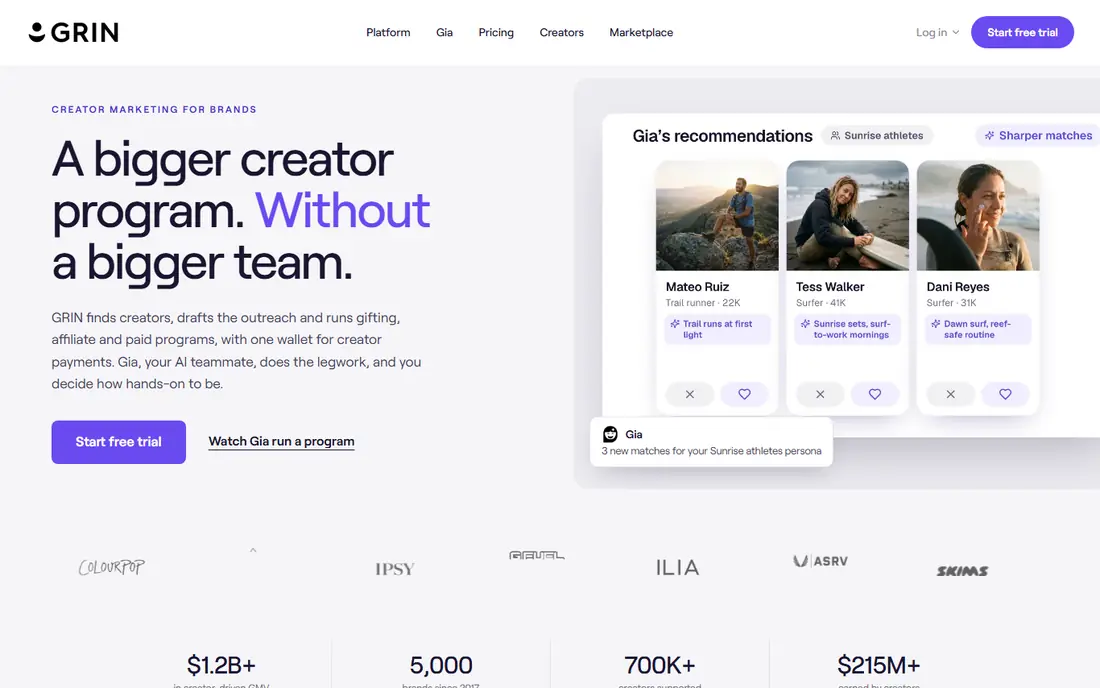
GRIN is built for ecommerce brands that want creator work tied to real orders. It connects with Shopify and other store platforms, so you can find creators, send products, track content and link sales back to each creator without moving data between tools. The free plan lets a small brand test the workflow with no monthly fee, which is rare in this category, and the Starter plan at 200 dollars per month adds more campaign capacity for teams that are ready to scale.
The limit to watch is the free plan. It charges a 20 percent management fee on wallet deposits, and it caps you at 2 live campaigns and 10 gifts in total, so it works as a trial of the system rather than a long term home for a growing program. Teams that outgrow it move to Starter or higher, where the fee structure changes and more campaigns open up. GRIN fits brands that already sell online and want creator results measured in orders, not just reach, and it is a strong first pick when you want a published price and a free entry point.
- Free plan with no monthly fee
- Deep Shopify and ecommerce integrations
- Free plan charges a 20 percent management fee on wallet deposits and limits you to 2 live campaigns and 10 gifts in total
Influencity
Ideal for: Creator search and discovery on a budget
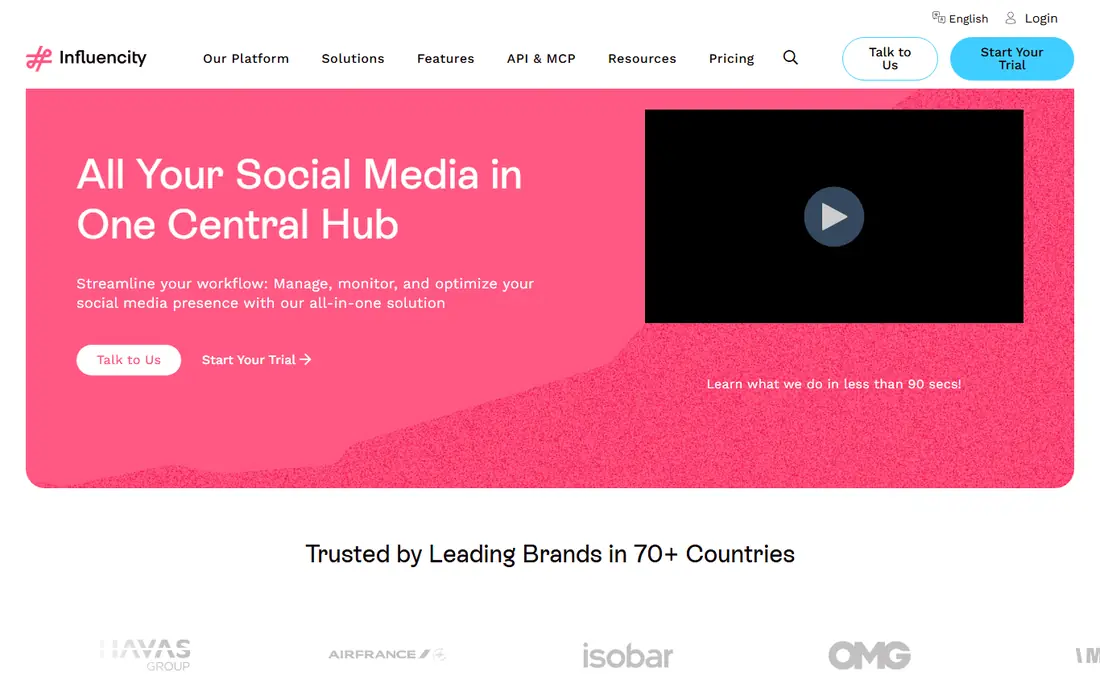
Influencity starts with search. Its Discover plan at 198 dollars per month, or 158 dollars per month billed annually, gives you access to a large creator database with filters for audience, location and engagement, so you can build shortlists fast. That makes it a practical pick for a team that knows what it wants to find and does not need a full campaign suite on day one. The 7 day free trial lets you test the search quality before you commit.
The trade off is that Discover is search only. You get no CRM and no outreach until Professional, and Shopify plus payments stay locked until Business, so a team that wants to run the whole workflow in one place will need a higher tier. Influencity works best when your main job is finding the right creators and you already have a way to manage outreach and payments, or when you are ready to step up to Professional once the shortlist is built.
- Published pricing with a clear entry tier
- Large creator database for search
- Discover is search-only, with no CRM or outreach until Professional and no Shopify or payments until Business
Aspire
Ideal for: Full-service creator programs with support
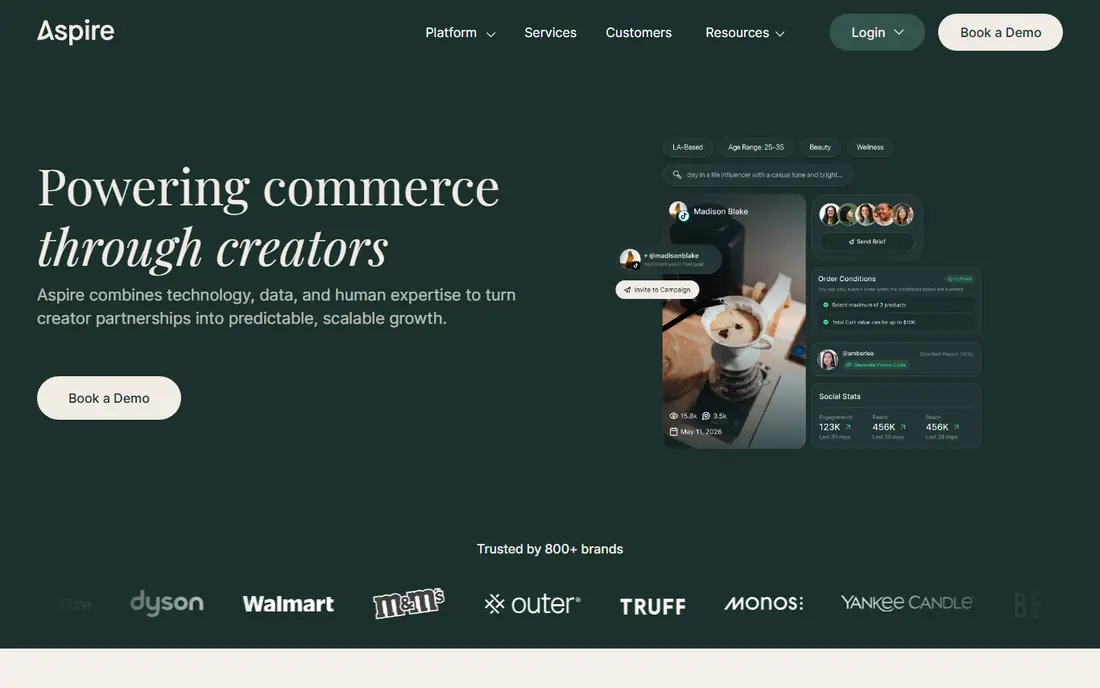
Aspire covers the full creator workflow, from discovery through campaigns, content approval, payments and reporting, and it adds a marketplace where creators can apply to work with your brand. Its AI discovery accepts plain language briefs, and its Shopify fulfilment ships products to creators without a separate system, which cuts a lot of manual work for ecommerce teams. The platform also offers a full-service agency option for brands that want experts to run the program.
The cost is the catch. Aspire publishes no price, and plans require a yearly commitment, so you will need a sales call and a budget discussion before you know what it costs. There is no free plan and no self-serve trial on the vendor site. Aspire fits brands with a real budget that want one system plus human support, and it is less suited to a small team that needs to start this week with a known monthly figure.
- Marketplace plus AI discovery and managed services
- Strong Shopify fulfilment
- Pricing is customised and requires a yearly commitment, with no self-serve price or trial on the vendor site
Upfluence
Ideal for: Combined influencer and affiliate programs
Upfluence brings influencer marketing and affiliate tracking into one system. You can recruit creators, run campaigns, track links and codes, and pay creators through the same platform, which suits ecommerce brands that treat creators as a revenue channel rather than a one-off campaign. Its database covers more than 12 million creators, and its AI co-pilot, Jaice, recommends creators and drafts outreach, which helps a small team run a program that would normally need more hands.
The pricing page shows custom-quoted modular pricing with no numbers, and the pricing FAQ states a 12 month minimum contract on annual plans, so this is a commitment, not a month to month test. A free trial is offered, but it is set up after an initial call rather than through self-serve signup. Upfluence fits brands that want influencer and affiliate work in one place and can commit for a year, and it is a poor fit for a team that needs a short trial with a clear monthly price.
- Large creator database with AI matching
- Affiliate tracking and payments in one place
- 12-month minimum contract on annual plans, stated on the vendor pricing FAQ
Traackr
Ideal for: Data-led enterprise creator programs
Traackr is a data platform first. It benchmarks creator performance across 70 countries, tracks brand vitality over time, and gives teams a shared way to measure what creators actually deliver, which is why large beauty, fashion and consumer brands use it to run global programs. Its AI strategist, Abigail, turns a campaign brief into a ranked creator shortlist and generates reports on what worked, so planning moves from guesswork to evidence.
There is no published price and no monthly option, because Traackr sells annual contracts only, set up through a sales team. That puts it out of reach for small brands and for teams that want to test a platform for a month before committing. Traackr fits enterprise teams that manage creators across many markets and need consistent measurement, and it is the wrong pick when you need a low cost entry point or a short contract.
- Deep creator data and benchmarking across 70 countries
- AI strategist for planning
- Annual contracts only, with no monthly or self-serve option
CreatorIQ
Ideal for: Large global brands with complex programs
CreatorIQ is built for the largest brands, with creator management, campaign workflows, payments and analytics designed to run across many markets and teams at once. It integrates with the marketing stack that enterprise teams already use, and it handles the compliance and reporting work that comes with running creator programs at scale. For a global brand with hundreds of creators, that structure is the point.
The price is only available through a sales demo or pricing request, and contracts are annual only, with no monthly or self-serve option. There is no free plan and no trial you can start on your own. CreatorIQ fits a large brand with a dedicated creator team and a budget to match, and it is not a fit for a small or mid-size brand that needs to see a price before talking to sales.
- Enterprise-grade creator management with deep integrations
- Built for global scale
- Annual contracts only, with no monthly or self-serve option, and pricing only via a sales demo or request
Creator.co
Ideal for: Small brands starting a creator program
Creator.co helps brands find and hire creators, run campaigns, automate routine work and measure return on investment from one platform. Its AI agent, London, supports the workflow, and the tool covers the basics a small brand needs: discovery, outreach, campaign tracking and reporting. It is positioned as a lighter option than the enterprise platforms, which makes it a natural first step for a brand moving from spreadsheets and direct messages to a real system.
The pricing page does not publish a number, so you will need to talk to the vendor to learn what a plan costs. The commitments are also worth noting: Self-Serve carries a 3 month minimum commitment, and Managed carries a 6 month minimum, so even the lighter entry point is not a single month test. Creator.co fits a small brand that wants a guided start and can commit for a quarter, and it is less suited to a team that wants to try a tool for one month with no lock in.
- Creator sourcing plus campaign tools in one place
- AI agent support for workflows
- Self-Serve carries a 3-month minimum commitment, and Managed carries a 6-month minimum
Later Influence
Ideal for: Social-first creator campaigns
Later Influence comes from Later, a company known for social media scheduling, and it adds creator campaigns to that social-first base. The idea is to plan creator content alongside your own social calendar, so campaigns and organic posts work together instead of living in separate tools. For a brand whose marketing already runs through Later Social, that link is a real convenience.
The pricing is the problem for buyers who want clarity. Later Influence pricing is sales-gated with an annual commitment and no self-serve entry, and the 18.75 dollar monthly Starter price shown on later.com is for Later Social scheduling, not for Later Influence, so do not mistake one for the other. Later Influence fits a brand already invested in Later Social that wants to add creator campaigns, and it is a poor fit for a buyer who needs a published price or a short contract.
- Strong social scheduling heritage
- Creator campaigns tied to social content
- Influence pricing is sales-gated with an annual commitment and no self-serve entry, and the 18.75 dollar monthly price on later.com is for Later Social scheduling, not Later Influence
How we chose
We compared the vendor pricing pages, product pages and docs for each platform, and we checked that every homepage listed here loads. Prices in this guide come from the vendor pricing pages we opened on 12 November 2026, and where a vendor hides its price we wrote quote only rather than copying a third-party figure. We looked at what each plan actually includes, such as creator search, outreach, payments and reporting, and we noted contract terms, free plans and trial lengths. We did not claim hands-on testing, and we did not use review scores or customer counts to rank the tools. The order below reflects fit for common buyer needs, from a low cost entry point to enterprise scale.
What to check before you buy
Use this decision table to match a platform to your team size and budget before you book a demo.
| Your situation | Best match | Why |
|---|---|---|
| Solo brand or small team, under 200 dollars per month | Influencity Discover | Published price, search first, 7 day trial |
| Ecommerce brand that wants a free start | GRIN Free | No monthly fee, store integration, clear upgrade path |
| Mid-size brand, full workflow, budget for a yearly deal | Aspire or Upfluence | Marketplace and AI discovery, or affiliate plus influencer in one place |
| Enterprise team, many markets, deep measurement | Traackr or CreatorIQ | Benchmarking and global scale, annual contracts |
| Social-first brand already using Later | Later Influence | Campaigns tied to your social calendar |
Before you sign, ask for the full contract in writing, including the minimum term, the renewal terms and any fees for extra creators, extra campaigns or extra seats. Check whether creator payments and tax forms are included or billed separately, and confirm which integrations are in your tier, because Shopify, payments and CRM access often sit on higher plans. Ask how the platform counts a creator, a campaign and a gift, since those counts drive the real cost. Finally, test the creator search with your own brief during any trial, because a large database is only useful when it returns creators who fit your audience.
Frequently asked questions
Which influencer marketing platform is cheapest to start with?
Influencity Discover is the cheapest published entry point in this comparison, at 198 dollars per month, or 158 dollars per month billed annually, with a 7 day free trial. GRIN also offers a free plan with no monthly fee, but it charges a 20 percent management fee on wallet deposits and limits you to 2 live campaigns and 10 gifts, so it works as a starting point rather than a full program.
Do any influencer marketing platforms have a free plan?
Yes. GRIN offers a free plan with no monthly fee, though it limits campaigns and gifts and adds a management fee on wallet deposits. Most other platforms in this comparison have no free plan, and several offer only a free trial that starts after a sales call. Check the plan page for the exact limits before you rely on a free tier.
Why do most influencer marketing platforms hide their prices?
Most enterprise platforms price by program size, creator count, features and support level, so a single sticker price would mislead buyers. Aspire, Upfluence, Traackr, CreatorIQ, Creator.co and Later Influence all use custom quotes, and several require annual contracts. Ask for a written quote that lists the tier, the term and what is included.
What is the difference between GRIN and Aspire?
GRIN is built around ecommerce, with a free plan, a published Starter price of 200 dollars per month and deep store integrations that tie creator work to orders. Aspire covers the full creator workflow plus a marketplace and managed services, but it publishes no price and requires a yearly commitment. GRIN suits a brand that wants a clear entry price, while Aspire suits a brand that wants full support.
Should a small brand choose Creator.co or Influencity?
Influencity suits a small brand that mainly needs creator search, because Discover has a published price and a 7 day trial. Creator.co suits a small brand that wants sourcing plus campaign tools in one place, but it publishes no price and requires a 3 month minimum on Self-Serve. Pick Influencity when search is the job, and Creator.co when you want a guided campaign start.