Best Influencer Marketing Platforms in 2026: 8 Platforms Compared

- Creator.co and Aspire suit small businesses starting influencer marketing, while CreatorIQ and Traackr suit enterprise brands.
- Influencer discovery, fraud checks and campaign reporting matter more than creator count alone.
- Most platforms use custom or monthly pricing, so get a quote for your campaign volume and creator count.
- Micro-influencers often deliver better engagement for small budgets than a single large creator.
- Our pick for small businesses is Creator.co, with Aspire as the pick for ecommerce brands.
Quick comparison
| Product | Ideal for | Price from | Free version | |
|---|---|---|---|---|
 Creator.co | Small business influencer campaigns | See website | Free trial | Visit |
 Aspire | Ecommerce influencer marketing | See website | No | Visit |
 CreatorIQ | Enterprise influencer management | See website | No | Visit |
 Traackr | Enterprise creator data and reporting | See website | No | Visit |
 Grin | Ecommerce creator management | See website | No | Visit |
 Upfluence | Creator discovery and outreach | See website | Free trial | Visit |
 Influencity | Affordable discovery and reporting | See website | Free trial | Visit |
 Collabstr | Marketplace for quick creator hires | Free | Yes | Visit |
The best influencer marketing platforms
Influencer marketing platforms help brands find creators, manage outreach and content, track performance, and pay creators. The right platform depends on budget, campaign type and whether you run influencer marketing in-house or through an agency. We compared official pricing pages, feature lists and public reviews.
Creator.co
Ideal for: Small business influencer campaigns

Creator.co is our pick for a small business starting influencer marketing because it lowers the barrier to a first campaign. Brands can post campaigns, receive creator applications, manage content approvals and track results without an enterprise contract. The marketplace model suits a brand testing influencer marketing with a modest budget.
Enterprise reporting, fraud analysis and API depth are thinner than CreatorIQ or Traackr, so a large brand running always-on programs may outgrow it. For a first or occasional campaign, Creator.co offers a practical, affordable start.
- Accessible for small brands
- Campaign marketplace
- Content and reporting tools
- Pricing varies by plan
- Enterprise depth below CreatorIQ
Aspire
Ideal for: Ecommerce influencer marketing
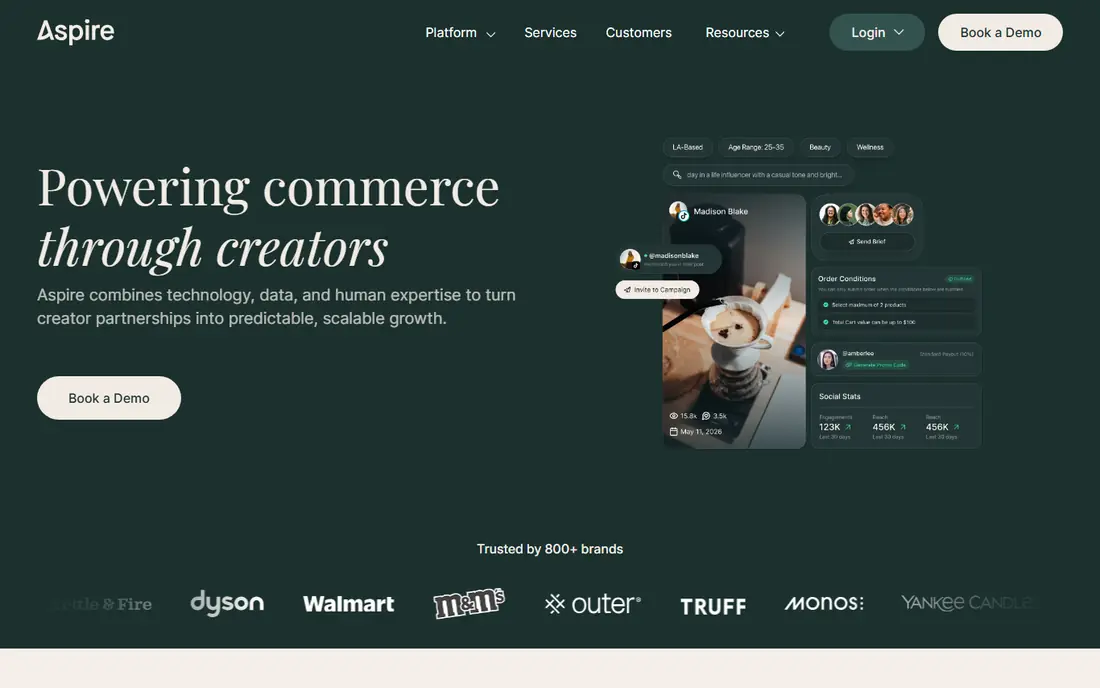
Aspire suits ecommerce brands that run creator programs as a sales channel. It covers discovery, outreach, relationship management, content approvals, affiliate links and sales tracking, with Shopify integration that ties creator content to orders. Brands that work with creators repeatedly, not just once, get the most from it.
Pricing is custom, so a small brand should get a quote for its creator volume before committing. For an ecommerce brand that wants creators as an ongoing channel, Aspire is one of the strongest platforms in this list.
- Strong for ecommerce and Shopify
- Creator relationship management
- Content rights tools
- Custom pricing
- Best for brands with ongoing creator programs
CreatorIQ
Ideal for: Enterprise influencer management
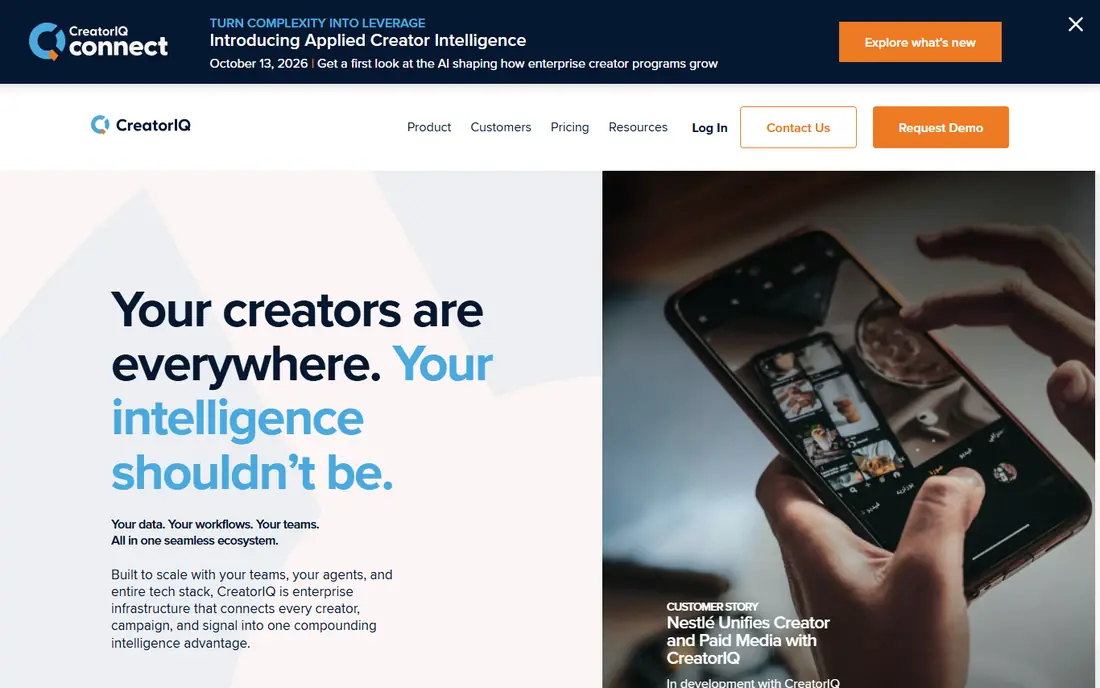
CreatorIQ is the enterprise pick for large brands running influencer programs at scale. Its creator database, audience authenticity checks, campaign workflows and reporting cover global programs with many creators and markets. Large brands that need governance, approvals and detailed ROI reporting will find it comprehensive.
Pricing is enterprise-level and the platform needs a dedicated owner. A small business will find it heavy and expensive. For a global brand where influencer marketing is a major channel, CreatorIQ is the standard to compare against.
- Deep creator data and fraud checks
- Enterprise reporting
- Global brand support
- Enterprise pricing
- Complexity suits large teams
Traackr
Ideal for: Enterprise creator data and reporting
Traackr suits an enterprise brand that values creator data, benchmarking and brand safety over a marketplace. It tracks creator performance, audience quality and share of voice, helping brands choose creators on data rather than follower count. Global coverage supports programs across markets.
It is less of a quick-hire marketplace than Collabstr or Creator.co, and pricing is custom. For a brand team that manages creator relationships strategically and reports results to executives, Traackr offers depth that marketplaces do not.
- Strong creator analytics and benchmarking
- Brand safety data
- Global coverage
- Custom enterprise pricing
- Less of a creator marketplace
Grin
Ideal for: Ecommerce creator management
Grin is built for ecommerce brands that seed products to creators and track resulting sales. It manages creator relationships like a CRM, handles product shipments, discount codes and affiliate links, and integrates with Shopify and WooCommerce. Brands that send products to many creators will save time on logistics alone.
Non-product brands, such as services or apps, will find less value, since Grin is built around product seeding. Pricing is custom. For a product brand scaling creator seeding, Grin is a leading choice.
- Strong Shopify and WooCommerce integrations
- Product seeding and affiliate tools
- CRM for creators
- Custom pricing
- Ecommerce focus means less for non-product brands
Upfluence
Ideal for: Creator discovery and outreach
Upfluence suits a brand that needs to find and contact many creators efficiently. Its database covers creators across major networks, with filters for audience, engagement and location, plus outreach emails and campaign management. Ecommerce integrations tie campaigns to store data.
Pricing varies, with custom quotes on higher plans, and the full suite takes time to learn. For a team that runs frequent discovery and outreach, Upfluence offers a strong balance of database depth and campaign tools.
- Large creator database
- Outreach and email tools
- Ecommerce integrations
- Pricing is custom on higher plans
- Learning curve for the full suite
Influencity
Ideal for: Affordable discovery and reporting
Influencity is a value pick for a team that wants discovery, analytics and reporting without enterprise pricing. It covers creator search, audience analysis, campaign tracking and reporting, with plans aimed at agencies and mid-size brands. For a team that needs solid data on a moderate budget, it is worth a trial.
Brand presence in the US is smaller than CreatorIQ or Aspire, so check creator coverage for your niche and market. Some advanced features sit on higher plans. For affordable, data-led influencer work, Influencity is a practical option.
- Good discovery and analytics at a lower price
- Reporting tools
- Influencer relationship features
- Smaller brand presence in the US than rivals
- Some features need higher plans
Collabstr
Ideal for: Marketplace for quick creator hires
Collabstr is a marketplace where brands can browse creators, see their rates, and hire for a specific post, video or package. It is free to browse, and pricing is transparent per creator, which suits a brand that needs a few pieces of content quickly without a platform subscription. Small businesses testing creator content will like the low commitment.
Campaign management, relationship tools and deep reporting are thinner than Aspire or CreatorIQ, and creator quality varies, so check past work and audience data before hiring. For a quick, one-off creator hire, Collabstr is the fastest route.
- Free to browse and hire
- Clear creator pricing
- Fast for one-off content
- Less campaign management depth than Aspire
- Quality varies by creator
How we picked these
We compared official pricing pages, feature lists and public reviews for influencer marketing platforms available in October 2026. We favored platforms with real creator databases or marketplaces, fraud or audience quality checks, campaign reporting, and a working official homepage. We left out platforms we could not verify as live products.
What to check before you hire creators
Check audience quality, not just follower count. Look at engagement rate, audience location, growth patterns and comment quality, and ask the platform how it flags fake followers or engagement. A creator with 10,000 real, engaged followers often outperforms one with 100,000 inflated followers.
Brief, rights and payment
Write a clear brief covering message, deliverables, deadlines, usage rights and disclosure duties. Confirm who owns the content, how long you can reuse it, and how creators are paid and when. Clear terms prevent disputes and make it easier to reuse good content in ads.
Try before you commit to a full rollout
Most tools in this list offer a free tier or a trial, and the smartest use of that trial is a small, realistic test rather than a tour of every feature. Pick one real job, such as a single project, a single campaign, or a single workflow your team runs every week, and run it end to end in the trial. Invite the people who will actually use the tool daily, not just the person choosing it, and ask them to complete that job without help. Note where they get stuck, how long the job takes compared with your current method, and whether the result is good enough to share with a client or a manager. Check support response times during the trial too, since a fast answer during a trial often predicts the help you will get later. At the end of the trial, compare the real time saved and the real cost per user against the plan you would buy, and only then decide whether the upgrade is worth it for your team.
Frequently asked questions
What is the best influencer marketing platform for a small business?
Creator.co is our pick for small businesses starting influencer marketing, thanks to its accessible campaigns and marketplace. Collabstr suits a quick one-off hire, while Aspire suits ecommerce brands with ongoing creator programs.
How much do influencer marketing platforms cost?
Many platforms use custom pricing based on creator volume and features, while marketplaces such as Collabstr are free to browse with per-creator rates. Get a quote for your campaign size before comparing, and budget creator fees separately from platform fees.
Should I work with micro-influencers or large creators?
Micro-influencers often deliver higher engagement and lower cost per result for small budgets, while large creators deliver reach. Many brands use several micro-influencers for engagement plus one larger creator for awareness.
How do I check if an influencer's audience is real?
Check engagement rate, audience location, follower growth patterns and comment quality, and use platform fraud checks where available. Sudden follower spikes, generic comments and mismatched audience locations are warning signs.
Do creators need to disclose sponsored content?
Yes, in the US creators should clearly disclose paid partnerships and gifted products under FTC guidance. Include disclosure requirements in the brief and check content before it publishes.