Best Inventory Optimization Software in 2026: 8 Tools Compared

- Netstock, Slimstock, and EazyStock lead for mid-size distributors and manufacturers that want forecasting and replenishment without an enterprise suite.
- Lokad and StockIQ suit teams that want deeper quantitative optimization and scenario modeling for complex inventories.
- Cin7, Katana, and Zoho Inventory combine inventory management with optimization features, suiting smaller businesses that need one system.
- Inventory optimization depends on clean demand, lead time, and supplier data, so data quality matters more than vendor choice alone.
Quick comparison
| Product | Ideal for | Price from | Free version | |
|---|---|---|---|---|
 Netstock | Inventory planning for distributors | See website | Free trial | Visit |
 Slimstock | Mid-size inventory optimization | See website | Free trial | Visit |
 Lokad | Quantitative inventory optimization | See website | Free trial | Visit |
 EazyStock | Cloud inventory optimization | See website | Free trial | Visit |
 StockIQ | Supply chain planning and inventory | See website | Free trial | Visit |
 Cin7 | Inventory management with planning | See website | Free trial | Visit |
 Katana | Manufacturing inventory | See website | Free trial | Visit |
 Zoho Inventory | Small business inventory | See website | Free trial | Visit |
The best inventory optimization software
Inventory optimization software balances service levels against stock costs, setting reorder points, safety stock, and replenishment quantities based on demand, lead times, and variability. Done well, it reduces stockouts and excess inventory at the same time. We compared official feature pages, pricing pages, and public reviews, focusing on forecasting, safety stock logic, replenishment, and ERP integration.
Netstock
Ideal for: Inventory planning for distributors
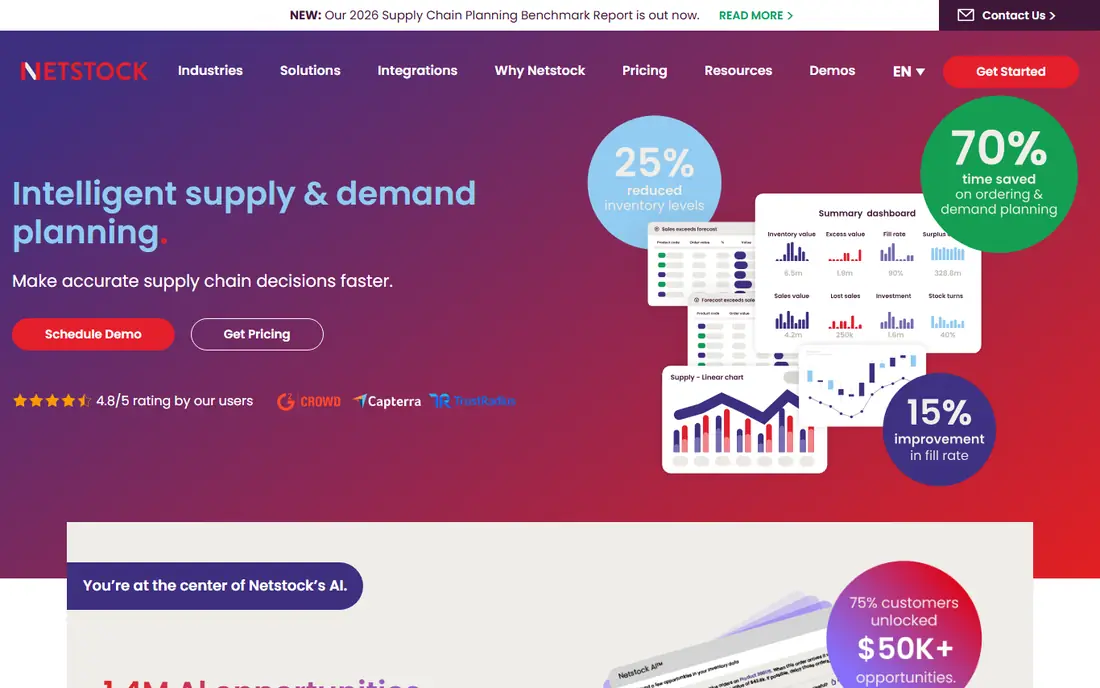
Netstock is an inventory planning platform for distributors and manufacturers, with dashboards that show excess stock, stockout risks, and supplier performance in plain terms. Its forecasting and replenishment tools set order recommendations based on demand and lead times, helping planners act rather than just report. Integrations with common ERP systems keep data flowing.
Pricing is quote-based, and very large enterprises may need a broader supply chain suite. For mid-size distributors, Netstock is a practical and well-regarded choice, and our pick for inventory health visibility.
- Clear inventory dashboards and health checks
- Forecasting and replenishment
- ERP integrations
- Pricing by quote
- Mid-market focus, less suited to very large enterprises
Slimstock
Ideal for: Mid-size inventory optimization

Slimstock combines demand forecasting with inventory optimization, letting planners set service levels by product group and see the stock investment needed to hit them. Dashboards highlight risks and excess, and the system generates replenishment suggestions that planners can review and adjust. That balance of automation and planner control suits mid-size wholesalers and manufacturers.
Very large, multi-plant supply chains may need enterprise suites such as Blue Yonder or Kinaxis. For mid-size businesses, Slimstock is a strong and proven option.
- Demand forecasting and inventory optimization
- Service level controls
- Clear dashboards
- Less suited to very large supply chains
- Feature depth varies by plan
Lokad
Ideal for: Quantitative inventory optimization
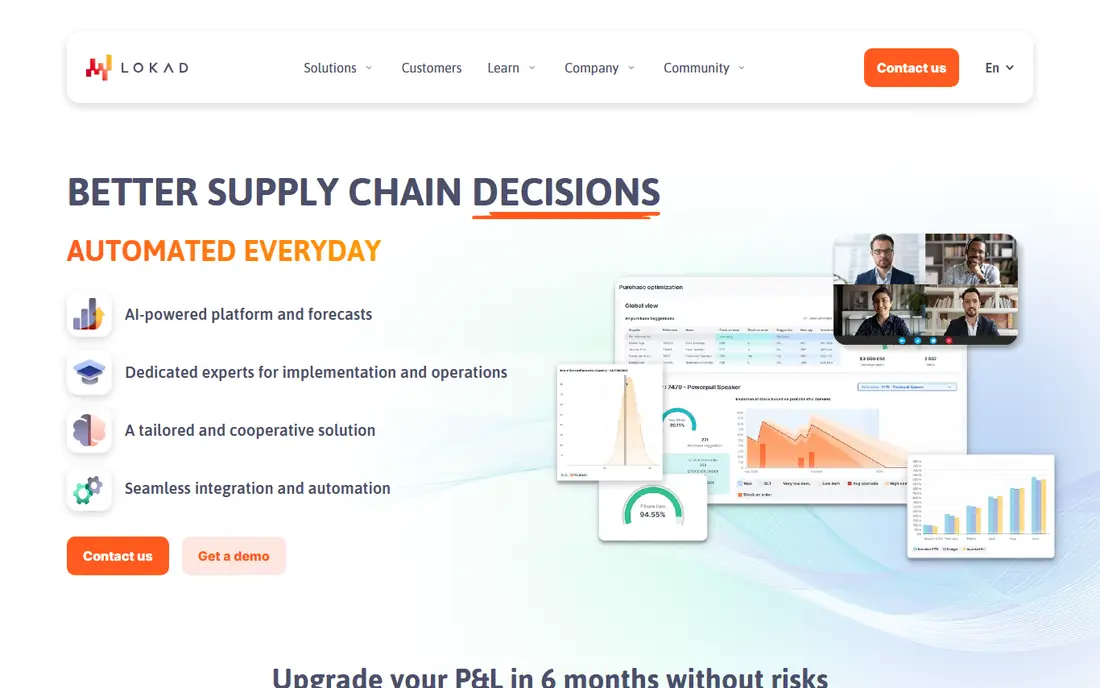
Lokad takes a quantitative approach to inventory optimization, using probabilistic forecasting to model demand uncertainty and set stock levels that balance service and cost. That depth suits businesses with complex, long-tail inventories, such as spare parts and e-commerce catalogs with thousands of slow-moving items. Its modeling can outperform simple average-based methods where variability is high.
The approach is technical and needs skilled users or Lokad's support to get full value. Pricing and setup require discussion. For complex inventories where math matters, Lokad is a leading specialist choice.
- Deep quantitative forecasting and optimization
- Probabilistic demand modeling
- Strong for complex inventories
- Technical approach needs skilled users
- Pricing and setup need discussion
EazyStock
Ideal for: Cloud inventory optimization
EazyStock is a cloud inventory optimization tool for distributors and manufacturers, offering demand forecasting, safety stock calculation, and replenishment recommendations, with integrations to ERP systems. Its cloud delivery and approachable interface suit mid-size firms that want optimization without a heavy on-premises project. Dashboards show stock health and order suggestions clearly.
Pricing is quote-based, and brand presence is smaller than Netstock or Slimstock, so buyers should check references in their sector. For cloud-based optimization, EazyStock is a solid option.
- Cloud-based forecasting and replenishment
- ERP integrations
- Approachable for mid-size firms
- Pricing by quote
- Smaller brand than Netstock or Slimstock
StockIQ
Ideal for: Supply chain planning and inventory
StockIQ combines demand planning, inventory optimization, and sales and operations planning in one platform for distributors and manufacturers. That breadth helps teams link forecasts to inventory and purchasing decisions without juggling separate tools, and scenario tools support planning discussions. It suits mid-size to large distributors with complex assortments.
Pricing is quote-based, and implementation takes planning and data work. For distributors that want planning and optimization together, StockIQ is a capable choice.
- Demand planning, inventory optimization, and S and OP in one platform
- Good for distributors
- Pricing by quote
- Implementation takes planning effort
Cin7
Ideal for: Inventory management with planning
Cin7, including Cin7 Core, is an inventory management platform with forecasting and replenishment features, plus e-commerce, warehouse, and accounting integrations. That breadth suits growing product brands that need inventory control, order management, and planning in one system, rather than a standalone optimizer alongside an ERP. Its channel integrations help multichannel sellers keep stock accurate.
Optimization depth is lighter than specialist tools such as Lokad or Netstock, so businesses with very complex inventories may need a dedicated optimizer. For growing brands that want one inventory system, Cin7 is a strong choice.
- Full inventory management plus forecasting
- E-commerce and warehouse integrations
- Good for growing brands
- Optimization depth is lighter than specialist tools
- Pricing scales with users and orders
Katana
Ideal for: Manufacturing inventory
Katana is a manufacturing inventory and production platform for small to mid-size makers, covering raw materials, finished goods, production orders, and sales, with forecasting and reorder tools. Its visual workflow suits workshops and small factories that need to see materials, production, and stock together without a full ERP. Integrations cover e-commerce and accounting tools.
Scale is smaller than ERP suites, and advanced planning features sit on higher plans. For small manufacturers, Katana is an approachable and practical choice.
- Manufacturing-focused inventory and production planning
- Clear visual workflow
- Good for small manufacturers
- Smaller scale than ERP suites
- Advanced planning features need higher plans
Zoho Inventory
Ideal for: Small business inventory
Zoho Inventory offers affordable inventory management with reorder points, basic forecasting, stock tracking across warehouses, and order management, plus integration with the wider Zoho suite for accounting, CRM, and e-commerce. That value suits small businesses that need reliable inventory control without specialist optimizer pricing. The free plan covers very small operations.
Optimization depth is lighter than Netstock or Lokad, and advanced features need paid plans. For small businesses already using Zoho, Zoho Inventory is a natural and affordable pick.
- Affordable inventory management
- Reorder points and forecasting basics
- Zoho ecosystem integration
- Optimization depth is lighter than specialists
- Advanced features need higher plans
How we picked these
We compared official feature pages, pricing pages, and public reviews for software that optimizes inventory levels, not just tracks stock. We looked at forecasting, safety stock and reorder logic, replenishment recommendations, and ERP or e-commerce integration, and we included both specialist optimizers and inventory platforms with planning features. Pricing is usually quote-based for specialists, so we marked those accordingly.
What to check before you choose inventory optimization software
Start with your data: demand history, lead times, supplier reliability, and current stock accuracy. An optimizer fed with wrong lead times or dirty sales data will recommend wrong stock levels confidently, so clean those inputs first and run a pilot on a subset of products. Compare recommended stock against actual service and cost over a few months, not just in a demo.
Next, check planner control. Good tools let planners override recommendations for promotions, supplier issues, or new products, and they show why a recommendation was made. Finally, confirm ERP integration and update frequency, since stale data makes optimization useless. A tool that updates daily and integrates cleanly will beat a cleverer tool that runs on monthly spreadsheets.
Also consider supplier constraints, since replenishment recommendations are only useful if suppliers can deliver on time and in the right quantities. Check whether the tool models minimum order quantities, pack sizes, supplier lead time variability, and multi-supplier sourcing, since those details change order recommendations significantly. A tool that ignores supplier realities will suggest orders you cannot place, which frustrates planners and undermines trust in the system.
Finally, plan for seasonal and promotional swings, since average demand hides the peaks that cause stockouts. Check whether the tool separates baseline demand from promotion-driven demand, and whether it can plan for seasonal ranges with different safety stock. A system that treats a holiday spike as normal demand will overstock after the season, while one that plans seasonally will keep service high without tying up cash in post-season excess.
Frequently asked questions
What is inventory optimization software?
Inventory optimization software sets stock levels, reorder points, and replenishment quantities to balance service levels against inventory cost, using demand forecasts, lead times, and variability. It aims to reduce both stockouts and excess stock at the same time.
How is inventory optimization different from inventory management?
Inventory management tracks what stock you have and where, while optimization decides how much stock you should hold and when to reorder. Many platforms do both, but specialist optimizers go deeper on forecasting and safety stock math.
How much does inventory optimization software cost?
Specialist tools are usually priced by quote, based on users, locations, and data volume, while inventory platforms such as Cin7, Katana, and Zoho Inventory publish plan-based pricing. Implementation and integration costs add to licenses for larger deployments.
Do small businesses need inventory optimization software?
Small businesses with simple stock can often manage with reorder points in an inventory tool such as Zoho Inventory or Katana. Optimization software becomes worthwhile when product counts, locations, or demand variability make manual reorder decisions slow or costly.
How long until inventory optimization pays off?
Many businesses see stock and service improvements within a few months, once data is clean and planners trust recommendations. Full benefits take longer, since safety stock changes flow through purchasing cycles and seasonal patterns need time to validate.