Best IoT Platform in 2026: 8 Platforms Compared

- 1
 AWS IoT CoreAWS-based fleets at scaleVisit
- 2
 Azure IoT HubMicrosoft-based fleetsVisit
- 3
 ParticleHardware products from prototype to scaleVisit
- 4
 ThingsBoardOpen-source dashboards and controlVisit
- 5
 BlynkMakers and small productsVisit
- AWS IoT Core and Azure IoT Hub suit teams already committed to those clouds, with the deepest scale and services.
- Particle is the easiest path from prototype to product for connected hardware, with devices and cloud together.
- ThingsBoard and Blynk suit smaller teams and makers, with dashboards and device management at lower cost.
- Losant, Ubidots and KaaIoT fill the middle ground for application-focused IoT products.
Quick comparison
| Product | Ideal for | Price from | Free version | |
|---|---|---|---|---|
| AWS IoT Core | AWS-based fleets at scale | See website | Free trial | Visit |
| Azure IoT Hub | Microsoft-based fleets | See website | Free trial | Visit |
| Particle | Hardware products from prototype to scale | See website | Yes | Visit |
| ThingsBoard | Open-source dashboards and control | Free | Yes | Visit |
| Blynk | Makers and small products | See website | Yes | Visit |
 Losant | Application-focused IoT products | See website | Yes | Visit |
 Ubidots | Quick dashboards and alerts | See website | Free trial | Visit |
 KaaIoT | Flexible enterprise IoT | See website | Free trial | Visit |
The best IoT platforms
An IoT platform connects devices to the cloud, collects their data, and turns it into dashboards, alerts and actions. The eight platforms below cover cloud giants, hardware-friendly startups and open-source options, and they differ in scale, price and how much code they demand. We compared official product pages, pricing pages and documentation.
AWS IoT Core
Ideal for: AWS-based fleets at scale

AWS IoT Core is the message broker and device gateway at the heart of Amazon's IoT offering, connecting billions of messages to storage, analytics, machine learning and business apps across AWS. Its security model, with per-device certificates and policies, is a strength for serious fleets.
The tradeoff is complexity: pricing is usage based across messages, connections and rules, and running it well takes AWS skill. For a team already on AWS with a large fleet, IoT Core is the natural and most scalable choice.
- Massive scale and AWS service depth
- Strong security with device certificates
- Rules engine routes data anywhere in AWS
- Pricing is usage based and complex
- Needs AWS expertise to run well
Azure IoT Hub
Ideal for: Microsoft-based fleets
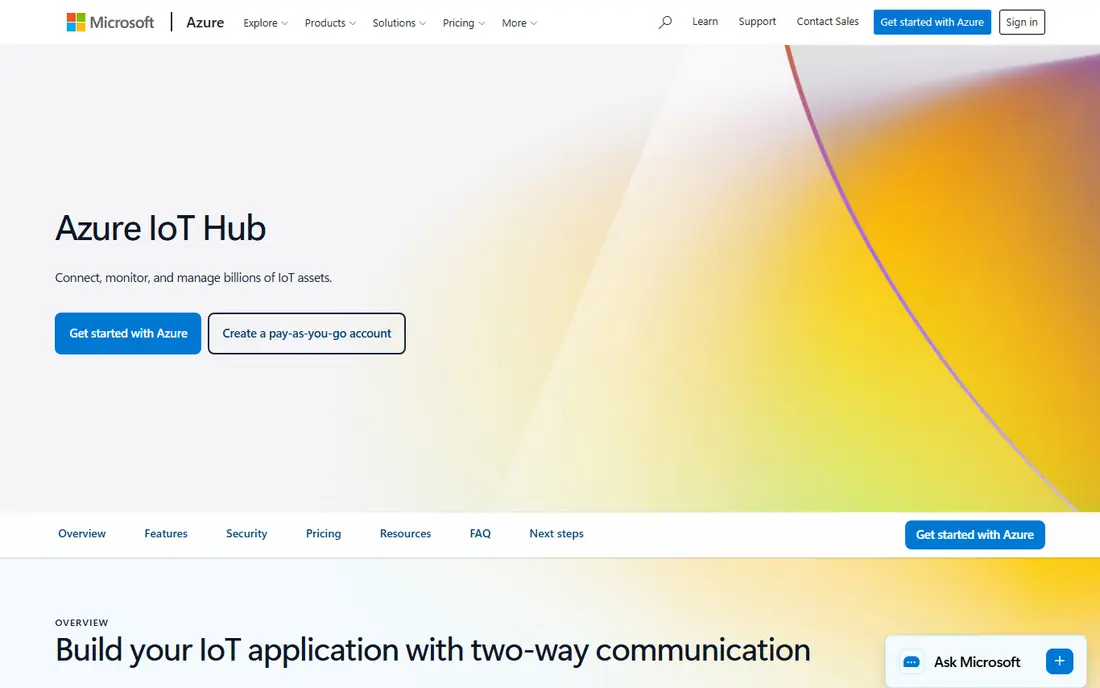
Azure IoT Hub is Microsoft's managed gateway for device messaging, with device twins that track each device's reported and desired state, plus links to Azure analytics, AI and business apps. It suits enterprises already standardizing on Microsoft cloud and identity.
Pricing is tiered by daily message volume, so sizing the tier to real traffic matters, and teams outside Azure get less value from the integration. For a Microsoft shop building connected products, IoT Hub is the obvious platform.
- Deep links to Azure analytics and AI
- Device twins track device state
- Good enterprise security options
- Pricing tiers need careful sizing
- Best value inside Azure
Particle
Ideal for: Hardware products from prototype to scale

Particle sells the whole stack: cellular and Wi-Fi devices, connectivity, device cloud and fleet management, so a hardware team can prototype on Monday and ship a managed product without assembling five vendors. Its console, APIs and over-the-air updates cover the full product lifecycle.
The tradeoff is hardware: you largely build on Particle devices, and cellular data costs apply per device. For teams shipping a connected product rather than a one-off project, that integrated path saves months of work.
- Devices, connectivity and cloud in one system
- Easy fleet management
- Good developer tools
- Hardware lock-in to Particle devices
- Cellular costs add up at scale
ThingsBoard
Ideal for: Open-source dashboards and control
ThingsBoard is an open-source IoT platform for device management, data collection, dashboards and rules, supporting common protocols like MQTT, CoAP and HTTP. Teams can self-host the community edition free or use ThingsBoard Cloud for a managed service.
Self-hosting means you own upgrades, backups and scaling, which takes skill. For teams that value control and low license cost, or need dashboards quickly without a cloud giant, ThingsBoard is a strong and flexible choice.
- Open source with self-hosting
- Rich dashboards and rule engine
- Supports MQTT, CoAP and HTTP
- Self-hosting needs operations skill
- Cloud pricing scales with devices
Blynk
Ideal for: Makers and small products
Blynk lets makers and small product teams build a mobile app and web dashboard for connected hardware with drag-and-drop widgets, without writing a full app. Its free plan covers personal projects, and its hardware libraries support popular boards and sensors.
Very large fleets and complex enterprise needs fit other platforms better, and the most powerful features sit on paid plans. For a prototype, a small product run or a hobby system, Blynk is the fastest route to a working app.
- Fast app and dashboard building
- Free plan for personal projects
- Good hardware library support
- Less suited to very large fleets
- Advanced features need paid plans
Losant
Ideal for: Application-focused IoT products
Losant is an enterprise IoT platform built around visual workflows: drag nodes to process device data, trigger alerts, call APIs and update dashboards, without writing glue code for every step. It also builds end-user experiences, so customers can see and control their own devices.
Pricing is usage based and aimed at commercial products, and its ecosystem is smaller than AWS or Azure. For teams building a connected product application rather than raw infrastructure, Losant is a productive middle ground.
- Visual workflow engine for device logic
- Dashboards and experiences for end users
- Good for connected product apps
- Pricing is usage based
- Smaller ecosystem than cloud giants
Ubidots
Ideal for: Quick dashboards and alerts
Ubidots focuses on getting device data visible fast: connect a device, build a dashboard, set alerts, and share views with customers or colleagues. It supports common protocols and hardware, and its learning curve is gentler than cloud-giant platforms.
Complex fleet management and deep device lifecycle features are lighter than on Particle or AWS, and pricing scales with devices and data points. For monitoring, agriculture, energy or facility projects, Ubidots is a practical and affordable choice.
- Fast dashboard setup
- Good for monitoring and alerting
- Supports common protocols and hardware
- Less depth for complex device management
- Pricing scales with devices and data
KaaIoT
Ideal for: Flexible enterprise IoT
KaaIoT is an enterprise IoT platform covering device management, data collection, dashboards and analytics, with deployment options from cloud to on-premises for industrial and regulated settings. Its flexibility suits teams that need data to stay in their own environment.
The community is smaller than ThingsBoard, and enterprise pricing is quoted rather than published. For industrial teams that need control over deployment and a full platform rather than a toolkit, KaaIoT deserves a place on the shortlist.
- Flexible deployment including cloud and on-premises
- Device management and dashboards
- Good for industrial use
- Smaller community than open-source rivals
- Enterprise pricing is quoted
How we picked these
We compared official product pages, pricing pages and documentation, focusing on device connectivity, messaging scale, dashboards, rules, security and deployment options. We favored platforms that are actively sold today and support standard protocols like MQTT.
We also checked whether a platform suits prototypes, products or fleets, since those are different jobs. A maker tool that shines with ten devices may struggle with ten thousand, and a cloud giant that scales beautifully may be overkill for a pilot.
How to choose an IoT platform for your project
Start with device count and data rate, not dashboards. Ten sensors sending hourly readings and ten thousand devices streaming every second are different engineering problems with different bills. Estimate messages per day honestly, then check pricing at that volume, since usage-based bills surprise teams that only tested with a handful of devices.
Match the platform to your team's skills
A cloud-giant platform rewards teams that already know AWS or Azure, while Particle, Blynk and Ubidots reward small teams that need results fast. An open-source platform rewards teams with operations skill and a desire for control. Pick the platform your team can actually run, not the one with the longest feature list.
Plan security from the first device
Use per-device credentials, encrypted connections and signed firmware updates from day one, even for pilots. Retrofitting security across a deployed fleet is painful and sometimes impossible without a site visit. Platforms with built-in device certificates and update tooling make this far easier.
Test the full loop, not just the dashboard
Connect a real device, send real data, trigger a real alert, and push a real firmware update during the trial. That loop reveals protocol quirks, latency and update reliability that a demo dashboard hides, and it is the loop your product will live or die by.
Frequently asked questions
What is the best IoT platform?
For large fleets on AWS, AWS IoT Core leads, and Azure IoT Hub leads for Microsoft shops. Particle is best for hardware products from prototype to scale, while ThingsBoard and Blynk suit smaller teams and lower budgets.
What is the best free IoT platform?
ThingsBoard community edition is free to self-host, Blynk and Particle offer free plans for small projects, and AWS and Azure offer free tiers or trials. Free tiers usually cap devices and messages, so check limits before building on them.
Do I need an IoT platform or just a cloud database?
A database stores data, but an IoT platform adds device connectivity, security, messaging, rules, dashboards and firmware updates. For more than a few devices, the platform saves substantial engineering time, though a simple project can start with a database and MQTT broker.
What protocols do IoT platforms use?
Most support MQTT as the main device protocol, plus HTTP and sometimes CoAP. MQTT suits low-bandwidth and unreliable networks, which is why it dominates IoT, and all platforms on this list support it in some form.
How much does an IoT platform cost?
Costs vary by messages, devices and data retention, from free for small pilots to usage-based cloud bills at scale. Cellular connectivity, if used, is a separate per-device cost. Model pricing at your real device count and message rate before committing.