7 Lead Gen Software, Compared by Cost and Features

- Top of the list is UpLead, which targets verified data with accuracy guarantee.
- Kaspr suits LinkedIn prospecting for Europe.
- Starting prices begin at $34/mo with Hunter.io.
- Free access is easy to find: 6 of the 7 tools have a free plan, for example ZoomInfo, Clay, Hunter.io and Apollo.io.
- A fair warning about Hunter.io: phone data is not the strength.
Direct answer
UpLead is the first pick on this list for verified data with accuracy guarantee. Alternatives: ZoomInfo for enterprise-grade data with intent, and Clay for waterfall enrichment across providers. The full list of 7 tools follows, with prices and free plan facts.
Quick comparison
| Product | Ideal for | Price from | Free version | |
|---|---|---|---|---|
 UpLead | Verified data with accuracy guarantee | See website | No | Visit |
 ZoomInfo | Enterprise-grade data with intent | See website | Yes | Visit |
 Clay | Waterfall enrichment across providers | $167/mo (Launch) | Yes | Visit |
 Hunter.io | Finding and verifying emails | $34/mo (Starter, billed yearly) | Yes | Visit |
 Apollo.io | All-in-one prospecting plus outreach | See website | Yes | Visit |
 RocketReach | Large database, straightforward lookup | See website | Yes | Visit |
 Kaspr | LinkedIn prospecting for Europe | See website | Yes | Visit |
The best lead gen software
Short on time? The summary and table above give the quick view of 7 tools for lead gen software, and the profiles that follow give the detail behind each entry.
UpLead
Ideal for: Verified data with accuracy guarantee
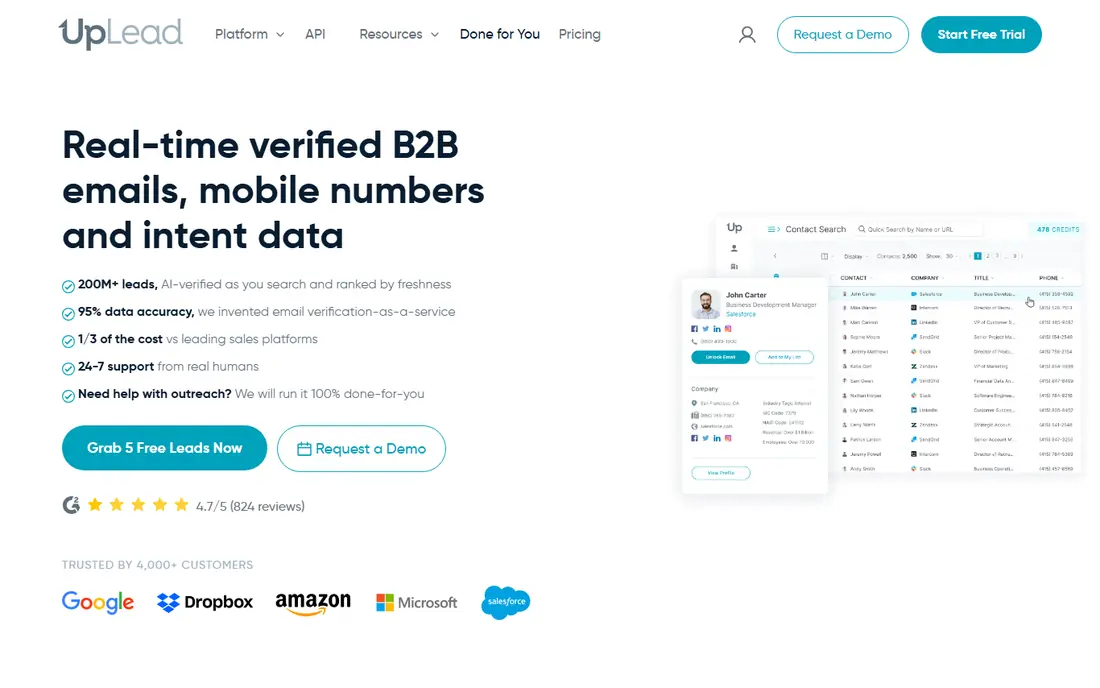
Where UpLead fits: verified data with accuracy guarantee. UpLead's pitch is quality over quantity, and it puts money behind it: a 95%+ data accuracy guarantee with friendly credits that refund you for bounces and poor data. The main limit is access.
Honest limits: Export limits can constrain large campaigns.
Export limits on bulk lookups can slow large campaigns. Every export passes through real-time email verification, and the Prospector supplies 50+ search filters across contacts and firms, plus technographics, intent data, mobile direct dials, and a Chrome extension. As for the details, the vendor says its CTO invented email verification as a service, and the product reflects that heritage. Check the vendor site for UpLead pricing; none is listed in this comparison. UpLead has no free tier.
- 50+ search filters
- Live email verification on every export
- No free plan, trial only
ZoomInfo
Ideal for: Enterprise-grade data with intent
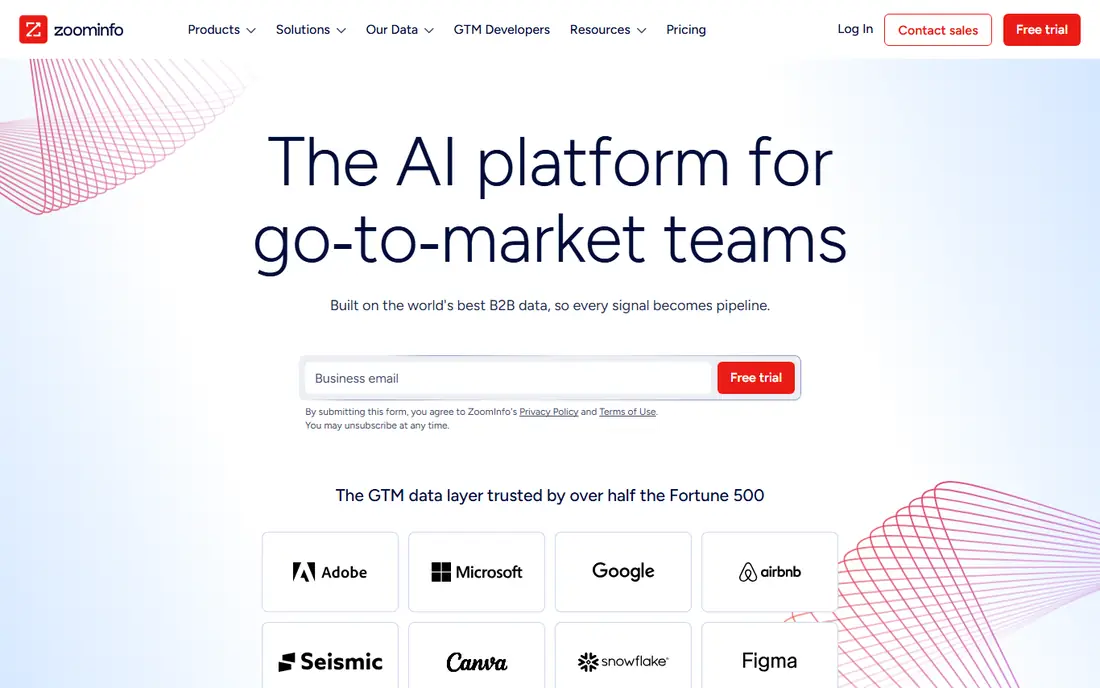
Where ZoomInfo fits: enterprise-grade data with intent. ZoomInfo is the incumbent: 500M+ contacts, 100M+ firms, intent data, org charts, and AI agents, used by more than half of the Fortune 500. From a buyer's view, compliance certifications bundle ISO 27001, ISO 27701, SOC 2 Type II, and GDPR and CCPA validations, and the vendor publishes how it sources data.
Trade-offs to know: Full system can be overkill for small teams.
As for the details, start with Lite, measure match rates on your ICP, and only then take the sales call. Worth adding: the data operation is serious: public web sources, filings, job postings, a contributory network, AI deduplication, and 300+ human researchers, processing 1.5B+ data points daily. This comparison lists no price for ZoomInfo; ask the vendor. A free plan is available with ZoomInfo.
- ZoomInfo Lite is a permanent free plan
- 500M+ contacts with intent signals
- Premium pricing is quote-only
Clay
Ideal for: Waterfall enrichment across providers
Clay works best for waterfall enrichment across providers. Clay is not a database. It is a spreadsheet-style workspace where each column can call one of 200+ data and AI vendors, try them in the order you set, and keep the first hit.
That waterfall approach is why enrichment match rates beat single-source tools. More specifically, actions and data credits are two separate currencies, and a team running big waterfalls needs to watch both dashboards. Launch is $167 per month with 15,000 actions and 3,000 data credits. Growth is $446 a month with 40,000 actions and 6,000 data credits. In practice, the main limit is the ramp-up time and the cost modeling. The starting price for Clay: $167/mo. Free access exists with Clay.
Where it falls short: Usage-based pricing takes effort to model.
- You pay nothing when an enrichment finds nothing
- 200+ data vendors in one marketplace
- Free plan caps tables at 200 rows
Hunter.io
Ideal for: Finding and verifying emails
Think of Hunter.io for finding and verifying emails. Domain Search, Email Finder, and Email Verifier handle that, and the pricing is refreshingly public. From a buyer's view, Hunter is an email tool that grew into outreach (Sequences, Inbox Protection, managed email accounts) instead of a full contact database with deep phone coverage.
Where it falls short: Credits do not roll over.
Worth adding: one credit buys one email found, half a credit buys one verification, and nothing is charged when an email cannot be found or verified. Growth is $149 ($104 annual) for 10,000 credits, and Scale is $299 ($209 annual) for 25,000 credits. Starter is $49 per month, or $34 per month billed yearly, for 2,000 credits. The free plan provides 50 credits per month, 500 recipients per sequence, and one connected email account. What you pay to start with Hunter.io: $34/mo. You can start on Hunter.io without paying.
- Failed searches and verifications cost nothing
- Free plan with 50 credits monthly
- Phone data is not the strength
Apollo.io
Ideal for: All-in-one prospecting plus outreach
Apollo.io works best for all-in-one prospecting plus outreach. Apollo wants to be the entire outbound stack: a contact database of 240M+ contacts and 30M+ accounts, email sequencing, a dialer, and pipeline tools in one subscription. Beyond that, admins can set per-user caps to stop one rep burning the pool.
The main drawbacks: No public starting price on the pricing page.
Also, Apollo data also may not be resold or used to power external products under standard terms. The main limit is transparency. The vendor's pricing page describes plans and credit mechanics but does not display dollar figures in the plan cards, so you will talk to sales. Beyond that, premium levels run Basic, Professional, and Custom, and every seat on an account sits on the same plan. No starting price is listed for Apollo.io here; confirm pricing on the vendor site. A free plan is available with Apollo.io.
- 240M+ contacts with sequencing built in
- Free Starter plan with no time limit
- Unused credits expire each cycle
RocketReach
Ideal for: Large database, straightforward lookup
RocketReach serves large database, straightforward lookup. RocketReach keeps the model straightforward: a huge database (700M profiles, 60M firms), search with 100+ filters, and real-time email and phone validation, with a browser extension for prospecting as you browse. The product also comes with Messages for sending emails with automatic follow-ups and Autopilot for automatic discovery workflows, plus a contact data API with 4.5B records.
Watch-outs: Engagement features are thinner than Apollo or Snov.io.
The vendor claims 90-98% deliverability on verified emails and 300,000+ extension users. For everyday use, CRM integrations include Salesforce and HubSpot. No starting price is listed for RocketReach here; confirm pricing on the vendor site. A free plan is available with RocketReach.
- 700M profiles and 60M firms
- Free account with up to 5 lookups
- Pricing is quote-based
Kaspr
Ideal for: LinkedIn prospecting for Europe
Kaspr is designed for LinkedIn prospecting for Europe. It is free to begin with no credit card required, and setup takes minutes with no onboarding.
What to check first: LinkedIn-centric workflow limits non-LinkedIn sourcing.
Pricing for Kaspr is not stated here, so ask the vendor for current figures. Kaspr has a free plan.
- Capable European data coverage
- GDPR-aligned with 500M+ contacts claimed
- Pricing is quote-based
Selection criteria
The comparison looks at four things: starting price, free access, how well the feature set matches lead gen software, and the main limit of each tool. Where a vendor does not publish a price, the entry says quote. Where a price depends on seats or billing term, the entry says so. Order on the page follows fit for the typical buyer first, then price transparency and free access. Your own requirements should decide the final pick.
Before you commit
- Get a written quote from UpLead, ZoomInfo, Apollo.io and others; the list shows no starting price for them.
- Look at free plan limits closely: ZoomInfo, Clay, Hunter.io and others have one, and the caps decide whether it is usable for real work.
- Before choosing UpLead, weigh its main limit: no free plan, trial only.
- Ask ZoomInfo how an export works before you move any records in; an easy exit lowers the risk.
- Look at the help docs and support options for UpLead before you commit.
Frequently asked questions
Can I try these options before paying?
Often, yes. ZoomInfo, Clay, Hunter.io and others have a free plan. Use your own data and a real task during the test, and check what the free tier or trial limits before you rely on it.
How are the tools for lead gen software ordered?
UpLead sits first and Kaspr last because the order follows typical fit for lead gen software, then price clarity and free access. It is a judgement call, so read each profile for fit and limits.
Is UpLead the right pick for everyone comparing lead gen software?
No single tool suits every team. UpLead comes first because it fits verified data with accuracy guarantee, while ZoomInfo suits enterprise-grade data with intent and Clay suits waterfall enrichment across providers. Match the tool to your own size, budget and workflow before deciding.
Which options for lead gen software have a free plan?
On this list, 6 of 7 tools include a free plan, among them ZoomInfo, Clay, Hunter.io and Apollo.io. Caps on seats, usage or features are common, so test the free plan against your real workload.